Brisbane's property market rewards disciplined buyers who lead with strategy, not sentiment. Whether you are buying your first investment property, adding to a portfolio, or searching for a family home, a clear plan separates buyers who secure the right asset from those who spend months chasing the wrong ones. This guide breaks down exactly how Queensland buyers can approach Brisbane with structure, confidence, and the kind of clarity that leads to better outcomes.
Brisbane buying strategy starts with the end goal
Before you look at a single listing, the most important question to answer is: what is this purchase meant to do? That single question shapes every decision that follows, from the budget you set to the suburbs you shortlist to the property type you target.
A Queensland investor chasing rental yield in a tight-vacancy market has a completely different brief to a professional couple relocating from Sydney who needs school zones and commute times to stack up. Both buyers might end up in Brisbane, but the suburb, price point, property type, and hold period each look different on paper.
This is where building a disciplined property investment strategy matters more than most buyers realise. Without a defined end goal, it is too easy to pivot toward whatever looks exciting on a Saturday morning or whatever a selling agent frames as a once-in-a-lifetime opportunity. Strategy removes that drift.
For SMSF investors, the stakes are higher still. Compliance rules, borrowing structures, and trustee obligations mean that buying the wrong property inside a self-managed fund is far more damaging than buying it in your own name. Goal clarity is non-negotiable before a single suburb is considered.
Buyers Agency Australia structures every client engagement around this principle: strategy before search. The team, led by Dragan Dimovski, a property expert with over 20 years of experience, starts with a thorough understanding of each buyer's financial position, timeline, risk appetite, and long-term objectives before recommending a single suburb or property type.
What Queensland buyers need to know about the Brisbane market
Brisbane is no longer the affordable alternative it was a decade ago. According to Cotality (CoreLogic) data, Brisbane's median house price crossed the $1 million mark in 2025 and has continued to grow, placing the city firmly behind only Sydney as Australia's most expensive capital city market by median value. That context matters for anyone arriving at the market with assumptions formed years ago.
The supply picture explains a lot of that price pressure. Advertised stock in Brisbane sits roughly 29% below its five-year average, which keeps competition high even as individual suburbs move through their own cycles. New apartment completions are running well short of demand, with the Property Council noting that only around 1,500 units were completed in Brisbane in 2024, far below the 7,500 attached dwellings the South East Queensland Regional Plan identifies as an annual requirement.
At the same time, Queensland's population grew at 2.3% in the year to June 2024, above the national average, with net overseas migration and net interstate migration both contributing strongly. More than 18,000 people relocated from Sydney to Queensland in 2024 alone, maintaining sustained pressure on housing demand across the greater Brisbane area.
The market is not uniform. Inner-ring prestige suburbs have seen price softness in some pockets, while middle-ring and outer growth corridors, particularly in the southern and south-western corridors, have continued to record strong annual gains. Springwood-Kingston, Sunnybank, and Nundah have been among the standout performers, driven by relative affordability and infrastructure access. Cross River Rail's four new underground stations are expected to reshape connectivity and property values around Woolloongabba, Dutton Park, and Bowen Hills across 2026 and beyond.
For investors, Brisbane's rental vacancy rate sits at approximately 0.8% to 1.0% across most data providers, among the tightest of any capital city in Australia. That structural undersupply in rental housing continues to support yields, particularly for well-located units and townhouses in middle-ring suburbs.
Understanding this landscape in detail, rather than relying on headlines, is the first step to buying better. For a closer look at which suburbs and strategies are performing, the top property investment hotspots and strategies for 2026 break down what the data is showing across Brisbane and other outperforming markets.
How a clear buying strategy improves results in Brisbane
A defined strategy does something that market research alone cannot do: it filters out noise. When you know your target suburb criteria, your maximum purchase price, your preferred property type, and your minimum hold period, you stop getting distracted by properties that look interesting but do not serve your goal.
Here is how that filters into practical decisions:
Budget discipline means knowing your borrowing capacity is not the same as your target price. Buying at the upper limit of what the bank will lend, with no buffer for rate movements or holding costs, is a common and expensive mistake.
Suburb filters are more than a wishlist. They should be built on vacancy rates, infrastructure pipelines, owner-occupier demand ratios, days on market trends, and comparable sales data. A suburb with strong lifestyle appeal but rising supply can underperform a less glamorous pocket with structurally tight stock.
Property type criteria should align with your income tax position, depreciation benefits, and risk tolerance. The capital growth versus cash flow decision is not a binary one, but it does need to be made consciously before you start inspections.
Hold period planning changes which assets make sense. If you are planning a five-year hold, you need a suburb with near-term drivers. If you are holding for fifteen years, you can accept slower early growth in exchange for a better land-to-asset ratio or location quality.
All of these filters together create a brief that guides every property shortlisted. Without them, buyers end up negotiating on intuition rather than evidence.
| Strategic Filter | What to Define Before You Start |
|---|---|
| End goal | Capital growth, cash flow, owner-occupied, or portfolio diversification |
| Budget ceiling | Purchase price plus acquisition costs plus 3-month holding buffer |
| Suburb criteria | Vacancy rate, infrastructure pipeline, owner-occupier ratio, supply trend |
| Property type | House, townhouse, unit; new vs established; depreciation profile |
| Hold period | Short (3-5 years), medium (7-10 years), or long term (10+ years) |
| Exit strategy | Hold and refinance, sell for capital, or develop and hold |
The key steps to buying better in Brisbane
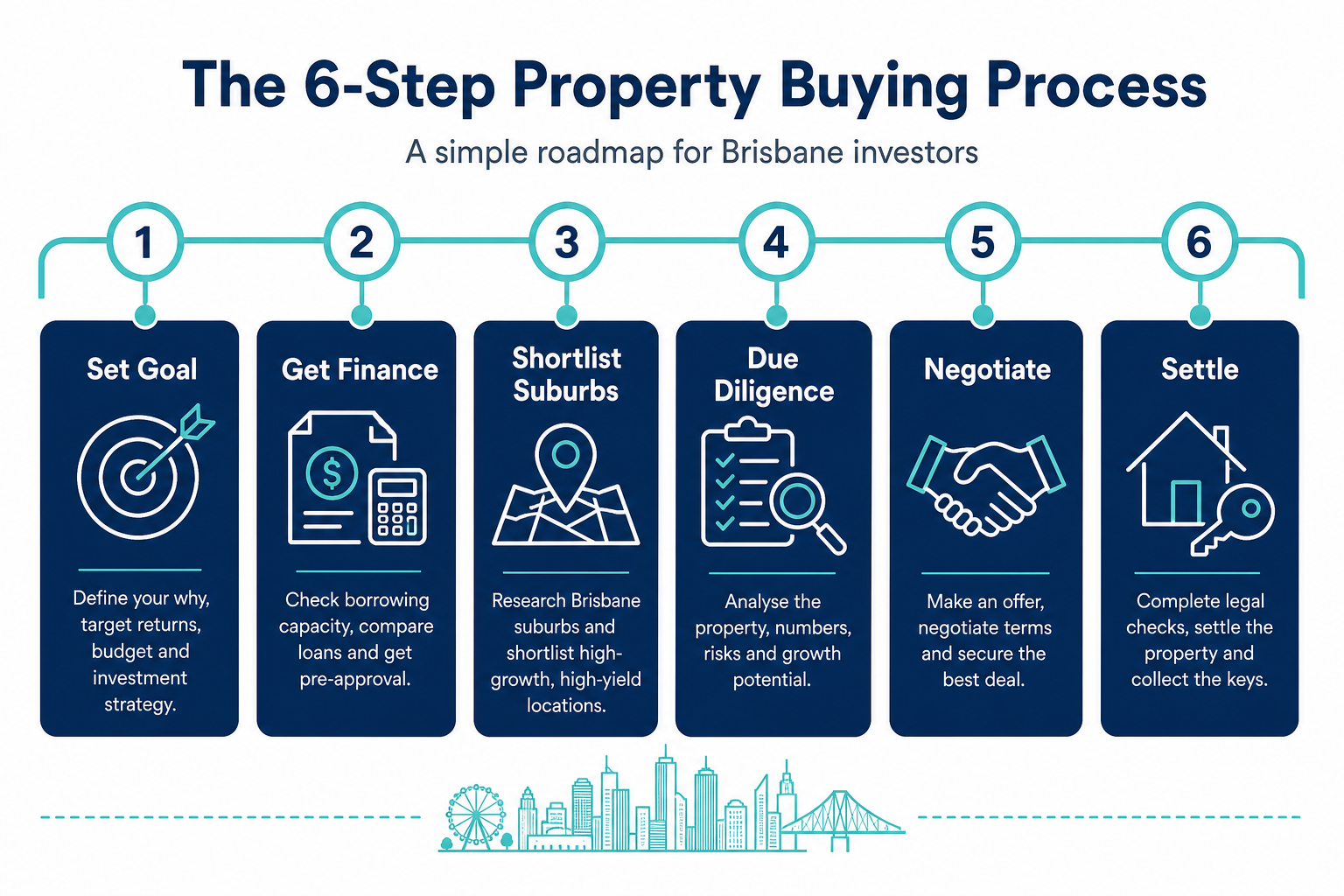
Strategy is only as useful as the process that puts it into action. Here is a practical sequence that reduces risk and improves decision quality at every stage.
1. Define your goal and financial position
Start with a finance pre-approval, not just an estimate. Know your borrowing capacity, your deposit position, your stamp duty liability under current Queensland regulations, and whether any concessions or grants apply to your purchase.
2. Research the market, not just the listings
Look at median price trends, days on market, listing volumes, and rental vacancy by suburb. Compare what is happening at the micro level, not just the city average. This is where working with a buyer's agent in Brisbane who monitors this data continuously gives buyers a clear edge.
3. Shortlist suburbs against your criteria
Use your defined suburb filters, not your preferences, to build a shortlist of three to five target areas. Cross-reference infrastructure plans, zoning changes, and demographic trends. Check the best suburbs to invest in Australia in 2026 for data-backed suburb analysis across Queensland and beyond.
4. Conduct structured due diligence on shortlisted properties
Once a property reaches serious consideration, due diligence should be thorough and systematic. This means independent valuation, building and pest inspection, title search, flood mapping, and rental appraisal if it is an investment. The property investment due diligence checklist is a useful resource for covering each of these steps methodically.
5. Negotiate from evidence, not pressure
The selling agent works for the vendor. Their job is to achieve the highest price. Entering negotiation without independent data on comparable sales and a clear walk-away point puts the buyer at a structural disadvantage. A buyer's advocate negotiates with both market data and emotional detachment.
6. Plan settlement and what comes next
Settlement is not the finish line. For investors, knowing when to refinance, how to structure your depreciation schedule, and whether the asset fits into a broader portfolio plan is part of buying well, not an afterthought.
Where off market opportunities can matter
Off market properties in Brisbane have become a meaningful part of the transaction landscape, and not just for prestige buyers. As market data suggests, a significant portion of Brisbane sales occur without full public campaign, with many sellers choosing quiet transactions over extended marketing periods.
For buyers, accessing off market properties Brisbane offers three advantages that on-market searches simply cannot replicate: more choice, less competition, and better alignment between what is available and what the strategy actually calls for.
Less competition matters enormously when Brisbane's vacancy rate is near 1% and buyer demand is sustained. An off-market offer, negotiated directly through agent relationships and advocate networks, removes the emotion and artificial urgency that a public campaign creates. It also gives buyers the chance to conduct due diligence without a competing offer breathing down their neck.
The quality of off-market access depends almost entirely on the depth of the buying network. Selling agents direct their off-market stock to buyers advocates they know will transact cleanly and quickly. This is a relationship-based market, and individual buyers searching portals simply do not see the same opportunities. Understanding how off-market properties are sourced in Australia gives buyers a realistic picture of what access actually involves.
Buyers Agency Australia maintains active relationships with selling agents across Brisbane and South East Queensland, which means clients are introduced to suitable properties before they are publicly listed. For investors with specific suburb criteria, this can materially reduce time in the market while improving the quality of the assets considered.
How Buyers Agency Australia supports Brisbane buyers
Buyers Agency Australia operates as a full-service buyer's advocacy firm for Queensland buyers approaching the Brisbane market. The approach is research-led and strategy-anchored, not driven by volume or speed for its own sake.
The process begins with a strategy consultation where the team, led by Dragan Dimovski, works through each client's goals, financial position, and risk profile. From there, suburb and property type criteria are set before any searching begins. This mirrors the structure outlined earlier in this guide and is what separates a disciplined engagement from a reactive property search.
For Brisbane-based acquisitions, the team conducts independent market analysis, accesses off-market opportunities through established agent relationships, attends inspections, conducts due diligence, and manages negotiation and contract through to settlement. Clients operating from interstate or internationally benefit from having a dedicated advocate on the ground in Brisbane.
Buyers Agency Australia also applies an AI-powered strategy planning approach that cross-references suburb-level data, rental demand metrics, infrastructure timelines, and portfolio fit before recommending a property. This is not a dashboard exercise. It feeds directly into what suburbs are shortlisted and which specific assets are pursued.
If you are ready to move beyond generic market research and want a structured plan for your Brisbane purchase, book a free strategy session to map out your next property move with the team.

Common mistakes Queensland buyers make when buying in Brisbane
Even buyers who approach Brisbane with good intentions make predictable errors. These are the most common ones worth avoiding.
Chasing headlines instead of data. A suburb that appeared in a property magazine as a hotspot six months ago has already priced in much of that expectation. Buying into momentum after the story has been told often means paying a premium for growth that has already occurred. Finding property hotspots before prices boom requires leading indicators, not lagging ones.
Overextending at auction. Brisbane's auction clearance rates have shown some softening in 2026 as buyers push back on vendor expectations, but auctions still produce emotional spending. Buyers without a firm walk-away price regularly overpay by 3% to 8%, which takes years of rental income to recover.
Ignoring the yield-versus-growth trade-off. A property with a strong gross yield in an outer suburb may have limited capital growth prospects. A tightly held inner-ring suburb may grow strongly but generate minimal cash flow. Neither is wrong, but choosing without understanding the trade-off creates portfolio imbalance. The distinction between positive cash flow property and capital growth assets deserves deliberate attention.
Skipping due diligence to move quickly. In a competitive market, the temptation to skip building inspections or shorten cooling-off periods is real. Properties with structural defects, flood exposure, or zoning constraints can become expensive liabilities. Due diligence is not optional, even when the market feels urgent.
Buying based on suburb names rather than suburb data. Popular suburb names carry brand value that does not always align with investment fundamentals. Some high-profile Brisbane suburbs have seen flat or declining prices in recent years, while less well-known middle-ring pockets outperformed significantly. The data matters more than the postcode's reputation.
| Mistake | Why It Costs You |
|---|---|
| Chasing headlines | Buying after growth is priced in, paying a premium for yesterday's story |
| Auction overextension | Emotional bidding erodes yield and distorts your cost basis |
| Ignoring yield-growth trade-off | Portfolio imbalance, mismatched cash flow needs |
| Skipping due diligence | Defect risk, flood liability, zoning constraints discovered post-settlement |
| Buying on suburb brand | Premium paid for reputation that does not reflect current fundamentals |
Final checklist for buying better in Brisbane
Before making an offer or formally beginning a property search in Brisbane, work through this checklist to confirm your foundations are in place.
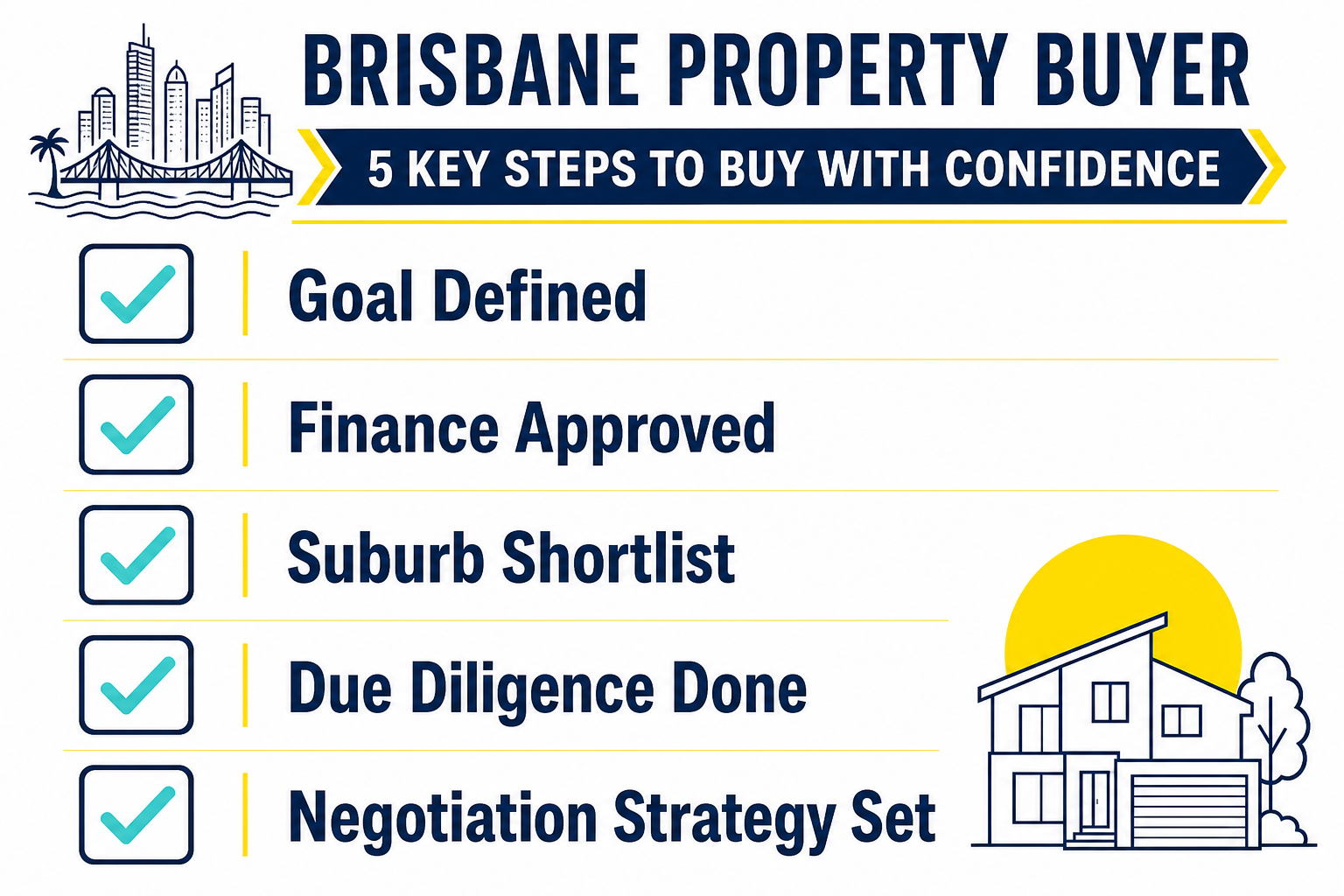
- End goal defined: home, investment, portfolio addition, or SMSF acquisition
- Finance pre-approval confirmed with a buffer above purchase price
- Queensland stamp duty calculated and acquisition costs accounted for
- Suburb shortlist built from data, not preference or headlines
- Property type criteria aligned with your tax position, yield needs, and hold period
- Due diligence process confirmed: building inspection, pest report, title search, flood check, rental appraisal
- Negotiation strategy defined: comparable sales reviewed, walk-away price set before any inspection
- Off-market access considered: are you seeing the full opportunity set, or just what is publicly listed?
- Settlement and post-settlement plan in place: depreciation schedule, property management, refinance timeline
- Professional advocacy engaged: is someone working exclusively for your interests in this transaction?
If several of these boxes remain unchecked, the risk of a poor outcome increases significantly. A buying decision made without this foundation in a market as active and nuanced as Brisbane's is a decision made on hope rather than evidence.
When you are ready to build a plan that covers all of these bases, book a free strategy session with Buyers Agency Australia, or contact the team directly to discuss your Brisbane buying goals.
Frequently Asked Questions
What does a buyer's agent in Brisbane actually do?
A buyer's agent researches suburbs, accesses off-market properties, negotiates on your behalf, and manages due diligence, working exclusively for the buyer, not the vendor.
Is it worth using a buyer's agent for an investment property in Brisbane?
Yes, particularly in a competitive, low-stock market. Buyer's agents typically access off-market deals and negotiate more effectively than individual buyers acting alone.
How do off-market properties in Brisbane work?
Off-market properties are sold without a public campaign. Access depends on agent relationships, which buyer's advocates build over time through consistent transaction volume.
What suburbs in Brisbane are performing well for investors in 2026?
Middle-ring and southern corridor suburbs, including Sunnybank, Springwood-Kingston, and Nundah, have shown strong annual price growth supported by affordability and infrastructure access.
What is the biggest mistake Queensland buyers make in Brisbane?
Buying without a defined strategy. Reactive purchases based on headlines or auction pressure consistently produce worse outcomes than structured, data-driven acquisitions.