
The question every investor is asking right now deserves a straight answer, not a sales pitch. With the RBA cash rate sitting at 4.35% after three consecutive hikes in 2026, borrowing costs have climbed sharply from where they sat just eighteen months ago. Markets in Sydney and Melbourne are softening, consumer confidence is near multi-decade lows, and a federal budget that rewrites the rules on negative gearing has added another layer of complexity. Yet rental vacancies remain critically tight, housing supply is structurally behind demand, and disciplined investors are still finding opportunities worth acting on. The real question is not whether property investing works in Australia. The question is whether it works for you, right now, with the right asset and the right approach.
Introduction: Is property investing still worth it in Australia in 2026?
If you bought in 2020 or 2021, you likely rode a wave of emergency-low interest rates and surging values. That environment is gone. What has replaced it is considerably more demanding: higher holding costs, tighter serviceability assessments, a more fragmented market, and an investing public that is either overconfident or paralysed by uncertainty.
None of that means property has stopped working as a wealth-building tool. It means the bar for a good decision has risen. Buyers Agency Australia works with investors across the country who are navigating exactly this environment, and the consistent finding is that strategy-led buying still produces results when everything else is harder.
This guide covers the market forces shaping investor decisions in 2026, when property still makes sense, what risks to weigh carefully, and how a clear property investment strategy can help you make better decisions in a more complex market.
What has changed for Australian property investors in 2026
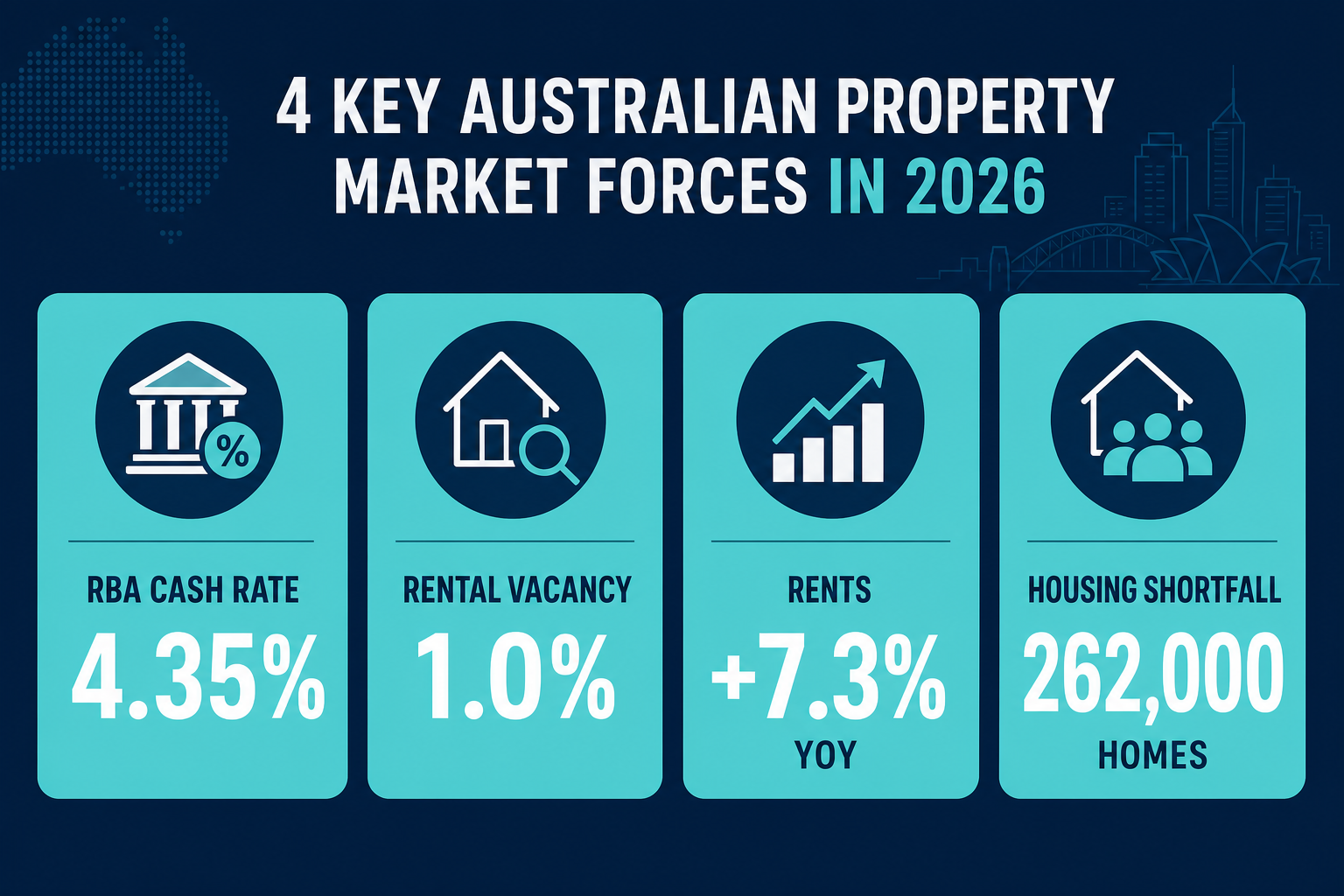
The single biggest shift for investors in 2026 is the interest rate environment. The RBA raised the cash rate to 4.35% at its May meeting, the third consecutive hike this year, as inflation picked up materially in the second half of 2025 and geopolitical pressures added to the cost of fuel and goods. Investment property loan rates are currently averaging around 5.66% to 5.74% on outstanding balances, according to RBA data, meaning serviceability is tighter than at any point since 2012.
At the same time, the federal government's May 2026 budget introduced changes to negative gearing and the capital gains tax discount for existing properties, creating material uncertainty for investors who have historically relied on these structures. The full impact of these reforms is still being absorbed by the market.
On the supply side, the structural picture still favours landlords. The national rental vacancy rate hit 1.0% in April 2026, well below the 2.5% to 3.5% range considered a balanced market, according to SQM Research data. National advertised rents have risen 7.3% year-on-year, with the average capital city rent above $794 per week. The National Housing Supply and Affordability Council forecasts the government's Housing Accord target of 1.2 million new homes will fall short by approximately 262,000 dwellings, meaning structural undersupply is set to persist.
| Market Force | 2024 Conditions | 2026 Conditions |
|---|---|---|
| RBA Cash Rate | 4.35% (post-cuts) | 4.35% (post-hikes) |
| National Vacancy Rate | ~1.4% | 1.0% (April 2026) |
| Annual Rent Growth | ~6% | 7.3% YoY |
| New Housing Loan Commitments | Rising strongly | Down 6.2% in Q1 2026 |
| Sydney/Melbourne Values | Stabilising | Modest decline |
According to ABS Lending Indicators for Q1 2026, total new housing loan commitments fell 6.2% in the March quarter, with investor loans down 5.3% in number and 3.0% in value. Despite the quarterly dip, investor lending activity remains 18.5% higher in value compared to a year earlier, signalling that serious investors have not exited the market.
The market is fragmented. Brisbane, Adelaide, and Perth are still delivering solid fundamentals for investors, while Sydney and Melbourne present a more nuanced picture. Understanding which market suits your goals is now more important than ever. The top property investment hotspots and strategies for 2026 are not uniform across the country.

When property investing can still make sense
Property does not suit every investor in every market phase, but there are clear scenarios where it still makes strong sense in 2026.
Long-term portfolio builders with a five-to-ten year horizon are positioned to absorb short-term rate volatility. Residential property has historically doubled in value over roughly every ten years in well-located Australian markets, though past performance does not guarantee future results. Investors who hold quality assets through cycles consistently outperform those who try to time the market.
Investors with clear serviceability who have modelled their cash flow at current rates, including a buffer for potential further hikes, are in a fundamentally stronger position than those relying on optimistic rate forecasts. If the numbers work at 5.5% to 6% on the investment loan, they are built on solid ground.
Rentvesting remains relevant for investors who cannot buy where they want to live but can access growth markets elsewhere. This approach separates the emotional decision of where to live from the financial decision of where to build wealth. Explore how positive cash flow properties still fit a portfolio for investors running this kind of strategy.
Investors targeting off-market opportunities are finding that reduced competition in some markets is creating entry points that were not available in 2021 or 2022. Vendor discounting has widened to a median of 3.1% across the combined capital cities, according to Cotality data, which represents better negotiating conditions than have existed for several years.
The key across all these scenarios is clarity: clarity about your budget, your cash flow position, the asset you are targeting, and how it fits your broader property portfolio goals.
The risks investors need to weigh before buying
The headline risk in 2026 is overpaying for the wrong asset at the wrong price point. Markets are more fragmented than they have been in a decade, and a property that would have sold quickly in 2021 may not perform the same way in the current cycle. Suburb-level research matters more than ever.
Weak suburb selection is one of the most common and costly mistakes. Chasing affordability into markets with limited employment diversity, population growth, or infrastructure investment often produces stagnant capital growth even in good cycles. The biggest property investment mistakes Australians are making in 2026 frequently come back to this point.
Poor due diligence on the property itself, including building and pest inspections, strata records for units, and council zoning checks, remains a risk that is easy to underestimate in a competitive market. Thorough property due diligence before you buy is non-negotiable.
Relying on short-term market timing is a trap. Investors who waited for rates to fall in early 2026 and expected the market to rally sharply were caught off guard by consecutive hikes. No one consistently predicts short-term rate movements, and building an investment thesis around a specific rate cut timeline is a fragile strategy.
Tax structure changes from the federal budget add a new dimension to the risk profile, particularly for investors who have built their cash flow models around full negative gearing deductions on existing properties. Getting proper tax advice before committing to a purchase is now more critical than in previous cycles.
How strategy matters more than chasing headlines
The most consistent thing separating investors who build wealth through property from those who do not is not timing, luck, or market knowledge. It is having a clear property investment strategy and sticking to it.
A well-constructed strategy defines the type of property you are targeting (house versus unit, established versus new), the market characteristics you require (employment diversity, population trends, rental demand), the financial parameters your purchase must satisfy, and the role this property plays in your broader plan. It filters out the noise of daily headlines and keeps you focused on decisions that move your position forward.
Dragan Dimovski, with over 20 years of experience in property acquisition, has consistently observed that investors who come to the table with a clear brief, a realistic budget, and a long-term lens make better decisions than those reacting to market fear or market hype. The 2026 environment rewards precisely this kind of disciplined thinking.
As interest rates rise, smart investors are still buying property in Australia, but they are doing so with sharper criteria and a greater emphasis on asset quality. The shift away from speculative buying toward fundamentals-led selection is, arguably, a healthier dynamic for long-term investors.
For investors considering Brisbane, the 2032 Olympics infrastructure pipeline, population growth, and relative affordability compared to Sydney make it one of the stronger strategic markets in the current cycle. Melbourne presents a different picture, where off-market properties are changing the way buyers search and access quality stock below the noise of the public market.
Questions to ask before buying your next investment property
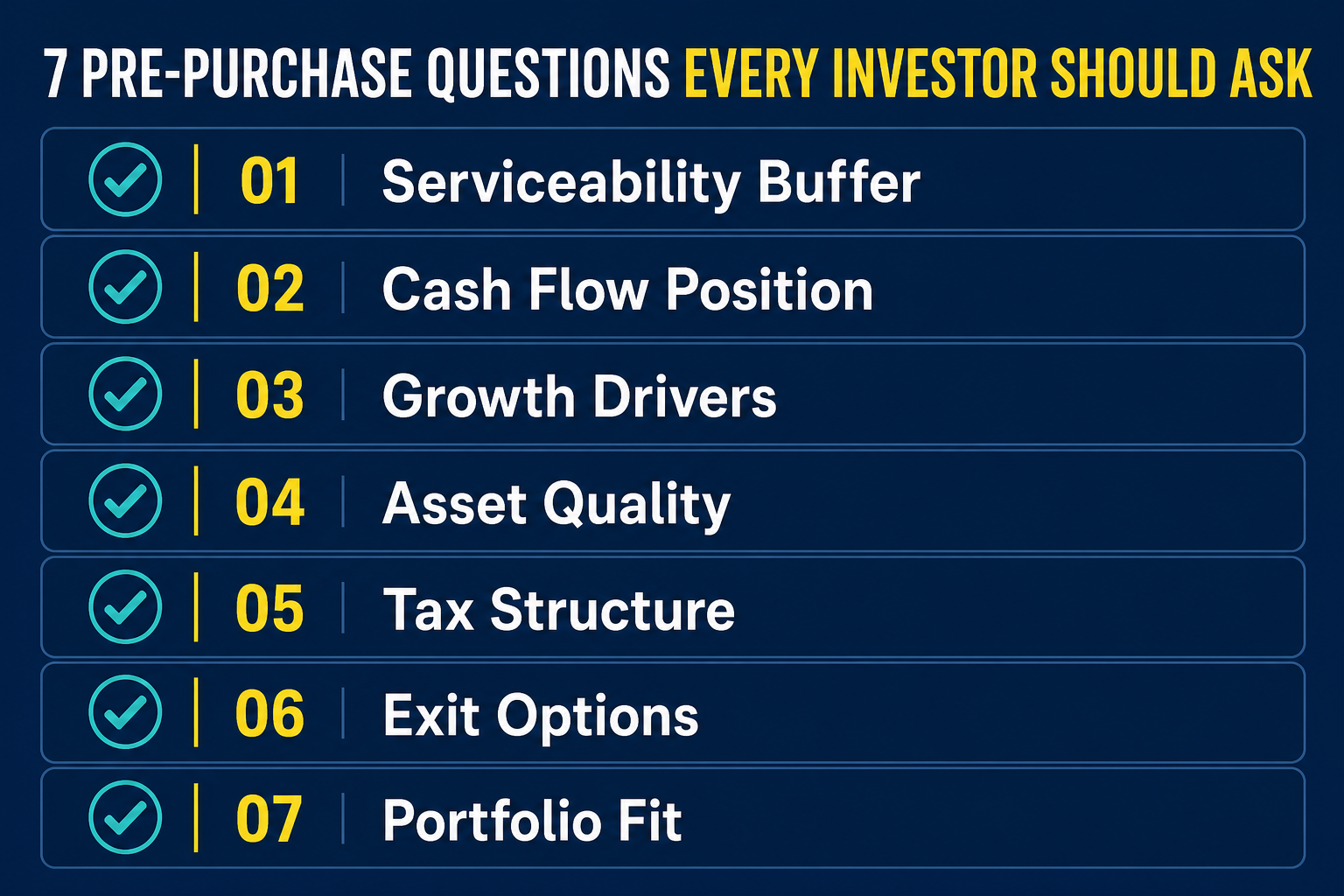
Before committing to any purchase in 2026, work through this practical checklist:
- Serviceability buffer: Can you service the loan at a rate 2% above your current offer, and does that still leave you with adequate cash reserves?
- Cash flow position: What is the realistic gross yield, and what are the total holding costs including rates, insurance, property management, and maintenance? Is the property positively geared or negatively geared, and by how much?
- Growth drivers: What are the specific demand drivers for this suburb: employment anchors, population trends, infrastructure projects, and rental demand characteristics?
- Asset quality: Is this a property that will attract consistent tenants and hold its value relative to surrounding stock over a full cycle?
- Tax structure: Have you reviewed how the 2026 budget changes to negative gearing and CGT interact with your intended holding structure? Has a qualified accountant reviewed your position?
- Exit options: If you needed to sell in three to five years, is there a liquid buyer pool for this property type and price point in this location?
- Portfolio fit: Does this purchase complement your existing holdings, or does it concentrate your exposure in a single market, sector, or risk profile?
None of these questions have universally right answers, but working through them honestly will tell you whether a property is the right fit for your goals or whether it just looks appealing at first glance. For a full framework, work through a property investment due diligence checklist before signing anything.
How a buyers agent can help investors buy more confidently
The case for using a buyers agent in 2026 is not about outsourcing your thinking. It is about improving the quality of information and access you bring to each decision.
A good buyers agent who works exclusively for the buyer brings three things that are genuinely hard to replicate independently: access to off-market and pre-market stock, data-backed suburb and asset selection, and negotiation discipline that is not clouded by emotional attachment to a property. In a market where vendor discounting has widened and some sellers are more motivated than they have been in several years, negotiation quality matters in a concrete, dollar-figure way.
Buyers Agency Australia operates nationally with deep market coverage across Sydney, Brisbane, Melbourne, and other major markets. The team works purely on the buyer's side, meaning the advice is not influenced by agency listings or vendor relationships. For investors who want off-market property access and a structured acquisition process, this kind of independent representation is particularly valuable in the current market.
If you are actively looking or planning your next move, book a free strategy session with the team to map out what a disciplined approach to your next purchase could look like.
Conclusion: A balanced view for 2026 investors
Property investing in Australia in 2026 is neither as easy as it was in 2020 nor as closed off as some headlines suggest. The market is harder, more fragmented, and more sensitive to the decisions investors make at the asset and suburb level. But the structural case for residential property, namely constrained supply, sustained rental demand, and long-term population growth, has not disappeared.
What has changed is the cost of a poor decision. In a lower-rate, rising-market environment, even average choices produced reasonable returns. In the current environment, asset quality, suburb selection, cash flow modelling, and purchase discipline are the factors that separate investors who build wealth from those who stall or go backwards.
For investors who are serious about their next move, the best starting point is always the same: clarity on your goals, honest assessment of your financial position, and a sound property investment strategy that guides the search rather than chasing whatever the market is talking about this week.
When you are ready to work through that process with someone who has navigated multiple market cycles, map out your next property move with Buyers Agency Australia, or contact the team to discuss your situation directly.
Frequently Asked Questions
Is property still a good investment in Australia in 2026?
Property can still build wealth in Australia in 2026, but only when the purchase aligns with your goals, cash flow capacity, and a sound long-term strategy.
How have RBA rate hikes affected property investors in 2026?
Three consecutive RBA hikes have lifted the cash rate to 4.35%, increasing holding costs and tightening borrowing capacity, which means serviceability modelling is now critical before any purchase.
Which Australian cities are performing best for investors in 2026?
Brisbane, Adelaide, and Perth are showing stronger fundamentals than Sydney and Melbourne, though all markets are fragmented and require suburb-level analysis.
What risks should investors watch most closely in 2026?
Key risks include overpaying in weak suburbs, poor due diligence, reliance on market timing, and the impact of 2026 budget changes to negative gearing and capital gains tax.
What does a buyers agent actually do for a property investor?
A buyers agent searches, evaluates, and negotiates exclusively on behalf of the buyer, providing off-market access, independent research, and disciplined acquisition support.