
Australian property prices have continued to rise through one of the sharpest rate-hiking cycles in decades. This guide explains the structural forces keeping values elevated, what a responsible property investment strategy looks like right now, and when it makes sense to seek expert guidance rather than act on headlines alone.
Why high interest rates do not always stop property prices rising
The conventional view goes something like this: rates go up, borrowing gets more expensive, fewer people can afford to buy, and prices fall. It is a logical sequence, but Australian property has repeatedly refused to follow that script.
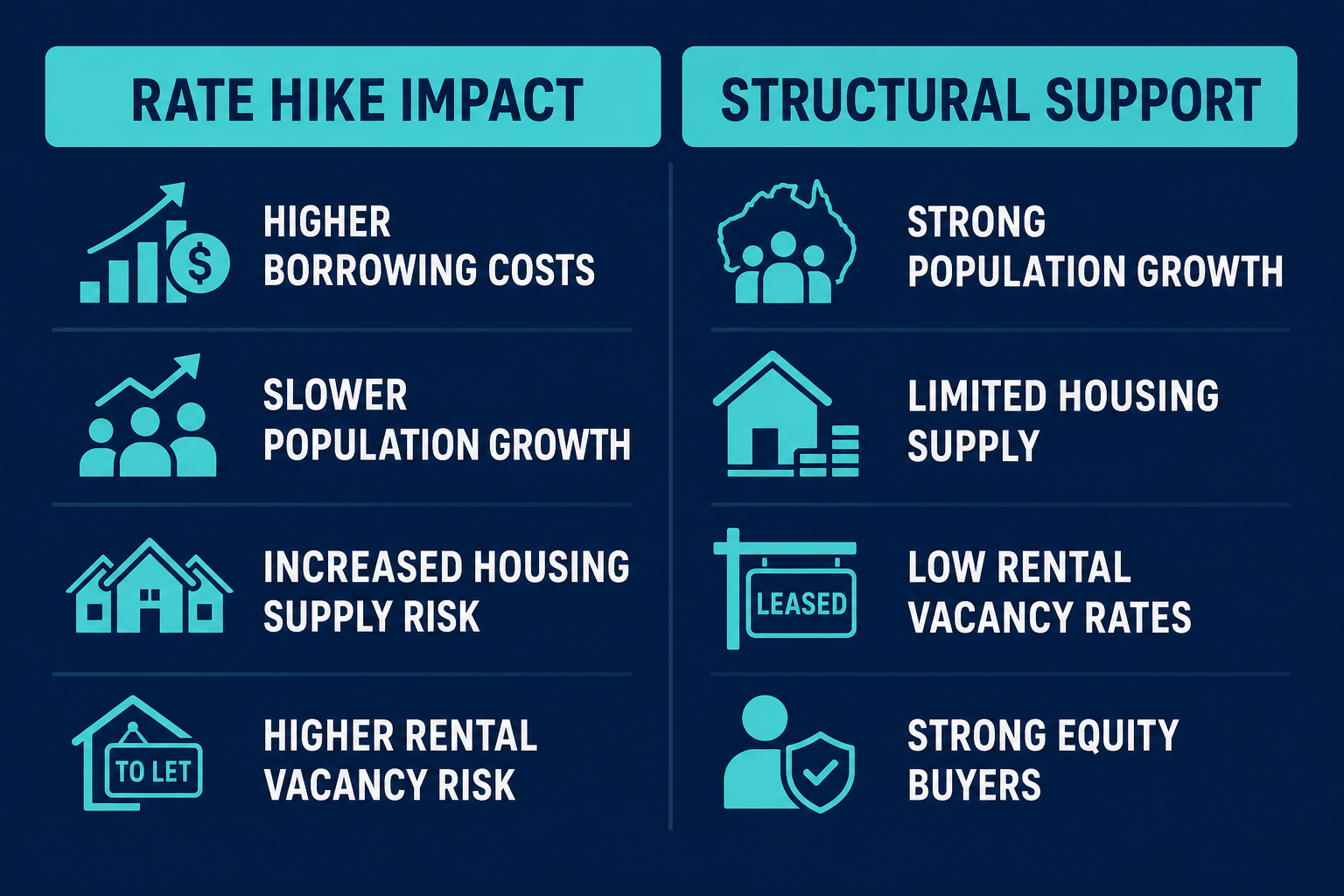
The Reserve Bank of Australia raised its cash rate to 4.35% at its May 2026 meeting, the third consecutive hike this year. Yet national home values still grew 8.6% through 2025, according to Cotality data, the strongest annual result since 2021. The relationship between borrowing costs and prices is more nuanced than most commentary suggests.
Interest rates influence how much a buyer can borrow, not whether demand for housing exists. When the fundamental gap between how many homes are available and how many people need them is wide enough, borrowing costs alone cannot close it. Prices reflect that structural tension.
It is also worth noting that a meaningful share of today's buyers are equity-rich upgraders, downsizing retirees, and SMSF investors who carry little or no new debt. Rate movements have a limited effect on their purchasing decisions. That cohort has continued to compete for a thin pool of listings, keeping clearance rates competitive across many suburbs even as mortgage costs rise.
None of this means property prices will always rise regardless of conditions. It means that in a market with Australia's specific supply and demand characteristics, rate movements are one input among many, and often not the dominant one. Understanding this distinction is the starting point for any credible property market forecast.
The main forces that can keep prices moving up
Several interconnected drivers have been working together to support Australian property values through this rate cycle. None of them are temporary.
Supply that cannot keep up with demand
Australia's population grew by more than 420,000 people in the year to late 2025, yet the net increase in housing stock was only around 165,500 dwellings, well below the pace needed to meet demand. Construction pipelines remain constrained by labour shortages, planning delays, and rising materials costs. The government's National Housing Accord target of 1.2 million new homes by 2030 is already tracking roughly 78,000 units behind schedule.
Population growth and migration
Net overseas migration has been running at historically high levels since borders reopened. Treasury estimates put net migration at around 306,000 for the 2024-25 financial year, with the population still adding more than 300,000 people annually going forward. New arrivals concentrate in Sydney, Melbourne, Brisbane, and Perth, which are already the tightest markets. That sustained inflow sustains rental demand, which in turn supports investor purchasing activity.
Rental vacancy rates nationally sat at approximately 1.7% in late 2025, well below the 3% level considered a balanced market. Extremely tight rental conditions push some renters toward purchasing, adding another layer of buyer demand.
Investor and owner-occupier activity
Buyers who were priced out of Sydney and Melbourne have contributed to strong demand in Brisbane, Adelaide, and Perth. According to KPMG's Residential Property Outlook, Brisbane house prices are forecast to grow by close to 11% in 2026, and Perth by nearly 13%, driven by population growth and constrained supply in those markets. Interstate investors seeking relative affordability and better yields have been an active segment, particularly in Queensland and South Australia.
| Market driver | Impact on prices in a high-rate environment |
|---|---|
| Chronic housing undersupply | Strong upward pressure, limits price falls |
| High net overseas migration | Sustained buyer and renter demand |
| Low rental vacancy rates | Pushes renters into buying market |
| Equity-rich non-leveraged buyers | Insulated from rate increases |
| Interstate investor demand | Supports mid-tier capital markets |
For investors researching where conditions are currently strongest, the top property investment hotspots and strategies for 2026 provide useful context on which markets are outperforming.
What investors should watch before buying in a high-rate environment
Strong structural drivers do not eliminate risk. A sound property investment strategy in this environment needs to account for the realities of borrowing at elevated rates, not just the macro tailwinds.
Serviceability and cash flow buffers
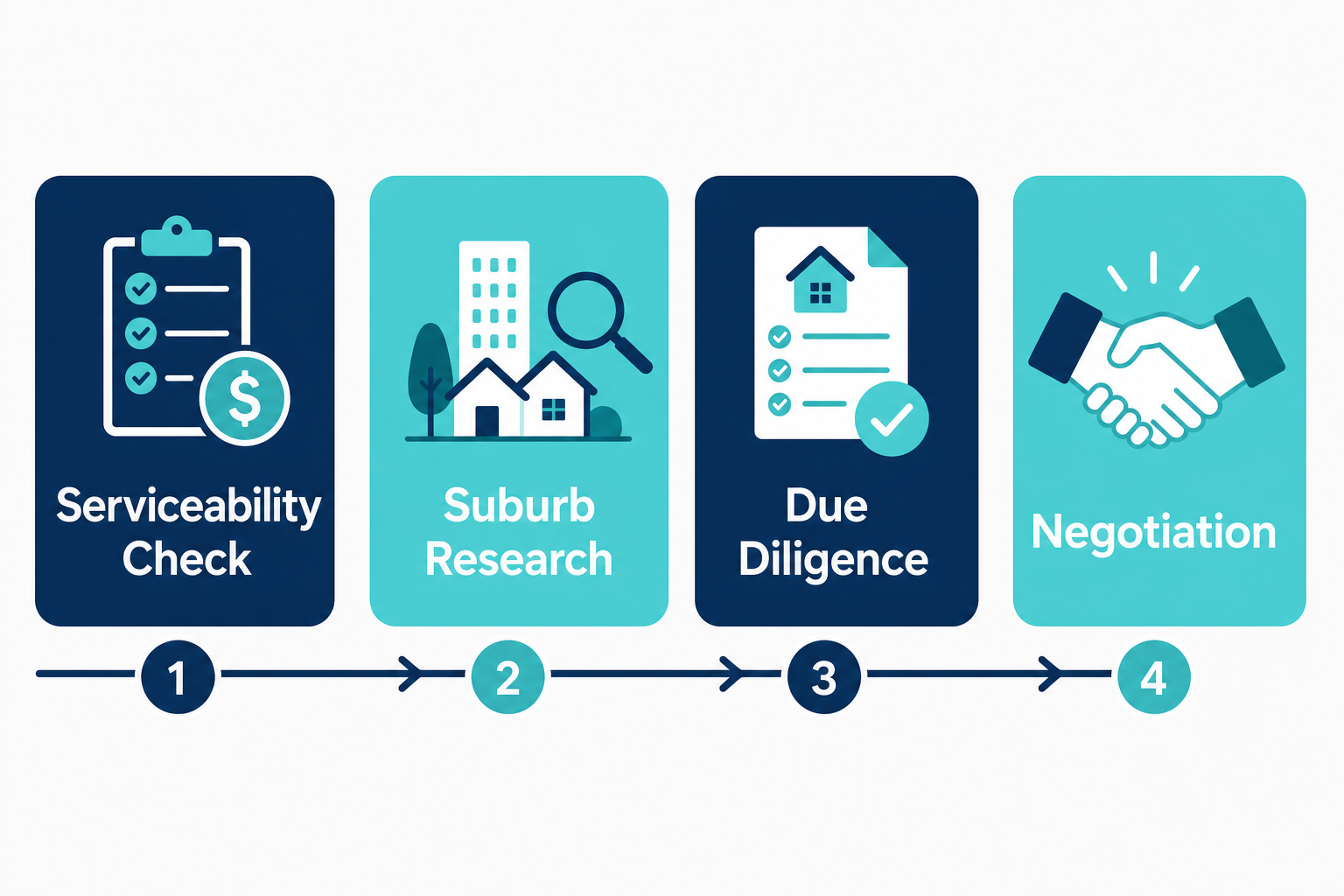
Lenders currently assess serviceability using a stressed rate typically 2-3% above the actual loan rate. That means your borrowing capacity is being calculated against a notional rate close to 7% or above in many cases. Investors need to stress-test their own numbers: if rates stay elevated for two or three years, can the property still be held comfortably?
Maintaining a meaningful cash flow buffer matters more in this environment than it did when rates were near record lows. Positively geared or near-neutral properties are more attractive for portfolio resilience, particularly for investors looking to preserve borrowing capacity for future acquisitions. For a deeper look at what is still possible, the guide on positive cash flow property in Australia is worth working through.
Suburb selection based on data, not instinct
Not every suburb will hold value or grow through this cycle. Markets with strong employment diversity, infrastructure investment, population inflows, and limited new supply are best positioned. Generic "property goes up" thinking does not survive a close look at local vacancy rates, days on market, or listing volumes.
Investors should examine how each target suburb's rental market is tracking, what the long-term owner-occupier demand profile looks like, and whether the local economy has the depth to support values if sentiment softens further.
Thorough due diligence before committing
In faster-moving markets, buyers sometimes compress their due diligence to avoid losing a property. That trade-off is rarely worth it. Building inspections, strata reports, flood and bushfire overlays, rental appraisals, and contract reviews should be non-negotiable steps. A property investment due diligence checklist is a practical starting point before engaging conveyancers or making offers.
Read More: Interest Rates Are Rising Again But Smart Investors Are Still Buying Property
How a buyers agent can help in this market
Buyers Agency Australia works with property investors nationally, taking a research-led approach to suburb selection and acquisition rather than responding reactively to whatever is listed on the major portals.
Leading the team is Dragan Dimovski, a property expert with more than 20 years of experience working across Australian residential markets. In a high-rate environment, where getting the wrong suburb or the wrong price can have outsized consequences on a portfolio's ability to grow, that experience matters in ways a weekend of online research rarely can replicate.
The practical value of a buyers agent in this market comes down to a few specifics:
- Research depth: Buyers Agency Australia analyses suburb fundamentals including vacancy rates, supply pipelines, infrastructure spending, demographic trends, and comparable sales before forming any view on where to buy.
- Negotiation discipline: When sentiment is mixed and some sellers remain anchored to peak prices, professional negotiation can mean the difference between an asset that performs and one that does not.
- Access to opportunities: Many quality properties change hands through agent networks, prior relationships, or vendor referrals before appearing publicly. Having an active buyer-side presence in target markets improves access to those situations.
- End-to-end process management: From initial strategy through to settlement coordination, having a consistent point of accountability reduces the risk of costly errors at each stage.
For investors considering markets like Sydney or Brisbane, the Sydney buyers agent guide and the broader national property investment approach from Buyers Agency Australia are worth reviewing before making any independent moves.
If you want to talk through your current position and what a buying strategy could look like given today's rate environment, book a free strategy session and get a clear-eyed view of your options.

Common mistakes buyers make when they assume rates and prices must move together
Some of the most costly errors in Australian property investment come not from bad analysis but from false assumptions about how markets work.
Waiting for the "perfect time" that may not come
Many prospective investors have been waiting for rates to fall before buying, expecting prices to dip in the interim. In practice, Australia's structural undersupply has meant no Australian capital city is expected to see prices fall through 2026 or 2027, even under scenarios with continued rate pressure. Waiting for a broad correction that may not materialise means missing months or years of rental yield and capital growth.
The opportunity cost of inaction is real, particularly in markets where supply is thin. First-time investors often underestimate how quickly a well-priced property in a strong suburb can attract multiple qualified buyers. For those new to the process, the guide on how first-time investors avoid costly mistakes covers this ground in detail.
Confusing headlines with local market conditions
National property headlines are useful for context but almost meaningless for individual buying decisions. Sydney's inner west, a coastal Queensland town, and a secondary suburb in Adelaide are three completely different markets, each with distinct supply, demand, vacancy, and price momentum dynamics. Treating them as interchangeable because they all sit under the banner of "Australian property" leads to poorly targeted purchases.
Smart investors look at micro-level data: listing volumes relative to historical norms, days on market trends, population growth at the SA3 or suburb level, and infrastructure announcements specific to the area.
Paying above value out of fear of missing out
Emotional urgency is the enemy of disciplined property acquisition. In a market where good properties attract multiple offers, the pressure to overbid is real. Investors who lack an independent analysis of fair market value going into a negotiation are vulnerable to paying a premium that takes years to recover through growth alone.
| Mistake | Why it is costly |
|---|---|
| Waiting indefinitely for rates to fall | Misses yield and growth in resilient markets |
| Relying on national headlines for suburb decisions | Poor targeting, wrong fundamentals |
| Overbidding from emotional urgency | Compresses returns, increases recovery time |
| Skipping due diligence to move fast | Exposes portfolio to structural, legal, or financial risk |
For investors curious about why some markets continue outperforming expectations, the analysis on why property isn't crashing despite rising rates adds useful perspective.
When to seek personalised advice
This article covers general market dynamics and common-sense investment considerations. It is not personal financial advice, and the right strategy for any individual investor depends on their income, existing assets, borrowing capacity, risk profile, tax position, and long-term goals.
General education about property markets and investment frameworks is a legitimate starting point. But at the point where a specific purchase, suburb, or portfolio structure is being considered, that is when general information stops being sufficient.
A qualified buyers agent can provide research and negotiation support grounded in your brief. A licensed financial adviser can assess whether a particular investment is appropriate for your overall financial position. These are complementary roles, not competing ones.
Buyers Agency Australia operates as a buyer-side advisory and acquisition service. The team does not sell properties and does not receive commissions from vendors or agents, which means the advice you receive is structured around your outcome, not a transaction fee.
If you are trying to decide whether buying in this market makes sense for your circumstances, map out your next property move with a free strategy session. Or if you are ready to start a conversation directly, contact the team and take it from there.
Frequently Asked Questions
Why are Australian property prices still rising if interest rates are high?
Structural undersupply, strong population growth, and equity-rich buyers insulated from rate movements are keeping prices elevated regardless of borrowing costs.
How do high interest rates affect property investment strategy?
Higher rates tighten serviceability, compress cash flow, and make suburb selection more important. Investors need adequate buffers and data-led market choices.
Will Australian property prices fall when interest rates drop?
Not necessarily. Prices are driven by supply and demand fundamentals. Rate cuts may boost sentiment, but supply constraints will continue supporting values.
What should I check before buying an investment property in a high-rate environment?
Review your serviceability buffer, target suburb fundamentals, rental vacancy rates, and complete thorough due diligence including building and strata inspections.
Does a buyers agent help in a high interest rate market?
Yes. Research-led suburb selection, disciplined negotiation, and access to opportunities not publicly listed become more valuable when every purchase decision carries greater financial consequence.