
Australian investors are rethinking tax-driven property strategies as negative gearing faces its biggest reform in decades and co-living emerges as a credible cash-flow-aware alternative. This guide compares both approaches across income, risk, complexity, and long-term portfolio fit – without the hype – so you can make a clearer decision for your own situation.
Introduction: Why This Topic Matters in 2026
For much of the past two decades, negative gearing sat at the centre of how many Australians built a property portfolio. The logic was straightforward: buy a property that runs at a rental loss, offset that loss against your salary income, and hold for capital growth. Tax relief cushioned the short-term pain while the long-term gain played out.
That model is now under serious pressure. The May 2026 Federal Budget announced that negative gearing on established residential properties will be abolished from 1 July 2027 for properties purchased after Budget night, with new builds remaining exempt. Investors who already hold property – or who were under contract before 12 May 2026 – retain their existing entitlements under a grandfather arrangement. But for anyone buying established residential property from here, the rules have materially changed.
At the same time, co-living has moved from a niche concept to a recognised investment category. According to Knight Frank's Co-Living Report, national co-living supply has now surpassed 10,000 units across completed, under-construction, and planned stock – and Sydney alone accounts for more than 90% of completed schemes. Investor attention has followed. The question is whether co-living actually suits your property investment strategy, or whether it is simply becoming fashionable at a convenient moment.
What Negative Gearing Does – and What It Does Not Do
Negative gearing occurs when the costs of holding an investment property – primarily mortgage interest, but also rates, insurance, and management fees – exceed the rental income it generates. The resulting net loss can be deducted against other income, including wages, which reduces the investor's overall tax liability in that financial year.
In practical terms, an investor earning $120,000 with a $15,000 annual rental loss is taxed as though they earned $105,000. At the 37% marginal rate, that is a $5,550 annual tax saving. The property still costs money each month, but less than it would without the deduction.
Negative gearing is not a profit strategy in isolation. It is a tax-deferral tool that only pays off when capital growth is strong enough to offset years of accumulated cash shortfalls. That trade-off has worked well in rising markets, but negative gearing and capital gains tax changes now mean investors relying on established properties face a fundamentally different return structure from 1 July 2027 onwards. The Australian Tax Office data shows negative gearing reduced personal income tax revenue by $10.9 billion in the 2023-24 financial year – which illustrates just how widely used the strategy has become, and why reform has attracted such political weight.
For a fuller breakdown of how the mechanics work, the negative gearing explainer for Australian investors covers the detail on losses, deductions, and the interaction with capital gains tax.
| Feature | Negative Gearing (Established) | Negative Gearing (New Build) |
|---|---|---|
| Tax deductibility from 1 July 2027 | Losses carry forward only; cannot offset salary | Fully deductible against all income |
| CGT discount (50%) | Still available | Still available |
| Who benefits most | Existing holders (grandfathered) | Buyers of new stock post-May 2026 |
| Cash flow profile | Negative short-term, relies on growth | Negative short-term, relies on growth |
| Complexity | Medium – increasing post-reform | Medium |
What Co-Living Is in Australian Property Investing
Co-living, in an investment context, refers to a residential property that houses multiple tenants in individual rooms or self-contained spaces, typically with shared common areas such as a kitchen, living room, and laundry. Tenants each sign separate lease agreements. The landlord collects multiple income streams from a single title.
At the residential end of the market, this often means a standard house with three to five bedrooms configured for separate occupation – sometimes called a rooming house or boarding house depending on state definitions. At the institutional end, purpose-built co-living schemes operate more like a hybrid between student accommodation and a serviced apartment, with professional management, shared amenities, and all-inclusive pricing.
The tenant base skews young. Knight Frank's research found that approximately 90% of co-living tenants are aged 20 to 40 – mostly working professionals who prioritise affordability, location, and flexibility over space. This demographic is growing, and national rental vacancy remains historically tight. According to SQM Research, the national vacancy rate sat at 1.0% in April 2026, well below the balanced-market threshold of 2.5% to 3.5%.
For investors, the appeal is income diversification. Because rooms are leased separately, the vacancy risk is spread across multiple tenants rather than concentrated in one household. An investment approach using standard houses not purpose-built assets is one model Buyers Agency Australia has examined for clients exploring this space.
Co-Living vs Negative Gearing: The Core Differences
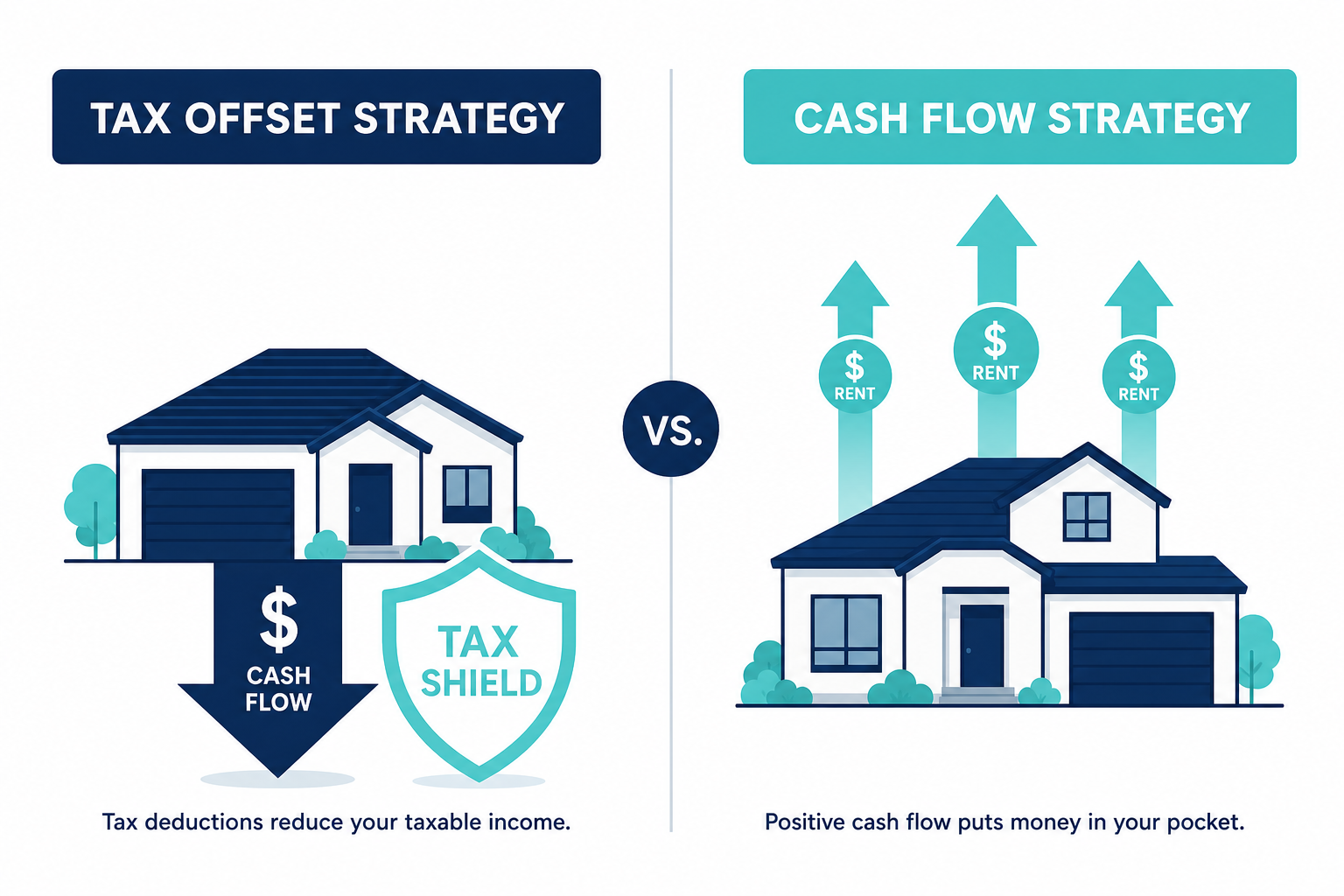
These two approaches are often discussed as though they are direct opposites. They are not – in fact, a co-living property can technically also be negatively geared if costs exceed income. The real comparison is between a cash-flow-aware strategy and a tax-offset strategy, and understanding that distinction matters more than the label.
| Factor | Traditional Negative Gearing | Co-Living Investment |
|---|---|---|
| Income profile | Single rental stream, often below costs | Multiple rental streams from same property |
| Tax strategy | Offset rental losses against salary (changing post-reform) | Gross yield improvement may reduce or eliminate losses |
| Tenant demand | Standard residential tenants | Working professionals, singles, transient renters |
| Vacancy risk | High concentration in one household | Distributed across multiple tenants |
| Management effort | Lower – single lease, standard PM | Higher – multiple leases, compliance, room turnover |
| Capital growth potential | Aligned with general market | Aligned with general market; property quality still matters |
| Regulatory complexity | Low for standard residential | Medium to high – varies by state and council zoning |
The key point is that co-living improves a property's income performance, which is especially relevant now that the tax offset benefit of negative gearing is being narrowed. It does not eliminate risk, and it introduces its own complexity. A genuine property investment strategy considers both the income and the asset quality together.
Why More Investors Are Exploring Co-Living Now
Several forces have converged to make co-living a more serious conversation in 2026.
Rental affordability pressure is real and structural. National advertised rents have risen approximately 7.3% year-on-year as of May 2026, according to SQM Research, while the National Housing Supply and Affordability Council forecasts a shortfall of approximately 262,000 dwellings against the government's Housing Accord target. In that environment, co-living offers tenants a more affordable per-room option – and landlords a more resilient income base.
Household structures are changing. More singles, young couples, and transient professionals are actively choosing flexible, well-located shared housing over the long-term lease model. That shift is demand-driven, not just supply-constrained, which matters for long-term vacancy management.
Negative gearing reform has prompted investors to question whether tax-dependency is a sound foundation for a portfolio. When the primary advantage of holding a loss-making property is its ability to reduce your tax bill – and that mechanism is being restricted – it becomes rational to ask whether the underlying investment fundamentals are strong enough to stand on their own. A rentvesting strategy that prioritises income performance alongside growth potential is attracting renewed interest from this cohort.
Institutional validation has also played a role. Knight Frank's research notes that co-living is now attracting high-net-worth individuals, small property companies, and family offices seeking yields above those available from traditional residential unit blocks. That shift in capital signals the asset class is maturing.
Risks, Trade-Offs, and Compliance Considerations
Co-living is not a passive strategy, and anyone presenting it as low-effort is not giving you the full picture.
Zoning and council approval vary significantly by state and local government area. NSW has a relatively clear planning pathway for co-living, established in 2021, which is why Sydney dominates supply. Victoria, Queensland, and Western Australia are still developing their frameworks, and approvals in those states require careful local due diligence before purchase. Buying a property with the intention of operating it as a co-living facility without confirming zoning compliance is a significant risk.
Financing is more complex. Many lenders treat properties with multiple individual leases differently from standard residential investment loans. Loan-to-value ratios may be lower, and some lenders will not finance rooming houses at all. Understanding your financing options before selecting a property is non-negotiable.
Property management is more demanding. Multiple tenants mean more tenancy agreements, more potential for disputes, more frequent room turnover, and additional wear on common areas. Professional management is almost always required, which affects net yield.
Insurance needs to be structured for multi-tenant occupancy. Standard landlord policies may not cover a rooming house arrangement, so specialist cover is required.
Tenancy law differs from standard residential leasing in several jurisdictions. In some states, rooming house occupants have different rights and protections, which affects how vacancies are managed and how exits are handled.
None of these risks are deal-breakers for the right investor in the right market. But they do mean that property due diligence for a co-living asset is more involved than for a standard rental. Skipping that step is where investors get into trouble.
How to Decide Whether Co-Living Suits Your Strategy
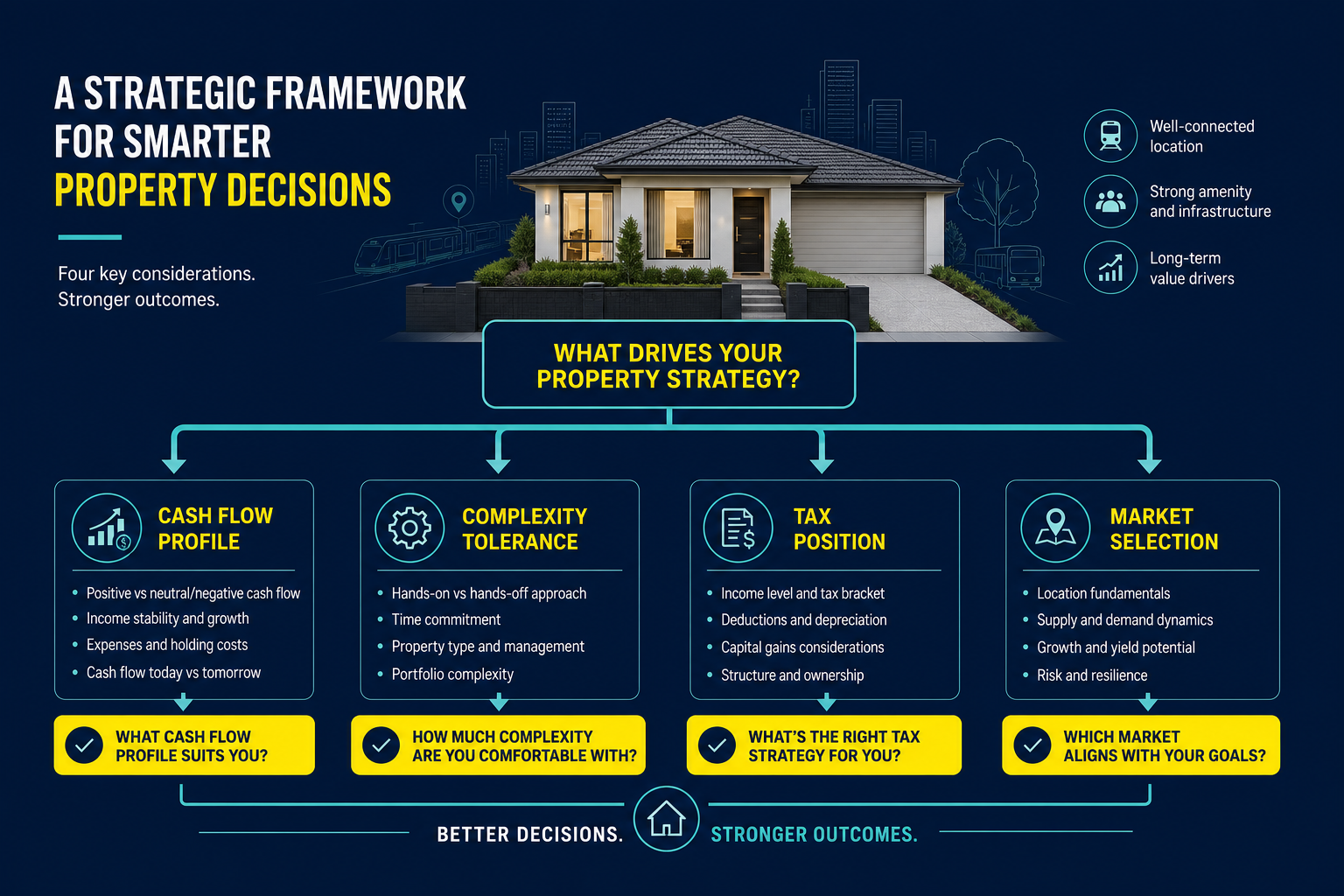
The honest answer is that it depends on a combination of factors that differ for every investor. A useful starting framework:
Your income and tax position matter. Negative gearing still works in certain structures – particularly for new builds, which remain exempt from the reform. If you are a high-income earner and you are buying a new build, the traditional tax-offset approach may still be appropriate. If you are buying established property after Budget night, the equation has shifted.
Your tolerance for complexity matters. Co-living adds regulatory, financing, and management complexity that standard residential investment does not carry. If you want a set-and-forget holding, a well-selected standard investment property in a high-demand suburb may serve you better.
Your cash flow profile matters. If your portfolio is already weighted toward negatively geared assets, adding a cash-flow-positive co-living property can improve overall portfolio resilience. If you are starting from scratch, co-living in the right location may allow you to service debt more comfortably from day one.
Your market selection matters more than the format. A co-living property in a suburb with weak rental demand will underperform a standard rental in a suburb with chronic undersupply. Location and fundamentals still dominate strategy choice. The two-speed property market in 2026 illustrates why market selection has become even more consequential than asset type.
The best investors are not choosing between co-living and negative gearing as ideological positions. They are selecting assets and structures that align with their goals, their borrowing capacity, and their tolerance for ongoing involvement.
How a Buyers Agent Can Help Assess the Right Property Type
One of the most consistent mistakes investors make is choosing a strategy before they have evaluated the asset. The format – co-living, dual income, standard rental, or new build – should follow from the market analysis, not precede it.
Buyers Agency Australia works with investors to run that process in the right order: first, understand the investor's financial position, borrowing capacity, and goals; then identify markets and suburbs where the selected strategy is viable; then locate assets – including off-market properties – that match the brief.
Dragan Dimovski, who leads the firm and brings more than 20 years of property experience across multiple market cycles, takes the view that no single format suits every investor. A co-living property in inner-western Sydney may suit an investor with strong borrowing capacity, a higher risk appetite, and access to professional management. The same format in a regional market without a supporting tenant base would be the wrong call entirely.
On the negative gearing side, the reform context changes some of the calculations around established property. But for new builds – which retain full negative gearing access – the case for careful site and developer selection remains strong, and buyer representation at that stage can prevent the kind of overpayment that erodes the tax benefit within the first few years of ownership. That is where investment property advice from an independent buyer's agent, rather than a selling agent or a developer's representative, carries the most value.
If you are still mapping out which approach matches your situation, book a free strategy session with the team. It is a starting point, not a sales pitch – and it costs nothing to get a clear picture of your options.

Conclusion: Choosing the Strategy That Fits the Plan
The shift toward co-living is not a rejection of all that negative gearing represented. For many investors, the traditional tax-offset model delivered real wealth over the past two decades, and it will continue to do so in specific structures – particularly new builds – that remain exempt from the 2027 reforms.
What has changed is the risk profile of relying on tax benefits as the primary investment thesis for established residential property. When the deductibility of rental losses against salary income is being removed for new purchases, the underlying asset – its location, its rental demand, its cash flow – becomes the thing that actually carries the investment. That is not a bad thing. It is a return to fundamentals.
Co-living adds genuine tools for managing cash flow and spreading vacancy risk, but it introduces complexity that requires clear-eyed due diligence and local knowledge. The best property investment strategy is not the most fashionable one in a given year – it is the one that reflects your goals, your structure, and the market you are entering.
If you want to work through what that looks like for your situation, map out your next property move with the Buyers Agency Australia team. Or, if you are ready to start a more detailed conversation, contact the team directly.
Frequently Asked Questions
Is co-living still a good investment in 2026 given negative gearing changes?
Co-living may suit investors seeking stronger cash flow, but it carries compliance and management complexity. Whether it fits your portfolio depends on location, structure, and your borrowing profile.
Does negative gearing reform affect all investment properties from July 2027?
No. Properties held before 12 May 2026 are grandfathered. New builds remain fully exempt. Only established residential properties purchased after Budget night are affected.
What types of properties qualify as co-living investments in Australia?
Typically multi-bedroom houses or purpose-built rooming houses with separate tenancy agreements per room. Definitions and approval requirements vary significantly by state and council.
Can a co-living property also be negatively geared?
Yes. If costs exceed the combined rental income, the property is still negatively geared. The format does not determine gearing – the income-to-cost ratio does.
How does a buyers agent help with co-living or negative gearing decisions?
A buyers agent assesses your goals and borrowing profile, identifies suitable markets and assets, and negotiates on your behalf – ensuring the property format matches the strategy, not the other way around.