
Brand-new investment properties are widely marketed as the smart, safe choice. Fresh finishes, depreciation benefits, builder warranties, and the comfort of knowing no previous owner has lived there all make a compelling pitch. But experienced investors know the surface appeal of a display suite rarely tells the full story. This guide cuts through the marketing gloss and covers the risks every buyer should assess before signing a contract on a new or off-the-plan property.
Why brand-new investment properties can look safer than they really are
New builds come with a natural sense of reassurance. There is no maintenance backlog, no tired kitchen from the 1990s, and no tenant-damage history to worry about. For investors new to the market, the depreciation schedule alone can feel like a compelling financial advantage. Developers spend considerable resources making their product look irresistible: polished display suites, glossy brochures, projected rental yields, and early-bird pricing all create a sense of urgency and certainty.
The trouble is that much of this is marketing, not independent analysis. Projected yields are often based on optimistic assumptions about the local rental market. Early-bird pricing structures can obscure how that price compares to genuine comparable sales nearby. And the clean, new-car feeling of a brand-new apartment or house-and-land package can make it emotionally harder to walk away, even when the fundamentals do not stack up.
At Buyers Agency Australia, one of the clearest patterns seen across years of investor client work is that new properties are the most heavily marketed segment in the entire property market, which means buyers face the highest information asymmetry. Understanding why off-the-plan and house-and-land packages carry specific risks is the first step toward making a clear-eyed decision.
The hidden risks investors should assess before buying
The risks that matter most to investors are rarely the obvious ones. Here is where real exposure tends to hide.
Price premiums and developer margin
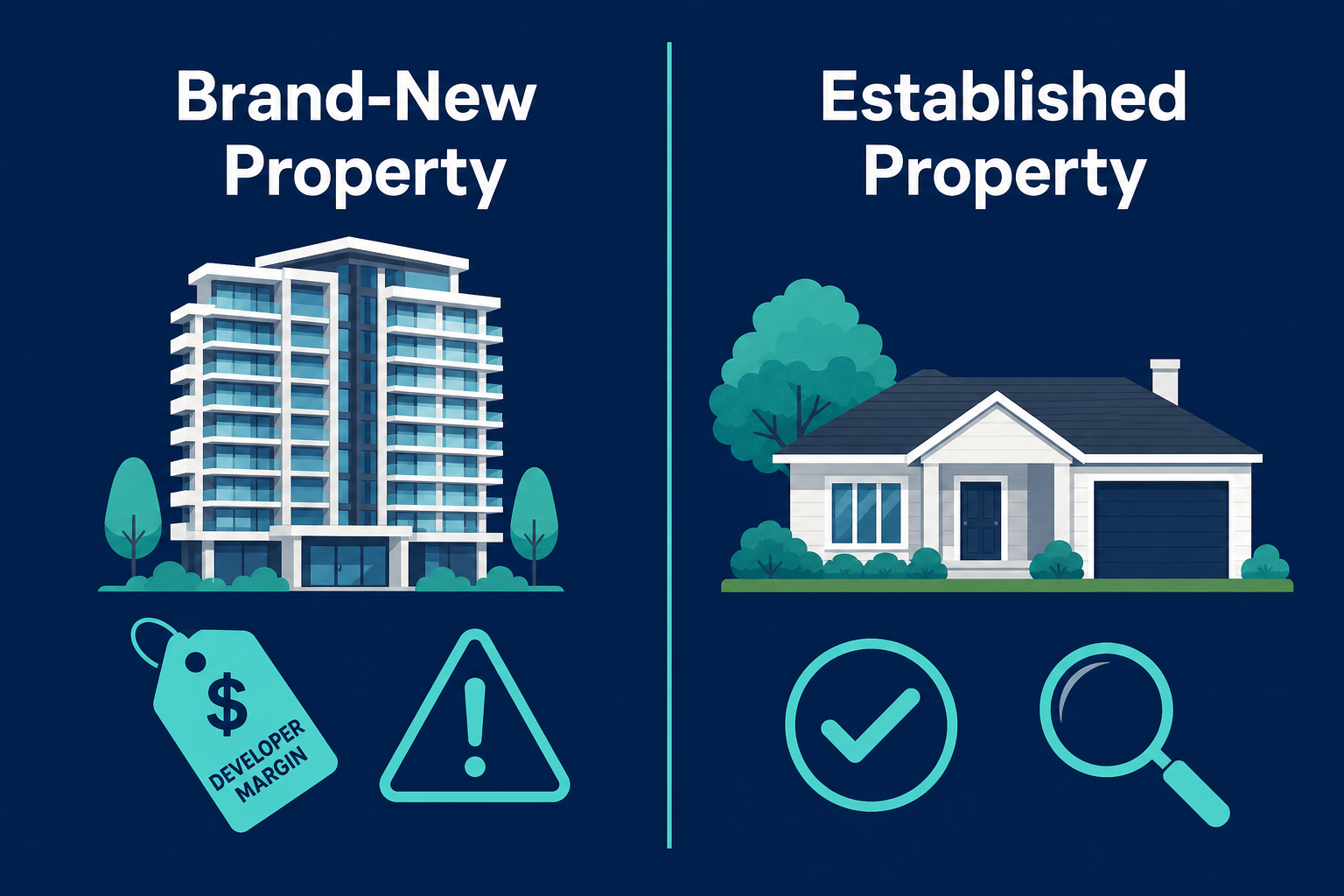
New properties carry a built-in developer margin. That margin covers land acquisition, construction, sales commissions, marketing, and project profit. Buyers absorb all of that in the purchase price. In many cases, comparable established properties in the same suburb trade at a genuine discount relative to the new stock, simply because no developer margin is baked in.
According to PropTrack data, building input prices have risen more than 33% since the pandemic. Those cost increases flow directly to buyers. In markets like Sydney and Melbourne, property price growth since 2021 has not kept pace with construction cost inflation, meaning new-build pricing often reflects what it costs developers to build, not what the market independently values the finished product at.
Valuation gaps at settlement
This is the risk that catches the most investors off guard. When buying off-the-plan, banks conduct a formal valuation at settlement, not at the time of signing. If the market softens, or the postcode is oversupplied, that valuation can come in below the contract price. The bank will only lend against the lower figure. The buyer must cover the gap in cash.
Valuation shortfalls of 5 to 15% are not uncommon on off-plan apartments in oversupplied postcodes, and some buyers have faced shortfalls exceeding 20% in market downturns. This is not a hypothetical risk. It played out at scale during the Melbourne and Brisbane apartment corrections between 2017 and 2020. If you cannot fund the gap, you risk losing your deposit and potentially facing legal action from the developer for any resale loss.
| Risk Area | What Can Go Wrong | Who Bears the Cost |
|---|---|---|
| Valuation shortfall | Bank values below contract price at settlement | Buyer must fund gap in cash |
| Developer insolvency | Builder collapses mid-construction | Buyer faces deposit recovery process |
| Strata defects | Building has undisclosed structural or waterproofing faults | Owners Corporation levy holders |
| Rental demand shortfall | Developer yield estimate does not reflect real market | Investor absorbs vacancy and cash flow gap |
| Settlement delay | Construction extends beyond contracted date | Holding costs, finance expiry, re-approval risk |
Developer and construction risk
Construction companies represented 26% of all Australian business insolvencies in 2024 to 2025, making developer collapse a genuine and live concern. If a developer fails mid-construction, recovering a deposit from a statutory trust account can take months or years. Even where deposits are protected, buyers may find themselves in a partially complete development with no clear path to settlement.
Settlement delays compound this. A contract with a 12-month build timeline can easily stretch to 24 or 36 months. In that time, your finance pre-approval expires and must be renewed under potentially different lending conditions. Your personal financial circumstances may also have changed.
Strata and build-quality risk
The NSW Government's Building Commission found that 53% of strata buildings registered between 2016 and 2022 had serious defects in common property. Waterproofing and fire safety systems were the most prevalent issues at 42% and 24% of defective buildings respectively. NSW Building Commissioner David Chandler stated publicly that 60 to 70% of recently built Sydney apartments likely have defects that have not yet been formally identified or reported.
Defects mean special levies. As an investor owning a strata lot, you have no ability to opt out of those levies. A building with a chronic waterproofing defect can generate six-figure rectification bills, spread across owners who had no knowledge of the problem when they purchased. Checking the sinking fund balance, reviewing strata records, and assessing the developer's track record are not optional steps when buying new strata property.
Rental demand uncertainty
New property developments are frequently marketed with projected rental yields. These projections are produced by the developer's appointed property managers and often assume optimal conditions: 100% occupancy, above-market rents, and no competing supply. Reality rarely cooperates.
New apartment complexes often deliver multiple units to the same rental market simultaneously, creating a temporary supply glut. In suburbs with heavy new construction pipelines, vacancy rates can spike and rents can soften just as buyers settle and begin their search for tenants. Solid property due diligence requires independently verifying actual comparable rents, suburb-level vacancy data, and the supply pipeline before accepting any developer yield projection.
How new properties can affect long-term portfolio strategy
The financial risks of a new property purchase do not always show up immediately. Some of the most consequential ones play out slowly across a portfolio.
Land content and capital growth
Capital growth in Australian residential property is overwhelmingly driven by land value, not the building sitting on it. A new apartment in a high-density tower holds a fractionally small share of the land beneath it. As the building ages and depreciates, the land component does the heavy lifting. Established houses or older units with genuine land content tend to outperform high-density new stock over the long term. This is not speculation; it is reflected in CoreLogic's long-run data showing capital city house values rising almost three times as fast as unit values since the onset of COVID.
Depreciation and the tax story
Depreciation is frequently used to justify new-property purchases. The benefits are real: brand-new buildings carry higher depreciation schedules, and investors can claim deductions on both the building structure and fixtures. But depreciation is a non-cash deduction, not a return on investment. It reduces your taxable income today while your asset may be underperforming on capital growth. The tax depreciation benefit does not compensate for overpaying on the purchase price.
Resale and exit flexibility
New properties sell on marketing, on newness, and on developer-supported launch pricing. When you come to resell, you compete against every other investor in the same building or development who may also be exiting. Resale values in new apartment blocks can be structurally suppressed by ongoing new supply from adjacent projects. Established properties in proven streets with genuine owner-occupier demand tend to have more liquid and resilient resale markets.
A practical due diligence checklist for brand-new purchases
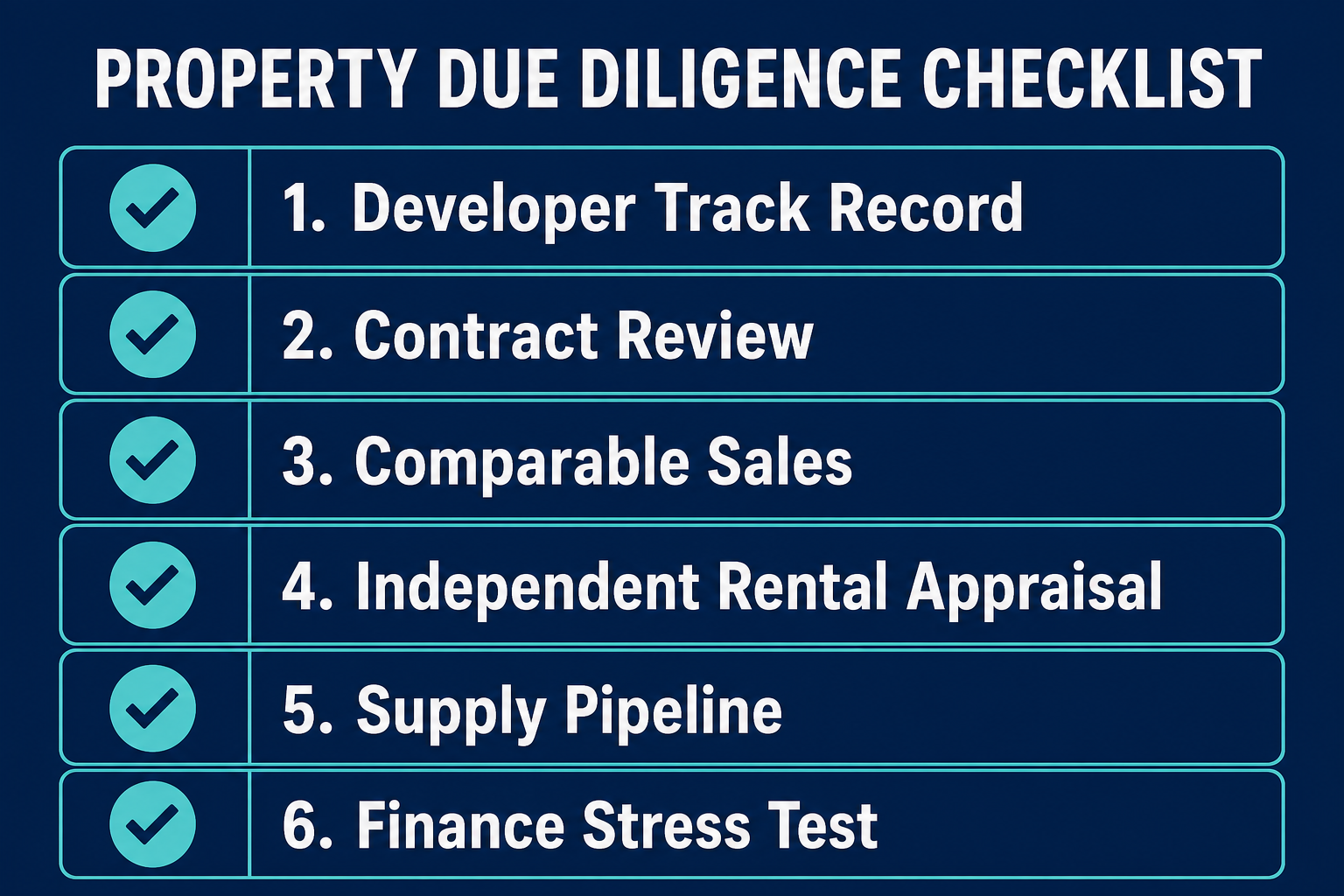
If you are seriously considering a new or off-the-plan property, every item below deserves attention before you exchange contracts. Treating any of these as optional materially increases your exposure.
- Developer track record: Review completed projects, search for disputes or ASIC actions, and speak to strata managers of finished buildings the developer has delivered.
- Contract review by a property solicitor: Specifically assess sunset clauses, variation provisions, and defect rectification obligations. Off-the-plan contracts are far more complex than standard purchase contracts.
- Independent comparable sales analysis: Do not rely on the developer's comparable evidence. Pull your own data from CoreLogic or PropTrack on genuine arm's-length sales of completed, comparable stock in the same suburb.
- Independent rental appraisal: Contact three or more independent property managers in the area, not the developer's appointed PM, and ask for a written rental estimate with vacancy rate data.
- Supply pipeline check: Establish how many similar properties are completing within a 2 km radius over the next 12 to 24 months. A heavy supply pipeline suppresses rents and resale values simultaneously.
- Finance stress test: Model what happens if the settlement valuation comes in 10% below your contract price. Confirm you can fund that gap without defaulting.
- Building and strata report: For completed new strata properties, obtain a full strata report including the sinking fund balance, any outstanding defect claims, minutes of recent Owners Corporation meetings, and the building's insurance history.
- Settlement conditions: Understand the sunset date, the developer's right to vary the plan, and your rights if completion is delayed beyond the contracted period.
Read more: Step By Step Guide To Buying An Investment Property In Australia
When a brand-new property may still suit an investor
It would be misleading to say new properties are never appropriate for investors. There are limited scenarios where the case is stronger.
An investor with specific SMSF or tax-planning requirements working closely with a qualified accountant may find that the depreciation benefits of a new build align with their strategy. Investors who require a property with no immediate maintenance exposure, such as those managing a portfolio remotely or interstate, may value the reduced short-term maintenance workload of a new build. In tightly held markets where genuine supply is constrained and the developer is highly credible with a strong delivery track record, a new property in an undersupplied suburb can represent reasonable value.
The key caveat in all of these scenarios is this: the decision should start with the evidence, not the display suite. If the comparable sales stack up, the rental demand is verified independently, the developer has a clean track record, and you have stress-tested your finance position, then a new property may be a reasonable fit. If any of those conditions are absent, the risk profile shifts significantly against you.
Investors exploring how off-market and established alternatives compare as part of a broader property investment strategy will generally find far more verifiable value in the established market.
How a buyers advocate can help reduce purchase risk
The structural information gap between developers and buyers is real and persistent. Developers know their product intimately and spend significant resources presenting it in the most favourable light. Buyers, especially those purchasing without independent advice, are making one of the largest financial decisions of their lives based on incomplete or selectively presented information.
A buyers advocate works solely for the buyer, not for the developer, not for the selling agent, and not for any referral fee paid by the development. Dragan Dimovski, the principal of Buyers Agency Australia, brings more than 20 years of property experience to bear when assessing any new-build opportunity. That means independently reviewing the purchase price against genuine comparable evidence, stress-testing the rental demand assumptions, scrutinising the contract terms, and pressure-testing the developer's track record before a client commits.
For investors considering new or off-the-plan stock, the due diligence process runs alongside access to the established and off-market property options that most buyers never see. Having a credible alternative on the table changes the negotiation dynamic entirely and removes the pressure of the developer's artificial scarcity tactics.
If you are weighing up a new-build purchase and want an independent assessment before you commit, book a free strategy session to work through the numbers with the team.

Conclusion: buy the asset, not the marketing
The most common mistake investors make with brand-new property is buying the presentation rather than the underlying asset. A polished display suite, a developer's projected yield, and a headline depreciation benefit are not a substitute for independent comparable sales analysis, verified rental demand, a stress-tested finance position, and an honest assessment of the developer's track record.
Every point in this guide comes back to one principle: your investment decision should be driven by evidence, not enthusiasm. The fundamentals that drive long-term property performance, land content, genuine rental demand, sustainable purchase price, and liquidity on exit, are the same regardless of whether the property is new or established. New properties introduce additional layers of risk that must be actively managed through rigorous property due diligence before you sign anything.
If you would like to map out your next property move with a team that prioritises your result over a developer's commission, book a free strategy session or contact the team at Buyers Agency Australia today.
Frequently Asked Questions
Is it risky to buy a brand-new investment property in Australia?
Yes. New properties carry specific risks including valuation shortfalls, developer insolvency, strata defects, inflated pricing, and rental demand uncertainty that established properties do not.
What is a valuation shortfall on an off-the-plan property?
A valuation shortfall occurs when the bank's independent valuation at settlement comes in below your contract price. You must fund the gap in cash or risk losing your deposit.
How common are building defects in new Australian apartments?
According to the NSW Government's Building Commission, 53% of strata buildings registered between 2016 and 2022 had serious defects in common property.
Does depreciation make a new investment property worth it?
Depreciation reduces taxable income but is a non-cash benefit. It does not compensate for overpaying on the purchase price or underperformance in capital growth.
How can a buyers advocate help with a new property purchase?
A buyers advocate independently verifies comparable sales, rental demand, contract terms, and developer track record so you make decisions based on evidence rather than developer marketing.