
Not every buyers agent is created equal. In a market where investor activity has surged – with investor loans up 64% from the early 2023 low according to the PropTrack Westpac Investor Report – the stakes of picking the wrong buyers agent have never been higher. This guide cuts through the noise so you can make an informed, confident decision.
Introduction: Why Buyers Agent Quality Matters in 2026
Property investors across Australia are facing one of the most complex buying environments in recent memory. National vacancy rates remain below 1.6% in many capital city markets, mid-cap cities like Brisbane and Adelaide are still posting strong annual growth, and the proposed changes to negative gearing rules from 2027 are reshaping acquisition timelines for many portfolios. Getting the strategy right matters enormously right now.
A good buyers agent for property investment does far more than search for properties on portals. The right buyers advocate reduces risk, brings independent market intelligence to every decision, and ensures that each acquisition is aligned to a defined wealth-building plan rather than a sales quota. The wrong one costs you time, money, and momentum.
Buyers Agency Australia, led by Dragan Dimovski – a property expert with 20+ years of hands-on investment experience – was built on exactly this distinction. What follows is an honest breakdown of what separates a genuinely strategic buyers advocate from one who simply adds cost and complication to your purchase.
What a Good Buyers Agent Should Do
Before identifying the red flags, it helps to be clear on the benchmark. A quality buyers agent delivers across several interconnected areas.
Strategy alignment: The engagement should start with your goals, your timeline, your borrowing capacity, and your risk profile. A competent buyers advocate builds a clear acquisition thesis before any property search begins. They reverse-engineer the asset type, suburb profile, and price point that serves your 10-year wealth target – not their preferred postcodes.
Suburb and asset research: Independent, data-led suburb analysis is non-negotiable. This means vacancy rates, rental demand trends, infrastructure pipelines, supply constraints, comparable sales, and demographic shifts. For investors building a property investment strategy oriented around long-term wealth, suburb selection is where outcomes are largely determined.
Due diligence and risk assessment: A thorough buyers agent coordinates building and pest inspections, reviews strata records for units, assesses contract conditions, and flags any overlays or planning risks that could affect the asset's value or usability. A full property investment due diligence checklist covers everything from title searches to rental appraisal verification.
Negotiation and purchase support: From structuring the offer and negotiating on price and terms, through to coordinating settlement, a good buyers agent remains present and accountable throughout the entire transaction.
| What a Good Buyers Agent Delivers | What to Expect in Practice |
|---|---|
| Strategy and acquisition brief | Written investment brief before any search begins |
| Independent suburb research | Data-backed shortlist with clear rationale |
| Due diligence coordination | Inspections, contract review, risk flagging |
| Negotiation and offer strategy | Evidence-based pricing and terms guidance |
| Settlement and handover support | Clear communication through to settlement day |

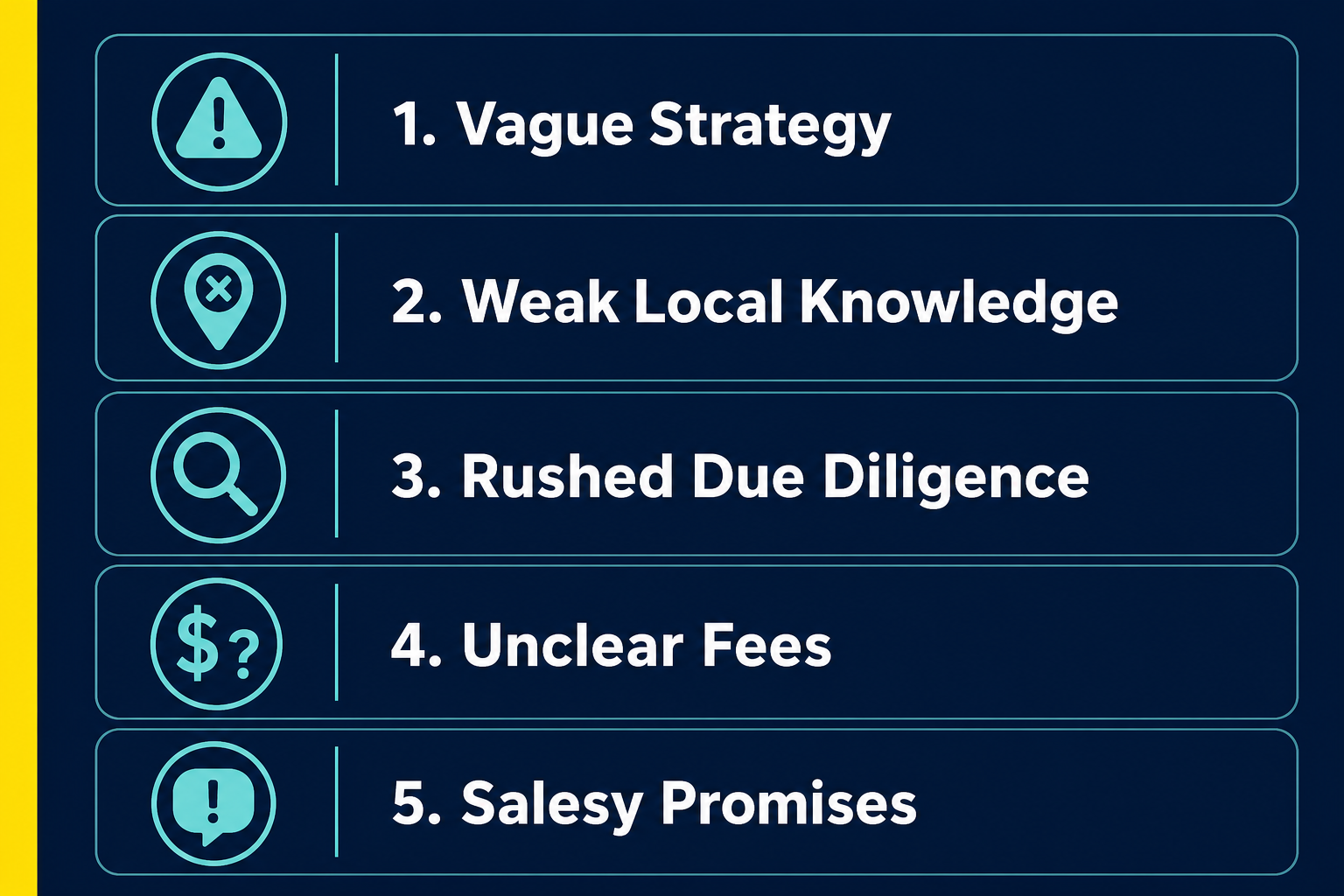
Red Flag #1: Vague Strategy and No Clear Investor Focus
When you speak with a buyers agent for the first time, they should be able to articulate a clear process. What does their acquisition brief look like? How do they define a good investment? What is their process for shortlisting markets and asset types?
If the answers are generic – phrases like "we look at growth areas" or "we focus on high demand suburbs" without any evidence-based substance behind them – that is a problem. A buyers advocate who cannot explain their investment thesis clearly is not thinking strategically about your portfolio; they are thinking about completing a transaction.
For investors who understand why property investment strategy matters more than picking the right suburb, this distinction is critical. Strategy comes first. Suburb selection and asset type follow from a defined goal, not the other way around.
Also watch for agents who present themselves as generalists serving both buyers and sellers in the same market. An agent who earns commission from vendors cannot be fully aligned to your interests as a buyer, regardless of what they claim.
Red Flag #2: Weak Local Knowledge or Generic Suburb Recommendations
Strong suburb knowledge is not simply knowing where a suburb is located. It means understanding the specific streets that outperform within a suburb, recognising which developments are under-supplied, reading rental demand patterns, and knowing which overlays or zoning changes could affect capital growth.
A buyers agent who recommends suburbs based on "what's trending" in property media is a concern. By the time a suburb appears in a mainstream top-10 list, the opportunity window has typically closed and buyer competition has already priced in the growth.
Ask directly: which specific council areas do you focus on, and why? What data sources do you rely on? How have your suburb recommendations performed over the past three to five years? A confident, experienced buyers advocate will answer these questions with precision. Hesitation or vague referrals to "positive sentiment" and "strong fundamentals" should make you cautious.
For investors assessing Brisbane, for example, a well-researched agent should be able to speak to specific conditions across inner, middle, and outer ring markets – not just repeat broad statements about Brisbane's investment property market in 2026.
Red Flag #3: Poor Due Diligence and Rushed Recommendations
One of the clearest warning signs is pressure to move fast without adequate evidence. A buyers agent who tells you that you "need to move today" or that "this one won't last" without supporting the urgency with detailed market analysis is not acting in your interest.
According to Australia's consumer protection regulator, high-pressure selling tactics – including artificial urgency – are a recognised indicator of conduct that may not serve the consumer's best interest. In property, that urgency often comes at the buyer's expense.
Shallow property analysis is another risk. A buyers advocate who skips building inspections, accepts the vendor's rental appraisal without independent verification, or fails to check strata records for units is exposing you to risks that could cost far more than their fee saved. A thorough buyers agent treats every property as a potential risk first and an opportunity second.
The approach at Buyers Agency Australia is the opposite: Dragan Dimovski's team works from a defined brief, runs independent comparable sales analysis, and coordinates all inspections before recommending a purchase. The buyer's interests are protected at every stage – not just the acquisition.
Red Flag #4: Unclear Fees, Scope, and Exclusions
Fee transparency is one of the clearest indicators of a buyers agent's integrity. Before engaging anyone, you should receive a written service agreement that clearly states:
- The total fee structure (fixed or percentage-based)
- What is included in the service (full search, negotiate-only, auction bidding)
- What is excluded (certain property types, geographies, price brackets)
- Any referral arrangements or third-party relationships
- Licensing details and the state in which they are licensed to operate
Buyers agents in Australia are required to hold a real estate agent licence under the relevant state legislation. From 1 July 2026, buyers agents also fall under new AUSTRAC AML/CTF obligations as reporting entities – so working with a properly licensed, compliant agency is now a regulatory as well as a practical consideration.
Percentage-based fees create a structural conflict: the agent earns more when you pay more. A fixed-fee model removes that conflict entirely. At Buyers Agency Australia, fees are structured to reflect the complexity of the search, not the purchase price – so the agent's incentive is always to find the best deal, not the most expensive one.
If an agent is reluctant to put their fee structure, scope of service, or licensing in writing, that reluctance tells you everything you need to know.
Red Flag #5: Salesy Promises and Unrealistic Claims
No buyers agent can guarantee growth. No one can guarantee that a property will be under market value. No one can guarantee exclusive off-market access that no other agent or investor has. These are not promises that any credible buyers advocate should make, and the presence of language like "guaranteed results" or "exclusive deals unavailable elsewhere" should prompt real scepticism.
As Australia's consumer regulator notes, claims that cannot be substantiated and that are likely to mislead consumers may constitute misleading conduct under Australian Consumer Law. In property, these claims are often used to create urgency and lower due diligence.
Authentic off-market access comes from genuine, relationship-driven networks built over years – not a marketing promise. Understanding how buyers agents find off-market properties is useful context here: it is a function of long-term agent relationships and local credibility, not a feature that can be switched on for any buyer at any time.
Also watch for social media-driven outreach and unsolicited messages promising specific off-market deals. In 2026, unsolicited digital solicitation has become one of the more visible patterns among less experienced operators entering the market.
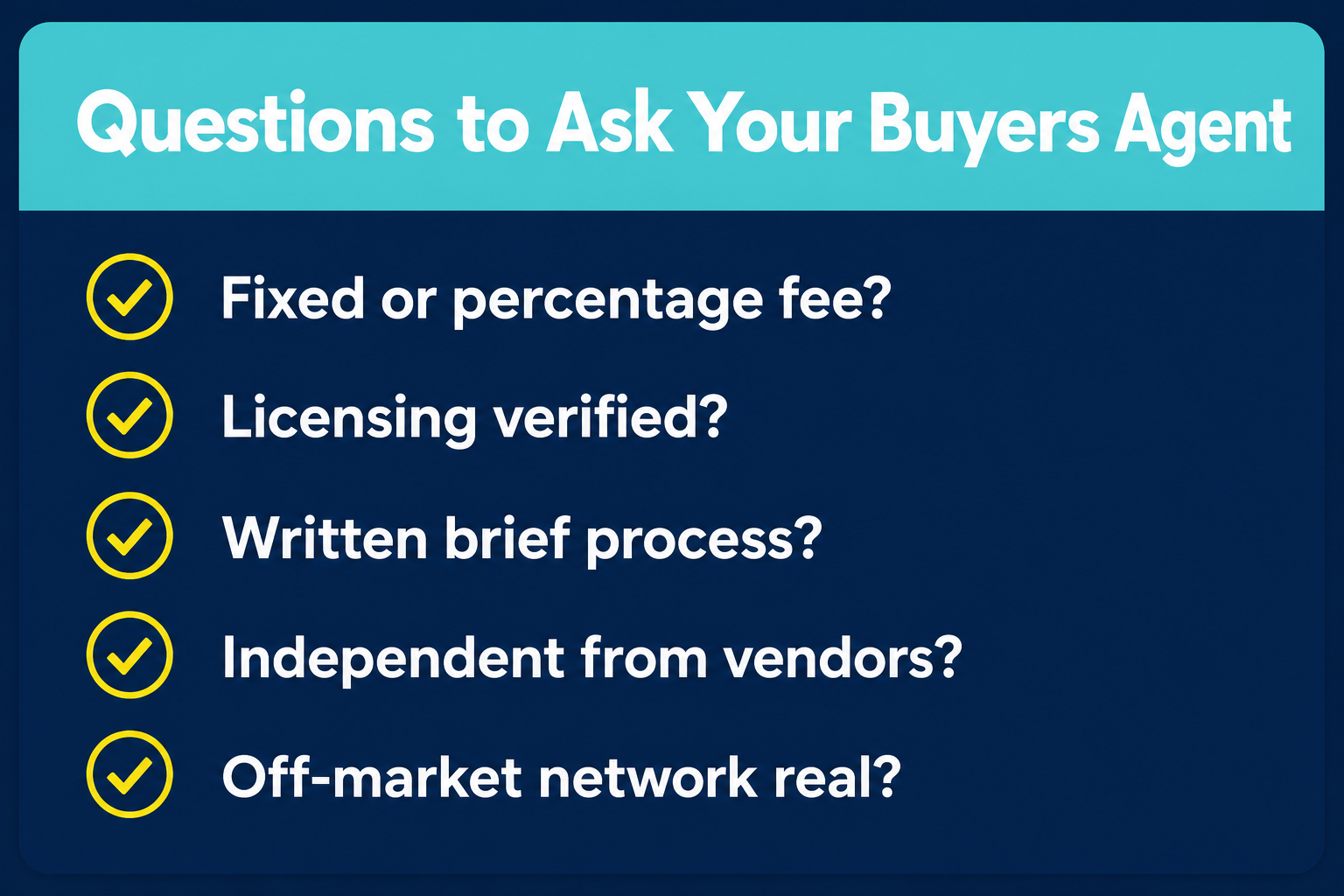
Questions Investors Should Ask Before Engaging a Buyers Agent
Before signing any engagement agreement, use these questions to assess the quality, alignment, and transparency of a potential buyers advocate:
- Experience and track record: How long have you been operating as a buyers agent? How many investment purchases have you facilitated in the last 12 months?
- Investor focus: Do you work primarily with investors, owner-occupiers, or both? What proportion of your clients are building multi-property portfolios?
- Strategy process: How do you develop a brief before searching? What does your acquisition thesis look like for a client in my position?
- Market coverage: Which markets do you operate in? Are you licensed to operate in each state where you recommend properties?
- Due diligence process: What inspections, reports, and checks do you coordinate as part of your standard service?
- Fee structure: Is your fee fixed or percentage-based? What does the engagement agreement include and exclude?
- Conflict management: Do you receive any referral fees, commissions, or benefits from third parties such as property managers, brokers, or developers?
- Communication: How frequently will I receive updates? Who is my main point of contact throughout the process?
- Off-market access: How do you source off-market properties, and can you provide examples from recent transactions?
- References: Can you provide references from investors with similar goals to mine?
A good buyers agent will welcome these questions. A hesitant or evasive response to any of them is itself important information.
How to Choose the Right Buyers Agent for Your Goals
The right buyers agent for an investor building a property portfolio is not necessarily the same as the right agent for an owner-occupier buying their first home. Matching the buyers advocate to your specific context matters.
| Investor Priority | What to Look For in a Buyers Agent |
|---|---|
| Portfolio growth strategy | Proven process for multi-property, goal-oriented acquisition |
| Off-market access | Genuine agent network, not just portal monitoring |
| Capital growth focus | Data-led suburb analysis with documented rationale |
| Yield and cash flow | Understanding of rental demand, vacancy, and holding costs |
| Transparent fees | Fixed-fee structure with written scope of service |
| Independent representation | No vendor-side conflicts, no developer or project referrals |
For investors who want strategy-led, independent buyer-side representation across Australia's major markets, Buyers Agency Australia offers a structured approach grounded in 20+ years of personal investment experience. The two-speed property market conditions of 2026 – with some cities still performing strongly while others soften – make the quality of suburb selection and asset research more consequential than in a broadly rising market.
If you are exploring how off-market properties change the way strategic buyers search, that context is also worth understanding before you engage any buyers advocate.
When in doubt, book a free strategy session and see whether the conversation is focused on your goals or on their listings.
Frequently Asked Questions
What qualifications should a buyers agent have in Australia?
A buyers agent must hold a valid real estate agent licence under the relevant state legislation. From July 2026, they must also comply with AUSTRAC AML/CTF obligations as registered reporting entities.
How do buyers agent fees typically work in Australia?
Fees are either fixed or percentage-based (commonly 1.5% to 2.5% of purchase price). Fixed-fee models remove the conflict of interest where an agent benefits from a higher purchase price.
Is it worth using a buyers agent for investment property?
For most investors, yes – particularly for off-market access, independent suburb research, negotiation, and due diligence coordination that would otherwise require significant time and expertise.
How can I verify a buyers agent is properly licensed?
Check the relevant state licensing register. In NSW, Fair Trading maintains a public register. In Queensland, the Office of Fair Trading holds licensing records for all real estate agents.
What is the difference between a buyers agent and a buyers advocate?
The terms are used interchangeably in Australia. Both refer to a licensed professional who acts exclusively on behalf of the buyer, not the vendor, throughout the property search and purchase process.
Closing: Choose Expertise, Transparency, and Alignment
In 2026, the Australian property market rewards disciplined, data-informed decision-making. The buyers agent you choose either reinforces that discipline or undermines it. Strategy clarity, suburb knowledge depth, rigorous due diligence, transparent fees, and honest communication are not optional extras – they are the baseline for anyone who genuinely acts in your interest.
The red flags covered in this guide are not hypothetical. They show up regularly in investor experiences across the country, and they carry real financial consequences. Choosing a buyers advocate who ticks the right boxes from the beginning is far less costly than course-correcting after a poorly structured acquisition.
If you want to work with a team that puts your strategy first, map out your next property move with Buyers Agency Australia. For any specific questions about the process or how the team works, contact the team directly.