
A clear property investment strategy is what separates accidental landlords from investors who build lasting financial independence. This guide breaks down the planning, risk management, and long-term thinking required to grow a property portfolio that performs over decades, not just market cycles.
Wealth starts with the right plan
Most people who enter the property market do so with a vague goal: own an investment property and hope it grows. That approach works occasionally, but it rarely produces the kind of compounding wealth that gives investors real financial choices. The difference between buying a single property and building a deliberate property portfolio comes down to intent, sequence, and structure.
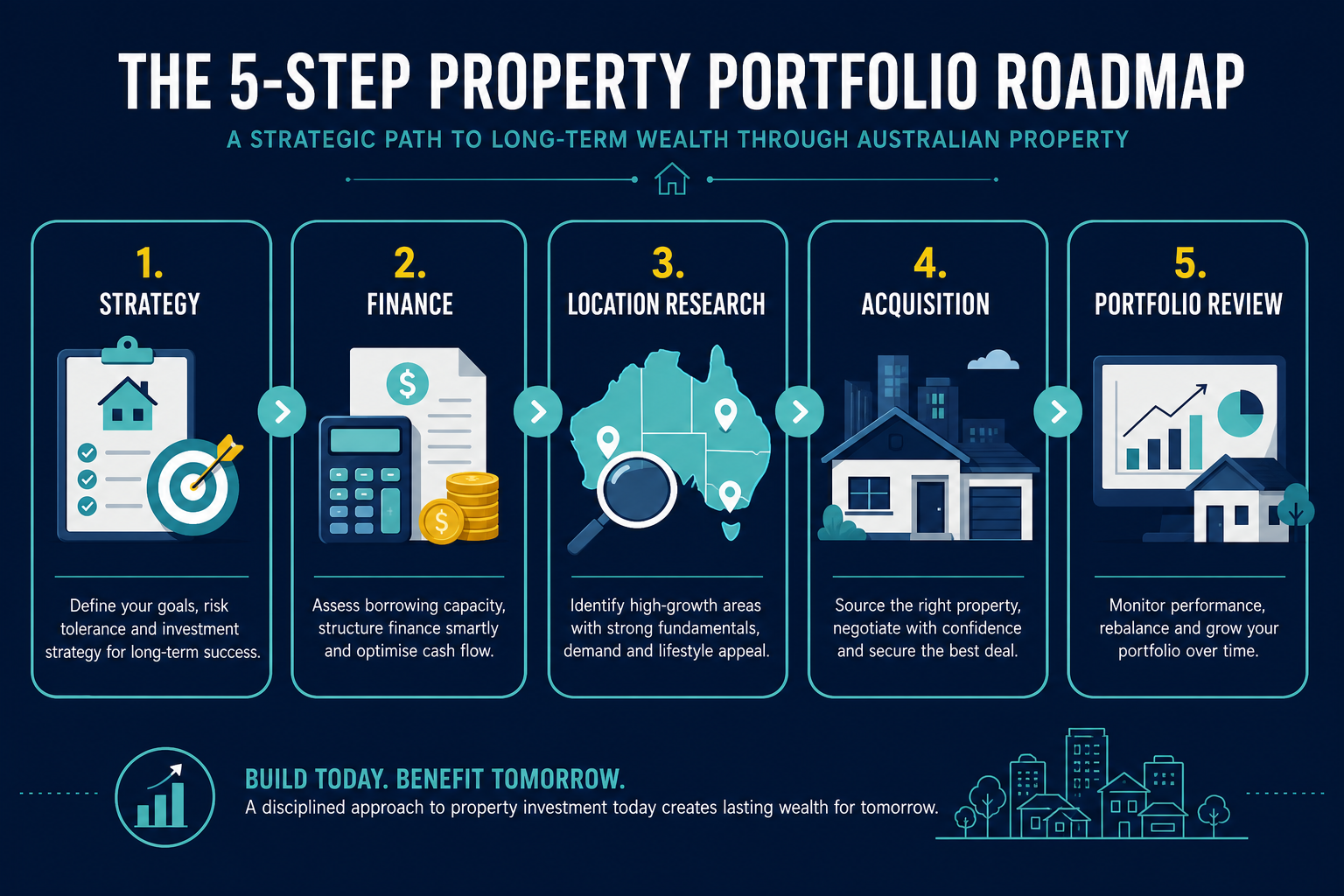
Building a property portfolio means making each acquisition serve a purpose within a broader plan. The first property should set the right foundation — delivering positive cash flow, strong capital growth prospects, or ideally both — so that it opens the door to a second purchase rather than closing it. Buying without that logic often means investors find themselves asset-rich, cash-poor, and unable to move forward.
Residential property accounts for 55.8% of total Australian household wealth, according to recent market data, which explains why it remains the primary vehicle through which most Australians build net worth. But owning property and strategically building through property are two very different things. One is passive. The other requires a plan.
Dragan Dimovski, founder of Buyers Agency Australia and a property expert with 20+ years of experience, describes the planning phase as the highest-leverage point in the entire process. Getting the strategy right early avoids the compounding cost of getting it wrong. The team at Buyers Agency Australia works with investors from that very first planning conversation through to settlement and beyond.
What a property investment plan actually covers
A genuine property investment strategy goes well beyond selecting a suburb. It covers:
- Financial position and borrowing capacity — what you can do now, and what you need to achieve to buy the next asset
- Target asset profile — yield-focused, growth-focused, or balanced
- Hold period and exit horizon — are you building for passive income, capital growth, or eventual sale?
- Portfolio sequencing — in what order should you acquire assets to keep borrowing power intact?
- Tax structure — how ownership is structured affects long-term returns significantly
These elements interact with each other. Skipping the plan and going straight to property search is one of the most common and costly mistakes investors make.
| Strategy Element | Why It Matters | Common Mistake |
|---|---|---|
| Borrowing capacity planning | Determines how many assets you can acquire | Buying at full capacity, leaving no room to grow |
| Asset sequencing | Each property should enable the next | Buying randomly based on emotion or opportunity |
| Cash flow management | Keeps the portfolio sustainable between purchases | Underestimating holding costs and vacancy risk |
| Portfolio diversification | Reduces exposure to single-market cycles | Over-concentrating in one city or property type |
| Regular strategy reviews | Markets shift; your plan should too | Set-and-forget approach that drifts off course |
Read More: Buyers Agent For Property Investment Complete Guide Australia 2026

How strategy protects decisions
Property markets move in cycles. Brisbane delivered 12.56% median price growth in 2024 while Melbourne recorded a slight decline. Perth has surged more than 26% over the past year, while Sydney has softened from its 2025 peak. These divergences are not anomalies — they are the norm. Every capital city operates on a different timeline, and understanding that reality changes how you allocate capital.
For investors without a strategy, market noise tends to drive decisions. A headline about surging prices in one city triggers FOMO. A correction in another triggers panic selling. Neither response is grounded in the investor's actual position or long-term goals. A documented strategy acts as an anchor that keeps decisions rational when emotions run high.
Timing, risk, and capital allocation
One of the most misunderstood concepts in property investing is timing. Many investors wait for the "right" moment to buy, often sitting on the sidelines for years while capital growth passes them by. The data consistently shows that time in the market outperforms attempts to time it — though that does not mean every property, at every price, in every location, at any point in the cycle is a sound purchase.
The skill is distinguishing between markets where conditions genuinely favour buyers and markets where caution is warranted. That distinction requires data: vacancy rates, days on market, infrastructure pipelines, population growth projections, and rental demand trends. These are the inputs that data-led suburb selection relies on — not gut feel or conversation at a dinner party.
Capital allocation also deserves strategic attention. Investors often fixate on the purchase price while underestimating holding costs: council rates, property management fees, insurance, maintenance, land tax, and periods of vacancy. A property that looks attractive on the gross yield alone can underperform significantly once those costs are factored in. Stress-testing your acquisition against conservative vacancy and interest-rate assumptions before you buy is a non-negotiable part of a sound property investment strategy.
Access to off-market properties can play a meaningful role here too. Properties acquired before they reach public listing often come with less competition, more transparent vendor motivations, and more room to negotiate — giving buyers a stronger starting position that compounds over the life of the hold.
Managing risk across the portfolio
Risk in property is rarely catastrophic if it is understood and managed. The risks that genuinely erode wealth are the quiet ones: overpaying in a competitive market, buying in a location with structural demand weakness, taking on too much leverage without adequate cash buffers, or holding a property that does not suit your tax position.
Geographic diversification reduces single-market exposure. A portfolio concentrated entirely in one city bears the full weight of that city's cycle. Spreading acquisitions across two or three markets — say, a growth-oriented asset in Brisbane and a yield-focused hold in a regional hub — smooths the performance curve and keeps cash flow more consistent across market phases.
The RBA's February 2025 rate cut began the easing cycle that investors had been anticipating, improving serviceability for new and existing borrowers. Risk-aware investors had already built buffers into their plans to absorb the rate environment of 2022 to 2024. Those who hadn't found their options constrained at the exact moment the market presented new opportunities.
Why long-term thinking matters
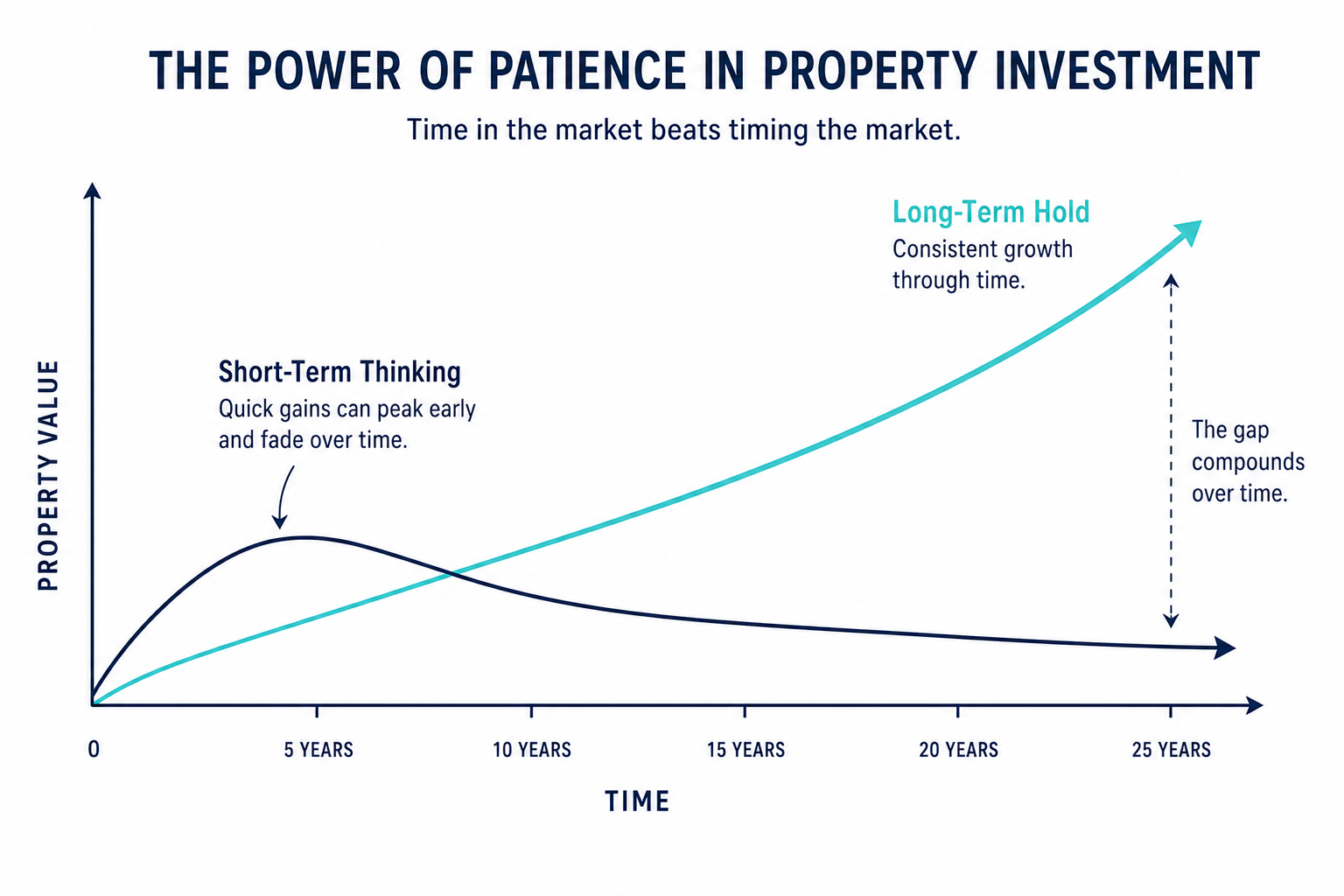
Property investment is not a short-term trade. The asset class rewards patience in a way that few others can replicate, because the combination of capital growth, rental income, equity release, and tax benefits compounds over time in ways that are difficult to achieve from cash or more liquid assets.
The national average total return on Australian residential property over the past 20 years — blending capital growth with rental income — has been approximately 477% according to Cotality's Hedonic Total Return Index. That is not a guaranteed future outcome, but it reflects the structural advantage of owning well-selected assets in a market with persistent undersupply, strong population growth, and a policy environment that has historically supported property values.
Patience matters because most of the value in a property investment is back-loaded. The first five years often look modest. The second five years typically see more meaningful equity growth. By year ten or fifteen, the combination of debt reduction, rental growth, and capital appreciation can dramatically change an investor's net position — provided the asset was well-selected and the portfolio was not disrupted by avoidable mistakes.
The cost of short-term thinking
Investors who exit too early, sell in response to short-term downturns, or hold assets selected without adequate research tend to underperform the market average. Transaction costs alone — stamp duty, agent commissions, and capital gains tax — are significant enough that a property typically needs a hold period of seven or more years just to neutralise them. Selling before that threshold rarely makes economic sense unless the asset is fundamentally flawed.
Short-term thinking also manifests in chasing the hottest market rather than buying for fundamentals. Markets that surge dramatically often attract speculation that distorts pricing. The investors who consistently build wealth tend to buy into markets before they peak — which requires research, patience, and the discipline to act when data supports it rather than when sentiment is already euphoric.
For investors building toward a multi-property portfolio, the compounding effect of holding through cycles is one of the most powerful forces available. Each property that grows in value increases the equity available to fund the next acquisition, creating a self-reinforcing cycle that accelerates as the portfolio matures.
Read More: The $700K Vs $1M Property Investment Strategy Which One Builds Wealth Faster In Australia
How to keep the plan realistic
A strategy that exists only on paper provides no real protection. The discipline is in returning to the plan regularly, testing it against current market conditions, and adjusting the inputs as your financial position evolves. Life changes — income grows, borrowing capacity shifts, risk appetite changes, family priorities adjust — and a good strategy accounts for that adaptability.
Data and professional advice are the two tools that keep a property plan grounded in reality rather than optimism. Market data from sources like CoreLogic, PropTrack, and the ABS provides the objective foundation for location decisions. A buyers agent or property advisor translates that data into decisions that fit your specific financial position and goals.
Using data to maintain discipline
The most common way property investors drift off strategy is by making decisions based on anecdote rather than evidence. A colleague mentions a suburb that "everyone is buying in." A vendor's agent presents urgency pressure at the inspection. An online forum champions a location based on incomplete analysis. Each of these inputs can override a sound plan if the investor hasn't built clear decision criteria in advance.
Clear criteria look like this: the property must meet a minimum gross yield threshold, be located in a suburb with population growth above a specified rate, have a vacancy rate below a defined level, and sit within a price range that keeps total debt-to-income at a manageable ratio. When a property meets those criteria, you buy. When it doesn't, you pass. Simple frameworks like this prevent emotion from overriding analysis.
The ABS reported the total value of Australian residential dwellings reached $11.366 trillion in the March 2025 quarter, an increase of $130.7 billion in a single quarter. That kind of structural wealth concentration in property means the market is unlikely to collapse dramatically, but it also means individual asset selection matters enormously within it.
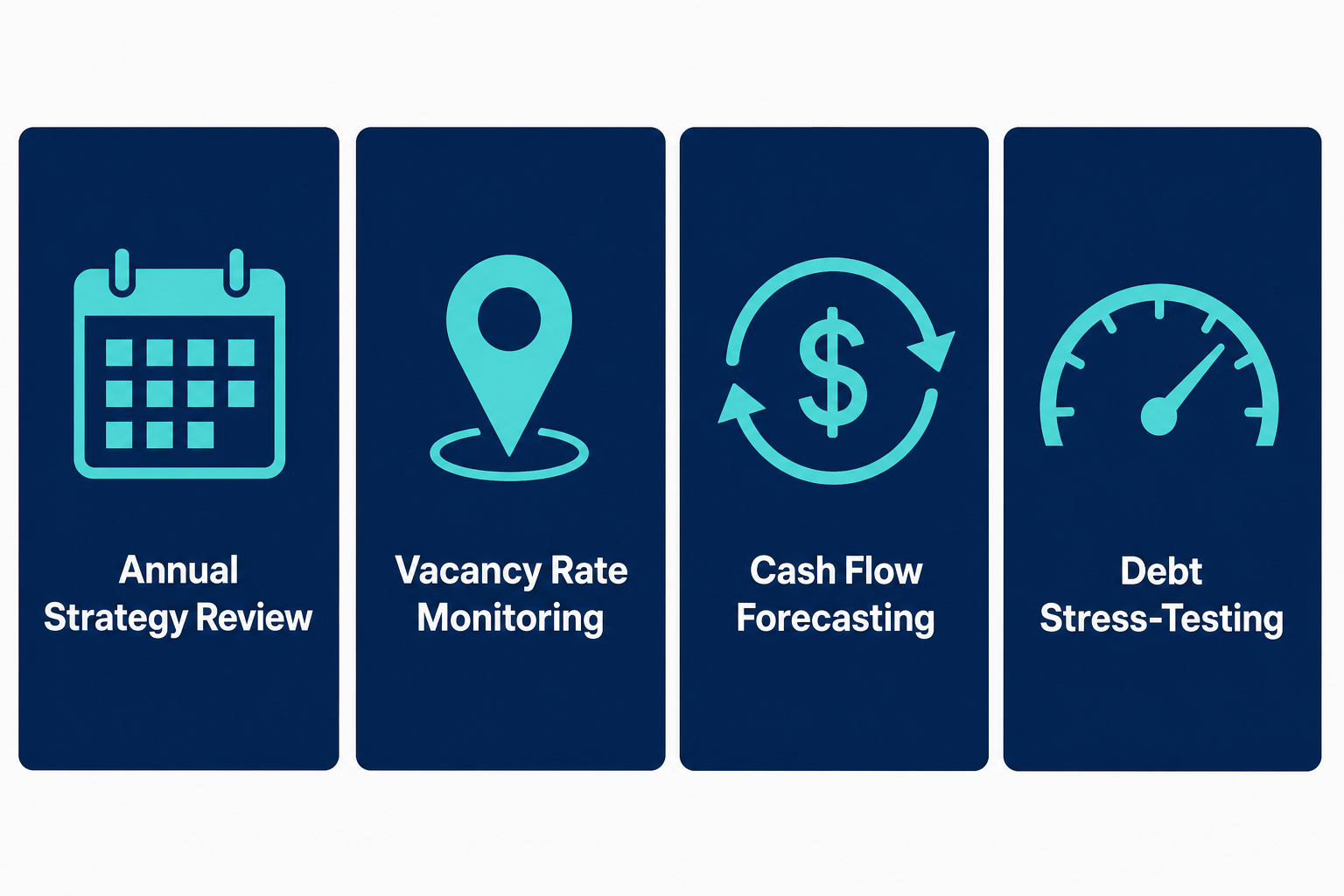
| Discipline Habit | Practical Application |
|---|---|
| Annual strategy review | Reassess borrowing capacity, portfolio performance, and acquisition targets each year |
| Vacancy rate monitoring | Track rental demand in target markets quarterly to validate location thesis |
| Cash flow forecasting | Model holding costs conservatively, assuming 5% vacancy and 0.5% interest rate increase |
| Independent due diligence | Commission building and pest inspections, independent valuations before every purchase |
| Debt stress-testing | Confirm serviceability under rate increase scenarios before each new acquisition |
Why professional guidance matters at each stage
Even experienced investors benefit from an independent perspective. The challenge with property decisions is that they are infrequent, high-value, and emotionally loaded — a combination that makes objective thinking difficult. A buyers agent who works through dozens of acquisitions each year brings a calibration that an individual investor simply cannot replicate from periodic personal experience.
Dragan Dimovski and the team at Buyers Agency Australia have built their process around exactly this principle: strategy-first, then search, then negotiation. That sequence keeps every acquisition accountable to the larger portfolio goal rather than becoming an isolated transaction. For investors wanting to see how this plays out in practice, the Brisbane property investment case study using 10-year modelling illustrates how structured thinking translates into measurable outcomes.
If you are building toward financial independence through property — whether that means a second acquisition, a third, or a fully passive income stream — getting the strategy right is where everything starts. Book a free strategy session with Buyers Agency Australia to map out your next property move with clarity and confidence.
Frequently Asked Questions
What is a property investment strategy?
A property investment strategy is a documented plan covering your financial goals, asset selection criteria, portfolio sequencing, risk tolerance, and target outcomes — so each purchase serves a clear purpose.
How many investment properties do I need to build wealth?
There is no fixed number. Two to three well-selected, high-growth properties held long-term can create significant wealth. Quality and sequencing matter more than quantity.
Should I prioritise capital growth or rental yield?
It depends on your financial position. Investors with strong income and equity often favour growth. Those with tighter cash flow benefit from yield-focused assets that support serviceability for future purchases.
How does a buyers agent support a property investment strategy?
A buyers agent provides independent property research, market data analysis, suburb selection, negotiation, and due diligence — keeping decisions aligned with your strategy rather than driven by vendor or agent pressure.
When should I review my property investment plan?
At minimum, annually. Also review after any significant life event — income change, new equity available, interest rate shifts — or when a target market shows a meaningful change in fundamentals.