
Suburb selection gets most of the attention in Australian property investment — but the investors who genuinely build wealth rarely credit a single postcode. What separates a thriving property portfolio from a stagnant one is almost always strategy: the decisions made before the search even begins. Structure, finance, risk tolerance, and long-term goals matter far more than whether you bought in Paddington or Parramatta.
Suburb Choice Is Only One Part of the Picture
Ask most Australian investors what drives property wealth and they'll point to location. And location does matter — but it is one input in a much larger equation. The real variables that determine whether an investment property succeeds over a decade are financing structure, entry timing relative to your own financial position, cash flow sustainability, and how each purchase fits the broader trajectory of your property portfolio.
Consider two investors entering the Brisbane market in the same year with the same suburb in mind. One has a carefully structured loan that preserves borrowing capacity for a second purchase within three years. The other maxes out their serviceability on a single asset and can't move again for seven years. Same suburb, very different outcomes. That difference has nothing to do with postcodes.
According to ABS and CoreLogic data, Australia's residential real estate market was valued at approximately $11.3 trillion as of mid-2025 — a market large enough to contain both excellent and poor investments within the very same street. The investors who navigate it well do so through disciplined planning, not lucky suburb picks.
Here's what the full picture actually includes:
| Strategic Factor | Why It Matters |
|---|---|
| Loan structure and serviceability | Determines how quickly you can buy again |
| Cash flow vs. capital growth balance | Affects holding power and portfolio scale |
| Entry price relative to market value | Impacts equity position from day one |
| Asset class and property type | Shapes risk profile and tenant demand |
| Tax position and ownership structure | Influences net return significantly |
A buyers agent for property investment who starts with strategy — rather than a property list — gives investors a genuine structural advantage that suburb research alone cannot replicate.
The Traps of Buying on Headlines
Property markets generate headlines the way stock markets do: momentum attracts attention, and attention fuels more momentum. By the time a suburb appears in a weekend magazine feature as the next hotspot, the sharpest investors have usually already bought, and the cycle is closer to its peak than its start.
Emotional and reactive buying is one of the most consistent wealth-destroyers in Australian real estate. Investors who chase the suburb of the moment often overpay at the top of a local cycle, stretch their finances to secure a property before prices rise further, and then find themselves holding a negatively geared asset with no capacity to buy again.
Fear of missing out is a real force in any property cycle. Investor lending as a share of total new loan commitments reached 40.6% in late 2025, a level not seen since December 2016 — and in heated markets, that kind of investor enthusiasm can compress yields and inflate entry prices faster than fundamentals justify.
Other common reactive traps include:
- Buying in a single market only because it is familiar, regardless of where the cycle sits
- Ignoring cash flow in favour of growth stories that may take a decade to materialise
- Selecting property type by trend rather than by what suits the local rental market
- Underestimating holding costs when making purchase decisions under time pressure
- Skipping due diligence on zoning, flood risk, and infrastructure plans because the suburb "feels right"
None of these mistakes are unique to inexperienced investors. Many sophisticated buyers make them when they skip the strategy layer and move straight to the search.
This is precisely why property investment advice that starts with your financial position — not a suburb shortlist — is so valuable at the consideration stage.
What a Real Strategy Includes
A genuine property investment strategy is not a summary of what suburb to buy in. It is a structured plan that connects your current financial position to a specific long-term wealth target, with every property decision mapped along that path.
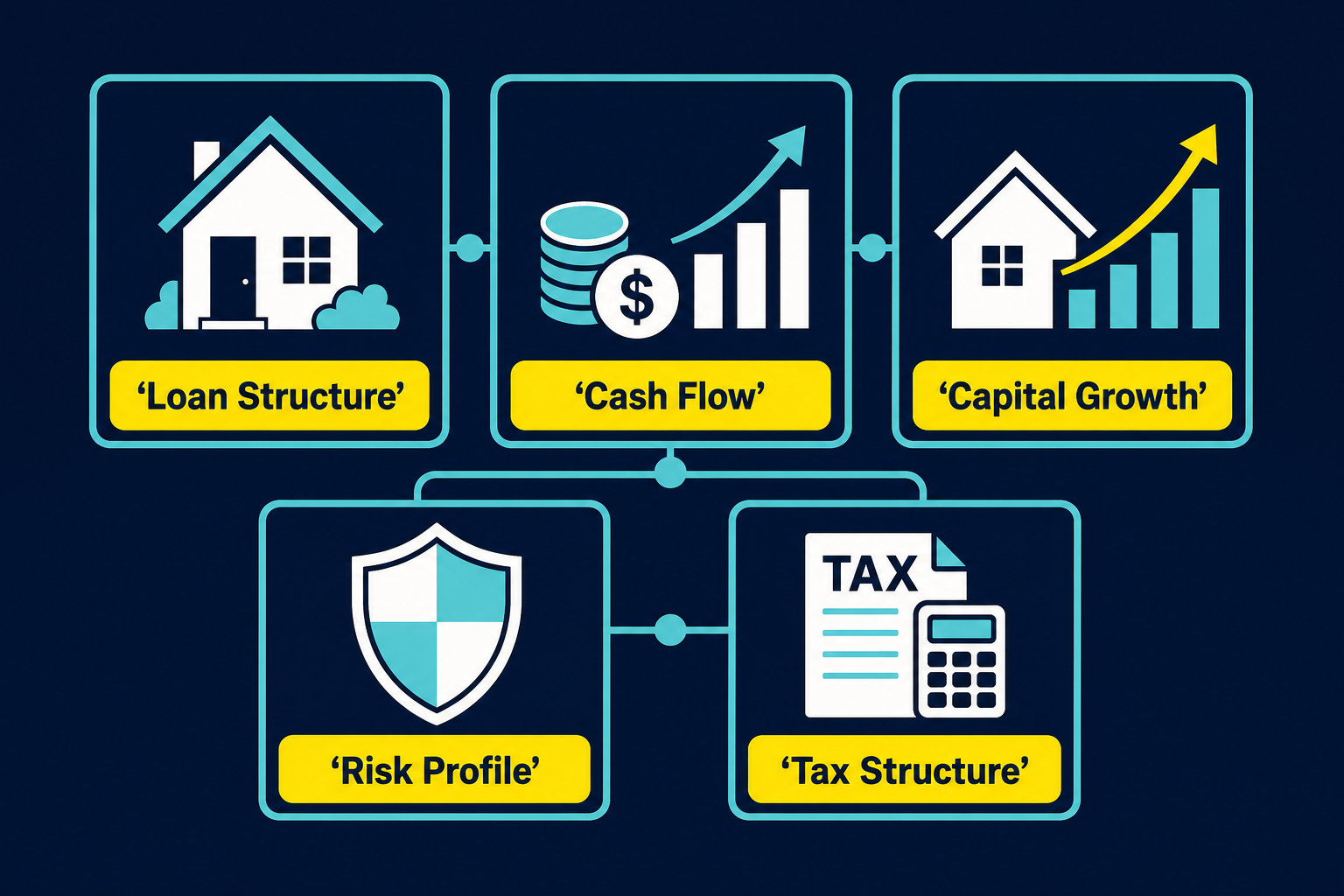
The core elements look like this:
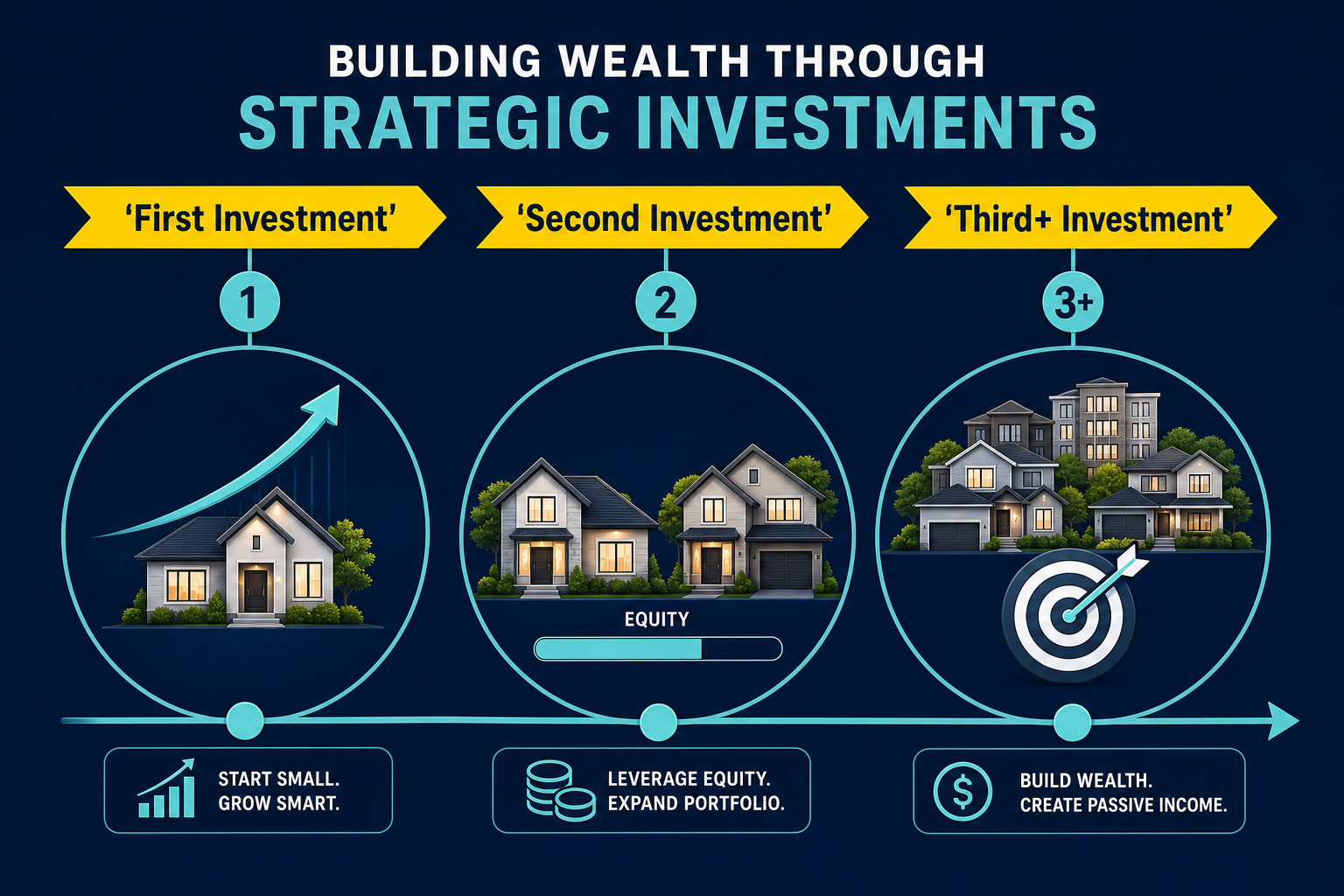
1. Portfolio stage and sequencing
Are you on your first investment, or building toward a third or fourth asset? The answer determines whether you should prioritise capital growth to build equity, or cash flow to maintain serviceability for your next move. Most investors need both across a portfolio — but the sequencing matters enormously. Understanding capital growth versus cash flow trade-offs is central to making that call intelligently.
2. Borrowing capacity and loan structure
Your borrowing capacity is not a fixed number — it shifts with lender policy, interest rate movements, and how your existing loans are structured. A smart strategy accounts for this and protects your ability to keep buying. How buyers agent fees compare to the cost of overpaying makes clear that financial structuring decisions at purchase have long compounding consequences.
3. Cash flow targets and holding sustainability
An investment property you cannot hold through a softening rental market or a vacancy period is a liability, not an asset. Strategy means knowing your cash flow floor — the minimum yield that keeps the property serviceable without eroding your lifestyle or derailing your next purchase.
4. Risk profile and timeline
A 35-year-old building toward early retirement has a very different risk tolerance than a 52-year-old looking to replace employment income within eight years. Strategy maps assets to timelines, not just to growth projections.
5. Tax structure and ownership entity
Negative gearing, depreciation schedules, and ownership structure — individual, joint, company, or trust — can dramatically shift the net return on any investment. This is a strategy question, not an afterthought.
Investors who build a thriving property portfolio from a clear plan rather than a reactive purchase sequence are far better positioned to reach their goals without unnecessary detours.
Here is a simple framework to think about strategic alignment:
| Investor Stage | Primary Focus | Secondary Focus |
|---|---|---|
| First investment | Borrowing capacity, entry price | Cash flow sustainability |
| Second investment | Equity access, serviceability | Capital growth potential |
| Third+ investment | Portfolio balance, risk management | Passive income targets |
How Buyers Agency Australia Approaches Planning
Buyers Agency Australia takes an approach that most buyers agents don't: every client engagement begins with financial modelling, not property searching. That difference is significant.
Dragan Dimovski, founder of Buyers Agency Australia and a property expert with 20+ years of hands-on investment experience, built his own successful portfolio using a methodology that starts with the end in mind. How much passive income does the client need? What does their balance sheet look like in ten years? What tax structures suit their situation? Only once those questions are answered does the property search begin.
This approach produces a ten-year portfolio model for each client — a living roadmap that shows which type of property to buy, in which sequence, and why. It accounts for cash flow, serviceability, expected capital growth, and risk tolerance at every stage. The model is updated as financial circumstances evolve, keeping the strategy current rather than static.
The practical outputs of this process include:
- A clear picture of how many properties are needed to reach a specific income or wealth target
- Identification of which markets suit each stage of the portfolio — growth-oriented capitals like Brisbane or cash flow-supportive regional markets
- Off-market access to investment-grade properties that most buyers never see
- Negotiation support that targets purchase prices below market value, preserving equity from settlement day
- End-to-end guidance from strategy session through to settlement, with ongoing support as the portfolio grows
This is why clients who have worked with Buyers Agency Australia frequently cite the clarity of the plan — not just the property secured — as the most valuable part of the service.
The team's work across Brisbane, Sydney, Melbourne, and national markets is backed by the kind of data-led research and agent relationships that take years to build. See how that plays out in practice through the Brisbane property investment case study using 10-year modelling, which shows exactly what structured planning looks like across a real investment horizon.
For investors wondering where the top property investment hotspots and strategies for 2026 sit, the starting point is always the same: get the strategy right first, then find the property that fits it.

Frequently Asked Questions
Is suburb selection still important in property investment?
Yes, but it follows strategy — not the other way around. A well-chosen suburb in the wrong portfolio context can still underperform relative to your goals.
What should a property investment strategy cover?
At minimum: your portfolio stage, borrowing capacity, cash flow targets, risk profile, timeline, and tax structure — before any property search begins.
How does cash flow fit into a long-term investment strategy?
Cash flow determines holding power and serviceability for future purchases. Without enough of it, even a great growth asset can force a poorly timed sale.
Can I buy interstate without having a clear strategy?
Technically yes, but the risks multiply significantly. Interstate buying without a strategic framework and local market intelligence is one of the most common sources of investor regret.
What is 10-year portfolio modelling?
It is a structured financial projection that maps out property acquisitions, equity growth, cash flow, and income targets across a decade — giving investors a clear plan rather than a series of ad hoc decisions.
Final Thoughts
A property investment strategy is not a luxury reserved for investors with large portfolios. It is the foundation that every first, second, and third purchase should be built on. Suburb selection matters — but it is a tactical decision that should always sit inside a clearly defined strategic framework.
The investors who build real, compounding wealth through Australian property are almost always the ones who planned before they searched. They knew their income targets, understood their borrowing position, sequenced their assets deliberately, and made suburb decisions as a result of strategy — not as a substitute for it.
If you are ready to build a portfolio with genuine structure behind it, book a free strategy session with Buyers Agency Australia and map out your next property move with confidence. Or contact the team to start the conversation today.