
Manufactured growth is a deliberate approach to building property equity through your own actions, not by waiting for the market cycle to do the work for you. It is one of the more powerful and widely misunderstood concepts in Australian property investing, and understanding it clearly can change the way you think about building a portfolio.
What manufactured growth means in property investing
Most investors are familiar with passive capital growth: you buy, you hold, and you trust that time and market forces will push values upward. That approach has worked well across many Australian cycles, and long-term property investment strategy still forms the backbone of most wealth-building plans.
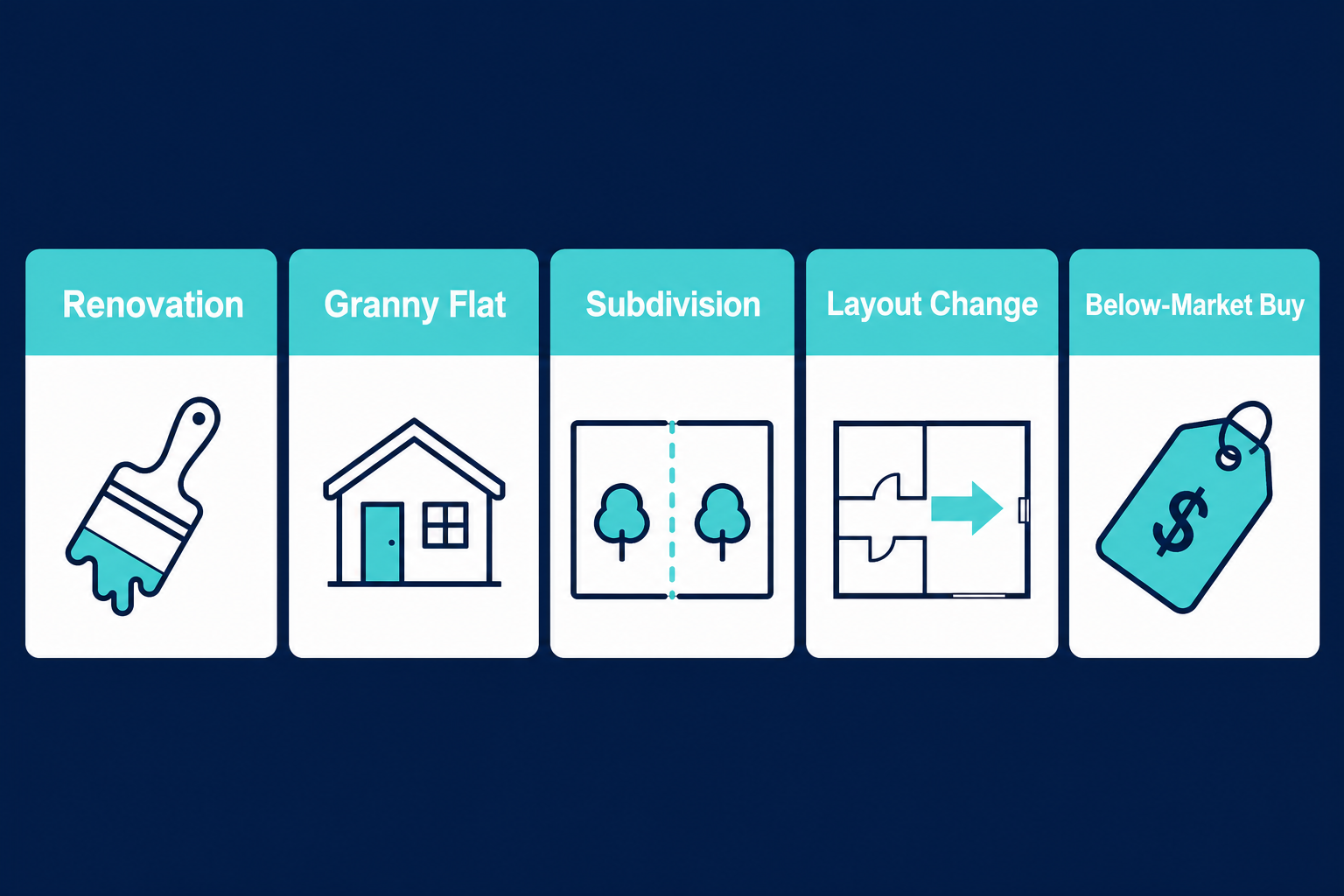
Manufactured growth, however, adds an active layer to that equation. The idea is that you take a property and increase its value through deliberate decisions, whether that is a structural improvement, a layout change, a secondary dwelling, or a smarter acquisition price in the first place. You are not sitting around hoping the suburb outperforms. You are taking specific steps to improve the asset's position relative to where you bought it.
The distinction matters because passive growth depends heavily on timing and market selection, both of which are outside your control. Manufactured growth gives investors a degree of influence over the outcome, within reason. That does not mean it is easy or risk-free, but it does mean the value creation is not purely a function of waiting.
According to the ABS Total Value of Dwellings data, the mean price of residential dwellings rose to $1,111,100 in the March quarter of 2026, reflecting continued national-level demand. Even within a rising market, investors who enter with a manufactured-growth mindset tend to build equity from a stronger starting position.
Buyers Agency Australia works with investors who want to go beyond hoping for market uplift. The goal is always to identify properties where there is a genuine angle, not just a story.
Common ways investors try to manufacture growth
There is no single method. The right approach depends on the property, the location, the zoning rules, and the investor's budget and capacity. Below are the most common tactics used across Australian markets.
Cosmetic and structural renovation
Renovation remains the most common entry point for manufactured growth. Kitchens, bathrooms, flooring, and landscaping can meaningfully lift a property's market appeal and rental yield without a full structural overhaul. Older homes, deceased estates, and neglected properties often carry the most upside because they are typically priced below their potential.
NAB data shows renovation lending rose 21% in 2025, outpacing growth from the two prior years. Investors are clearly leaning into value-add renovation as a deliberate strategy, not just a cosmetic preference.
The catch with renovation is overcapitalisation. Spending $120,000 on a suburb where comparable properties cap out at a certain valuation does not produce equity; it produces a loss. The numbers have to be stress-tested before any work begins.
Granny flats and secondary dwellings
Adding a compliant granny flat or self-contained secondary dwelling is one of the more efficient manufactured-growth plays available to Australian investors. Research by InvestorKit shows that adding a granny flat can increase a property's overall rental yield by 1.4 to 1.65 percentage points compared to similar homes without one. In a rental market where vacancy rates nationally sit near 1.7%, that income uplift is significant.
Typical build costs range from $100,000 to $200,000 for a self-contained secondary dwelling, with achievable rents of $400 to $600 per week in many metropolitan areas. Granny flat builds are expected to grow substantially through 2026, with the Housing Industry Association tracking surging demand particularly in Sydney and Perth.
Rules differ by state and council, so understanding what is permissible under local planning controls before purchasing a site is non-negotiable. This is an area where understanding how buyers agents find off-market properties gives serious investors a real edge, because suitable sites are rarely listed with their potential clearly stated.
Subdivision
Subdivision involves splitting a block into two or more separate titles, either to sell one portion or develop both. In growth corridors where zoning supports increased density, the land value uplift from a clean subdivision can be substantial. Buying properties with existing Development Approval, or sites with clear rezoning potential, can create meaningful value without significant construction.
This approach carries more complexity: council approval timelines, infrastructure contributions, holding costs, and builder availability all affect outcomes. It is not a strategy for the impatient or undercapitalised.
Layout and floor plan improvements
Not all manufactured growth requires a hammer. Converting a three-bedroom house to a four-bedroom layout by reconfiguring underused space, or adding a home office or second bathroom, can shift a property into a higher comparable bracket at relatively modest cost. These improvements often lift rental yield and broaden the buyer pool at resale, both of which support valuation.
Strategic acquisition price
Buying below intrinsic value is itself a form of manufactured growth, because you enter the market with an immediate equity buffer rather than paying at the ceiling. Sourcing properties with genuine motivated sellers, deceased estates, or off-market conditions often allows a purchase at a price below what an arms-length open-market transaction would produce.
This is one reason off-market property access is so central to a value-add approach. If you start at a fair price, your manufactured growth needs to do all the heavy lifting. If you start below fair value, you already have a margin of safety.
| Manufactured Growth Tactic | Typical Investor Skill Required | Timeframe | Key Risk |
|---|---|---|---|
| Cosmetic renovation | Low to moderate | 2-6 months | Overcapitalisation |
| Granny flat addition | Moderate | 3-9 months | Council approval, cost blowout |
| Subdivision | High | 12-36 months | Approval delays, holding costs |
| Layout improvement | Low to moderate | 1-4 months | Limited valuation uplift |
| Strategic below-market acquisition | Moderate (sourcing) | At purchase | Limited supply of suitable sites |
How manufactured growth can support a long-term portfolio plan
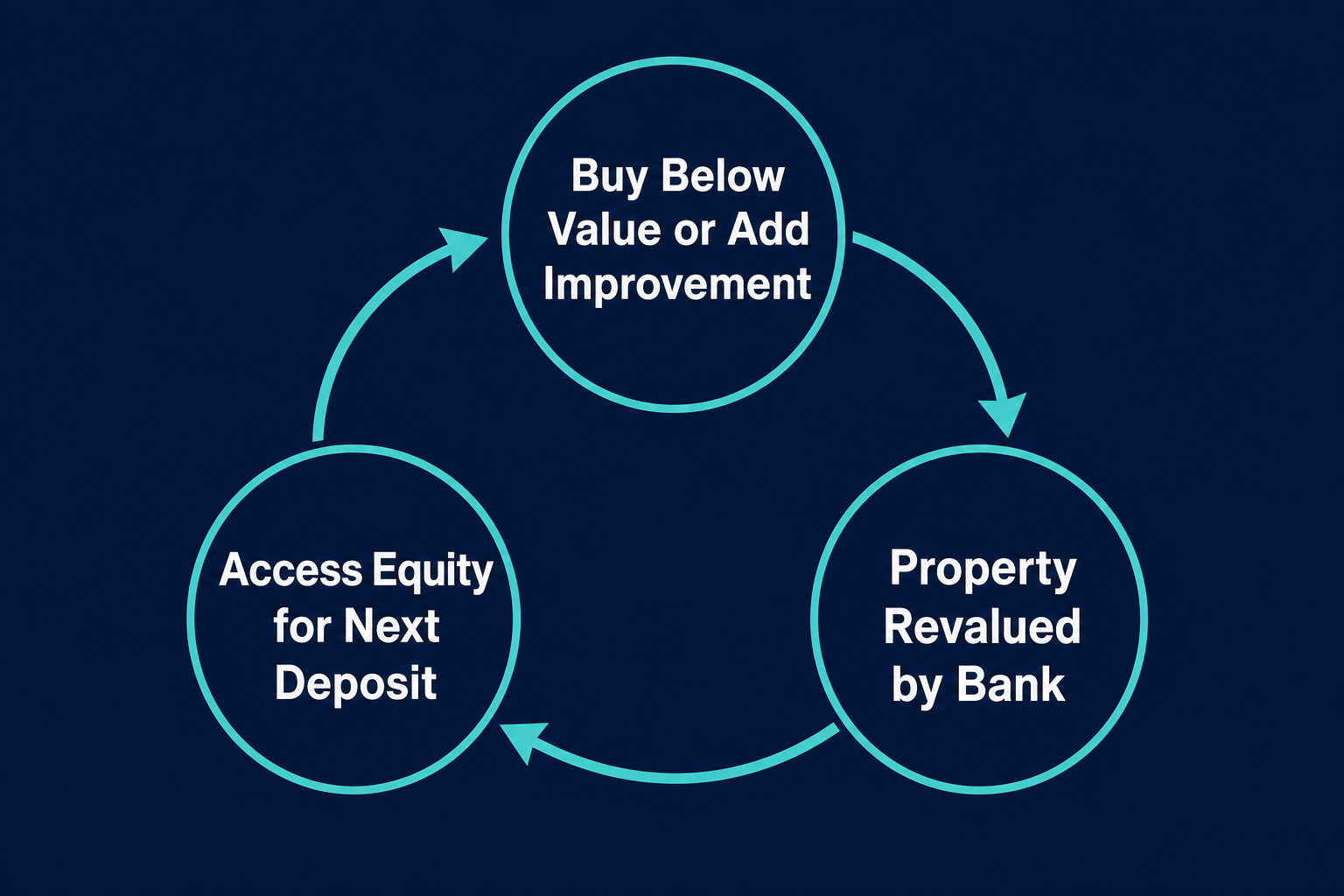
The core appeal of manufactured growth within a property portfolio strategy is that it may compress the timeline to meaningful equity. Rather than waiting five to seven years for a market cycle to produce a revaluable equity position, a well-executed value-add play can potentially create usable equity in a shorter window.
That equity, once accessible through refinancing, becomes the deposit or security for the next acquisition. This is the mechanism through which investors build multiple properties without always needing to save additional cash deposits from scratch. How property investors use equity to buy multiple properties explains this mechanic in detail.
Manufactured growth works best as a complement to sound market selection, not a substitute for it. A well-located property with genuine demand drivers and a manufactured-growth angle is significantly stronger than either approach used alone. A poorly located property with a granny flat attached is still a poorly located property.
The broader context matters here. Investment property advice consistently shows that market selection underpins long-term performance. Manufactured growth is the accelerant, not the engine.
The risks, trade-offs, and due diligence steps
Manufactured growth strategies carry real costs and real risks. Understanding them honestly is part of making a sound decision.
Cost blowout risk: Construction quotes frequently come in higher than anticipated, and materials cost pressures have remained elevated. ABS Producer Price Index data shows building construction prices rose 4.2% in the year to March 2026. Renovation and construction budgets should include a contingency of at least 15 to 20%.
Holding cost risk: Subdivision and development projects can run for 12 to 36 months. During that period, you are servicing debt without necessarily receiving the uplift. If interest rates move adversely or rental income drops, the holding burden increases.
Execution risk: Finding reliable builders, contractors, and certifiers who deliver on time and on budget is genuinely hard in a competitive construction market. One delayed approval or a builder substituting cheaper materials can erode projected margins.
Valuation risk: Banks assess value on comparable sales. If comparable sales in the area do not support the improved valuation, refinancing to access manufactured equity may not go as planned.
Planning and zoning risk: State and local planning rules are not static. What is permissible under today's controls may be subject to change, and council decisions can significantly affect timelines and feasibility.
Due diligence before committing to a manufactured-growth strategy should include:
- Independent feasibility analysis (not a builder's estimate)
- Comparable sales research to confirm ceiling values
- Pre-purchase planning advice from a qualified certifier or town planner
- Confirmation of council requirements, infrastructure contributions, and approval timelines
- Stress-testing the project against a 15 to 20% cost increase and a six-month delay
A thorough property investment due diligence checklist covers many of these steps across the acquisition process.
| Due Diligence Step | Why It Matters |
|---|---|
| Independent feasibility study | Avoids relying on builder or agent projections |
| Comparable sales ceiling analysis | Confirms that uplift will be recognised by the market |
| Pre-purchase planning advice | Confirms feasibility before exchange |
| Cost contingency modelling | Protects against the most common failure point |
| Holding cost stress test | Validates cashflow resilience during the project |
When manufactured growth may suit an Australian investor
Manufactured growth is not the right approach for every investor or every budget. There are scenarios where it makes genuine sense and others where the complexity outweighs the return.
It may suit investors who:
- Have solid borrowing capacity and a cash buffer for construction contingencies
- Are in a position to hold for at least two to three years beyond the project completion
- Can access suitable sites (often off-market) where the improvement upside has not already been priced in
- Have a clear, specific plan rather than a vague aspiration to "add value"
- Are working with an experienced buyers agent and professional team who have done this type of project before
It may be less suitable for investors who:
- Are stretching serviceability to make the purchase work in the first place
- Have limited time or capacity to manage a construction project remotely
- Are looking at a location where comparable improvements have already been absorbed into the market pricing
- Are relying on the manufactured growth to make an otherwise marginal deal viable
The question is not whether manufactured growth sounds attractive in principle. The question is whether the specific property, in the specific location, with the specific improvement plan, produces a margin of safety that justifies the execution risk. That is a data question, not an enthusiasm question.
For investors considering Brisbane, Adelaide, or other outperforming markets, it is worth looking at current property investment hotspots and strategies for 2026 to understand which locations currently present the strongest combined fundamentals.
How a buyers agent can help assess opportunities
Identifying a manufactured-growth opportunity is not straightforward. The properties with genuine upside are rarely sitting on portals at obvious prices with a sign saying "renovate me." They are in off-market networks, vendor-distressed situations, and estates that a well-connected buyers agent sees before the general public does.
Dragan Dimovski, founder of Buyers Agency Australia and a property expert with 20+ years of experience, has built a practice specifically around finding investment-grade properties where the numbers genuinely stack up. That includes sites where a manufactured-growth angle exists, but only when the entry price, location, and improvement plan are all aligned.
The buyers agent's role in a manufactured-growth strategy goes well beyond finding a property. It includes:
- Identifying sites where the improvement potential has not been priced in by the vendor
- Running an independent feasibility check before any offer is made
- Negotiating the acquisition price to create a margin of safety for the project
- Coordinating due diligence with planners, valuers, and building inspectors
- Advising on whether a specific tactic (granny flat versus subdivision versus renovation) matches the investor's capacity, timeline, and broader strategy
Buyers Agency Australia focuses exclusively on the buyer's side and takes no commissions from selling agents or developers. That independence matters when you are relying on someone to tell you honestly whether the numbers work or not.
If you are thinking about a manufactured-growth approach as part of your next acquisition, the best starting point is a structured conversation about your current position, what you can actually build on, and which markets have the right conditions right now. You can book a free strategy session to map out your next move with the team.

Frequently asked questions
What does manufactured growth mean in property?
Manufactured growth means actively increasing a property's value through deliberate improvements or strategic acquisition, rather than relying purely on market-driven capital growth over time.
Is manufactured growth the same as renovating a property?
Renovation is one method, but manufactured growth also includes granny flats, subdivision, layout changes, and buying below market value. Renovation is the entry point; manufactured growth is the broader strategy.
How long does it take to manufacture equity in a property?
Timelines vary. A cosmetic renovation may take two to six months. A granny flat addition typically takes three to nine months. A subdivision project can run 12 to 36 months depending on approval timelines and build complexity.
What are the main risks of a manufactured-growth strategy?
The main risks are cost blowouts, approval delays, valuation shortfalls, and holding cost pressure during construction. A thorough feasibility study and contingency buffer are essential before committing.
Can a buyers agent help with manufactured-growth property selection?
Yes. A buyers agent with investment expertise can identify off-market sites with genuine upside, run independent feasibility checks, negotiate entry price, and coordinate due diligence across the full process.
Manufactured growth works best when the entry is smart, the plan is specific, and the execution team is credible. It is not a shortcut, but it is a legitimate way to build equity faster when the conditions are right. If you want guidance on whether it fits your portfolio, contact the team at Buyers Agency Australia to get an honest assessment of your options.