
Understanding SMSF property investment rules is one of the most important steps any Australian investor can take before acting. The rules are specific, the ATO's enforcement is firm, and the cost of getting it wrong can far outweigh any tax advantage gained. This guide explains the core framework clearly so you can make informed decisions.
Important: This article contains general information only and does not constitute personal financial, legal, or tax advice. Always consult a licensed financial adviser, SMSF specialist, and solicitor before proceeding with any SMSF property strategy.
What SMSF property investment rules mean in Australia in 2026
Australia's self-managed super fund sector has grown substantially. According to the ATO's December 2025 quarterly SMSF statistical report, there are now 663,867 SMSFs holding an estimated $1.06 trillion in assets across more than 1.2 million members. That scale reflects genuine demand for control over retirement savings, and property sits at the centre of many investors' thinking.
Buying property through an SMSF is permitted under Australian superannuation law, but the framework that governs it is tightly defined. The Superannuation Industry (Supervision) Act 1993 (SIS Act) and related ATO rulings set strict boundaries around how property can be acquired, held, and used within a fund. These rules exist to protect the integrity of the retirement system and to ensure that super assets are not misused for personal benefit before retirement.
The foundational principle is the sole purpose test. Under section 62 of the SIS Act, every investment decision an SMSF makes must be directed at providing retirement benefits to fund members, not current personal benefit to trustees, members, or their related parties. That single test underpins every rule discussed in this guide.
For Australian property investors thinking about property investment strategy within a super structure, understanding this framework at a high level is the essential starting point before speaking with any licensed adviser.
Who an SMSF property strategy may suit
Not every investor benefits from buying property through super. The structure tends to suit a specific profile: typically, investors who already have a meaningful SMSF balance, a long investment horizon, and the discipline to manage compliance obligations over time.
Common suitability indicators include:
- A fund balance generally above $200,000 to $500,000, where annual compliance costs represent a smaller proportion of returns
- Members who are more than a decade from retirement, allowing capital growth to compound inside the concessional tax environment
- Business owners looking to hold commercial premises through their SMSF and lease the property back to their business at market rates (one of the few related-party exceptions permitted under the rules)
- Investors who want direct control over asset selection and are prepared to meet trustee obligations, including annual audits and ATO reporting
According to ATO statistics for 2023-24, the average SMSF held $1.63 million in assets, up 29% over the prior five years. That average masks a wide distribution, and investors with smaller balances should weigh annual administration costs carefully before committing to a property acquisition structure.
SMSF property is not suited to everyone. Investors who need liquidity flexibility, who are close to the pension phase, or who have limited super balances may find that direct property significantly reduces their fund's ability to meet drawdown obligations. This is an area where professional investment property advice is genuinely valuable before any structure is chosen.
Core rules to understand before buying property through an SMSF
The compliance framework for SMSF property investment covers several distinct areas. Each one carries real consequences if misunderstood.
The sole purpose test
As noted above, every SMSF investment must satisfy the sole purpose test. In practical terms for property, this means no fund member or related party can live in, holiday in, or use an SMSF-owned residential property in any way before retirement. The ATO is unambiguous on this point. Even allowing a family member to stay for a weekend at no charge can constitute a breach.
Limited Recourse Borrowing Arrangements (LRBAs)
An SMSF cannot use a standard residential mortgage to purchase property. If the fund needs to borrow, it must do so through a Limited Recourse Borrowing Arrangement. Under an LRBA structure, the property is held in a separate bare trust until the loan is fully repaid, at which point legal title transfers to the SMSF. The "limited recourse" element means that if the fund defaults, the lender can only recover the property itself, not other fund assets.
Key LRBA rules to understand:
- One property per LRBA; each acquisition requires a separate bare trust
- Borrowed funds cannot be used to improve the property, only to acquire it (maintenance costs can be paid from fund income, but structural improvements that change the property's character are not permitted under borrowed funds)
- The bare trustee entity must be separate from the SMSF trustee, and the bare trust deed must be executed before or on the settlement date
- Related-party loans under an LRBA must meet the ATO's safe harbour terms under PCG 2016/5 to avoid non-arm's length income (NALI) penalties
Related-party acquisition restrictions
An SMSF generally cannot purchase residential property from a related party. Business real property (commercial premises used wholly and exclusively in a business) is one of the few exceptions, and even then, the transaction must occur at market value and on arm's length terms.
In-house asset rules
No more than 5% of an SMSF's total assets can be invested in related-party assets. This rule has direct implications for any arrangement where the fund's property intersects with a trustee's business or personal interests.
Tax treatment
Rental income received by an SMSF is taxed at 15%, compared to up to 47% at an individual's marginal rate. Capital gains on property held for more than 12 months are taxed at 10% within the fund. In pension phase, where the fund is paying retirement income streams, both rental income and capital gains may attract 0% tax, subject to the member's transfer balance cap (currently $2 million for the 2025-26 financial year, rising to $2.1 million from 1 July 2026).
For context on how recent tax policy changes may affect overall property investment strategy, it is worth reviewing the 2026 budget implications alongside your adviser.
| Rule Area | Key Requirement |
|---|---|
| Sole purpose test | Property held for retirement benefit only; no personal use by members or related parties |
| LRBA structure | Separate bare trust required; one asset per arrangement; no borrowing to improve |
| Related-party purchases | Residential property generally cannot be bought from a related party |
| In-house asset limit | No more than 5% of fund assets in related-party assets |
| Annual compliance | Independent audit, ATO annual return, documented investment strategy required |
Common compliance mistakes to avoid
Most SMSF property breaches are not the result of deliberate rule-breaking. They typically arise from misunderstanding the rules or acting on incomplete advice. The consequences, however, can be severe: the ATO can declare a fund non-complying, resulting in the fund's assets being taxed at 45% rather than 15%.
Mistakes that regularly attract ATO attention:
- Incorrect bare trust setup: Using the same company as both the SMSF trustee and the bare trustee invalidates the LRBA structure. Setting up the bare trust after settlement rather than before or on the settlement date is another structural flaw that creates significant compliance risk.
- Personal use of residential property: Any use of the property by a member, family member, or related party, regardless of how brief, can breach the sole purpose test. The ATO is specific on this, and the risk does not diminish simply because the use seems trivial.
- Related-party loan terms not at arm's length: If the fund uses a related-party loan under an LRBA and does not apply the ATO's safe harbour interest rates, the income generated from that arrangement can be reclassified as non-arm's length income and taxed at the top marginal rate.
- Borrowing to renovate: Borrowed funds under an LRBA cannot be used to improve the property. Renovations that change the property's fundamental character must be funded from the fund's own cash, and even then the rules around what constitutes an "improvement" require careful interpretation.
- No documented investment strategy: Every SMSF must maintain a written investment strategy that accounts for liquidity, diversification, risk, and the fund's retirement objectives. Acquiring property without updating this document is a compliance failure in itself.
For a broader view of mistakes investors commonly make in the Australian property market, the property investment mistakes Australians are making in 2026 covers both SMSF and non-SMSF scenarios worth reviewing.
Property types and asset-selection considerations
The type of property an SMSF can hold matters as much as the structure itself. Understanding the differences between residential and commercial property within a super environment is part of any sound property investment strategy.
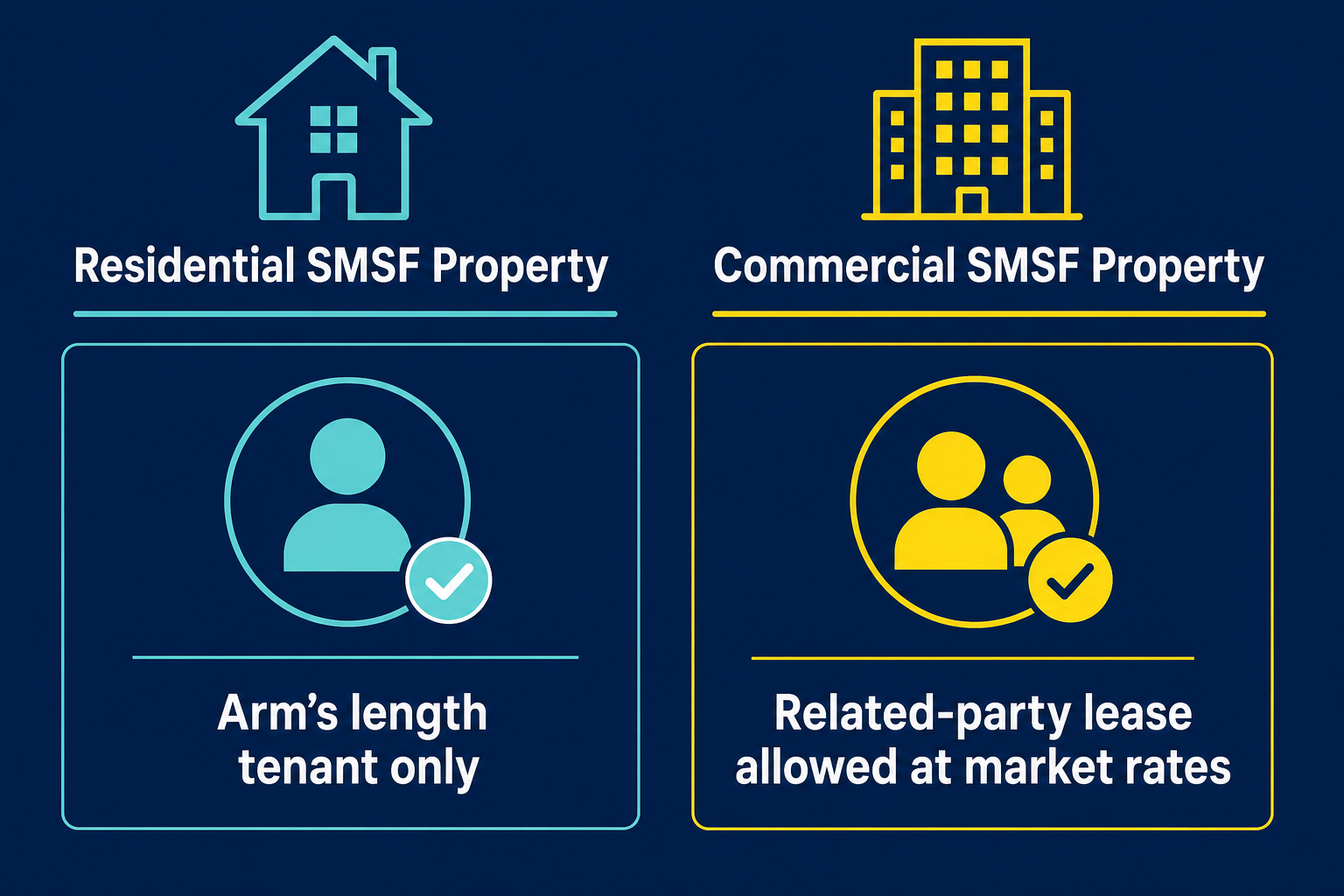
Residential property is the most commonly considered option for SMSF investors. The key constraint is that the property cannot be leased to any related party and must not be used personally by any fund member or their relatives. It must produce genuine rental income from an arm's length tenant at market rates.
Commercial property (business real property) offers more flexibility in one important respect: the fund can lease commercial premises to a related party, including a trustee's own business, provided the lease is at market rates and documented properly. This is a common and legitimate use case for small business owners who want to hold their business premises inside super.
From an asset-selection standpoint, the considerations that apply to any property due diligence process remain relevant inside an SMSF: location quality, rental yield, vacancy risk, liquidity, and capital growth potential. The difference is that within a super fund, an illiquid or underperforming property can create pressure on the fund's ability to meet pension obligations, especially as members approach retirement.
Geographic diversification matters too. Concentrating a fund's entire property allocation in a single asset in a single market increases risk in ways that standard portfolio theory would caution against. Investors researching where Australian property markets are heading in 2026 can read where investors should focus in 2026 for current market context.
Dragan Dimovski, founder of Buyers Agency Australia with 20+ years of property experience, consistently notes that asset selection within an SMSF requires even more discipline than standard investment property acquisition, because the margin for error is narrower when the asset is inside a regulated retirement structure.
Step-by-step checklist before acting
Before taking any steps toward purchasing property through an SMSF, working through a structured pre-purchase checklist reduces the risk of costly errors.
Pre-purchase SMSF property checklist:
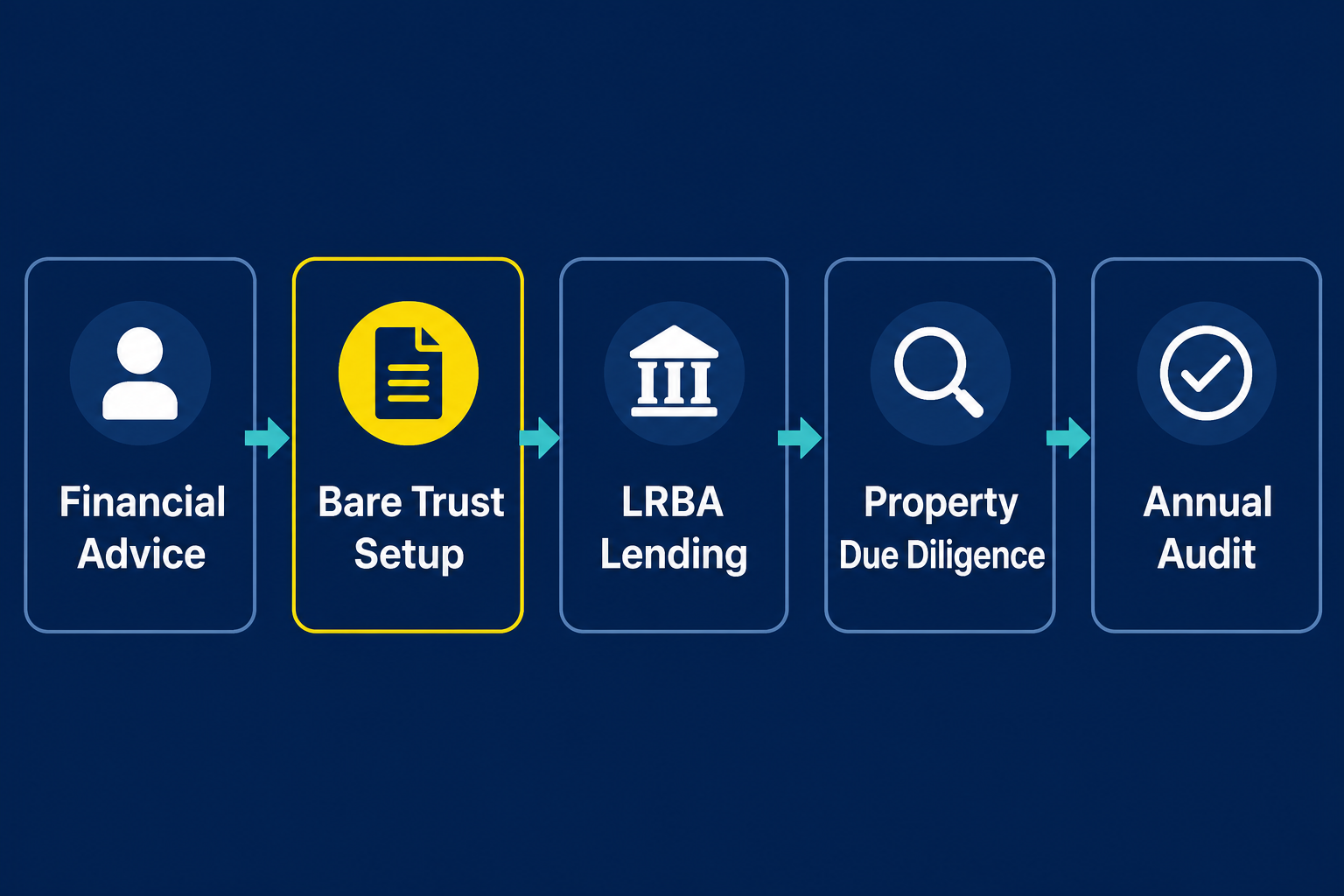
- Obtain personal financial advice from a licensed financial adviser who specialises in SMSF structures
- Confirm your fund's current balance and whether it is sufficient to support a property purchase without creating liquidity risk
- Review and update the fund's written investment strategy to reflect the intended acquisition
- Engage a specialist SMSF solicitor to establish the bare trust structure before exchanging contracts
- Confirm the property meets the sole purpose test and is not connected to any related-party arrangement that would breach the rules
- Check whether LRBA lending is required and engage a lender familiar with SMSF loan products (the SMSF lending market is significantly smaller than the standard residential mortgage market)
- If using a related-party loan, confirm the interest rate and loan terms are consistent with the ATO's safe harbour guidelines under PCG 2016/5
- Commission an independent property valuation to confirm the purchase price reflects market value
- Complete thorough property due diligence covering building and pest inspections, title searches, zoning, and rental comparables
- Confirm the fund's annual compliance obligations, including independent audit requirements, are clearly understood before settlement
For investors wanting a broader step-by-step framework for property acquisition, the guide to buying an investment property in Australia covers the full purchase process in detail.
| Pre-Purchase Stage | Key Action |
|---|---|
| Financial advice | Engage a licensed SMSF financial adviser |
| Legal structure | Set up bare trust before contract exchange |
| Lending | Confirm LRBA eligibility and lender options |
| Property selection | Conduct full due diligence and independent valuation |
| Compliance review | Update investment strategy; confirm audit obligations |
When to speak with an adviser
SMSF property is not a structure that rewards a DIY approach. The complexity of the rules, the volume of compliance obligations, and the severity of potential penalties mean that specialist advice is not optional: it is part of the process.
You should speak with a licensed professional before acting if:
- You are considering establishing an SMSF for the specific purpose of buying property
- Your existing SMSF does not currently hold property and you are evaluating whether to add it
- You are close to retirement or in the pension phase, where liquidity demands increase
- You are a business owner considering using an SMSF to hold commercial premises
- You have received a sales pitch from a property promoter encouraging an SMSF purchase without first directing you to a licensed financial adviser
The advice team you need typically includes three professionals: a licensed financial adviser who holds an SMSF authorisation, an SMSF specialist solicitor for trust structure and conveyancing, and a qualified tax agent or accountant familiar with SIS Act compliance. Each plays a distinct role, and gaps in any one area tend to create the structural problems that attract ATO scrutiny later.
At Buyers Agency Australia, the team works alongside investors who have already taken those advice steps and are ready to focus on what the property search and acquisition process actually looks like: which markets, which property types, and how to secure the right asset on the right terms. That is where a specialist buyer's agent adds genuine value within the SMSF process.
If you have done the groundwork with your advisers and are ready to map out your property strategy, book a free strategy session to talk through your situation with the Buyers Agency Australia team.

Frequently Asked Questions
Can I live in a property my SMSF owns before I retire?
No. Residential property owned by your SMSF cannot be occupied by any fund member or related party at any point before retirement. Doing so breaches the sole purpose test.
Can my SMSF buy a property from a family member?
Generally no. Residential property cannot be acquired from a related party. Business real property is a limited exception, provided the transaction is at market value and on arm's length terms.
What happens if my SMSF breaches the compliance rules?
The ATO can declare the fund non-complying, which means fund assets are taxed at 45% instead of 15%. Administrative penalties and civil or criminal liability are also possible in serious cases.
How much do I need in my SMSF before buying property makes sense?
Most specialists suggest a minimum balance of $200,000 to $500,000 before property is cost-effective inside super, as annual compliance costs can erode returns in smaller funds.
Do I need a buyer's agent when buying property through an SMSF?
A buyer's agent is not legally required, but engaging one for investment property advice and asset selection can significantly improve the quality of the acquisition, particularly for investors purchasing in unfamiliar markets.
SMSF property investing remains a genuine strategy for the right investor profile in 2026. But it demands structured advice, careful asset selection, and a clear understanding of rules that have real compliance consequences. When you are ready to move beyond the research stage, contact the team at Buyers Agency Australia to discuss how a specialist buyer's agent can support your property acquisition within a compliant, strategy-led approach.