
Brisbane's 2026 property market remains one of Australia's strongest performers, but the conditions have shifted enough that investors need a sharper lens than the broad headlines suggest. Population growth, tight supply, and Olympic-era infrastructure all remain in play, yet rising interest rates and affordability pressure mean suburb selection and portfolio fit matter more than ever.
Brisbane property outlook for 2026
Anyone tracking the Brisbane market closely knows this is no longer the underdog story it was in 2020. Median dwelling values hit $1,116,180 in April 2026 according to Cotality data, representing annual growth of 19.7 per cent that comfortably outpaces every other major capital city. That pace is moderating, but the direction has not reversed.
Bank forecasts for full-year 2026 growth range from roughly 4.4 per cent (NAB, Queensland-wide) to 12 per cent (CBA), a span that reflects genuine uncertainty about how far the current rate-hiking cycle will travel. ANZ sits at 9.7 per cent, while Westpac adopts a more measured 7 per cent view. The spread matters: investors should plan around a moderate-case outcome rather than the optimistic end.
The most useful framing is not whether Brisbane is rising, but whether growth is broad or selective. The April 2026 data shows Brisbane's southern and south-western corridors leading on annual gains, while the auction clearance rate dipped to 48.8 per cent in recent weeks, signalling that buyers are applying more price discipline even as listings remain constrained. Understanding which parts of Australia's two-speed property market are actually moving is the first question serious investors should ask before committing to a Brisbane purchase.
| Bank / Research House | Brisbane 2026 Price Forecast |
|---|---|
| CBA | +12.0% |
| ANZ | +9.7% |
| KPMG | +9.3% (houses +10.9%, units +7.8%) |
| Westpac | +7.0% |
| NAB | +4.4% (Queensland-wide) |
Sources: Major bank economic research desks and KPMG Australia, 2026.
What is driving Brisbane's investment appeal?
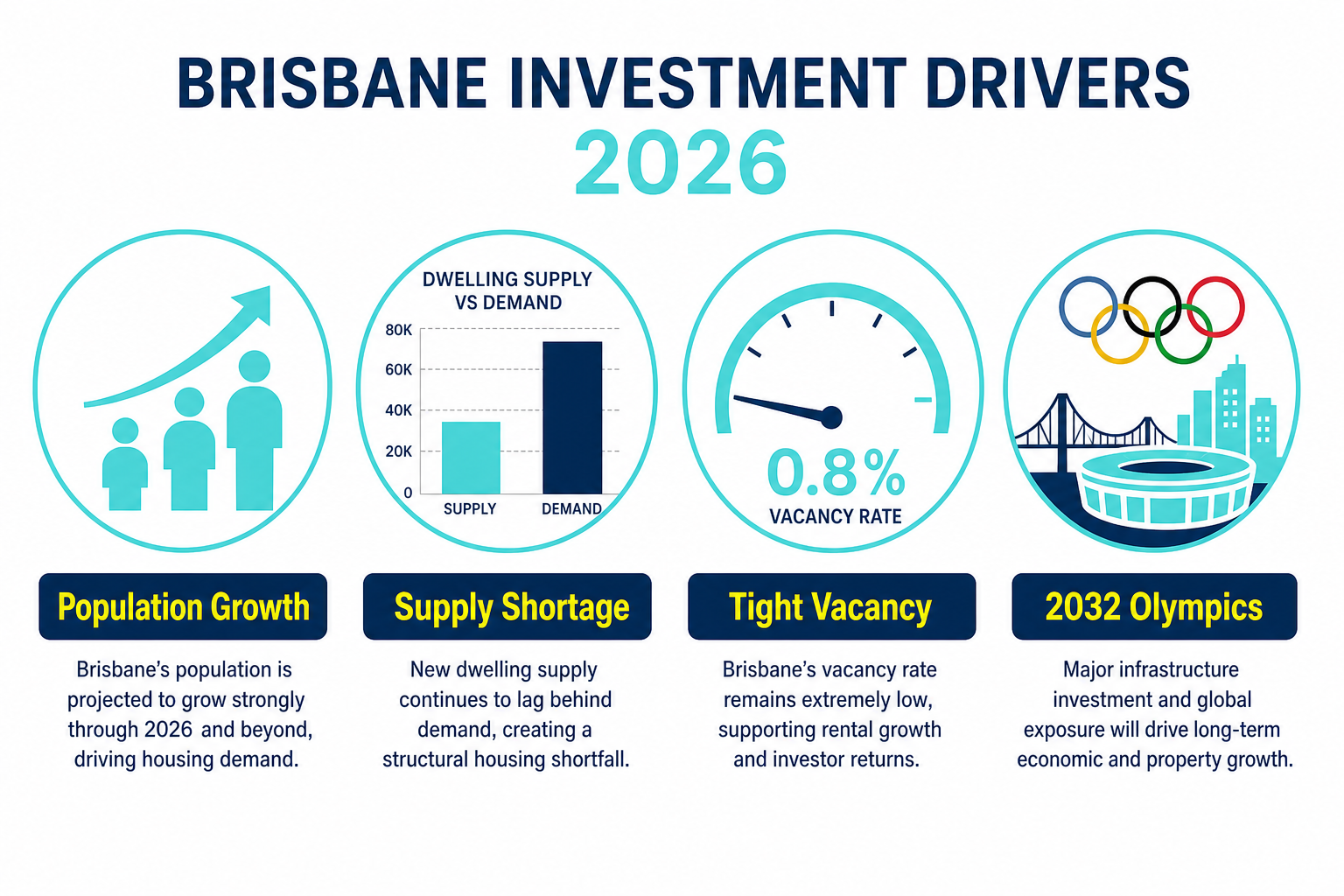
Four structural forces continue to make Brisbane a credible investment destination for portfolio-focused buyers.
Population growth and migration. Greater Brisbane added 58,200 residents in 2024-25, a 2.1 per cent population growth rate that ranked second nationally behind Perth, according to ABS Centre for Population data. Of those arrivals, 33,900 came from overseas migration and 11,100 from interstate, predominantly from NSW. The Centre for Population projects Greater Brisbane to add around 44,000 people in 2026-27, sustaining pressure on a housing stock that is not keeping pace.
Structural undersupply. CBRE forecasts just 3,100 new inner-city dwellings per year from 2026 to 2031, a fraction of what demand implies. Construction costs are up substantially over five years, builder insolvencies continue to restrict the pipeline, and Queensland dwelling approvals have been volatile, trending flat rather than accelerating. The gap between population growth and completions is widening, not closing.
Tight rental conditions. Brisbane's vacancy rate sat at just 0.8 per cent in April 2026 according to SQM Research, well below the 2 to 3 per cent range typically associated with a balanced market. Annual rent growth of 6.7 per cent matched Perth as the highest of any Australian capital. For investors targeting both yield and capital growth, Brisbane's rental market currently delivers a stronger income profile than Sydney or Melbourne.
2032 Olympics infrastructure. Projects including Cross River Rail, Brisbane Metro, and broader venue precinct upgrades represent a multi-billion-dollar city-shaping pipeline. The infrastructure story is real, but it warrants care: not every suburb benefits equally, and delivery timelines can shift. The Olympics accelerates what was already happening rather than replacing fundamental asset selection.
For a broader view of how these tailwinds compare across markets, the top property investment hotspots and strategies for 2026 provides useful context on where Brisbane sits relative to Adelaide, Sydney, and Melbourne.
Key risks investors should weigh before buying
Brisbane is not a risk-free market, and the current environment carries headwinds that were not present three years ago.
Interest rate pressure. The RBA raised the cash rate to 4.35 per cent in May 2026, the third consecutive hike of the year, fully unwinding the cuts made in 2025. Each 0.25 per cent move trims roughly $12,000 off a single-income borrower's capacity, and the cumulative three hikes in 2026 have meaningfully eroded what investors can borrow. APRA also activated DTI limits in February 2026 that cap high-DTI lending at 20 per cent of an authorised deposit-taker's new mortgage book, adding another layer of credit constraint for investors carrying existing debt.
Affordability ceiling. Brisbane's median house value has roughly doubled since early 2020. At over $1.2 million, the city is no longer an affordable alternative to Sydney for most interstate migrants. A narrower buyer pool means price growth depends more on local demand dynamics and less on the migration tailwind that drove the prior cycle.
Oversupply in specific segments. Not all Brisbane product is equal. Off-the-plan apartment stock in certain inner-city precincts carries higher vacancy risk and valuation risk at settlement, particularly where developer pipelines have been running hard. Established houses and well-located townhouses with genuine owner-occupier appeal are a different story. Treating the Brisbane market as a single entity is one of the most common mistakes investors make.
Softening auction results. Clearance rates below 50 per cent suggest that vendor and buyer price expectations are diverging in some segments. Days on market for prestige stock are extending. Neither signal points to a sharp correction, but they do indicate that the exceptional seller conditions of 2024 and early 2025 are fading.
Before committing capital, investors should work through a thorough property investment due diligence checklist that covers contract terms, building and pest, strata records, rental history, and local planning constraints. In a market where the margin for error is thinner, due diligence is not optional.
Which Brisbane areas may suit different strategies?
Different investment goals point toward different parts of Greater Brisbane. Broad suburb recommendations in any market can age quickly, so the following is offered as a strategic framework rather than a shortlist.
Established inner and middle-ring suburbs (5 to 15 km from CBD). Suburbs with genuine lifestyle appeal, character housing stock, and strong owner-occupier demand tend to hold value through rate cycles because the buyer pool is more diverse. These areas trade at premium prices, but the track record on capital growth and resale liquidity is stronger. Investors with a long holding period and sufficient serviceability buffer are most suited here.
Middle-ring affordability pockets (10 to 20 km from CBD). The April 2026 data shows Brisbane's strongest annual gains concentrated in the southern and south-western corridors, where buyers priced out of closer suburbs have been redirecting demand. Logan, Moreton Bay, and parts of Redland City continue to attract buyers seeking more value per dollar. Gross rental yields in some of these pockets sit between 4.5 and 5.5 per cent, offering a better income return than inner-ring houses.
Growth corridors tied to infrastructure. Suburbs near confirmed Cross River Rail stations and the Brisbane Metro network present a longer-horizon opportunity. The key qualifier is "confirmed": investors should distinguish between projects that are funded and under construction versus aspirational proposals. Infrastructure delivery risk is real, as Cross River Rail's own timeline and cost history demonstrates.
Units and townhouses for yield. Brisbane unit values posted 22.6 per cent annual growth to April 2026, outpacing houses over that period. Units also offer a lower entry point at around $876,000 median, with gross yields in desirable pockets running 5 to 5.5 per cent. New off-the-plan product in oversupplied precincts is a different risk profile to established, well-located units with proven rental demand.
For investors considering a dual-income structure to boost cash flow, dual income properties in Australia can be a relevant strategy in the right Brisbane context.
How to assess whether Brisbane still fits your portfolio
The question "is Brisbane a good investment?" is less useful than "does Brisbane fit my portfolio right now?" The following framework helps answer that more precisely.
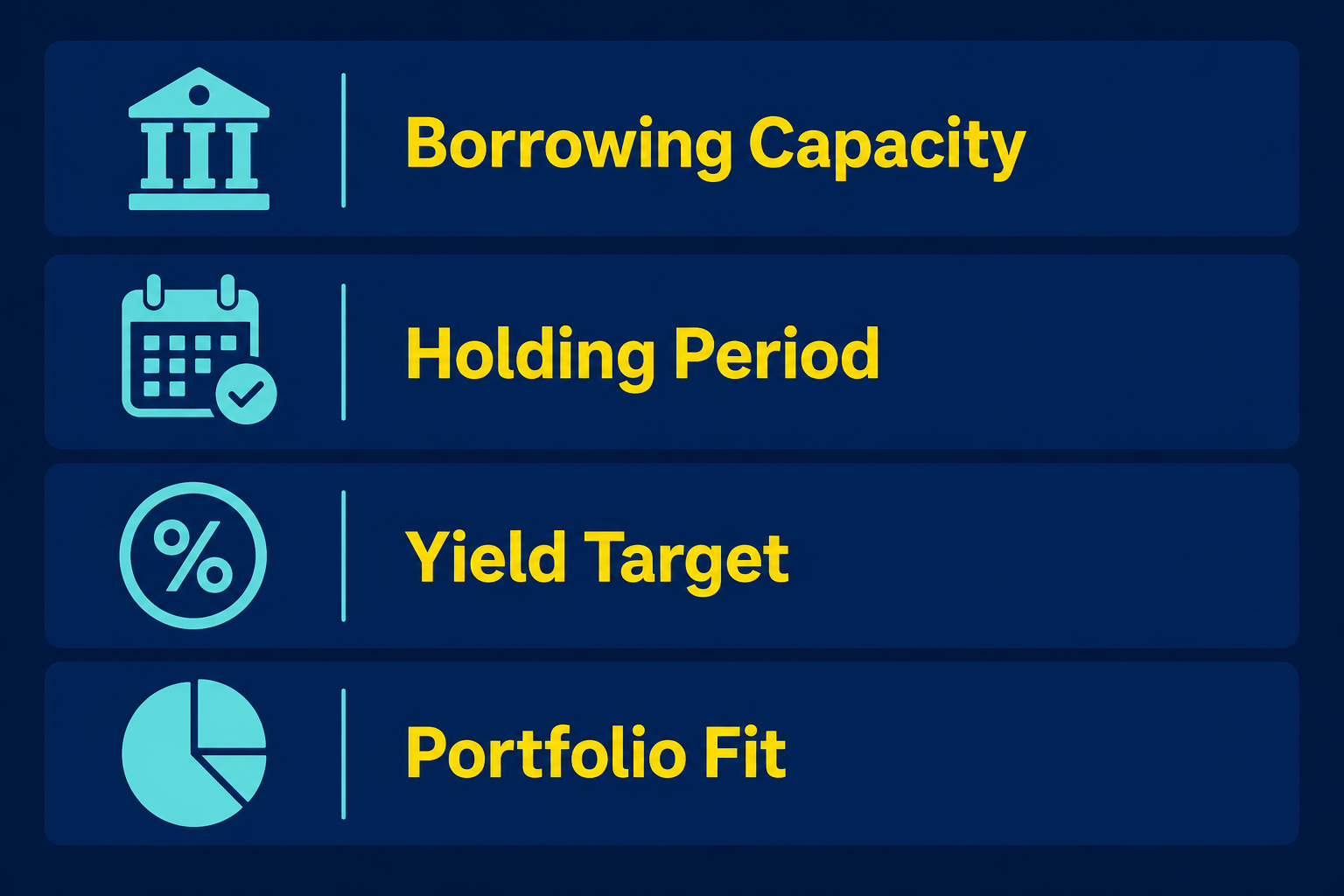
Borrowing capacity and buffer. With the cash rate at 4.35 per cent and APRA stress-testing loans at three per cent above the actual rate, an investor's real assessment rate is approaching 10 per cent. Any purchase analysis should model holding costs at current rates, not at a hoped-for future rate cut. A meaningful cash-flow buffer, typically three to six months of holding costs, is prudent in the current environment.
Holding period. Brisbane's structural supply-demand imbalance points to continued price support over a medium to long horizon. Investors with a minimum five-year holding period are better placed to absorb short-term rate pressure and any interim softening. Those looking for a 12 to 18-month flip face a very different risk profile than they would have in 2022.
Yield expectations. Houses are returning gross yields of approximately 3.1 per cent, while units sit closer to 3.9 to 5 per cent depending on location. Investors targeting neutral or positive cash flow need to focus on the higher-yield segments, which generally means middle-ring units and townhouses rather than prestige houses.
Diversification fit. For investors already holding Sydney or Melbourne assets, Brisbane can add geographic and cycle diversification to a portfolio. For investors with concentrated Brisbane exposure, the more useful question may be whether a second or third Brisbane property adds diversification or compounds concentration risk.
For a structured view of how Brisbane fits within broader Australian market conditions, the property investment trends shaping 2026 covers the macro forces most relevant to this decision.
| Investor Profile | Brisbane Suitability (2026) | Key Consideration |
|---|---|---|
| Long-term (5+ years), strong serviceability | High | Focus on established suburbs with owner-occupier demand |
| Yield-focused, middle-ring budget | Medium-High | Units and townhouses in 10-20 km ring |
| Short-term (under 3 years) | Lower | Rate cycle and softening auction conditions add timing risk |
| Already Brisbane-heavy portfolio | Reassess | Consider diversification before adding more Queensland exposure |
When to work with a buyers agent in Brisbane
The conditions that made Brisbane an easy "set and forget" decision in 2021 have passed. Selecting the right suburb, the right asset type, and the right price in a market where the margin for error has narrowed is where expert guidance genuinely earns its place.
A buyers agent in Brisbane working exclusively on the buyer's side brings three distinct advantages in the current market. First, access to off-market and pre-market opportunities: a meaningful share of well-located Brisbane properties transact before public listing, and agents with established selling agent relationships can surface stock that never appears on portals. Second, suburb-level due diligence grounded in current data, rather than twelve-month-old headlines. Third, negotiation discipline at a time when vendor expectations and buyer capacity are diverging, which is precisely when securing the right price requires experience rather than optimism.
Dragan Dimovski, the principal of Buyers Agency Australia with over 20 years of property experience, works with investors nationally to build portfolios built around strategy rather than sentiment. The approach covers initial goal-setting through to settlement support, with fixed-fee positioning that keeps incentives aligned with the buyer rather than the sale price.
For investors questioning whether Brisbane suits their specific financial position, holding period, and portfolio composition, the most useful step is a structured conversation before committing to search. Book a free strategy session to map out whether Brisbane fits your next property move, or explore the best property investment strategies in Australia for 2026 for a broader strategic framework.

Frequently asked questions
Is Brisbane property still a good investment in 2026?
Brisbane remains one of Australia's stronger markets in 2026, with solid population growth and tight supply. Asset selection and holding period now matter more than in prior years.
What are the biggest risks of investing in Brisbane in 2026?
Rising interest rates, a narrowing buyer pool due to affordability, and oversupply in some apartment precincts are the key risks investors should model before buying.
What rental yield can I expect from Brisbane investment property?
Houses are returning roughly 3.1 per cent gross, while well-located units and townhouses can deliver 4 to 5.5 per cent gross depending on suburb and property type.
Which areas of Brisbane offer the best investment potential right now?
Established middle-ring suburbs within 10 to 20 km of the CBD with strong owner-occupier demand and proximity to confirmed infrastructure tend to offer the strongest fundamentals.
Do I need a buyers agent to invest in Brisbane?
Not mandatory, but a strategy-led buyers agent provides off-market access, independent due diligence, and negotiation support that is increasingly valuable as Brisbane's market becomes more selective.