
The 2026 Federal Budget has rewritten two of the biggest tax settings Australian property investors have relied on for decades. If your portfolio is built around negative gearing or long-term capital growth, the rules have shifted and now is the time to understand exactly what changed, what stayed the same, and how to position yourself before the new regime takes hold.
What is changing in 2026 and why investors are paying attention
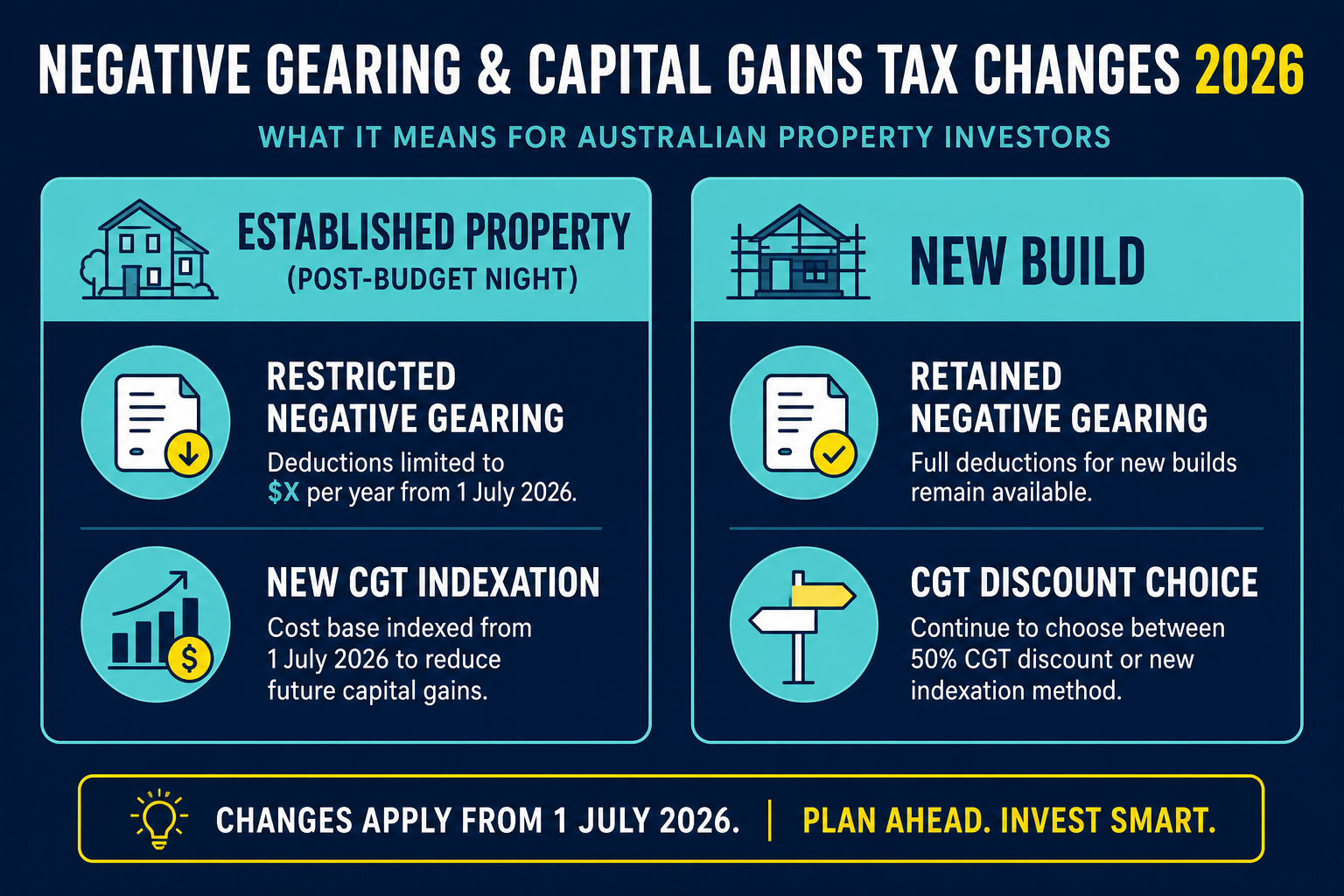
On 12 May 2026, the Federal Government announced two major reforms as part of the 2026–27 Budget. First, negative gearing on established residential properties purchased after Budget night will be restricted from 1 July 2027. Second, the 50% capital gains tax (CGT) discount will be replaced with cost base indexation and a 30% minimum tax on net capital gains, also from 1 July 2027.
These changes are not yet law — the ATO has confirmed the measures are intended to apply from 1 July 2027, subject to Parliament passing the relevant legislation. That distinction matters. Policy announcements and legislated law are not the same thing, and experienced investors know to plan thoughtfully rather than react impulsively to headlines.
Still, the direction is clear. The Federal Budget factsheet on negative gearing and CGT reform frames the changes as targeting housing affordability, with incentives deliberately steered toward new construction rather than established property. For anyone building or reviewing a property portfolio, this deserves careful attention.
Buyers Agency Australia has been fielding questions from investors across Australia since Budget night, and Dragan Dimovski — with 20+ years of property experience — is clear on one thing: the investors who come out ahead will be those who understand the rules and plan accordingly, not those who panic or freeze.
| Key change | Detail |
|---|---|
| Negative gearing restriction | From 1 July 2027, rental losses on established residential properties bought after 12 May 2026 can only offset rental income or residential property capital gains — not salary or other income |
| CGT discount replaced | The 50% discount replaced by CPI indexation plus a 30% minimum tax on net capital gains from 1 July 2027 |
| Existing properties protected | Properties held before 7:30 pm AEST on 12 May 2026 remain under current rules until sold |
| New builds exempted | New builds retain full negative gearing and investors can choose between the 50% discount or the new indexation method at sale |
| Main residence unaffected | The CGT main residence exemption is unchanged |
How negative gearing works in practice
Negative gearing is straightforward in concept. When the costs of owning an investment property — including mortgage interest, rates, insurance, property management fees, and depreciation — exceed the rental income it produces, you are running at a net rental loss. Under the rules that have applied since the mid-1980s, that loss can be deducted against your other taxable income, including your salary.
For a high-income earner on a 47% marginal tax rate, that tax offset provides meaningful cash flow relief while they wait for the property to grow in value. The strategy has always been a bet on capital growth outweighing the annual cash shortfall. According to ATO data analysed by RMIT researcher Liam Davies, approximately 1.1 million Australian taxpayers were negatively gearing property as of the 2022–23 financial year, out of around 2.26 million total property investors.
Under the proposed new rules, that tax offset only works if you have other rental income to absorb it. Net losses from established residential properties bought after Budget night will be quarantined — ringfenced to offset future rental income or capital gains from residential property, not your wages. Those losses can be carried forward indefinitely, so they are not lost entirely, but the immediate annual benefit many investors counted on will no longer apply to new purchases of established homes.
Commercial property, shares, and other asset classes are not affected by the negative gearing changes. New residential builds — including off-the-plan apartments, newly constructed houses, granny flats on vacant land, and significantly renovated properties — retain the full concession.
For investors considering their property investment strategy, this means the asset class and purchase date now carry significant tax consequences that need to be modelled properly.

How CGT is calculated and where it affects long-term strategy
Capital gains tax applies when you sell an asset for more than you paid for it, adjusted for the cost base — which includes purchase price, stamp duty, legal costs, and capital improvement costs. Under the current system, if you hold the asset for more than 12 months, the taxable gain is halved by the 50% CGT discount before it is added to your assessable income.
From 1 July 2027, that discount is replaced for gains accruing after that date. Instead of halving the gain, you will adjust the cost base for CPI inflation — you only pay tax on your real, above-inflation gain. However, a 30% minimum tax rate applies, meaning the strategy of timing a sale into a low-income year to reduce effective CGT no longer works the same way for post-July 2027 gains.
The transitional treatment is important. For properties held before 1 July 2027, gains that accrued up to that date are still eligible for the 50% discount. Only the portion of gain arising after 1 July 2027 falls under the new indexation and minimum tax framework. This split-gain approach means long-held properties are partially insulated.
For portfolio builders thinking about exit timing, the implication is real. Selling before 1 July 2027 captures the full 50% discount on total gains. Selling significantly later means a larger share of the total gain is subject to the new rules. Read More: Property Investors Beware Big Tax Changes Could Be Coming In 2026
New build investors get a structural advantage here — they can choose between the 50% discount or the indexation method at the time of sale, whichever produces a better outcome for their circumstances.

Potential impacts on buying strategy, cash flow, and holding decisions
Several decision points are worth reviewing now, regardless of whether your portfolio is established or you are yet to buy your first investment property.
Asset selection: New builds have moved from broadly comparable to established property to clearly more tax-advantaged under both the negative gearing and CGT settings. If your investment plan has historically favoured established homes for their renovation upside and lower construction risk, the tax gap now needs to be factored into the comparison.
Purchase timing: Properties where contracts were exchanged before 7:30 pm AEST on 12 May 2026 are protected under current rules — including those awaiting settlement. If you were under contract before Budget night, you are not caught by the new restrictions.
Ownership structure: The changes apply to individuals, trusts, and partnerships. Widely held trusts and superannuation funds are excluded from the negative gearing restrictions. This is worth discussing with your accountant, particularly if you hold properties through a discretionary trust — noting that a separate 30% minimum tax on discretionary trust distributions is also proposed from 2028.
Hold versus sell: Investors planning to sell in the medium term need to weigh the benefits of capturing the 50% CGT discount before July 2027 against the costs of exiting too early from a growth cycle. This is not a one-size-fits-all answer; it depends on your marginal tax rate, the size of accrued gains, your holding period, and your overall portfolio position.
For investors still building their property portfolio, the good news is that well-selected properties in strong growth corridors still make compelling long-term sense. The arithmetic has changed, but the fundamentals of location, supply constraints, population growth, and rental demand have not.
Who is most likely to be affected
Impacts vary significantly depending on personal circumstances, so the following scenarios are general observations only — not personal advice.
High-income earners buying established residential property after Budget night face the clearest change. The annual tax offset from negative gearing losses against salary income will no longer apply from 1 July 2027. Carried-forward losses remain usable against future rental income or residential property gains, but the immediate cash flow benefit changes.
Portfolio builders with two or more investment properties buying established homes after Budget night will feel the cumulative effect of both reforms. The Parliamentary Budget Office found that 60% of the benefits of negative gearing go to the top 20% of income earners — this cohort will see the sharpest change in after-tax returns on new purchases.
Investors who purchased before Budget night are in a protected position. Properties held at announcement remain under current negative gearing rules until sold, and the CGT discount applies to gains accrued before 1 July 2027. The key is maintaining strong records and getting a professional market valuation around the 1 July 2027 date to establish the split-gain position.
First-time investors considering an established property purchase need to understand the new holding economics before committing. The investment property advice conversation has shifted — cashflow modelling from day one, without the assumption of a full negative gearing offset, is now the more prudent starting point.
Owner-occupiers are unaffected by these changes. The CGT main residence exemption remains intact.
How to prepare a property plan before making any tax-driven decisions
The strongest response to any policy shift is a well-stress-tested plan — not a rushed decision in either direction. Here are practical steps worth taking now:
1. Revisit your cashflow model without the negative gearing offset. For any established property you are considering buying after Budget night, run the numbers assuming losses can only offset future rental income. If the holding economics still work over a 7 to 10 year horizon, you have a more resilient investment.
2. Get a tax depreciation schedule reviewed. Tax depreciation — claiming the wear and tear of the building and fixtures as a deduction — still applies under the proposed rules. For negatively geared investors carrying losses forward, a current depreciation schedule ensures every legitimate deduction is captured and applied against future rental income.
3. Speak with a qualified accountant about your ownership structure. Whether you hold properties individually, through a trust, or via superannuation changes the applicability of these reforms. Do not assume your current structure is optimal without independent tax advice.
4. Clarify your borrowing capacity with a mortgage broker. If the annual negative gearing benefit has historically supported your serviceability assessment, the change may affect your ability to borrow for subsequent purchases. Understanding this early avoids surprises.
5. Align your purchase decisions with a long-term property investment strategy. Tax settings shift. Growth fundamentals in well-selected markets are far more durable. Properties with strong owner-occupier appeal, infrastructure support, and genuine supply constraints have always been more resilient through policy cycles — and that does not change here.
Buyers Agency Australia works with investors across Australia to build data-led acquisition strategies that account for holding costs, tax environments, and long-term growth factors. If you want to map out your property plan with the new tax settings factored in properly, book a free strategy session with the team.
Common mistakes to avoid when reading tax headlines
Every significant tax announcement generates a wave of commentary — some of it useful, much of it speculative or oversimplified. Here are the traps experienced investors know to sidestep:
Treating announced policy as law. The ATO's own guidance states these measures are not yet law. They are proposed to apply from 1 July 2027, subject to Parliament. Policy can be modified, amended, or delayed through the legislative process. Making irreversible property decisions based on a Budget announcement alone carries real risk.
Assuming all properties are affected equally. The rules draw a hard line between established residential property and new builds. They also draw a hard line at the 12 May 2026 contract date. These distinctions are not minor — they fundamentally change the analysis for each individual situation.
Selling well-held assets out of fear. If you have a property with strong capital growth and years of accrued value, selling prematurely to avoid new CGT rules could cost you more in opportunity than the tax saving delivers. Always model the full picture with your accountant before acting.
Relying on general commentary as personal advice. This article — like any editorial content — is general in nature. It does not account for your income level, existing portfolio, ownership structure, borrowing capacity, or personal financial goals. The right decision for one investor is rarely the right decision for another.
Understanding these traps is part of avoiding the costly mistakes first-time and experienced investors alike tend to make when navigating a changing market environment.
| Strategy check | Current rules (pre-Budget night purchases) | New rules (established property, post-Budget night) |
|---|---|---|
| Negative gearing offset against salary | Yes | No (losses quarantined to rental income/gains) |
| Carry-forward of rental losses | Yes | Yes |
| 50% CGT discount on sale | Yes (gains to 1 July 2027) | No (indexation + 30% min tax post-July 2027) |
| New builds — negative gearing | Yes | Yes (retained) |
| New builds — CGT discount | Yes | Choice of 50% discount or indexation |
When to seek tailored advice
None of what you have read here replaces advice from a registered tax professional or licensed financial adviser. The interaction between negative gearing rules, CGT calculations, ownership structures, and individual tax positions is nuanced — and the stakes are high enough that guessing is an expensive strategy.
For the property acquisition side of your plan, the Buyers Agency Australia team is available to help you work through market selection, asset type decisions, and holding strategies that account for the current tax environment. The goal is never to make a tax-driven purchase — it is to make a sound property investment that also makes sense under the tax settings that apply.
If you are unsure how to align your next purchase with both your financial goals and the new policy landscape, book a free strategy session and get clarity before you act. For more detailed enquiries, you can also contact the team directly.
Read More: Negative Gearing Australia Explained For Property Investors In 2026
Frequently asked questions
Are properties I already own affected by the negative gearing changes?
No. Properties held before 7:30 pm AEST on 12 May 2026 remain under current negative gearing rules until they are sold.
Do the CGT changes apply to gains I have already accrued?
No. The new CGT framework only applies to gains accruing after 1 July 2027. Pre-July 2027 gains are still eligible for the 50% discount.
Are new build investment properties still negatively geared under the new rules?
Yes. New builds retain full negative gearing and investors can choose between the existing 50% CGT discount or the new indexation method at the time of sale.
Does the CGT main residence exemption change under the 2026 Budget?
No. The main residence exemption is unchanged. These reforms apply specifically to investment assets, not owner-occupied homes.
Should I sell my investment property before July 2027 to use the 50% CGT discount?
This depends entirely on your individual circumstances, accrued gains, marginal tax rate, and long-term plan. Speak with a registered tax adviser before making any sale decision.