Owning property in Australia does not automatically mean building wealth. Thousands of investors hold one or more assets yet remain financially stretched, cash-poor, and no closer to the freedom they were working toward. This article examines the patterns behind that gap and the disciplined approaches that change the outcome.
Why many investors look successful on paper but remain cash-poor
There is a persistent illusion in Australian property circles: if you own an investment property, you must be getting ahead. The reality is far more complicated. A growing body of data shows that holding assets and actually building wealth are two very different things.
KPMG modelling released in May 2026 found that Australian average household wealth rose nearly 23.6% in real terms between 2019-20 and 2024-25, yet median household wealth was essentially unchanged at around $700,000 over the same period. The gains went to those with the right assets, held in the right way. Owning property did not guarantee inclusion in that group.
The gap between paper wealth and actual financial progress is driven by a set of recurring, avoidable patterns. An investor can hold a property worth $900,000, carry $750,000 in debt, face ongoing holding costs that exceed rental income, and sit on an asset that is growing slowly in a suburb they chose because a seminar presenter said so. The spreadsheet looks impressive. The bank account tells a different story.
Buyers Agency Australia works with investors across every stage of this journey, and the same themes appear repeatedly: asset ownership without asset quality, growth without cash flow, and activity without strategy. Understanding where wealth quietly leaks is the first step toward stopping it.
This is not a commentary on whether property investment works. It does, when approached with genuine discipline. The question is why so many investors never reach the outcome they planned for, and what separates them from those who do.
The most common mistakes that quietly erode investor wealth
Most of the damage done to Australian property portfolios is self-inflicted and slow-moving. The mistakes that cost investors the most are rarely dramatic. They are structural, and they compound over time.
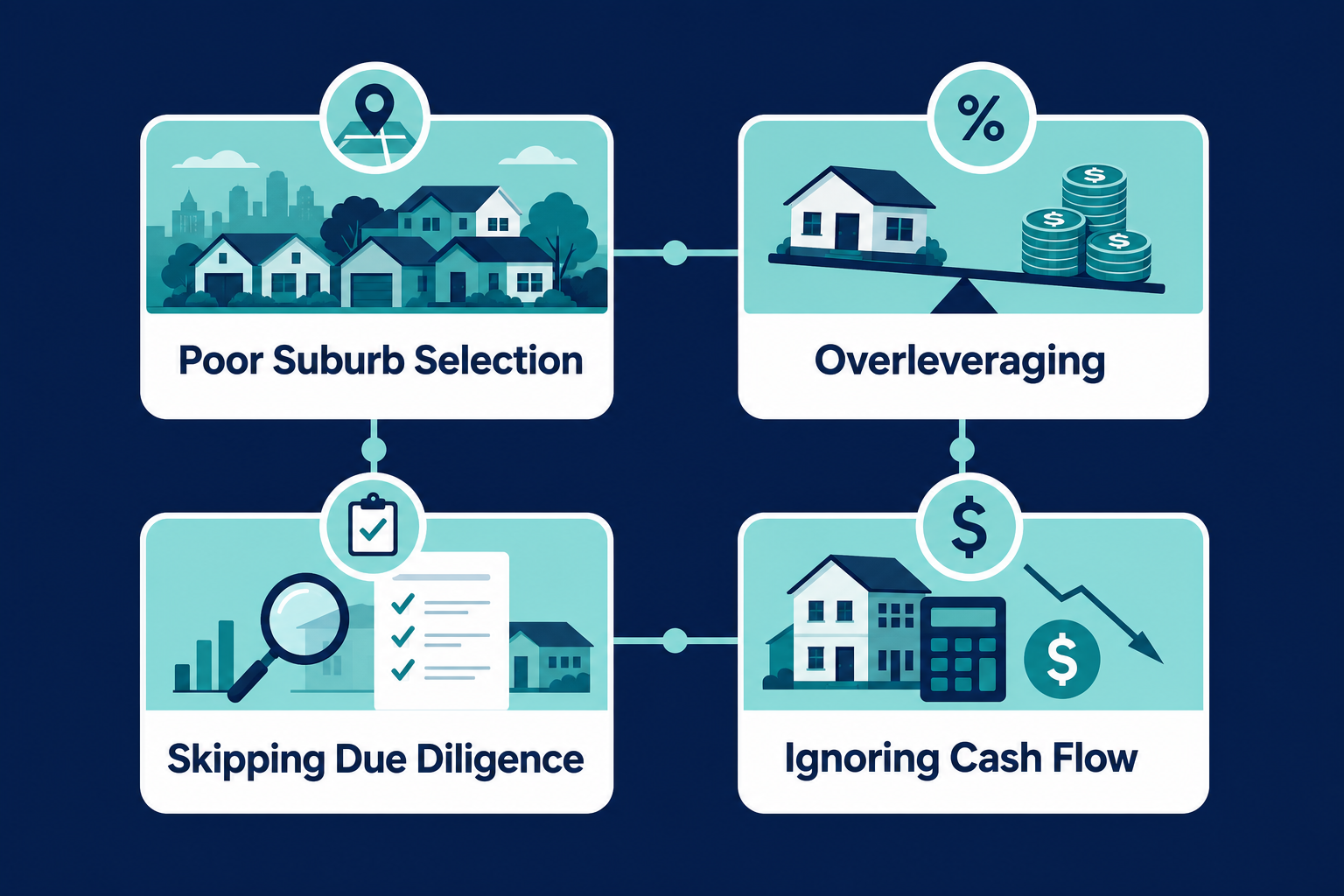
Overleveraging without a cash flow buffer
The Reserve Bank of Australia's May 2026 Bulletin on housing investors found that around 20% of leveraged investors had a housing debt-to-income ratio above 6, a level both APRA and the RBA classify as higher risk. High leverage is not inherently reckless, but high leverage without adequate cash reserves is a genuine vulnerability.
When rates move, vacancy appears, or a repair bill arrives, thinly buffered investors are forced into reactive decisions: drawing on lines of credit, delaying maintenance, or selling at the wrong point in the cycle. The property itself may be sound. The structure around it is not.
| Common Investment Mistake | Why Investors Make It | The Long Term Cost |
|---|---|---|
| Overleveraging | Chasing rapid growth without properly stress testing cash flow | Financial pressure, refinancing issues, and potential forced sales during downturns |
| Poor suburb selection | Buying based on hype, emotion, or familiarity rather than research | Weak growth performance and lower future demand |
| Emotional buying | FOMO at auctions or pressure from agents and developers | Overpaying and purchasing the wrong type of property |
| Ignoring holding costs | Focusing only on the purchase price and loan approval | Ongoing negative cash flow that reduces overall returns |
| Skipping due diligence | Rushing to secure a deal before completing proper checks | Hidden defects, council restrictions, or costly legal issues |
Poor asset selection driven by emotion or convenience
Around 70% of Australian housing investors own a single property, and the remaining 30% with multiple properties hold roughly half of all investment stock. The investors who expand their portfolios consistently tend to have one thing in common: they buy based on criteria, not feelings.
Emotional buying shows up in several forms. It is the investor who purchases in their own suburb because they know it. It is the one who buys off-the-plan because the display suite felt aspirational. It is the couple who stretched their budget on a renovated terrace because they could picture themselves living there. In each case, the decision process prioritised comfort over evidence.
The biggest property investment mistakes Australians are making in 2026 frequently trace back to this single issue: the asset was chosen for the wrong reasons. Growth fundamentals, rental demand, supply constraints, and long-term owner-occupier appeal were secondary considerations at best.
Ignoring ongoing holding costs and true cash flow
A property that looks marginally positive on a back-of-envelope calculation can look very different when council rates, insurance, property management fees, maintenance, land tax, and vacancy periods are modelled properly. A useful benchmark is to budget approximately 2% of the property's value annually for ongoing holding costs, excluding loan repayments. On a $750,000 asset, that is $15,000 per year before a single mortgage dollar is counted.
Investors who skip this modelling tend to be the ones surprised by their cash position twelve months in. They planned for the rent they hoped for, not the rent the market delivers after a vacancy gap or a lease renegotiation. The result is a drain on personal income that was never expected, reducing the ability to service additional debt or act on future opportunities.
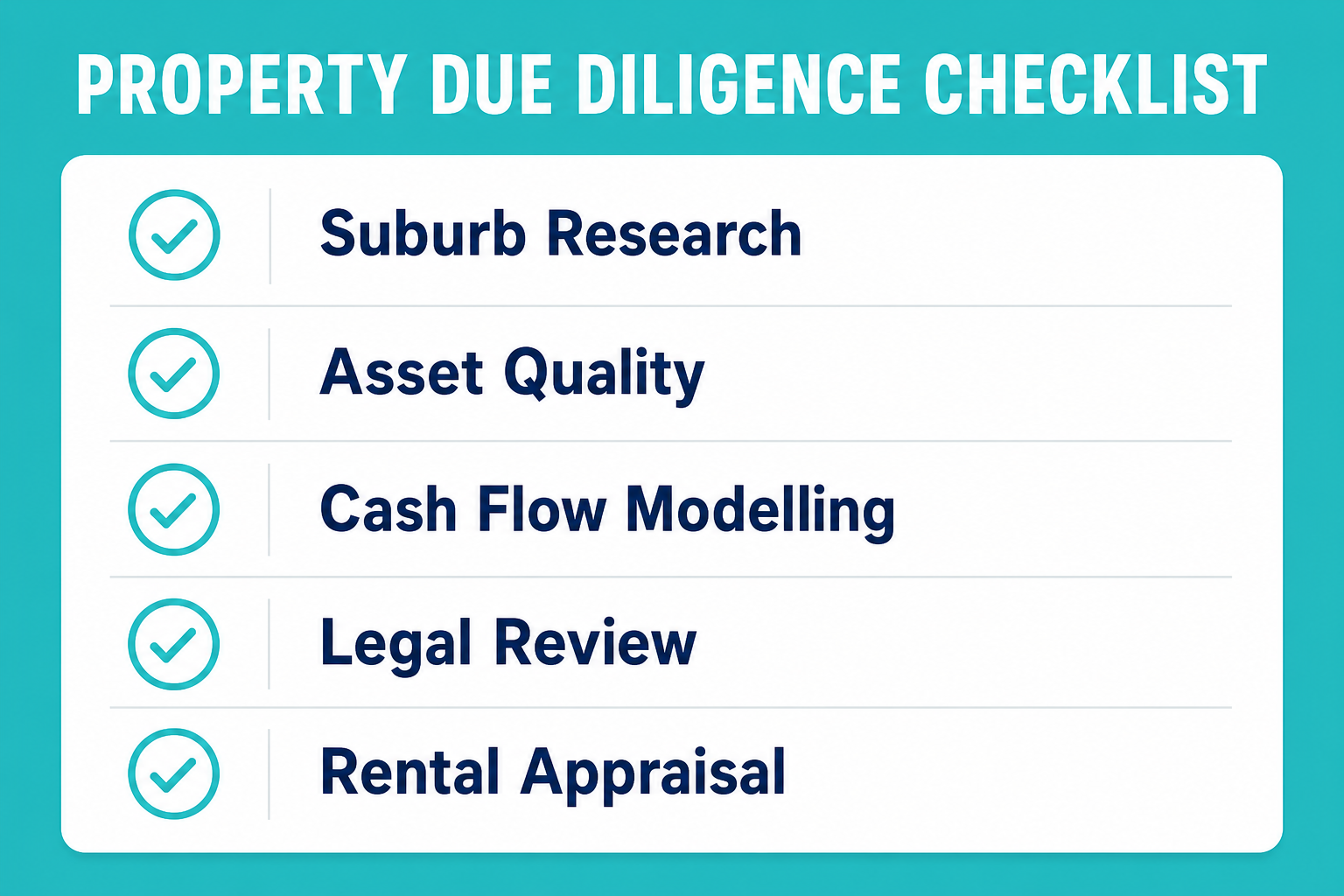
For a clear checklist on what to examine before committing to any investment property, the due diligence process should begin before the contract, not after.
Skipping due diligence to move quickly
In a market where competition for quality assets is real, the pressure to act fast can override sound process. Investors who skip building and pest inspections, title searches, zoning checks, and rental appraisals to secure a deal faster often discover problems that a few extra days of scrutiny would have surfaced. Speed is not a competitive edge if it means buying a liability.
Why strategy beats speculation in 2026
The Australian property market in 2026 is not uniform. Performance is increasingly determined by local supply constraints, infrastructure spending, population inflows, and the depth of owner-occupier demand. The broad market cycles that once lifted almost every suburb have fragmented. Picking the right market now requires genuine analysis, not assumption.
This is precisely why a clearly defined property investment strategy matters more in this environment than it did even five years ago. Strategy is not a vague commitment to buying well. It is a documented set of buy criteria, a cash flow model stress-tested against realistic scenarios, a hold horizon, and a plan for the next acquisition before the current one settles.
Investors who operate from strategy make fundamentally different decisions. They define acceptable yield thresholds before inspecting a property, not after falling in love with it. They set a maximum acquisition cost and treat it as a real boundary. They model what happens to cash flow if their borrowing rate increases by one percentage point, and they only proceed if the numbers still work.
Speculation, by contrast, relies on the market doing the heavy lifting. It assumes that any property in a growing city will perform. That assumption is increasingly expensive to hold.
The top property investment trends for 2026 reinforce this point consistently: asset selection precision, cash flow discipline, and suburb-level research are the characteristics separating investors who grow their portfolios from those who remain stuck at one property for a decade.
How a buyers agent can help investors avoid costly missteps
A buyers agent for property investment provides something most investors do not have on their own: an independent, research-backed perspective applied consistently across every acquisition decision.
The value is not simply access. It is structure. A skilled buyers agent works through a systematic evaluation process for every potential asset: suburb fundamentals, supply pipeline, rental demand depth, comparable sales, asset quality, and negotiation positioning. That process removes the emotional variables that compromise most self-directed investment decisions.
Dragan Dimovski, founder of Buyers Agency Australia and a property expert with more than 20 years of experience, has observed that the investors who struggle most are rarely short of capital or market access. They are short of discipline. They buy when they should wait, overpay because the negotiation felt uncomfortable, or select an asset that fits their lifestyle rather than their portfolio goals.
Buyer-side representation addresses each of these gaps directly:
- Research depth: A buyers agent assesses fundamentals that most investors do not know to look for, including absorption rates, development approval pipelines, and owner-occupier demand ratios.
- Off-market access: Many of the strongest investment-grade properties are acquired before they reach listing portals. Access to off-market properties in Australia is a structural advantage that compounds across a portfolio.
- Negotiation: An experienced buyers agent negotiates without emotional attachment, which consistently produces better acquisition prices.
- Decision quality: Having a professional accountability partner prevents the reactive decisions that tend to destroy returns.
First-time investors who have worked with a buyers agent consistently report that the greatest value was not finding the property. It was avoiding the wrong one.
For investors in Sydney, Brisbane, Melbourne, or anywhere across Australia's major markets, Buyers Agency Australia provides end-to-end acquisition support from strategy through to settlement.

A practical checklist for smarter property decisions
This framework is designed as a decision-quality tool, not financial advice. It reflects the kind of discipline that separates investors who build genuine portfolio momentum from those who stay stuck.
Before selecting a suburb:
- Is population and employment growth in this area structurally supported, not just cyclically elevated?
- What does the supply pipeline look like over the next three to five years?
- Is owner-occupier demand strong enough to support prices if investor sentiment softens?
- What is the median vacancy rate, and how has it trended over the last two years?
Before selecting an asset:
- Does the property have broad appeal across multiple tenant and buyer segments?
- Are land content and scarcity characteristics strong relative to comparable assets?
- Can the asset service itself at a 1% higher interest rate than your current loan rate?
- Have you obtained an independent building and pest inspection, not just a vendor-provided report?
Before signing a contract:
- Have you obtained a written rental appraisal from a property manager, not an estimate from the selling agent?
- Have you modelled total annual holding costs, including land tax at your cumulative portfolio value?
- Does this asset fit your portfolio plan, or does it just look good in isolation?
- Have you had the contract reviewed by a solicitor or conveyancer with investment property experience?
| Due Diligence Area | Key Question to Ask | Potential Red Flag |
|---|---|---|
| Suburb Fundamentals | Is long term demand supported by jobs, infrastructure, and population growth? | Reliance on a single industry, employer, or mining sector |
| Asset Quality | Does the property have strong land value and solid construction quality? | High strata fees, poor maintenance, or aging complexes |
| Cash Flow | Can the property comfortably hold at higher interest rates? | Negative cash flow under current lending conditions |
| Legal & Planning | Is the title clear and zoning suitable for the intended strategy? | Unapproved structures, easements, or planning restrictions |
| Rental Demand | Is the projected rental return supported by real market evidence? | Rental estimates without comparable leasing data |
The property investment hotspots and strategies shaping 2026 share a common thread: the investors performing best are those working from a clear framework, not reacting to headlines.
When to seek tailored guidance
This article provides general information about common investor behaviours and strategic frameworks. It is not personal financial advice, and every investor's situation involves specific circumstances that general guidance cannot account for. Before making any property acquisition or portfolio decision, you should consider seeking advice from a licensed financial adviser and a qualified property professional who can assess your individual position.
That said, the difference between investors who move forward with confidence and those who stay stuck is almost always the same thing: access to a structured, accountable process. Not more information. Not more time. A clear process applied consistently.
If you are reviewing your property investment approach for 2026 or preparing to add to your portfolio, book a free strategy session with the Buyers Agency Australia team to map out your next property move. The session is obligation-free and focused on your specific goals, market, and timeline.
For investors ready to take the next step, contact the team directly to discuss acquisition support, suburb research, and off-market opportunities across Australia's major markets.
Frequently Asked Questions
Why do so many Australian property investors only ever own one property?
High property prices, overleveraging early, and poor cash flow planning limit borrowing capacity. Without a clear strategy, many investors simply cannot qualify for or sustain a second acquisition.
What is the biggest mistake first-time property investors make?
Buying based on emotion or convenience rather than researched criteria. This often results in poor suburb selection, overpaying, and holding an asset that underperforms for years.
How does a buyers agent help with property investment strategy?
A buyers agent provides research-led suburb and asset analysis, negotiation support, off-market access, and an independent decision-making process that removes emotion from acquisitions.
What holding costs should Australian property investors budget for?
Budget approximately 2% of the property's value annually for council rates, insurance, management fees, and maintenance, plus land tax based on your cumulative portfolio value across each state.
Is property investment still worth pursuing in 2026?
Yes, when approached with disciplined strategy, clear buy criteria, and proper due diligence. The market rewards structure over speculation, particularly in a fragmented cycle where suburb selection matters more than ever.