
The deposit question trips up more aspiring investors than almost any other. The real answer in 2026 is not a single number — it depends on your lender, your existing assets, the property type, and how you plan to structure the purchase across your broader portfolio.
How much deposit do you really need in 2026?
Most first-time investors arrive at this question expecting a clean answer. In reality, deposit requirements for investment properties sit at a crossroads of lender policy, loan-to-value ratio (LVR) rules, regulatory settings, and individual financial position.
The headline benchmark most lenders work toward is 20% of the purchase price, which delivers an 80% LVR loan and avoids Lenders Mortgage Insurance (LMI). At the national median dwelling value of approximately AUD 922,838 as of early 2026 — according to Cotality's Home Value Index — that translates to a deposit of roughly $185,000 before you account for a dollar of transaction costs.
Investment lending carries additional weight compared to owner-occupied purchases. Lenders treat investment properties as higher-risk assets because, statistically, an investor is more likely to sell an investment property during financial hardship than their family home. That view flows directly into stricter LVR caps, higher interest rates, and tighter serviceability assessments.
From 1 February 2026, APRA also activated a new debt-to-income (DTI) lending cap, limiting banks to writing no more than 20% of new investment loans at a DTI of six times income or higher. The 3% mortgage serviceability buffer has also been retained, meaning lenders assess your ability to repay at a rate roughly three percentage points above your actual loan rate. These settings do not make investing impossible — but they make planning non-negotiable.
For investors considering the deposit question for the first time, understanding how much is genuinely required to buy an investment property is the starting point — not just the percentage, but the full cash requirement including costs.
The main deposit benchmarks investors should know
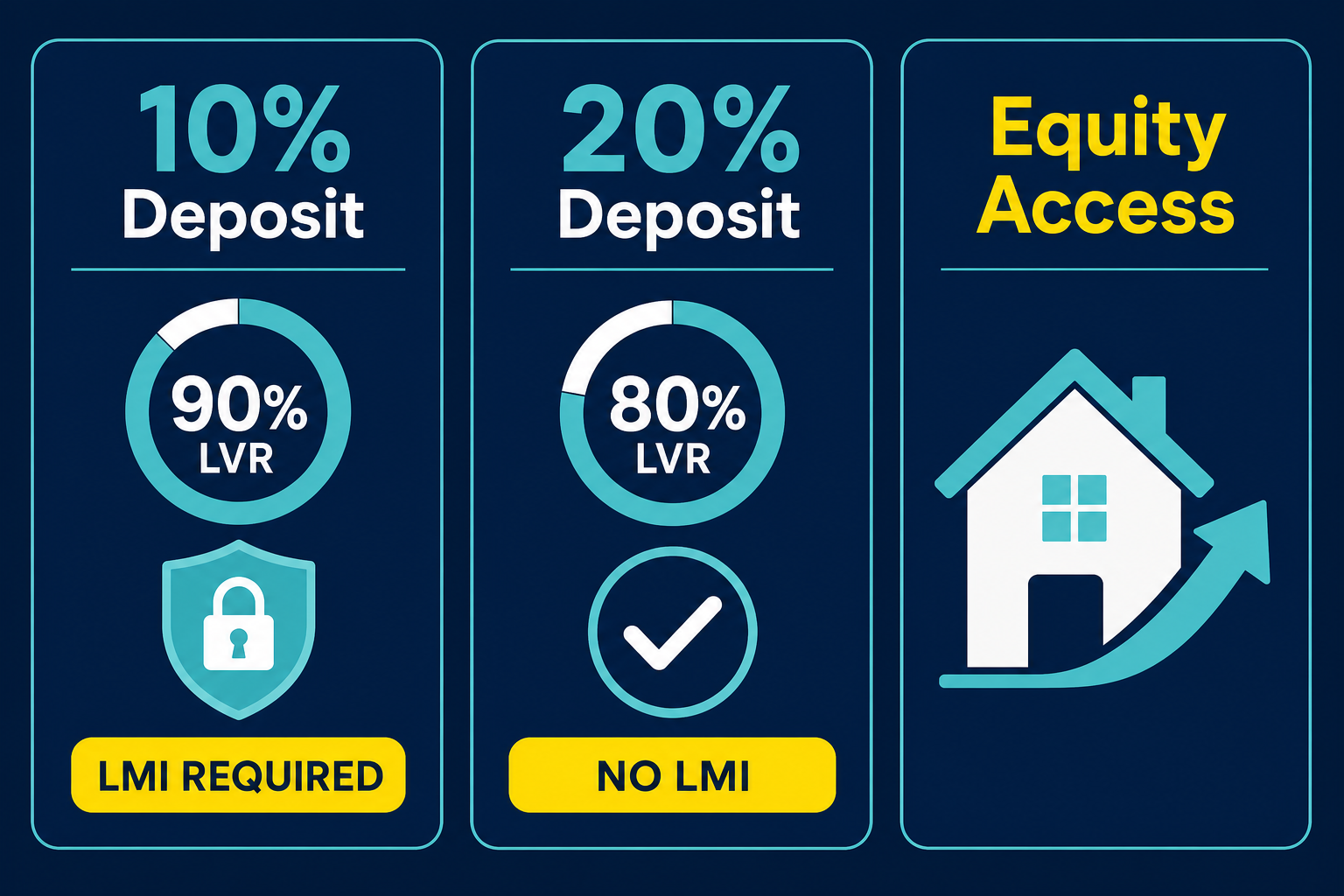
There are three deposit levels that matter in practice for Australian investment property buyers in 2026:
| Deposit Level | LVR | LMI Required? | Notes |
|---|---|---|---|
| 10% of purchase price | 90% | Yes | Minimum practical level; LMI premium substantial for investors |
| 20% of purchase price | 80% | No | Standard benchmark; cleanest path to approval |
| 20%+ using equity | Varies | No (if structured correctly) | Most common path for existing property owners |
A 10% deposit is achievable with most lenders, but LMI applies and the premium at 90% LVR for an investment loan is meaningfully higher than for an owner-occupier at the same ratio. On a $700,000 investment purchase, LMI at 90% LVR can reach approximately $24,000 — a cost that can be capitalised onto the loan but still increases your total debt and repayments.
A 20% deposit removes LMI entirely and gives lenders more confidence in the application. It also typically unlocks lower interest rates, since most lenders price investor loans at 80% LVR more favourably than higher-LVR tiers.
For investors who already own a property, using equity as the deposit is by far the most common path. The usable equity formula is straightforward: current property value multiplied by 80%, minus the outstanding mortgage balance. If that figure comfortably covers the deposit and costs on the target property, many buyers enter the investment market without saving additional cash at all. This approach is explored in detail in our guide on how property investors use equity to buy multiple properties.
The first home buyer deposit concept is worth clarifying here: government guarantee schemes like the First Home Guarantee allow eligible owner-occupiers to purchase with as little as 5%, but these programs are exclusively for properties you intend to live in. They do not apply to investment purchases.
Why the right deposit amount is not just about the percentage
Two investors with the same deposit percentage can face very different outcomes at the lender's desk. Serviceability — your ability to meet repayments under stress-testing conditions — carries as much weight as deposit size in 2026's lending environment.
Lenders shade rental income, typically accepting only 70–80% of the gross rent when calculating your income for the application. They then apply the 3% serviceability buffer on top of the actual loan rate. For an investor carrying existing mortgage debt, that buffer applies to both the new investment loan and the existing home loan balance, which is why property investors often see their borrowing capacity reduced more significantly than owner-occupiers under current APRA macroprudential settings.
Income stability and structure matter too. A PAYG employee with a clean credit file and no other investment debt faces a simpler serviceability picture than a self-employed investor with complex income or an existing portfolio. Employment type, declared living expenses, and any credit card limits (not just balances) all feed into the calculation.
The source of your deposit also carries weight. Lenders assess whether funds are genuinely saved, gifted, or drawn from equity — and for investment loans, a pattern of consistent saving or demonstrated asset growth tends to support stronger applications. Checking your first home buyer schemes and how they affect your budget can also clarify what options are available at different price points.
For investors with existing portfolios, the DTI cap active from February 2026 means those approaching six times gross income in total debt need to carefully consider which lender to approach and when, since not all institutions will be at the same quarterly allocation at any given time.

Extra costs to budget for beyond the deposit
One of the most consistent mistakes first-time investors make is treating the deposit as the total cash required. In practice, a 20% deposit on a $700,000 investment property ($140,000) needs to be accompanied by an additional $30,000 to $40,000 for transaction costs — and that figure is not negotiable.
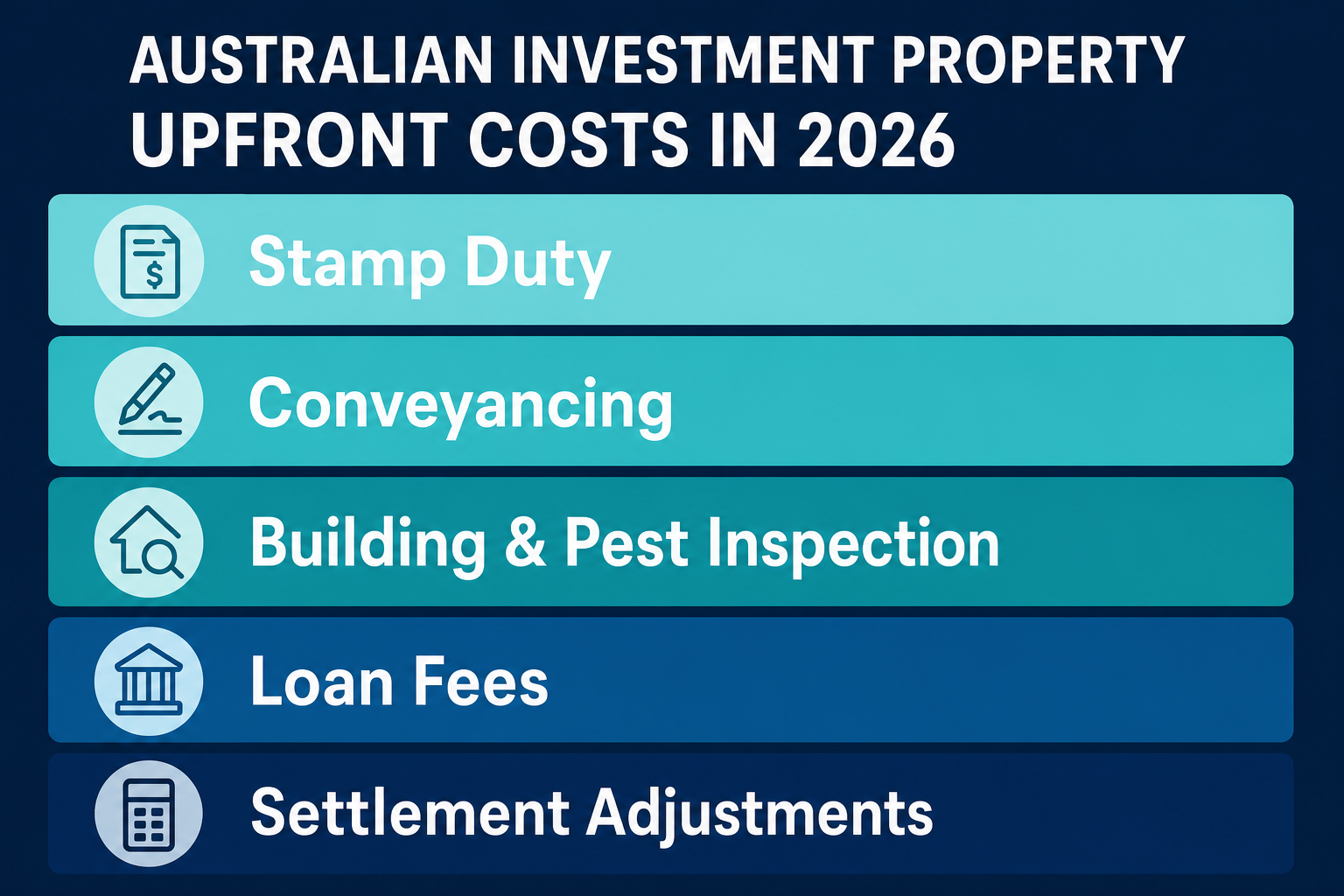
Here is what to plan for:
- Stamp duty (transfer duty): The single largest transaction cost, typically 3–5% of the purchase price depending on your state. Investment purchases receive no first home buyer concessions. On a $700,000 property in NSW, stamp duty runs to approximately $26,857, while in Victoria the figure on the same price point is higher. Queensland's rates are among the lowest nationally. Use each state's revenue office calculator for an accurate figure before committing.
- Conveyancing and legal fees: $1,500–$3,000 for a standard residential purchase.
- Building and pest inspections: $500–$800, and non-negotiable for established properties.
- Loan establishment fees: Vary by lender and product; often $300–$600.
- Settlement adjustments: Council rates, water rates, and strata levies may be pro-rated at settlement.
- Landlord insurance: Not a settlement cost, but should be in place from day one.
The combined picture on a $700,000 investment property in NSW is typically $165,000 to $175,000 in total cash required — not $140,000. Planning around the headline deposit alone creates a genuine shortfall risk at settlement.
Our property investment due diligence checklist covers what to verify before exchange, including the cost items that can catch first-time investors off guard.
How deposit size can affect your investing options
A larger deposit does more than reduce your borrowing cost. It affects which lenders will consider your application, which property types you can target, and how much flexibility you retain for your next purchase.
Investors with 20% deposits and strong serviceability can typically access the full range of major bank products, which tend to carry the most competitive rates and the most predictable approval pathways. Those entering at 10% with LMI may find their lender choices narrower, especially for properties in regional locations or higher-density apartment markets, where some lenders apply lower LVR caps regardless of deposit size.
A larger upfront equity position also supports borrowing capacity planning for subsequent purchases. If you enter a property at 80% LVR and values rise meaningfully — national home values were approximately 9.9% higher year-on-year as of early 2026 — the equity growth accelerates faster in dollar terms, providing a platform for the next acquisition sooner.
That said, there is a genuine case for entering the market earlier with a smaller deposit in rising markets. Paying a $15,000–$24,000 LMI premium to buy now may compare favourably against waiting two more years as prices continue to rise. The calculus depends on the specific market, the property fundamentals, and whether your serviceability position supports the higher loan balance comfortably. Seeking property investment strategy advice before committing to one approach is time well spent.
| Purchase Price | 20% Deposit | Estimated Stamp Duty (NSW) | Additional Costs | Total Cash Required (approx.) |
|---|---|---|---|---|
| $600,000 | $120,000 | ~$21,330 | ~$5,000 | ~$146,000 |
| $700,000 | $140,000 | ~$26,857 | ~$5,000 | ~$172,000 |
| $900,000 | $180,000 | ~$35,835 | ~$5,000 | ~$221,000 |
Stamp duty estimates are indicative for NSW investor purchases. Other states vary significantly — Queensland and Western Australia are generally lower, Victoria is typically higher at these price points.
How buyers can prepare a stronger purchase plan
Approaching a property purchase with a clear financial map is what separates investors who execute confidently from those who stall. A few practical steps make a measurable difference:
Check your borrowing capacity before you set a price range. A pre-approval conversation with a mortgage broker — not a single lender — gives you a realistic picture of what you can borrow across multiple lenders, not just one institution's policy. This matters especially in 2026, when APRA's DTI cap means different lenders may be at very different points in their quarterly allocation. Our guide on choosing the right mortgage broker for your investment property walks through what to look for.
Clarify your serviceability position in full. List every liability: existing mortgage balances, personal loans, car finance, and every credit card limit you hold. Lenders assess limits, not balances. Reducing or closing unused credit cards before applying can improve your serviceability position noticeably.
Compare suburbs and property types against your deposit capacity. A $700,000 budget in Brisbane faces different stamp duty, different yield conditions, and different growth drivers than the same budget in Sydney or Melbourne. Understanding where your deposit goes furthest in fundamental terms — not just price — is part of building a credible strategy. Our analysis of the best suburbs to invest in Australia in 2026 provides a useful starting framework.
Consider whether off-market opportunities reduce your effective competition. In tight markets, having access to off-market properties before they reach public listing means less auction pressure and more time for due diligence — directly reducing the risk of overpaying under competitive conditions.
If this is your first investment purchase, book a free strategy session to review your numbers, clarify your capacity, and identify the right market and property type for your situation before committing funds.
When to speak with a buyers agent
Deposit planning answers the question of whether you can buy. It does not answer what to buy, where, or at what price — and those decisions carry far more long-term consequence than whether you entered at 10% or 20%.
Buyers Agency Australia works with investors across the full purchase cycle — from initial strategy and suburb selection through to due diligence, negotiation, and settlement. The team is led by Dragan Dimovski, a property expert with more than 20 years of experience, who brings a data-led, investor-first perspective to every engagement.
The value of buyer-side representation shows up clearly during three stages. First, in market selection — identifying the suburbs and asset types where your deposit and borrowing capacity are matched to the strongest risk-adjusted fundamentals, rather than the most advertised opportunities. Second, in off-market sourcing — because a meaningful share of quality investment stock changes hands before it ever reaches a public portal. Third, in negotiation — where disciplined, evidence-based offers consistently produce better purchase prices than emotional, market-pressured decisions.
For investors already in the research phase, the 2026 Australian property market outlook guide provides context on where growth and yield drivers are currently concentrated.
Ready to map out your next property move? Book a free strategy session or contact the team directly to start the conversation.
Frequently Asked Questions
What is the minimum deposit for an investment property in Australia in 2026?
The practical minimum is 10% with LMI applied. Most mainstream lenders cap investment LVR at 80%, requiring a 20% deposit to avoid LMI entirely.
Can I use equity instead of a cash deposit for an investment property?
Yes. If you own a property, usable equity — calculated as 80% of its current value minus your outstanding loan — can typically fund the deposit and costs on a new investment purchase.
Does the First Home Guarantee apply to investment properties?
No. Government low-deposit guarantee schemes are exclusively for owner-occupiers. Investment purchases require a minimum 10% genuine deposit, and no concession schemes apply.
How does the APRA serviceability buffer affect my investment deposit planning?
Lenders assess your repayment capacity at 3% above your actual loan rate. For investors with existing debt, this can significantly reduce maximum borrowing capacity, which affects the price range your deposit can support.
What upfront costs should I budget for beyond the deposit?
Stamp duty (3–5% of purchase price), conveyancing fees ($1,500–$3,000), building and pest inspections ($500–$800), loan fees, and settlement adjustments. Total costs on a $700,000 NSW investment purchase typically add $30,000–$40,000 on top of the deposit.