
Investing in property through a self-managed super fund (SMSF) is one of Australia's most discussed retirement strategies, but it's also one of the most misunderstood. The rules are strict, the costs are real, and the consequences of getting it wrong can be severe. This guide covers what SMSF property investing actually involves in 2026, how to assess whether the strategy suits your goals, and what the acquisition process looks like when done properly.
Disclaimer: This article is general information only and does not constitute personal financial, tax, legal, or investment advice. Speak with a licensed SMSF specialist, registered financial adviser, and accountant before acting on any of the information discussed.
What SMSF property investing means in Australia
An SMSF allows its members to take direct control of how their superannuation savings are invested, including the option to purchase residential or commercial investment property. Unlike a standard investment property purchase in your own name, property bought through an SMSF sits inside the superannuation environment, which means different tax treatment, different legal obligations, and a completely different compliance framework.
According to ATO data for December 2025, there are now 663,867 SMSFs in Australia holding $1.06 trillion in total assets. Property, both residential and non-residential, accounts for a meaningful portion of that allocation, though it remains a minority of the overall sector.
The key attraction of holding property inside super is tax efficiency. Rental income earned within a complying SMSF is taxed at a concessional rate of 15%, compared to a marginal tax rate of up to 47% outside super. Capital gains tax reduces to 10% for assets held longer than 12 months, and in pension phase, if the sale falls within the member's transfer balance cap, no capital gains tax may be payable at all.
For many investors, those numbers are compelling. The reality, however, is that the strategy carries significant structural complexity, ongoing compliance obligations, and liquidity demands that require careful planning before any purchase.
This guide focuses on general education about how the strategy works. It is not personal advice. Anyone considering SMSF property investing should engage a licensed SMSF specialist before proceeding.
Key SMSF rules to understand before you buy
The SMSF framework is governed by the Superannuation Industry (Supervision) Act 1993 (SIS Act) and enforced by the Australian Taxation Office. Breaching the rules can result in the fund being declared non-compliant, which means the fund's assets could be taxed at 45% rather than 15%. The penalties are severe and not worth risking.
Here are the core compliance considerations every trustee must understand:
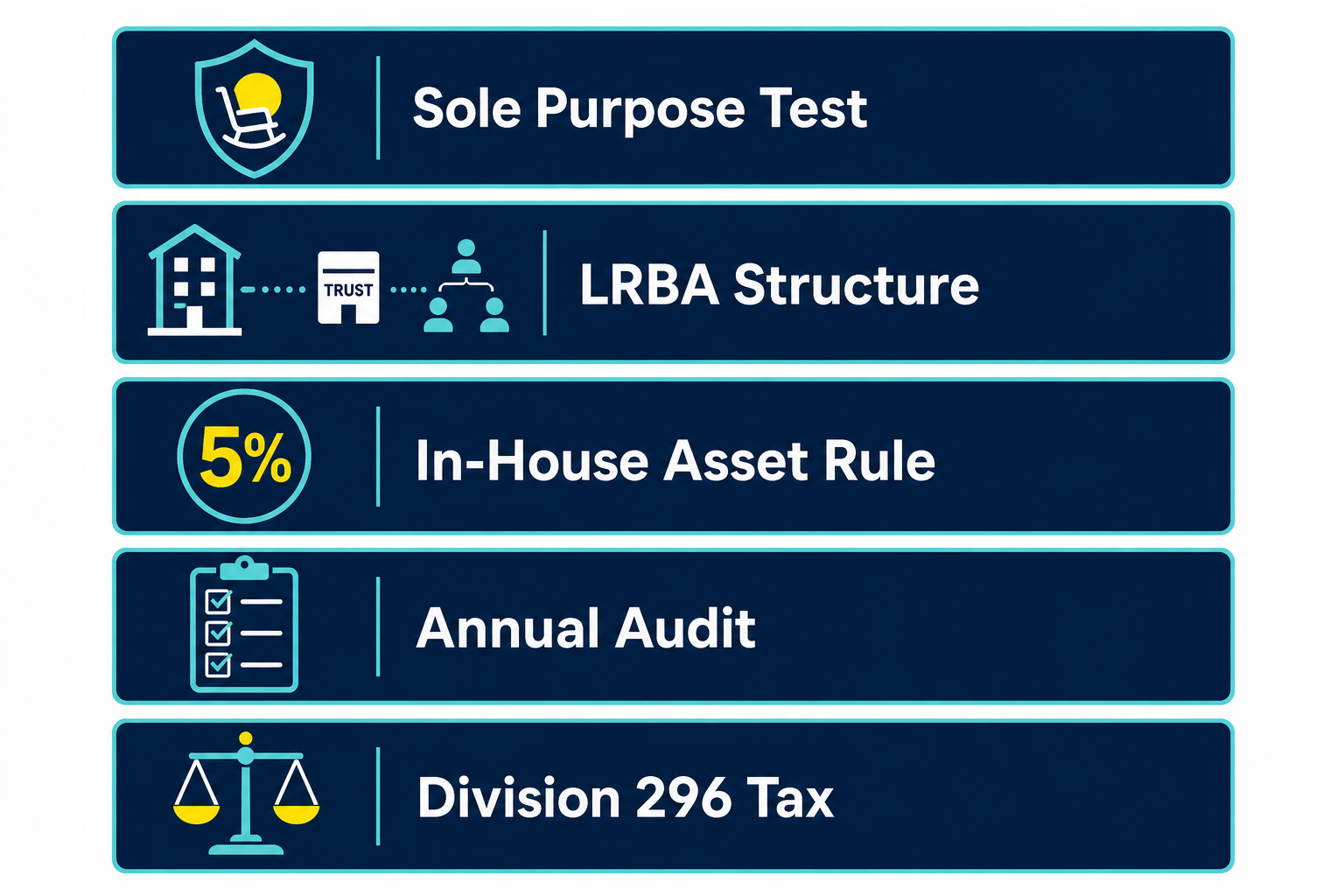
The sole purpose test
Every investment decision inside an SMSF must be made solely to provide retirement benefits to members. This means no member or related party can live in, holiday in, or derive any personal benefit from an SMSF-owned residential property. Even allowing a family member to stay in the property for a short period is a breach. The ATO's SMSF investment restrictions guidance outlines these obligations in full.
Limited Recourse Borrowing Arrangements (LRBAs)
An SMSF cannot take out a standard mortgage. If the fund needs to borrow to buy property, it must use a Limited Recourse Borrowing Arrangement (LRBA) under section 67A of the SIS Act. Under this structure, the property is held in a separate bare trust until the loan is fully repaid. The "limited recourse" element protects the fund's other assets: if the fund defaults, the lender can only take the property itself.
LRBA loans come with stricter lending criteria than standard investment loans. In April 2026, SMSF loan rates sat around 6.6% to 6.8% for residential property, compared to roughly 5.5% to 6% for standard investment loans. Most lenders require a 20% to 30% deposit and a minimum fund balance of $200,000 to $300,000 before approving the loan.
Borrowed funds can only be used to acquire the property, cover acquisition costs such as stamp duty, and fund repairs and maintenance. They cannot be used to improve the property in a way that changes its fundamental character. A cosmetic repaint is fine; a structural extension is not while the loan remains outstanding.
The in-house asset rule
SMSFs are restricted from holding more than 5% of their total assets in in-house assets, which includes investments in or loans to related parties. Residential property leased to a related party breaches this rule. Commercial property is the main exception: a related business can lease commercial premises owned by an SMSF at market rates, which is one reason business owners find commercial SMSF property particularly attractive.
Related party acquisition restrictions
Your SMSF generally cannot purchase residential property from a related party. You cannot transfer an investment property you personally own into your SMSF; it must be purchased from an unrelated third party at market value.
Ongoing valuations and compliance costs
The ATO requires annual market-based valuations for SMSF property assets. The fund must also be independently audited each year and lodge an annual return. Running costs for an SMSF holding property typically sit in the range of $5,000 to $7,000 per year before standard property holding costs are factored in.
Division 296: the new tax for high balances
From 1 July 2026, the Division 296 tax applies a tiered additional tax on superannuation earnings for individuals with a total super balance above $3 million. Balances between $3 million and $10 million will attract an additional 15% tax on earnings attributable to that portion, bringing the effective rate to 30%. The legislation passed both houses of Parliament on 10 March 2026 and applies to realised earnings only, not unrealised gains. Trustees with balances approaching that threshold should model their position with a qualified SMSF adviser before the end of the 2025-26 financial year.
| Compliance area | Key requirement |
|---|---|
| Sole purpose test | Property held for retirement benefit only; no personal use by members or related parties |
| LRBA (borrowing) | Must use a bare trust structure; one asset per LRBA; borrowed funds cannot fund improvements |
| In-house assets | No more than 5% of fund assets in related-party investments; residential leases to family not permitted |
| Related party acquisition | Residential property must be purchased from unrelated third party at market value |
| Annual obligations | Independent audit, annual return lodgement, market-based valuations |
| Division 296 (from 1 July 2026) | Additional 15% tax on earnings above $3M total super balance; applies to realised earnings only |
How to assess whether SMSF property investing suits your goals
Not every investor with an SMSF should put property in it. The strategy makes most sense when the fund has a meaningful balance, trustees have a clear long-term retirement horizon, and the purchase genuinely serves the fund's retirement objectives rather than satisfying a short-term property impulse.
Before progressing further, consider these questions honestly:
Does your fund have the cash flow to sustain the strategy? A property inside super needs to be serviced entirely from within the SMSF. Loan repayments, council rates, property management fees, insurance, and vacancy periods all come from the fund. You cannot top up a shortfall from your personal bank account. Concessional contributions are capped at $30,000 per member per year (2025-26 figure), with the cap rising to $32,500 from 1 July 2026. Non-concessional caps sit at $120,000 for 2025-26, rising to $130,000 from 1 July 2026. Fund liquidity needs to be modelled across realistic scenarios, including periods of vacancy.
Is your fund balance sufficient to make the strategy cost-effective? Most advisers consider $200,000 to $300,000 the minimum realistic fund balance before SMSF property purchasing becomes cost-justified. Below that level, ongoing running costs represent too large a drag on returns.
What does concentration risk look like for your portfolio? A single residential property inside an SMSF can easily represent 70% to 90% of the fund's total assets. That level of concentration in one illiquid asset is a risk that needs to be factored into your overall property investment strategy. Diversification matters, especially as members approach pension phase and require minimum drawdowns.
What is your time horizon? SMSF property works best as a long-term hold. Selling property in a fund that is in pension phase and needs to fund member drawdowns can create serious liquidity pressure if the timing does not align with market conditions.
Does the property choice support genuine investment returns? Property selected with clear investment logic, including strong fundamentals around rental yield, capital growth potential, and suburb-level demand, produces different outcomes than property selected based on familiarity or convenience. Emotion and geography are two of the most common drivers of poor SMSF property decisions.
For investors building a property portfolio over time, the SMSF can be one piece of a broader, structured strategy, rather than the whole plan. It works best alongside personal holdings, serviced by a clear overall financial plan.
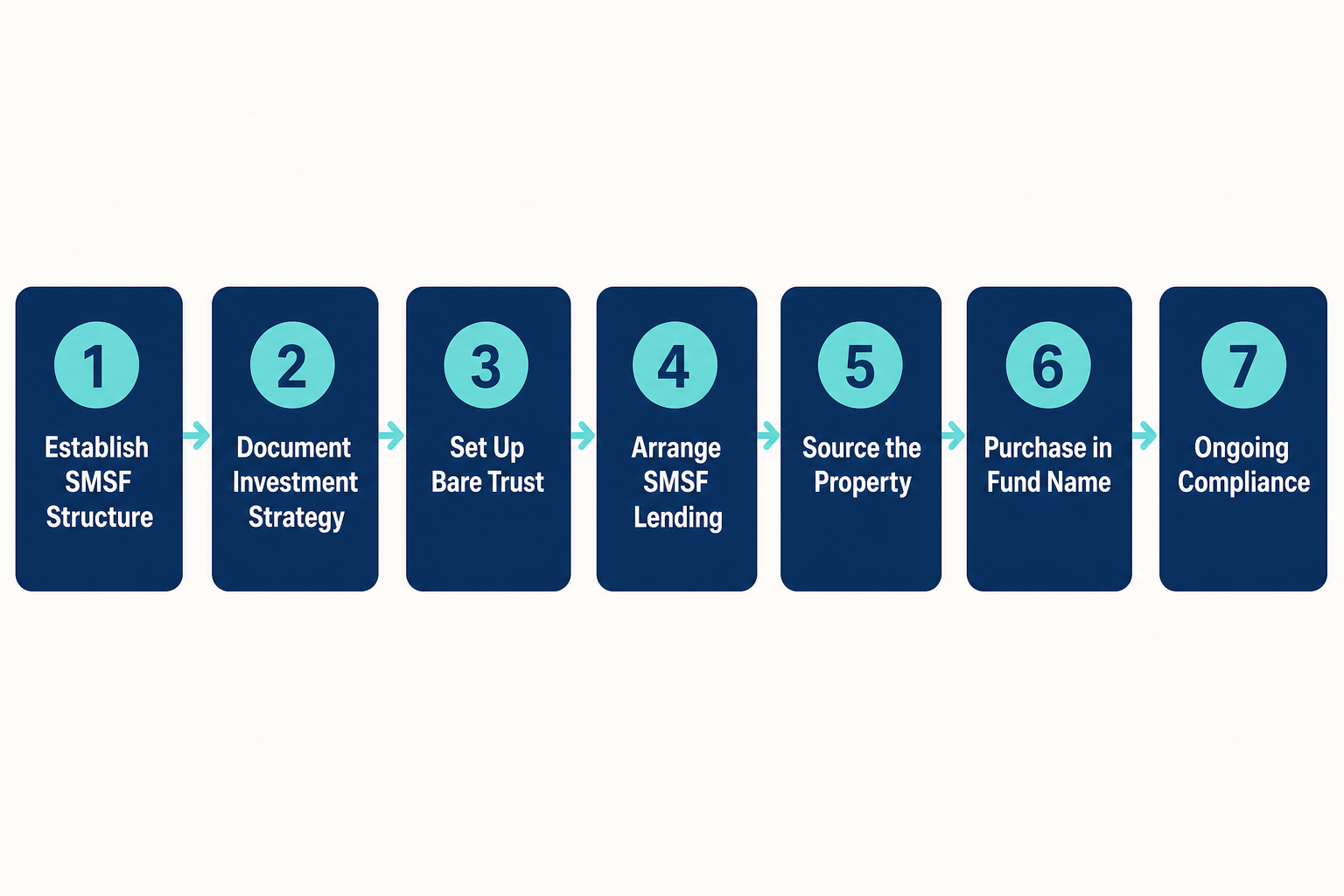
Step-by-step: how to buy property using superannuation
The process of buying property through an SMSF involves more moving parts than a standard property purchase. Getting the structure right from the start prevents expensive and difficult-to-unwind problems down the track.
Step 1: Establish or review your SMSF structure
If you do not already have an SMSF, it needs to be established with a properly drafted trust deed that explicitly permits property investing and LRBA borrowing. A corporate trustee structure is generally preferred for its governance and estate planning benefits. Initial setup costs typically range from $1,500 to $3,000 depending on complexity. If your existing SMSF is already established, have your trust deed reviewed to confirm it allows for the contemplated investment.
Step 2: Document an investment strategy
All SMSFs are legally required to maintain a written investment strategy that considers risk, return, diversification, liquidity, and the members' circumstances. Before any property purchase, the strategy must be updated to specifically reflect the intended acquisition. This document is reviewed by your independent auditor each year and must align with how the fund actually invests.
Step 3: Establish the bare trust
If you are borrowing to buy the property, a separate bare trust must be established before settlement. The bare trust holds legal title to the property during the loan term; the SMSF holds the beneficial interest. A specialist SMSF solicitor should prepare the bare trust deed. Using the wrong trust structure is one of the most common and costly compliance errors.
Step 4: Arrange SMSF lending pre-approval
SMSF property lending is a specialist product not offered by all lenders. Approach a mortgage broker with demonstrated SMSF experience to identify suitable lenders and obtain pre-approval before committing to a purchase. SMSF loan rates are higher than standard investment loans, and lenders apply stricter criteria including higher deposit requirements and liquidity buffers.
Step 5: Source and assess the property
This is where investment discipline matters most. The property must be selected based on its investment merit within your fund's documented strategy, not on personal preference or lifestyle appeal. Strong indicators of investment quality include off-market access to properties with genuine demand-side fundamentals, manageable vacancy rates, and clear long-term capital growth logic. Conduct thorough property investment due diligence before making any offer, including building and pest inspections, strata reports where applicable, and an independent market valuation.
Step 6: Purchase in the fund's name
Settlement must occur in the name of the bare trust (if borrowing) or directly in the SMSF trustee's name (if buying outright). The property cannot be purchased in your personal name and transferred later. Stamp duty and conveyancing apply as normal. Your SMSF solicitor should handle conveyancing or at minimum review all documents before settlement.
Step 7: Manage ongoing compliance
Post-settlement, the fund must ensure rent is collected into the SMSF's bank account, all expenses are paid from the fund, annual valuations are conducted, and the independent audit is completed each year. The property must not be used by any member or related party at any time.
Common SMSF property mistakes to avoid
The most expensive mistakes in SMSF property investing are structural, not market-based. Most of them are avoidable with the right preparation.
Poor liquidity planning. Running a property with an LRBA inside an SMSF means the fund must absorb loan repayments, vacancy costs, rates, insurance, and management fees entirely from within the super environment. Funds that do not model worst-case scenarios, including extended vacancy or major maintenance, can find themselves unable to meet obligations without breaching compliance.
Overconcentration in a single asset. When a $500,000 property represents 80% of a fund's total balance, the fund's entire retirement outcome becomes dependent on one asset in one suburb. This is a risk profile that few trustees would accept in any other context. Understanding the biggest investment mistakes Australians make helps frame why diversification inside the fund matters.
Buying for the wrong reasons. Choosing a property because it is nearby, familiar, or emotionally appealing rather than because it meets clear investment criteria is one of the most common drivers of underperformance. SMSF property must be purchased at arm's length and justified by its investment merits.
Using borrowed funds for improvements. Under LRBA rules, borrowed money cannot be used to improve a property in a way that changes its character. Using LRBA funds for anything beyond repairs and maintenance risks a compliance breach. Improvements must be funded from the SMSF's own cash reserves.
Weak or missing documentation. The ATO has increased data matching and audit activity in 2025-26. Every transaction, valuation, trust deed, investment strategy update, and bare trust document must be properly maintained. Late lodgements and missing records are among the most common triggers for deeper scrutiny.
Ignoring Division 296 implications. For investors approaching the $3 million total super balance threshold, buying property inside super without modelling the Division 296 impact could result in an unexpected tax outcome. The legislation applies from 1 July 2026 and only covers realised earnings, but the cost-base reset election available to SMSFs must be lodged by the due date of the 2026-27 annual return.
| Common mistake | Why it happens | How to avoid it |
|---|---|---|
| Poor cash flow modelling | Contributions underestimated; vacancy not stress-tested | Model fund cash flow across 2 to 3 vacancy scenarios before purchase |
| Overconcentration | Single property dominates the fund | Consider portfolio mix; property should sit within a broader asset plan |
| Wrong purchase structure | Legal title held incorrectly | Use a specialist SMSF solicitor; never settle before bare trust is established |
| LRBA used for improvements | Misunderstanding of borrowing rules | Fund improvements from SMSF cash only; get legal advice before any renovation |
| Related party breach | Member or family uses property | Strict no-personal-use policy from day one; document and audit annually |
How a buyers agent can support SMSF property acquisition
The compliance framework governing SMSF property purchases does not reduce the importance of buying the right property. It increases it. Mistakes inside super are harder to unwind and carry greater financial consequences than mistakes made in personal name. That is one reason why buyer-side representation adds meaningful value in this context.
A buyers agent operating within an SMSF purchase works on the buyer's side exclusively. Their role covers sourcing, assessing, negotiating, and managing due diligence on the property itself. They do not provide financial advice, SMSF structuring advice, or legal counsel. Those services remain the domain of licensed SMSF specialists, financial advisers, and solicitors.
Where buyer-side support genuinely helps in an SMSF context:
Property sourcing with investment discipline. The property must meet the fund's documented investment strategy. A buyers agent focused on investment-grade assets applies consistent sourcing criteria, including suburb fundamentals, rental yield, tenant demand, vacancy rates, and long-term capital growth indicators, rather than personal preferences.
Off-market access. A proportion of quality investment properties change hands before they are publicly listed. Access to off-market properties that most buyers never see is a genuine advantage in a compliance-sensitive purchase where the selection process must be defensible and documented.
Objective due diligence. Thorough property due diligence, including building reports, strata reviews, and independent valuation confirmation, is particularly important inside an SMSF. A buyers agent coordinates and reviews these reports objectively, without the emotional bias that often affects self-directed purchasers.
Negotiation at arm's length. SMSF property must be purchased at market value from an unrelated third party. Professional negotiation supports this requirement while also working to achieve the best possible terms for the fund.
Buyers Agency Australia works with investors across the country seeking to build portfolios with conviction. Led by Dragan Dimovski, a property expert with over 20 years of experience in investment-grade acquisition, the team brings a data-led, strategy-first approach to sourcing properties that meet clear investment criteria, whether purchased inside an SMSF or in personal name.
For investors who want to understand how buyer-side support fits their SMSF strategy, booking a free strategy session is a practical starting point for mapping out the property side of the acquisition plan before committing to anything.

Next steps and when to seek professional advice
SMSF property investing is a legitimate and potentially powerful strategy for the right investor with the right structure. It is not a shortcut to property wealth, and it is not suitable for every fund or every stage of life.
Before proceeding, work through this checklist:
- Speak with a licensed SMSF specialist to confirm your fund structure supports property investment and LRBA borrowing
- Engage a registered financial adviser to assess whether the strategy aligns with your overall retirement objectives
- Have your SMSF trust deed reviewed by a specialist solicitor before any purchase
- Confirm your fund has the cash flow and liquidity to service the loan and absorb vacancy without relying on additional contributions beyond current caps
- Update your SMSF investment strategy document to reflect the intended acquisition before settlement
- Engage an SMSF auditor early to ensure the fund's records, bare trust documentation, and compliance obligations are in order
- Model your total super balance against the Division 296 threshold if your balance is approaching or above $3 million
- Engage a buyers agent for the property sourcing and acquisition component once your structural, legal, and financial foundations are in place
For the property acquisition side of the process, Buyers Agency Australia supports investors in identifying and securing investment-grade properties that align with their documented fund strategy. The team works across major Australian markets and brings both buyers agent expertise for property investment and deep knowledge of what makes a property perform inside a long-term portfolio.
If you are ready to map out the property component of your SMSF acquisition plan, book a free strategy session with the team or contact the team directly to get started.
Frequently asked questions
Can I live in a property owned by my SMSF?
No. ATO rules prohibit SMSF members and related parties from living in or using residential property owned by the fund. Any personal use constitutes a sole purpose test breach.
How much super do I need before SMSF property investing makes sense?
Most advisers recommend a minimum fund balance of $200,000 to $300,000. Below that level, ongoing SMSF running costs typically outweigh the tax benefits of the structure.
Can my SMSF buy property from a family member?
Generally no. Residential property cannot be purchased from a related party. Commercial business real property is an exception when acquired at market value on arm's length terms.
What happens to SMSF property when I retire?
The property can be sold with proceeds retained in the fund, transferred out as an in-specie payment, or continue to be held in pension phase where income may attract a lower or zero tax rate depending on your transfer balance cap.
Does my SMSF need a separate bank account for property?
Yes. All SMSF transactions, including rental income received and property expenses paid, must flow through the fund's dedicated bank account, kept separate from any personal or business accounts.