
The 2026 Federal Budget rewrote key rules for property investors. With negative gearing on established residential properties now quarantined for new purchases made after 12 May 2026, income-generating assets are no longer just attractive – they have become strategically essential for many investors. Understanding what makes a positive-geared established property genuinely worth holding is now one of the most important investor skills in Australia.
Why positive-geared established properties are back in focus
For much of the past decade, Australian investors accepted that cash flow would run negative for years, banking on future capital growth and a tax offset to bridge the gap. That model demanded patience, strong income, and confidence that rates would stay manageable. All three conditions have shifted.
With the RBA cash rate sitting at 4.10% and investor mortgage rates ranging between 6.2% and 6.8% in mid-2026, holding a property at a 3% gross yield is an expensive commitment. The 2026 Budget then removed the ability to deduct those rental losses against wage income for newly acquired established properties – meaning the after-tax relief investors previously relied on no longer applies to fresh purchases.
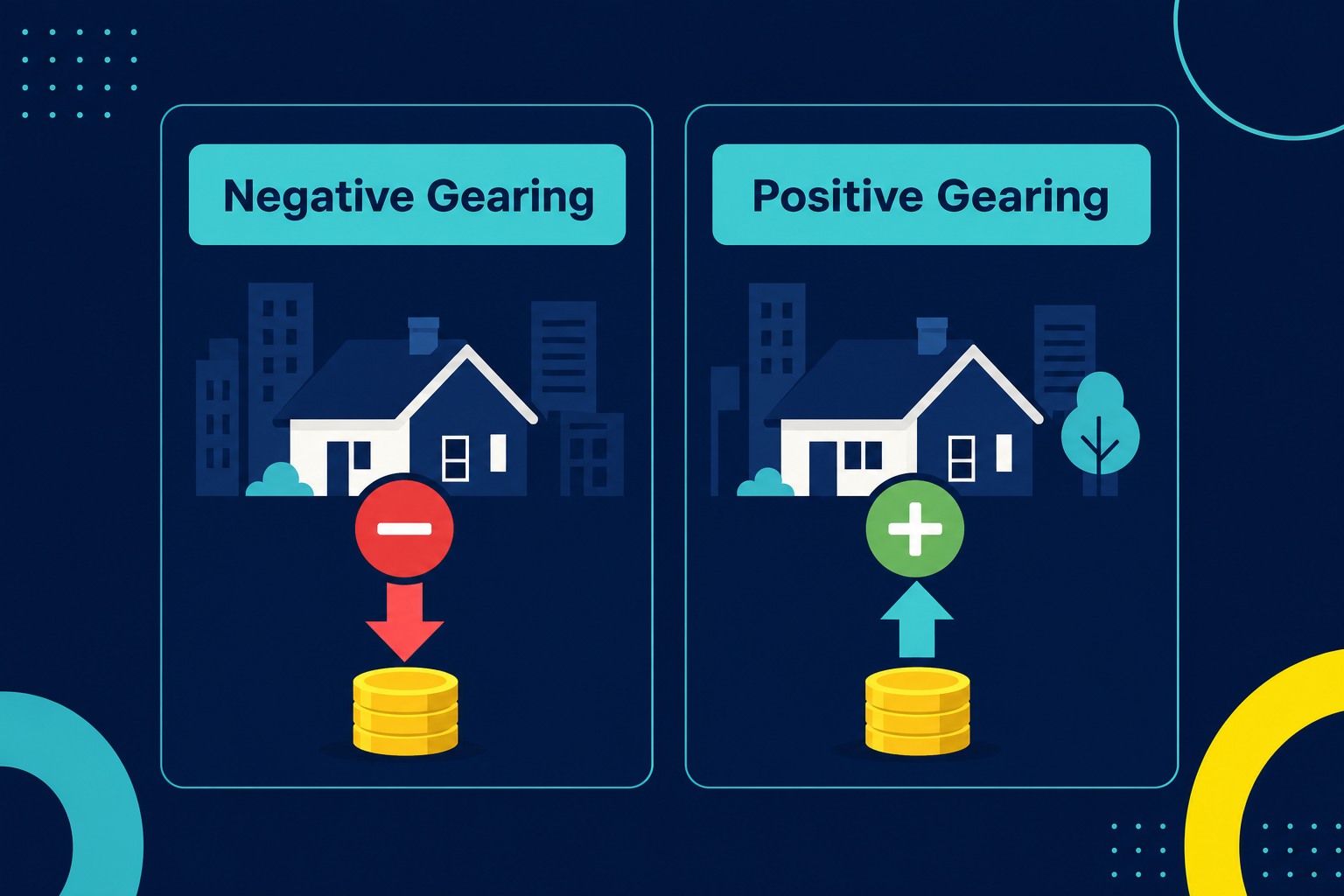
Positive gearing changes that dynamic entirely. When rental income covers or exceeds total holding costs, the investor is no longer funding a shortfall. The asset contributes to the portfolio rather than drawing from personal income each month. For investors planning to build a resilient property portfolio, that shift in cash flow position can be the difference between being able to hold and being forced to sell.
What the post-2026 Budget environment changes for buyers
The headline reforms from the 12 May 2026 Federal Budget introduced two major changes to the property investment landscape. First, from 1 July 2027, negative gearing on residential property will be limited to new builds. Established properties acquired after Budget night will no longer allow rental losses to be deducted against broader income such as wages, though losses can be carried forward to offset future residential property income.
Second, the 50% capital gains tax discount is proposed to be replaced with cost-base indexation and a 30% minimum tax rate on capital gains from 1 July 2027. Existing properties held before Budget night are grandfathered for the negative gearing changes. These are significant shifts – as detailed in the government's Budget housing reforms – but it is important to note the changes still require full legislation before they take effect.
| Change | Established Properties (new purchases post 12 May 2026) | New Builds |
|---|---|---|
| Negative gearing | Quarantined (losses offset only against property income) | Fully retained |
| CGT discount (from 1 July 2027) | Replaced by indexation + 30% min. rate | Investor can choose old or new method |
| Grandfathering | Yes, for properties held before Budget night | Not applicable |
| Cash flow dependency | Higher – income must cover more costs | Lower – tax benefit reduces holding cost |
For investors thinking through their next move, the implication is direct: for newly acquired established properties, cash flow quality now carries more weight than ever before. You cannot rely on a tax offset to subsidise a poorly performing asset. This has put income-positive investing back at the centre of portfolio conversations across the country.
According to CBA's updated housing outlook following the Budget, dwelling price growth is forecast at 3% to December 2026 – a more modest environment than many investors assumed heading into the year. That moderating backdrop makes starting cash flow position even more critical for total return calculations.
Why established properties can be strategically attractive
The Budget's carve-out for new builds has sent some investors directly toward off-the-plan and new construction. That can be a sound approach in the right circumstances, but it also introduces a different set of risks: construction timelines, valuation gaps at completion, developer risk, and limited comparable sales data to verify whether the purchase price reflects genuine market value.
Established properties sidestep many of those uncertainties. A property with rental history offers real data: actual vacancy periods, what tenants have paid, how rents have moved, and what maintenance costs have looked like. That is harder to model on a new build that has never been tenanted. Established stock in mature locations also tends to draw from a broader tenant pool – families, working professionals, and long-term renters who prioritise suburb quality, access to schools, and transport links over the novelty of a new fit-out.
From a comparables perspective, established properties in established suburbs come with transaction history. You can verify recent sales, check price movements, and build a more grounded view of what the asset is worth before you negotiate. That visibility is genuinely useful – it creates the conditions for disciplined buying rather than speculative pricing.
The two-speed property market emerging across Australia in 2026 further supports selectivity. Not every established market is equally attractive, but markets where rental demand is structurally tight and supply constrained can offer both income stability and long-run growth potential.
The cash flow and risk-management lens
Positive gearing supports what experienced investors call borrowing resilience – the ability to hold a property through a rate cycle without requiring the asset to be subsidised by personal income. When national asking rents are growing at 6.6% year-on-year according to SQM Research and national vacancy sits at approximately 1.2%, the fundamentals underpinning rental income remain supportive across most markets.
That said, results vary significantly depending on the asset, location, purchase price, financing structure, and assumptions about vacancy and maintenance. Positive gearing is not a guaranteed outcome – it is a calculation that must be run on each individual property with realistic inputs. An investor who buys at an inflated price, assumes full occupancy throughout the year, and ignores maintenance reserves may believe they are positively geared when the true position is neutral or negative.
From a portfolio construction perspective, cash flow-positive assets also expand future borrowing capacity. Lenders typically count surplus rental income as serviceability, which means a positively geared property can improve your ability to finance the next acquisition. For investors focused on systematic portfolio growth, that compounding effect on borrowing power is a meaningful structural advantage.
It is also worth considering the role these assets can play in a mixed portfolio. Many experienced investors hold a blend – some income-focused established properties providing cash flow stability, alongside growth-oriented assets in locations with stronger capital appreciation prospects. Dual income property strategies represent one way to pursue both objectives simultaneously, where a single title generates combined yields that approach or exceed holding costs.
How to assess whether a property is truly positive geared
Gross yield figures are the number agents advertise. Net cash flow is the number that matters. The gap between the two can easily represent 2% to 3% of the property's value each year once you account for all running costs.
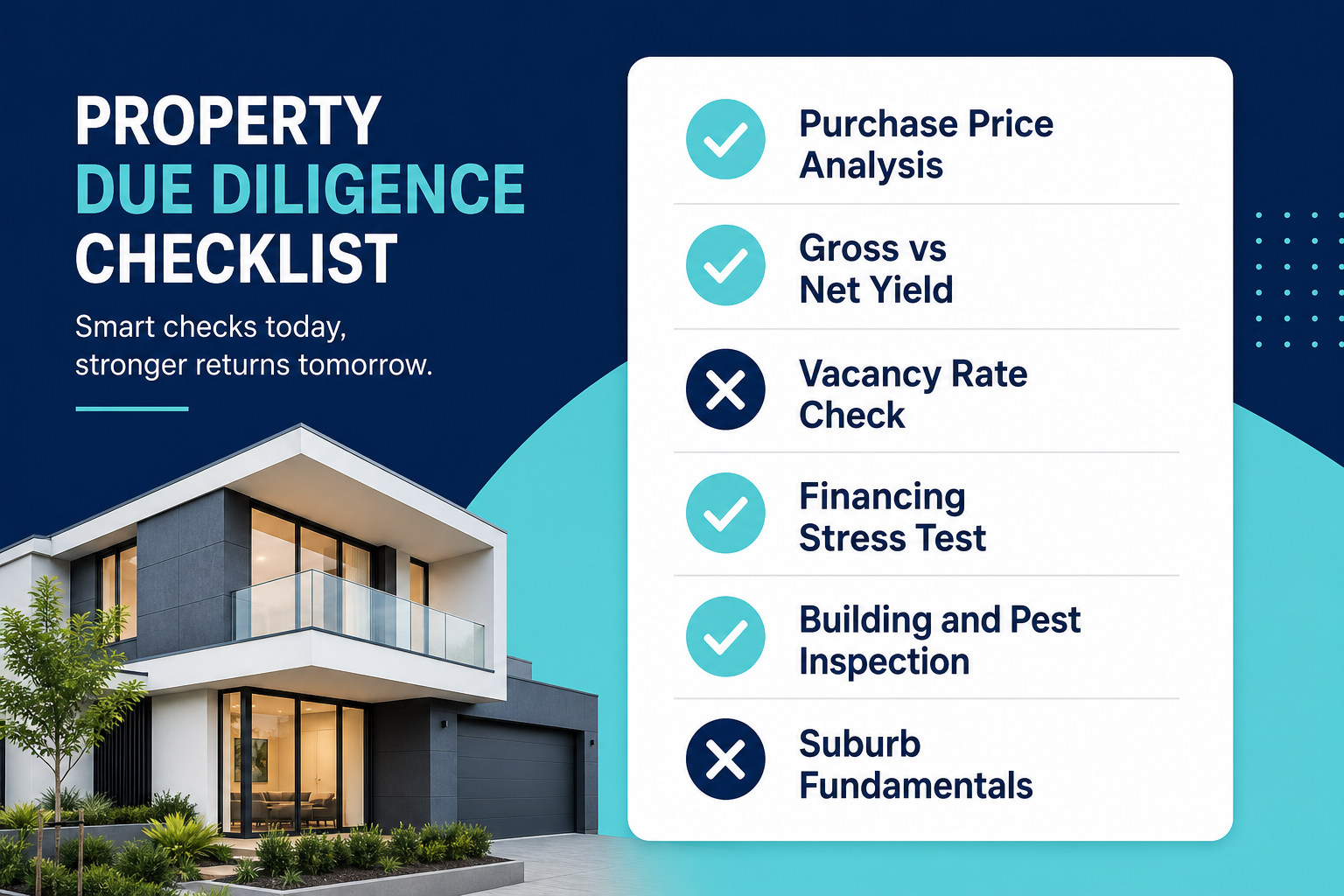
A practical positive-gearing assessment should work through the following items:
- Purchase price and LVR: Your deposit size directly affects loan size and therefore interest cost. A 30% deposit versus 20% meaningfully changes the cash flow equation.
- Gross yield: Annual rent divided by purchase price. A gross yield above 6.5–7% is typically needed at standard 80% LVR financing rates in mid-2026 to approach neutral or positive territory, though this depends on your specific loan rate and cost structure.
- Net yield: Subtract property management fees (typically 7–10% of rent), council rates, water rates, landlord insurance, maintenance allowance (budget 1–2% of property value annually), and any body corporate or strata costs.
- Vacancy risk: Model at least 4–6 weeks vacancy per year even in tight markets. Check the suburb's actual vacancy rate via SQM Research rather than relying on agent estimates.
- Financing structure: Interest-only loans reduce monthly cash outflow but do not build equity. The eventual switch to principal-and-interest creates a step-up in repayments. Structure matters.
- Stress testing: Run the numbers with your interest rate 1–1.5% higher. If the position is still serviceable, you have a genuine buffer.
| Assessment Factor | What to Check | Common Mistake |
|---|---|---|
| Gross yield | Annual rent / purchase price x 100 | Treating this as the final figure |
| Net yield | Gross yield minus all running costs | Ignoring vacancy and maintenance |
| Vacancy rate | SQM Research suburb-level data | Using metro averages for regional buys |
| Financing cost | Actual investor rate at your LVR | Modelling at owner-occupier rates |
| Stress test | Recalculate at +1.5% interest rate | Assuming rates stay static |
The practical process of buying a cash flow positive property is detailed – and shortcuts at the analysis stage tend to show up as costly surprises after settlement.
Common mistakes investors make when chasing positive cash flow
The appeal of income-positive property can push investors into poor decisions if the search for yield replaces disciplined analysis. Several patterns appear consistently among investors who end up disappointed with cash flow assets.
Overpaying to secure the deal. A property bought 10–15% above market value needs a materially higher yield just to recover from the purchase. The cost of overpaying relative to what a buyers agent fee might have prevented is often far greater than investors expect.
Buying in weak or single-industry locations. Regional markets with high gross yields often carry concentration risk – a dominant employer, mining operation, or seasonal workforce can collapse rental demand rapidly. A yield of 9% in a town dependent on one employer is not the same quality asset as a 6% yield in a diversified regional centre with multiple demand drivers.
Ignoring due diligence. Building and pest inspections, title searches, flood overlays, zoning checks, and body corporate records all matter. A property with structural issues, litigation risk in the strata, or planning restrictions on future use can destroy the investment thesis regardless of its yield.
Confusing headline yield with long-term investment quality. A cheap property in a low-demand suburb that happens to yield 7% might never deliver meaningful capital growth. An investor who holds it for a decade ends up with income but no equity progression – which undermines the portfolio compounding effect they were building toward. The biggest property investment mistakes Australians are making in 2026 often come back to exactly this trade-off, where short-term yield metrics crowd out long-term fundamentals.
Where a buyers agent adds value
For investors assessing positive-geared opportunities in the post-Budget landscape, the challenge is not simply finding a high-yield listing – it is finding a high-yield asset in a location with genuine long-term tenant demand, verifiable comparables, and a purchase price that reflects reality rather than optimism.
That is precisely where Buyers Agency Australia operates. Dragan Dimovski, who brings more than 20 years of property investment experience, has built the firm's approach around data-led suburb selection, disciplined due diligence, and access to off-market stock that does not reach the open market. For investors seeking income-positive established properties, off-market access matters – it means negotiating from an informed position without competing against a field of buyers who have also spotted the same publicly advertised yield.
The strategic value of a buyers agent in this environment goes beyond sourcing. Running the actual cash flow numbers – accounting for your specific loan rate, management costs, vacancy assumptions, and maintenance reserves – requires both data access and real-world experience. Modelling a deal incorrectly at this stage is a structural risk, not just a paperwork error. A disciplined acquisition process protects the integrity of the investment thesis from day one.
For investors building or restructuring a portfolio around the top property investment hotspots and strategies for 2026, having experienced representation on the buy side is not a luxury – it is a structural advantage in a more policy-sensitive and cost-conscious market. If you want to understand how the negative gearing and CGT changes interact with your specific holdings, our detailed breakdown of negative gearing and CGT changes for Australian property investors is a useful starting point.
If you are navigating your property investment strategy in the post-Budget environment, book a free strategy session to map out a clear acquisition framework before committing capital.

Next steps for investors
The policy environment has changed. The analytical discipline required to invest well has not – if anything, it has increased. Here is a practical framework for investors assessing positive-geared established properties right now:
- Clarify your borrowing position. Know your actual investor loan rate and maximum LVR before assessing any property's cash flow viability.
- Run net cash flow, not gross yield. Build a full holding cost model before shortlisting any asset.
- Check vacancy at the suburb level. National averages mask significant local variation. Use current data sources for the specific suburb you are assessing.
- Stress-test at higher rates. The position should remain serviceable at 1–1.5% above your current rate.
- Assess the location fundamentals, not just the yield. Tenant demand drivers, employment diversity, infrastructure access, and comparable sales depth all matter for long-term hold quality.
- Get proper due diligence on every shortlisted property. Building and pest, strata records (where relevant), flood and planning checks.
The investors who navigate this environment well will be those who treat cash flow discipline and location quality as inseparable – not as a trade-off. Buyers Agency Australia works with investors at each of these stages, from initial strategy through to settlement and beyond.
Ready to take the next step? Book a free strategy session with the team, or contact the team directly to discuss your investment brief.
Frequently Asked Questions
What is a positive-geared property in Australia?
A positive-geared property generates rental income that exceeds all holding costs – mortgage repayments, rates, insurance, management fees, and maintenance – leaving a net surplus each period.
Does the 2026 Budget make established property a worse investment?
Not automatically. It changes the tax treatment for new purchases, making cash flow quality more important. Well-selected established properties with strong yields remain viable investment assets.
What gross yield do I need for positive gearing in 2026?
At standard 80% LVR with investor rates around 6.2–6.8%, a gross yield above 6.5–7% is generally needed to approach neutral or positive cash flow before tax, depending on location costs.
Are the 2026 Budget negative gearing changes already in effect?
The changes were announced on 12 May 2026 and apply to properties acquired after that date, but full legislation is still pending. The proposed start date for the negative gearing limit is 1 July 2027.
How does a buyers agent help with positive cash flow property selection?
A buyers agent provides data-led suburb analysis, realistic cash flow modelling, due diligence oversight, and access to off-market stock – reducing the risk of overpaying or buying in the wrong location.