
Australian property investors in 2026 face a more complex but still opportunity-rich market. The headline cycle has shifted – rate hikes returned, tax changes are coming, and some capital city markets are softening – yet structural undersupply, tight rentals, and long-run demographic tailwinds continue to reward investors who lead with strategy rather than sentiment. This guide breaks down the eight most important trends shaping smart acquisition decisions right now.
Introduction: What Smart Australian Investors Are Prioritising in 2026
The property conversation in 2026 has moved beyond simple questions about interest rates or which city is "hot." Serious investors are asking sharper questions: Which fundamentals actually hold up through a rate cycle? Where does cash flow still make sense without compromising growth? How do I sequence my next purchase within a broader plan?
Those questions matter more than ever. Buyers Agency Australia has observed that the clients who enter 2026 with the clearest investment frameworks are best positioned to act decisively when the right asset appears. The noise around the market is loud; the right property investment strategy cuts through it.
Capital city housing prices rose 7.3% in 2025 before the RBA's rate hike cycle resumed, according to ANZ's February 2026 Australian Housing Outlook. That growth has moderated into 2026 as borrowing capacity tightens, but property hasn't stopped performing for disciplined buyers. The divide is widening between markets and between investors – and that gap is where strategy lives.
1. Growth-Focused Suburbs with Strong Long-Term Fundamentals
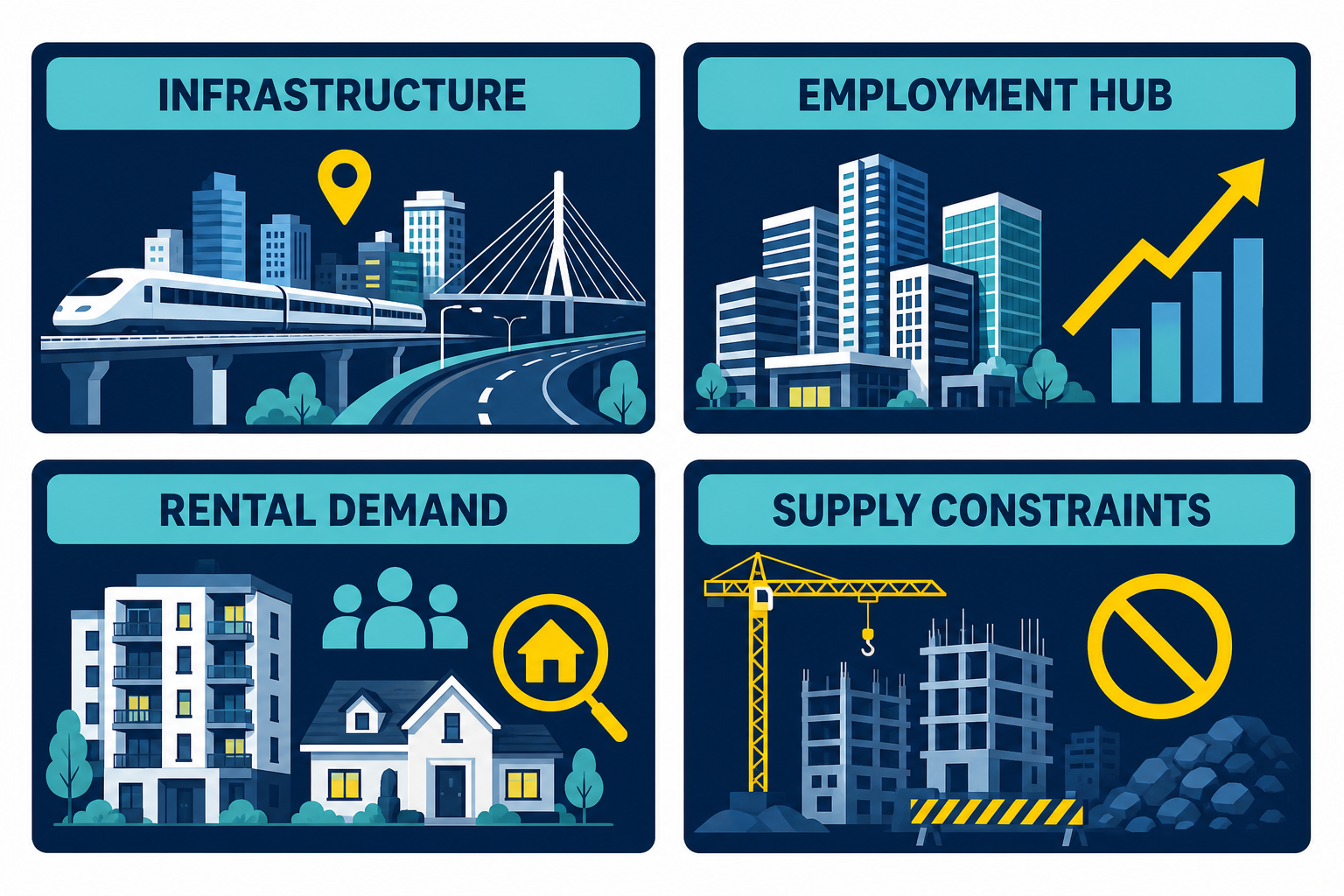
The most consistent investors in 2026 are not chasing suburbs that have already run hard. They are identifying locations where the underlying drivers – employment diversity, infrastructure investment, and amenity – create durable demand regardless of short-term rate noise.
Key indicators worth examining include proximity to major employment hubs, planned transport corridors, hospital and university precincts, and population growth supported by genuine job creation rather than lifestyle migration alone. Perth continued to record some of the strongest listed stock shortfalls nationally, with advertised listings sitting around 40% below the five-year average, maintaining upward pressure on values despite affordability constraints.
Understanding how professional buyers agents analyse growth suburbs using data rather than headlines gives investors a practical framework for filtering noise from signal. The best suburbs in 2026 are not always the most talked-about ones.
2. Cash Flow Remains Important, but Selection Is More Nuanced
With the RBA cash rate sitting at 4.10% as of May 2026, holding costs are a real consideration for every investor. But the response to that pressure is not to chase the highest gross yield at the expense of everything else – it is to select assets where yield and growth potential overlap.
Nationally, rents are up 5.7% over the year to April 2026, according to Cotality's latest rental data, and the vacancy rate remains at 1.6% – well below the historical average of 2.5% to 3.3%. That rental tightness means well-chosen assets can generate meaningful income, but yield alone does not guarantee growth. Investors who understand the capital growth versus cash flow trade-off are better placed to build a portfolio that works across multiple rate environments.
No return can be guaranteed. What can be controlled is the research process, the location selection, and the asset quality that underpins both income and long-run value.
3. Established Properties Versus New Stock
The debate between established and new dwellings has gained fresh relevance in 2026 as build costs remain elevated and construction timelines stay stretched. For most investors with a capital growth focus, established properties continue to represent the preferred path.
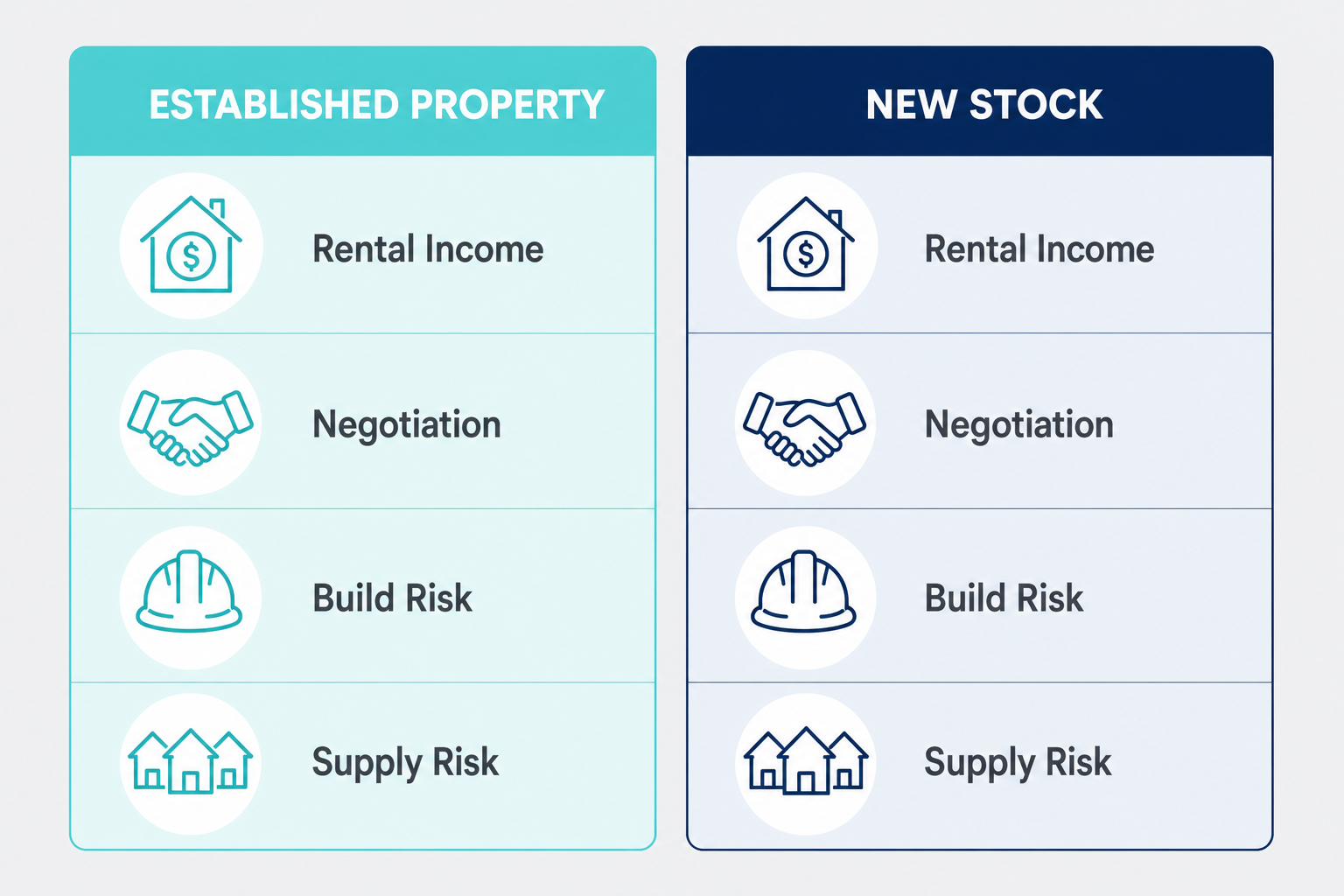
Established homes typically offer known condition, immediate rental income, and negotiable pricing – particularly as vendor discounting has widened to a median of 3.1% across combined capitals. New stock, including off-the-plan apartments and house-and-land packages, may suit investors seeking specific depreciation profiles or targeting government incentives, but valuations at settlement, builder risk, and supply concentration in certain corridors deserve careful scrutiny.
| Factor | Established Property | New / Off-the-Plan |
|---|---|---|
| Rental income | Immediate | Delayed until completion |
| Negotiation | Typically flexible | Limited |
| Depreciation | Reduced | Higher in early years |
| Build risk | None | Completion and valuation risk |
| Supply risk | Usually lower | Higher in certain corridors |
As Buyers Agency Australia approaches property selection, established assets in proven locations remain the starting point for most investor briefs – particularly for those building a property portfolio with repeatable acquisition logic.
4. Unit Markets in Selected Locations Are Attracting Attention
For many years, the conventional investor wisdom favoured houses over units. That preference remains valid in many contexts, but 2026 is producing genuine exceptions. Brisbane units surged 20.3% year-on-year to February 2026, outpacing even Brisbane houses at 14.6%, according to PropTrack and Cotality data.
The structural shift is driven by affordability pressure. As median house prices climb past $1 million in Brisbane, Adelaide, and Perth, well-located units and townhouses are absorbing demand from buyers who cannot reach the house median. Three factors make certain unit markets worth examining: lower entry price within desirable suburbs, tighter vacancy rates in the unit sector specifically (1.5% nationally), and growing tenant demand from smaller households and young professionals.
Selection still matters enormously. Oversupplied corridors, high body corporate levies, short-term let saturation, and poor floor plans can erode returns. The question is not whether to buy a unit but whether the specific building, location, and price point represent a credible case for growth and income.
5. Off-Market Opportunities Still Matter for Serious Buyers
Off-market access is frequently overstated as a guaranteed advantage. In reality, it is one input within a disciplined acquisition process – but a meaningful one when the market is competitive and listed stock sits well below average.
When an investor has a clearly defined brief, a trusted agent network, and the capacity to act quickly on a well-priced property, off-market opportunities can reduce competition and occasionally allow a negotiated outcome that would not be available at public auction. The off-market property landscape is not a secret pipeline of discounted assets – it is a relationship-driven channel that rewards preparation over opportunism.
For investors working within a fixed budget and a specific brief, Buyers Agency Australia maintains active agent relationships across multiple markets to surface properties before they are formally listed. That access matters most when on-market competition is fierce and speed is an advantage.
If you want to understand how that process works in practice, book a free strategy session to discuss your brief and buying timeline.
6. Portfolio Sequencing and Equity Recycling
One of the clearest differences between investors who build wealth through property and those who stall is how intentionally they sequence each purchase. A single investment property is a start; a considered portfolio is a plan.
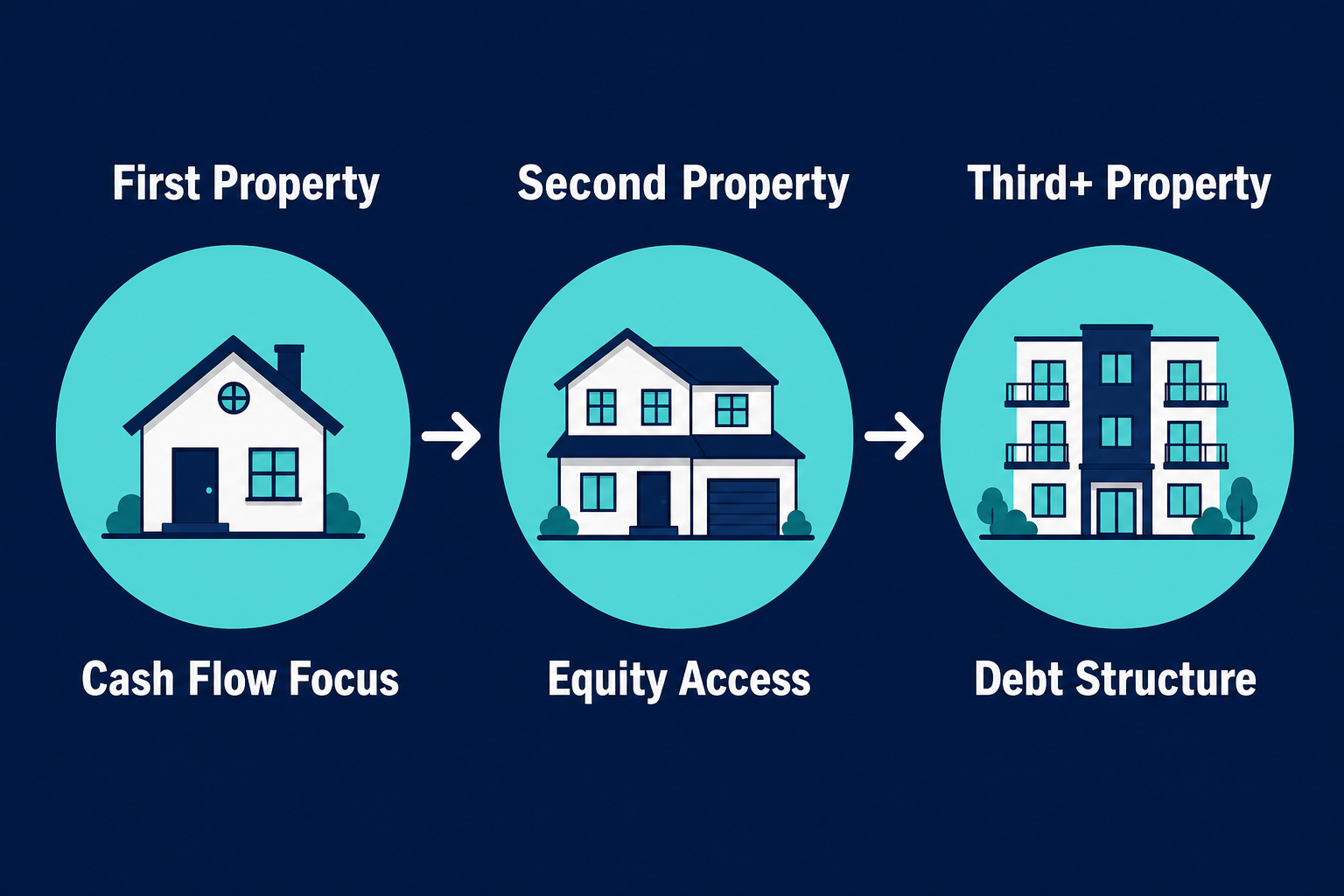
Equity recycling – the practice of drawing on grown equity in existing assets to fund future deposits – requires accurate valuation awareness, lending capacity planning, and a clear view of where each next purchase fits within the overall strategy. The smart investors turning one property into five are not doing so by accident. They are working within structured plans that account for serviceability, cash flow buffer, and hold periods across the portfolio.
In 2026, with serviceability buffers set at 3% above the actual lending rate under APRA guidelines, the capacity to service additional debt is a real constraint. Portfolio sequencing that accounts for cash flow, equity position, and timing is not optional – it is the difference between compounding and stalling.
| Portfolio Stage | Key Consideration | Common Mistake |
|---|---|---|
| First property | Cash flow sustainability | Ignoring holding costs |
| Second property | Equity access and serviceability | Buying too soon or too late |
| Third+ property | Debt structure and diversification | Concentrated market exposure |
Read More: Why Property Investment Strategy Matters More Than Picking The Right Suburb
7. Regional Markets with Clear Demand Drivers
Not all regional markets are equal, and the investors doing well in regional Australia in 2026 are highly selective. The difference between a regional market that outperforms and one that disappoints often comes down to two factors: genuine employment diversity and constrained supply.
Regional values have risen 51.1% over five years nationally, compared to 33.7% across combined capitals, according to Cotality data. That long-run outperformance reflects the structural affordability advantage of regional markets and the genuine migration that followed it. However, some of that growth was driven by pandemic-era migration that has partially reversed, and not every regional market has the job base to sustain price levels or rental demand independently.
Markets anchored by university towns, defence facilities, mining services, health campuses, or logistics corridors tend to show more durable fundamentals than those relying on lifestyle migration alone. Investors entering regional markets in 2026 should assess vacancy rates, days on market, and council planning pipelines before committing. The two-speed property market of 2026 is visible in the regional space as much as the capitals.
8. Due Diligence and Negotiation Are More Important Than Ever
In a market where vendor discounting is widening and buyer sentiment is more cautious, due diligence and negotiation discipline are delivering real results for prepared investors. But the same environment that rewards careful buyers also punishes those who cut corners.
Pre-purchase due diligence in 2026 should cover building and pest inspections, strata records where applicable, title searches, flood and contamination overlays, council zoning and planning notices, and a clear view of comparable sales. Skipping any of these steps in a slower market can leave investors exposed to conditions that would have been priced in during a competitive market.
Negotiation is a skill, not just a tactic. Understanding a vendor's motivation, the days on market, and the local comparable evidence allows a buyer to make a calibrated offer rather than a speculative one. For investors who lack negotiation experience or market-specific knowledge, the cost of overpaying typically dwarfs any advisory fee paid to get the process right.
Dragan Dimovski brings 20+ years of property investment experience to every acquisition, ensuring that due diligence and negotiation are handled with the rigour that protects both the purchase price and the long-term investment case.
How Buyers Agency Australia Helps Investors Act Strategically
The eight trends above share a common thread: they all reward preparation, data literacy, and a clear investment framework. That is exactly what Buyers Agency Australia provides for investors across Sydney, Brisbane, Melbourne, Perth, Adelaide, and beyond.
The team's approach combines data-led suburb analysis, off-market property access, and a structured end-to-end process that covers strategy, research, negotiation, due diligence, and settlement support. Rather than reacting to market headlines, the process starts with each investor's goals, timeline, and risk profile – then works backwards to identify the assets that fit.
For investors looking at their next purchase within a broader portfolio plan, the top investment hotspots and strategies for 2026 offer a useful starting point for market context. And for those wanting to understand whether the Australian property market is positioned for further growth, that deeper analysis is available alongside a personalised conversation about your situation.

Conclusion: Focus on Strategy, Not Headlines
The best property investment decisions in 2026 will not be made by investors who correctly predicted the RBA's next move or picked the suburb that generated the most media coverage. They will be made by investors who understood their own goals, built a coherent property investment strategy around them, and executed that strategy with discipline.
Market conditions change. Interest rates move. New tax rules arrive. What does not change is the underlying logic that well-researched, well-purchased assets in locations with genuine demand drivers compound wealth over time.
If you are ready to map out your next property move with a team that has seen these cycles before, book a free strategy session with Buyers Agency Australia. For direct enquiries, contact the team to discuss your situation and next steps.
Frequently Asked Questions
What is the most important factor in a property investment strategy in 2026?
Location fundamentals – employment, infrastructure, and supply constraints – matter more than timing the market or chasing recent price performance.
Are units a good investment in Australia in 2026?
Selected unit markets, particularly in Brisbane and supply-constrained capital city suburbs, are attracting genuine investor interest as affordability pressure shifts demand.
How does off-market property access help investors?
Off-market access reduces auction competition and can allow negotiated pricing, but it works best within a clearly defined brief and active agent network, not as a standalone strategy.
What is equity recycling in a property portfolio?
Equity recycling involves drawing on grown equity in existing properties to fund deposits for future purchases, allowing portfolio growth without solely relying on savings.
How important is due diligence before buying an investment property?
Essential. Building reports, title checks, zoning overlays, and comparable sales analysis protect against overpaying and reveal risks that are not visible in a listing description.