
The rules of Australian property investment have shifted decisively. With the RBA raising the cash rate three times in 2026 to a current 4.35%, investor mortgage rates sitting above 6%, and proposed changes to negative gearing announced in the May federal Budget, the cost of holding a poorly selected property has never been higher. Investors who built portfolios around capital growth alone and accepted deeply negative cash flow as standard practice are now carrying a real and growing burden.
Why positive cash flow matters in 2026
For most of the last decade, negative gearing was almost a badge of honour in Australian property circles. Rates were low, borrowing capacity was generous, and the tax benefits of offsetting rental losses against salary income made the maths feel manageable. That era has closed.
The RBA has raised the official cash rate three times in 2026, taking it from 3.60% to 4.35% by May, effectively unwinding all three of the cuts delivered through 2025. Annual rent growth has reaccelerated to 5.7% nationally (Cotality, May 2026), which is helping investors on the income side, but holding costs on investment loans have risen faster for many portfolios. The national vacancy rate sits at just 1.7% (Cotality, April 2026), well below the decade average of 2.5%, so rental demand remains structurally strong. That combination of tight vacancy and rising rents is what keeps cash flow positive investing viable, but it requires targeting the right markets rather than simply buying wherever prices look attractive.
The May 2026 federal Budget added further urgency. From 1 July 2027, negative gearing on established residential properties purchased after Budget night will be restricted, meaning rental losses can no longer be offset against wages or other income for newly purchased established properties. Investors who rely on salary-linked tax benefits to make negatively geared properties work will face a fundamentally different equation. Cash flow positive properties, where rental income covers all holding costs without relying on the tax refund, will carry considerably less policy risk going forward.
For investors exploring where the strongest opportunities are sitting right now, the top property investment hotspots and strategies for 2026 offer a useful starting point for understanding which markets are aligning yield with growth fundamentals.
Positive cash flow vs capital growth: how to think about the trade-off
The tension between cash flow and capital growth is real, and anyone who tells you it does not exist is selling something. The highest-yielding suburbs in Australia, places like regional north Queensland, outer Western Australia, and fringe South Australia markets with gross yields of 6.8% to 8.5%, are rarely the same suburbs producing the strongest long-term capital growth. That is not a flaw. It is simply how yield math works: higher income return often reflects a lower price base or lower growth expectations already priced into the market.
The more useful question is not "which is better" but "what does my situation actually require right now?"
An investor with strong income and manageable debt load may accept mild negative gearing if the asset has genuine long-term capital growth potential in a supply-constrained market. An investor approaching their serviceability ceiling, or building toward a second or third property, often cannot absorb another $400 to $600 per month in holding costs. For that investor, stronger cash flow is not just a preference, it is a structural necessity.
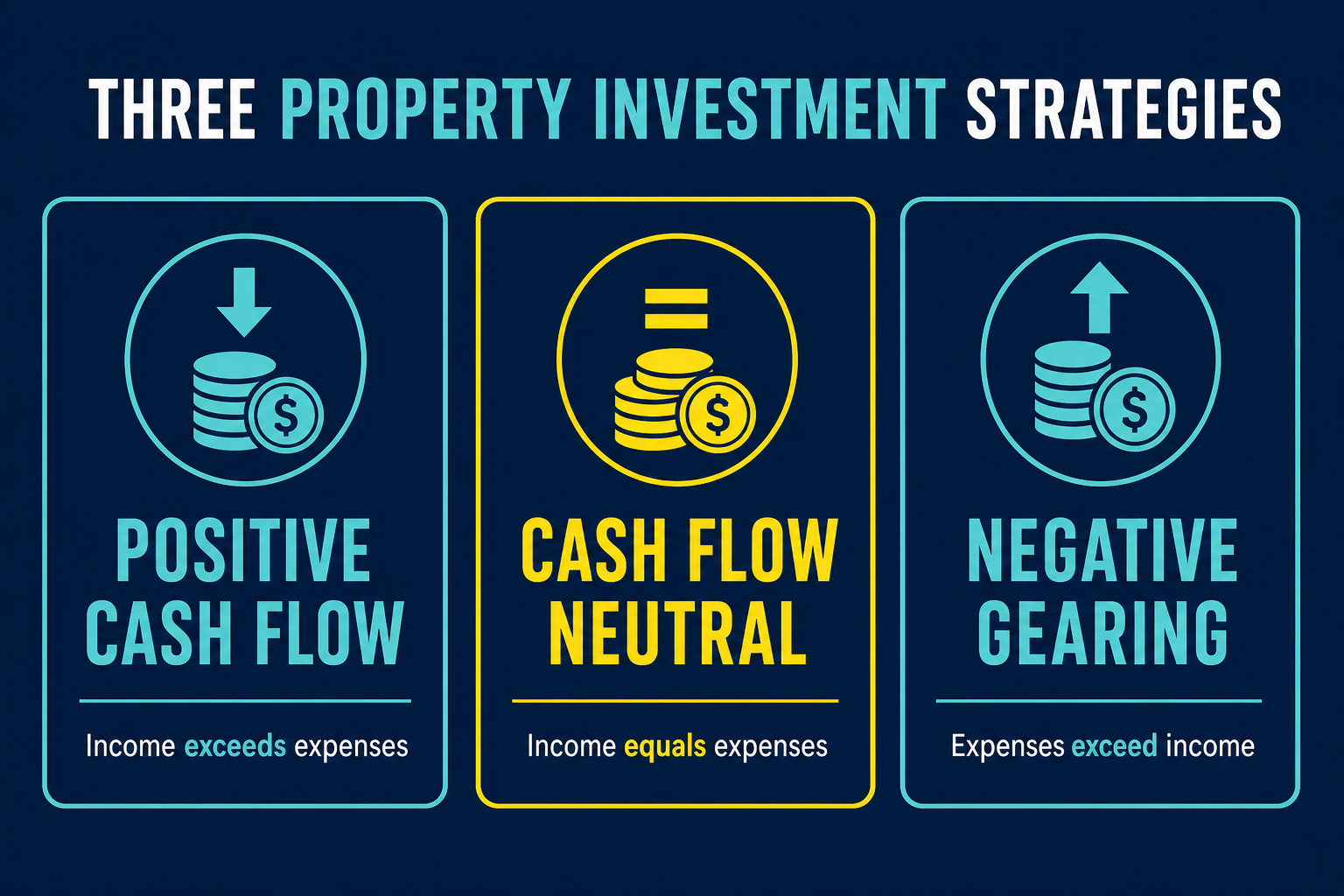
| Strategy | Best suited to | Key trade-off |
|---|---|---|
| Positive cash flow | Investors near serviceability limits, portfolio builders | Lower capital growth in many cases |
| Mildly negative / neutral | Investors with strong income buffers | Monthly holding cost; increased policy risk post-Budget |
| Strong negative gearing | High-income earners, short-term strategy | Higher risk under 2027 tax changes for new purchases |
A sound property investment strategy will blend these considerations based on your current borrowing position, income profile, and portfolio ambitions, rather than applying a one-size-fits-all label.
What makes a property genuinely cash flow positive
Gross yield is where most investors start, and where many make their first mistake. A property advertising a 6.5% gross yield can still be deeply negative in practice. Once you account for all holding costs, the real picture often looks very different.
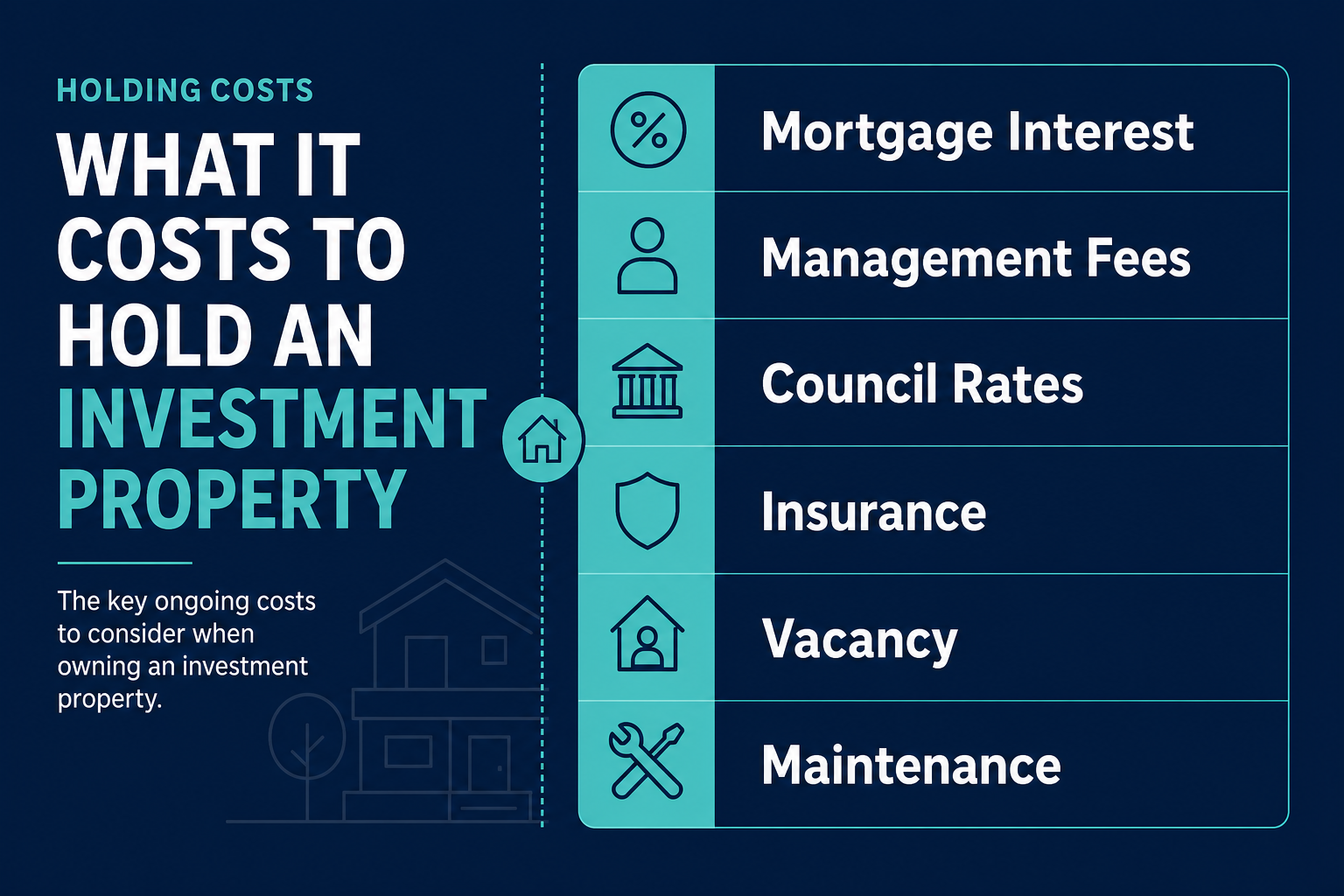
A genuinely cash flow positive outcome means that annual net rental income, after all costs including mortgage interest, exceeds total holding costs and leaves a monthly surplus. The costs that eat into gross yield include:
- Mortgage interest: At 80% LVR with a 6.2% investor rate, the break-even gross yield just to cover interest sits at approximately 5.0%. Add all other costs and the true break-even rises to 6.0% to 6.5% or higher.
- Property management fees: Typically 7% to 10% of gross rent in most Australian markets.
- Council rates, water rates, and land tax: Vary significantly by state and property value.
- Landlord insurance: Often underestimated, particularly in high-risk or regional areas.
- Vacancy allowance: Even in a 1.7% vacancy environment nationally, smart underwriting assumes at least 2 to 3 weeks of vacancy per year.
- Maintenance and capital expenditure reserve: A 1% to 2% annual allowance on property value is a conservative and realistic assumption.
The gap between the headline yield and the actual net result is where portfolio decisions go wrong. A $500,000 property with a 5.5% gross yield might look reasonable on a listing portal, but after all costs it could be neutral at best and negatively geared at worst. Running a full net cash flow analysis before making any offer is non-negotiable.
For a structured approach to this analysis, the property investment due diligence checklist at Buyers Agency Australia covers exactly what to verify before committing to a purchase.
When positive cash flow can support portfolio building
One of the most practical, underappreciated benefits of a cash flow positive property is what it does to your borrowing capacity for the next purchase.
Lenders assess serviceability by looking at all existing debt obligations against income. A negatively geared property adds to your monthly expenses from a lender's perspective. In a market where serviceability buffers have tightened and lenders are scrutinising debt-service coverage ratios more carefully, each negatively geared property effectively reduces your capacity to borrow for the next one.
A cash flow positive property works in the opposite direction. The surplus income it generates is counted as income by many lenders, which can actually improve your capacity to service further debt. For investors with a clear goal of building a multi-property property portfolio, this is a meaningful structural advantage.
This is also why dual-income properties have attracted significant investor interest in 2026. A house with a secondary dwelling or a granny flat can shift a property from a 3.5% to 4.0% gross yield into a 6.0% to 7.0% yield range, depending on the configuration and local rental market. That shift can be the difference between a property that holds back your portfolio and one that funds it. The dual income property strategy for 2026 explores this approach in more detail.
Cash flow positive properties also reduce portfolio pressure during rate volatility. Investors with positive cash flow buffers are better placed to hold through uncertain periods without being forced to sell at the wrong time. In a market where the RBA has shown a willingness to raise rates three times in a single calendar year, that resilience has real value.
Risks and misconceptions to avoid
Chasing yield alone is one of the most consistent ways investors destroy long-term wealth in Australian property. A gross yield of 9% or 10% often signals something the listing portal is not advertising clearly: a regional market with limited population growth, an oversupplied dwelling type, a mining-town exposure, or a price that reflects minimal future demand.
The biggest misconceptions to watch for:
High yield does not mean high quality. Asset quality drives long-term total return. A property in a supply-constrained, economically diverse market at a 5.5% yield will almost always outperform a 9% yield property in a single-industry town over a ten-year horizon. Prioritise asset quality and yield together, not yield in isolation.
Gross yield is not net cash flow. This distinction is covered above but bears repeating. Always model the full holding cost before drawing a conclusion about cash flow.
Positive cash flow is not just a regional play. While regional Queensland, outer WA, and fringe SA markets dominate the cash-flow-positive landscape in 2026, dual-income configurations in metropolitan fringe markets, well-located units in Brisbane and Adelaide, and strategic suburb selection can produce defensible yields without sacrificing all capital growth potential.
Vacancy rates can move. The current 1.7% national vacancy rate is historically very tight. Markets that depend on tourism, seasonal employment, or a single major employer can see vacancy rates double or triple quickly. Run your cash flow analysis on a 5% vacancy assumption minimum, not on today's market conditions alone.
For investors who want a broader view of the mistakes derailing portfolios right now, the biggest property investment mistakes Australians are making in 2026 is worth reading before making any purchase decision.
How a buyers agent can help assess opportunities
Assessing whether a property is genuinely cash flow positive requires more than a quick yield calculation on a listing portal. It requires verified rental data, an honest vacancy assessment, a clear view of comparable sales, a full holding cost model, and the negotiation capability to buy at a price that preserves the cash flow advantage.
This is where Buyers Agency Australia adds specific, measurable value for investors focused on cash flow outcomes. Dragan Dimovski, founder and lead buyers agent with 20-plus years of property investment experience, approaches every brief with a strategy-first mindset. Rather than searching for a property and hoping the numbers work, the process starts with your income position, borrowing capacity, target yield, and portfolio goals, and works backward to a clear purchase criteria.
The practical support covers:
- Market and suburb research: Identifying markets where yield and vacancy fundamentals genuinely support positive cash flow, not just where gross yields look attractive on paper.
- Property due diligence: Full holding cost modelling, rental appraisal verification, building and pest assessment coordination, and title and zoning checks before any offer is made.
- Off-market access: A meaningful share of strong investment-grade properties are transacted off market, and access to these opportunities typically requires buyer-side relationships that individual investors cannot easily replicate.
- Negotiation: Buying at the right price directly affects yield. Every dollar saved on purchase price improves your cash flow from day one.
- Portfolio sequencing: Understanding which purchase to make now, in which market, at which price point, to keep serviceability intact for the next acquisition.
For investors who want to understand what separates a genuinely capable buyer-side advisor from a poor one, what makes a good buyers agent in 2026 covers the key selection criteria and red flags in detail.
To book a free strategy session and map out a cash flow focused purchase plan with the Buyers Agency Australia team, the consultation covers your current position, target markets, and a clear next step forward.

Next steps for investors
Before acting on a cash flow property opportunity, use this checklist to confirm your position is solid:
- Know your current serviceability position. Get an updated borrowing capacity assessment from a mortgage broker familiar with investor lending. This is the ceiling everything else works within.
- Run a full net cash flow model. Include mortgage interest at today's rate, management fees, council rates, insurance, 2-3 weeks vacancy, and a 1% maintenance reserve. Do not rely on gross yield figures from a listing portal.
- Assess the vacancy fundamentals. Check SQM Research or CoreLogic vacancy data for the specific suburb, not just the state average. Look for markets consistently below 2.5%.
- Review asset quality alongside yield. Is the suburb population growing? Is the local economy diversified? Is there meaningful infrastructure investment or employment demand? Yield must be supported by underlying demand drivers.
- Consider the post-Budget tax environment. If you are purchasing an established property after 12 May 2026, understand how the 2027 negative gearing changes affect your modelling. Cash flow positive properties are more resilient to these changes than negatively geared ones.
- Plan the portfolio sequence. Decide whether this purchase is a standalone acquisition or one step in a multi-property strategy. The sequencing affects which market, which price point, and which property type makes the most sense right now.
- Seek professional advice. Property investment advice from a qualified buyers agent and tax advice from a property-specialist accountant are both worth investing in before committing to a purchase of this size.
If you are serious about acquiring a cash flow positive property in 2026, map out your next property move with a strategy session. And if you are ready to speak to the team directly, contact the team to get started.
Frequently Asked Questions
What does positive cash flow mean in property investment?
A property is positively cash flow when rental income exceeds all holding costs, including mortgage interest, management fees, insurance, and maintenance, leaving a monthly surplus.
Is positive cash flow property investing still possible in Australia in 2026?
Yes, but it requires deliberate suburb selection. Regional Queensland, outer WA, fringe SA, and dual-income configurations in metro fringe areas offer the strongest opportunities at current interest rates.
How does a cash flow positive property help with borrowing capacity?
Surplus rental income from positively geared properties is recognised as income by many lenders, which can improve your ability to qualify for finance on subsequent investment purchases.
What is the minimum gross yield needed for positive cash flow in 2026?
At an 80% LVR with a 6.2% investor rate, break-even gross yield before other costs sits around 5.0%. After all holding costs, the threshold rises to approximately 6.0% to 6.5% or higher depending on the property and state.
How do the 2027 negative gearing changes affect cash flow property strategy?
From 1 July 2027, losses on established properties bought after 12 May 2026 cannot be offset against wages. Cash flow positive properties carry less exposure to this policy change because they do not depend on the negative gearing tax benefit to remain viable.