
The established-versus-new-build debate has never carried more weight for Australian investors. With significant tax reforms taking effect from July 2027, a capacity-constrained construction sector, and tightening borrowing conditions reshaping how every purchase decision stacks up, the case for established stock is stronger and more nuanced than it has ever been.
Why established properties are gaining the edge in 2026
The property market entering mid-2026 is operating under pressure from multiple directions. The May 2026 Federal Budget introduced the most significant property tax changes in nearly three decades, restricting negative gearing on established properties purchased after 12 May 2026 to apply only from 1 July 2027. Westpac's housing forecast update projected a 34% fall in new investor activity near-term, with dwelling price growth expected to stall broadly across the major capital cities for 2026.
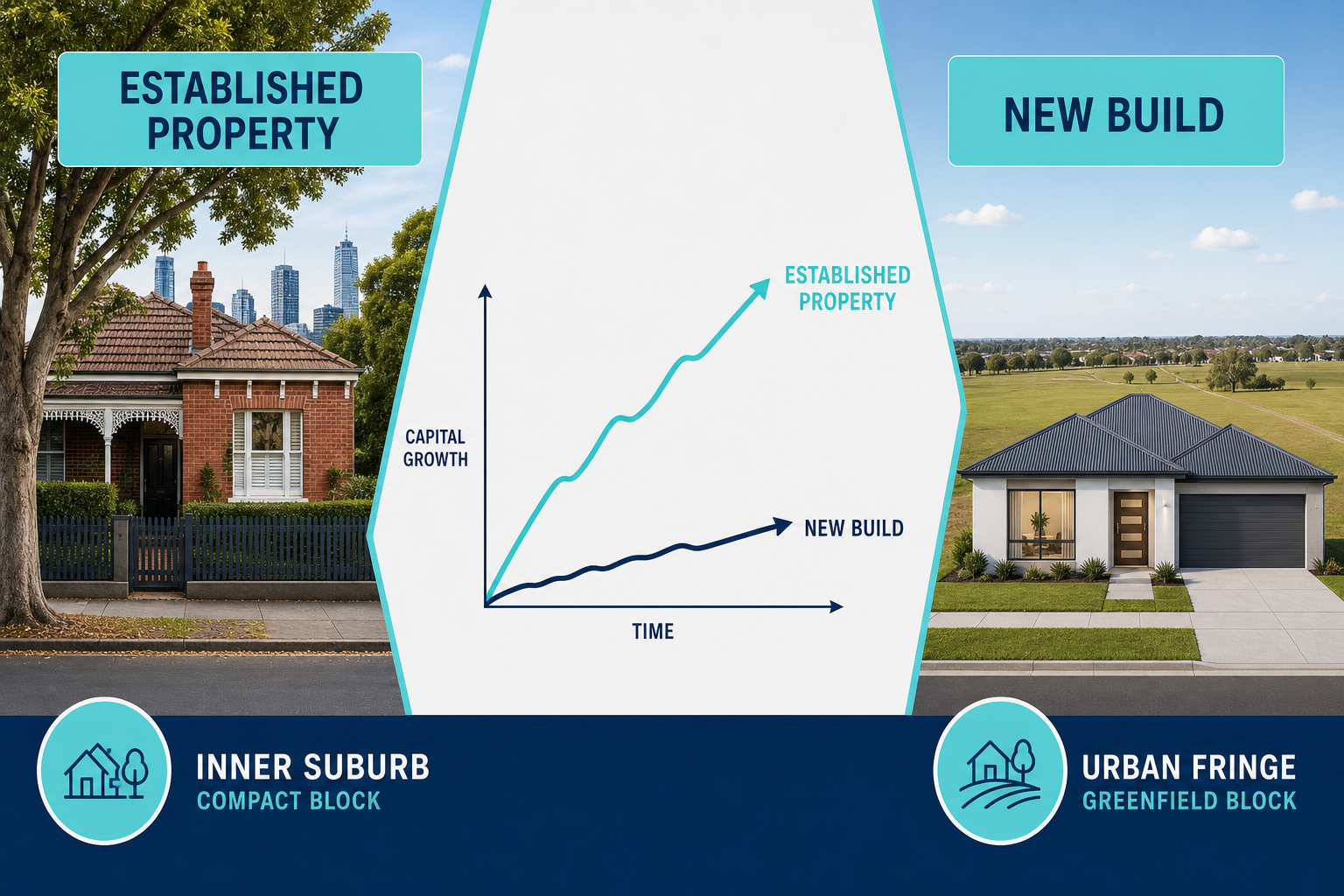
For investors who understand how property investment strategy builds long-term wealth, none of this changes the core thesis. Established properties in well-located suburbs carry a structural advantage that no policy change removes: a high land-to-asset ratio where the appreciating component dominates the balance sheet. Buildings depreciate over time; well-located land does not.
The short-term noise around tax incentives is real, but experienced investors at Buyers Agency Australia know that good property investment decisions are built on long-term fundamentals, not a single budget cycle.
Established vs new builds: the factors that matter most
The comparison between established stock and new builds ultimately comes down to what drives value over a 7 to 15 year hold. The table below summarises the key differences investors should assess before committing.
| Factor | Established Property | New Build |
|---|---|---|
| Land-to-asset ratio | Typically higher in inner/middle rings | Lower; building value dominates initially |
| Location depth | Proven suburbs, infrastructure in place | Often outer-ring or greenfield |
| Settlement risk | Low; property exists and is priced by market | Moderate to high; construction delays, builder insolvency |
| Depreciation | Limited plant and equipment post-2017 changes | Higher first-year depreciation claims |
| Renovation flexibility | Strong; value-add potential at your discretion | Nil for several years; warranty constraints apply |
| Resale buyer pool | Broad owner-occupier and investor demand | Narrower; loses "new" premium on first resale |
| Build-quality certainty | Assessed pre-purchase via inspection | Unknown until practical completion |
Land is the appreciating component of any property asset. In established suburbs, land scarcity is structural, driven by heritage overlays, planning constraints, and the simple fact that no new land is being created inside the 10 to 20-kilometre ring. This scarcity compounds over time and drives the long-term capital growth that genuine portfolio builders rely on.
New builds in greenfield estates often carry significant building value relative to land. When a buyer pays a premium for a completed new home, part of that price reflects developer margin, construction cost, and marketing. The Altus Group noted that only 174,030 homes were completed in the first year of the National Housing Accord, 27.5% below the 240,000 annual rate required, a signal that supply-side ambitions are not translating into delivered stock. That construction cost pressure flows directly into new-build pricing.
Settlement risk is a material consideration that many investors underestimate. Australia's construction sector entered 2026 with rising insolvencies, labour shortages, and persistent cost escalation. Very few projects finish on schedule due to weather events, regulatory approvals, and subcontractor failures. An investor buying off-the-plan may be waiting 18 to 36 months with capital tied up, interest accruing, and no rental income flowing.
For a comprehensive view of what can go wrong on the other side, read more: The Hidden Risks Of Buying Brand-New Investment Properties.
Where new builds can still make sense
A balanced view requires acknowledging that new builds suit specific investor profiles and strategies. Under the proposed 2026 Budget framework, eligible new builds retain full negative gearing deductibility from 1 July 2027 and investors can choose between the existing 50% CGT discount or the new indexation treatment when they sell. For a high-income earner in the 45% marginal tax bracket with a strong cash-flow focus and a short-to-medium hold horizon, the after-tax position on an eligible new build may be favourable.
Turnkey convenience also has genuine appeal for interstate or time-poor investors who cannot manage a renovation or want predictable holding costs from day one. New builds often attract better rental yields initially relative to purchase price, particularly in areas with tight rental markets and low vacancy.
Some SMSF strategies may also find new builds appropriate because the fund's tax environment differs from individual investors, and depreciation benefits are meaningful at lower tax rates. Investors in regulated superannuation funds are excluded from the negative gearing restrictions entirely.
The honest answer is: if your strategy is purely income-driven, your tax position is high, and you are buying a genuinely supply-adding new build in a suburb with strong rental fundamentals, it can work. However, tax benefits support a good investment decision; they do not replace one.
Common mistakes investors make when choosing new over established
The most damaging investor decisions tend to follow a predictable pattern. Understanding these mistakes is part of sound property investment advice for anyone evaluating their next purchase.
Chasing developer incentives. Fixed-rate finance, cashback offers, and rental guarantees are marketing tools, not investment fundamentals. Rental guarantees in particular are often priced into the purchase cost and expire after 12 to 24 months, leaving the investor exposed to the actual market rental rate.
Overvaluing display-home appeal. A display home is designed to sell. The fixtures, finishes, and landscaping shown are often upgrades not included in the standard package. Investors who buy on emotion rather than suburb fundamentals frequently find themselves holding a property that looks great but sits in a location with limited comparable sales depth and weak buyer competition at resale.
Ignoring future buyer demand. When an investor eventually sells, the property becomes an established property. At that point, a buyer will compare it against all other established stock in that suburb. If the suburb has weak owner-occupier demand, limited amenity, or a glut of similar new builds, the resale pool shrinks materially.
Underestimating holding costs and build-quality risk. Off-the-plan purchases lock in a price today for a product that is delivered in the future. If construction costs rise sharply (as they have through 2024 to 2026), the builder's margin is squeezed, and so is build quality. Warranty claims, defects, and strata disputes in new apartment complexes are consistently among the most common post-settlement complaints from investors.
| Mistake | Why It Hurts the Portfolio |
|---|---|
| Chasing incentives | Real cost is embedded in the purchase price |
| Display-home emotion | Misses suburb fundamentals and resale depth |
| Ignoring owner-occupier demand | Limits buyer pool at exit |
| Underestimating holding costs | Cash flow shortfalls undermine long-term hold |
| Skipping due diligence | Build defects and strata issues erode equity |
How a strategy-led buyers agent assesses the right purchase type
Buyers Agency Australia approaches every purchase brief from a portfolio-first position. That means understanding what the client is actually trying to achieve before any property type is considered.
Dragan Dimovski, with more than 20 years of property investment experience, builds the assessment around four core questions: What is the investor's growth objective versus income objective? What is their realistic hold period? What does their borrowing capacity and cash-flow buffer look like under stress-tested conditions? And what does exit strategy look like in five, ten, and fifteen years?
From there, the process involves a suburb-level comparison that goes beyond median prices. It accounts for infrastructure spending commitments, off-market property access, rental vacancy trends, comparable sales depth, and the ratio of owner-occupiers to investors in the target suburb. A suburb with high owner-occupier demand is a stronger signal of long-term capital growth than one driven primarily by investor buying.
For established properties, due diligence includes a building and pest inspection, strata records review (where applicable), council zoning confirmation, and a comparable sales analysis that tests both the buy-in price and the likely resale price in five to ten years. For clients considering new builds, the same rigour applies to the developer's track record, the contract terms, the feasibility of the pricing relative to comparable established stock, and the rental market in that specific suburb.
If you are weighing up the right approach for your situation, book a free strategy session to work through the numbers with the team.

What investors should review before buying in 2026
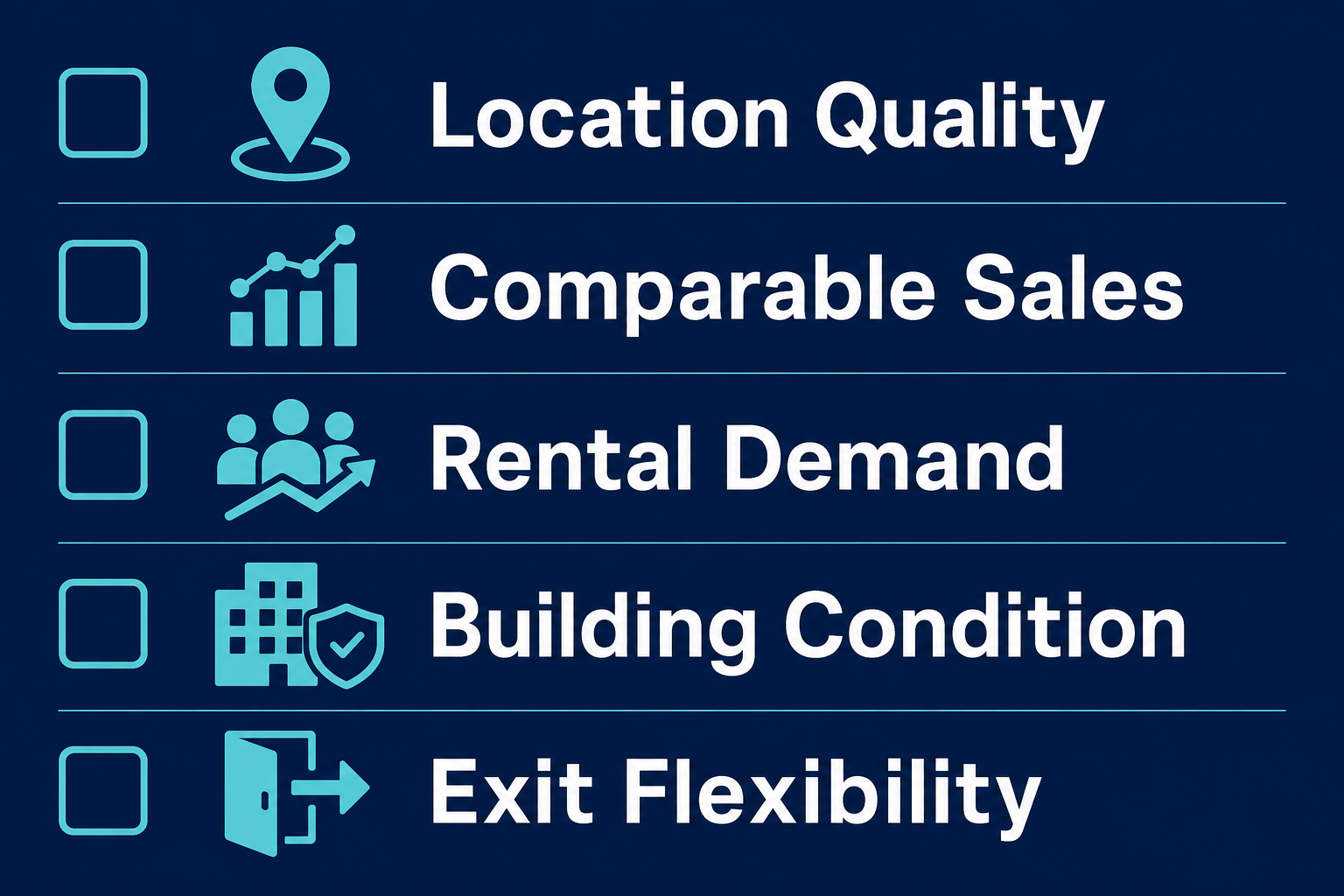
Regardless of purchase type, the following checklist covers the due diligence items that matter most in the current environment. For a more detailed breakdown, the property investment due diligence checklist covers these points in full.
Location quality
- Is there genuine infrastructure in place: employment nodes, public transport, schools, retail?
- What is the owner-occupier percentage in the suburb?
- Is the suburb in the inner or middle ring, or fringe/greenfield?
Comparable sales
- What have similar properties sold for in the last 12 months?
- Is there a sufficient volume of comparable sales to validate the asking price?
- What is the spread between buy-in price and likely resale price?
Rental demand
- What is the current vacancy rate in the suburb?
- Is rental demand driven by long-term tenants or seasonal/transient population?
- Does the gross yield support your cash flow under current interest rate conditions?
Building condition (established properties)
- Is a full building and pest inspection commissioned from an independent inspector?
- Are there any structural issues, drainage problems, or undisclosed defects?
- What is the strata maintenance fund balance and what are the capital works levy exposure?
Exit flexibility
- Who will buy this property in 10 years, and why?
- Is the suburb likely to attract a broader buyer pool over time?
- Does the property have development potential, or is it a hold-and-grow asset?
This checklist is not exhaustive, but it covers the core decision points that separate a portfolio-grade purchase from a product sale. Investors who are working through these questions for the first time will benefit from reading about top property investment hotspots and strategies for 2026 to identify where the stronger fundamentals currently sit.
Final takeaway: choose the asset that best supports long-term portfolio outcomes
The 2026 market environment is complex. The Federal Budget has introduced real tax incentives for new builds, construction costs remain elevated, and the broader market is navigating a period of slower price growth. For most investors focused on building genuine long-term wealth, established properties in well-located suburbs remain the more reliable foundation.
The land-to-asset ratio, resale depth, renovation flexibility, and proven buyer demand that characterise quality established stock are structural advantages that outlast any budget cycle. Tax benefits are one variable in the investment equation; they should support a sound purchase decision, not drive it.
If you are unsure whether established or new-build is the right fit for your strategy, the team at Buyers Agency Australia can help you work through the analysis. Map out your next property move with a free strategy session, or contact the team directly to discuss your circumstances.
Frequently asked questions
Do established properties always outperform new builds on capital growth?
Historically yes, particularly in inner and middle-ring suburbs where land scarcity drives appreciation. Location and land content matter more than the age of the building.
Will the 2026 Federal Budget changes make new builds a better investment?
New builds retain negative gearing and CGT flexibility from July 2027, which improves their tax position. However, tax benefits alone do not make a property a sound investment; location fundamentals still apply.
What is the main risk of buying off-the-plan in 2026?
Settlement risk is significant: construction delays, builder insolvency, rising costs, and the possibility that the completed property is worth less than the contract price at settlement.
Can established properties still be negatively geared after May 2026?
Properties purchased before 7:30pm AEST on 12 May 2026 are fully grandfathered. Established properties purchased after that date will have restricted negative gearing from 1 July 2027 under the proposed changes.
How does a buyers agent help investors choose between established and new build?
A buyers agent assesses your goals, cash flow, hold period, and exit strategy before recommending a property type, then applies independent due diligence to validate the purchase on fundamentals, not marketing.