
Dual key properties are attracting fresh attention from Australian investors in 2026, but the structure comes with genuine trade-offs that rarely make the headline. This guide unpacks the mechanics, the appeal, the risks, and the practical steps to assess one properly before signing a contract.
What dual key properties are and how they work
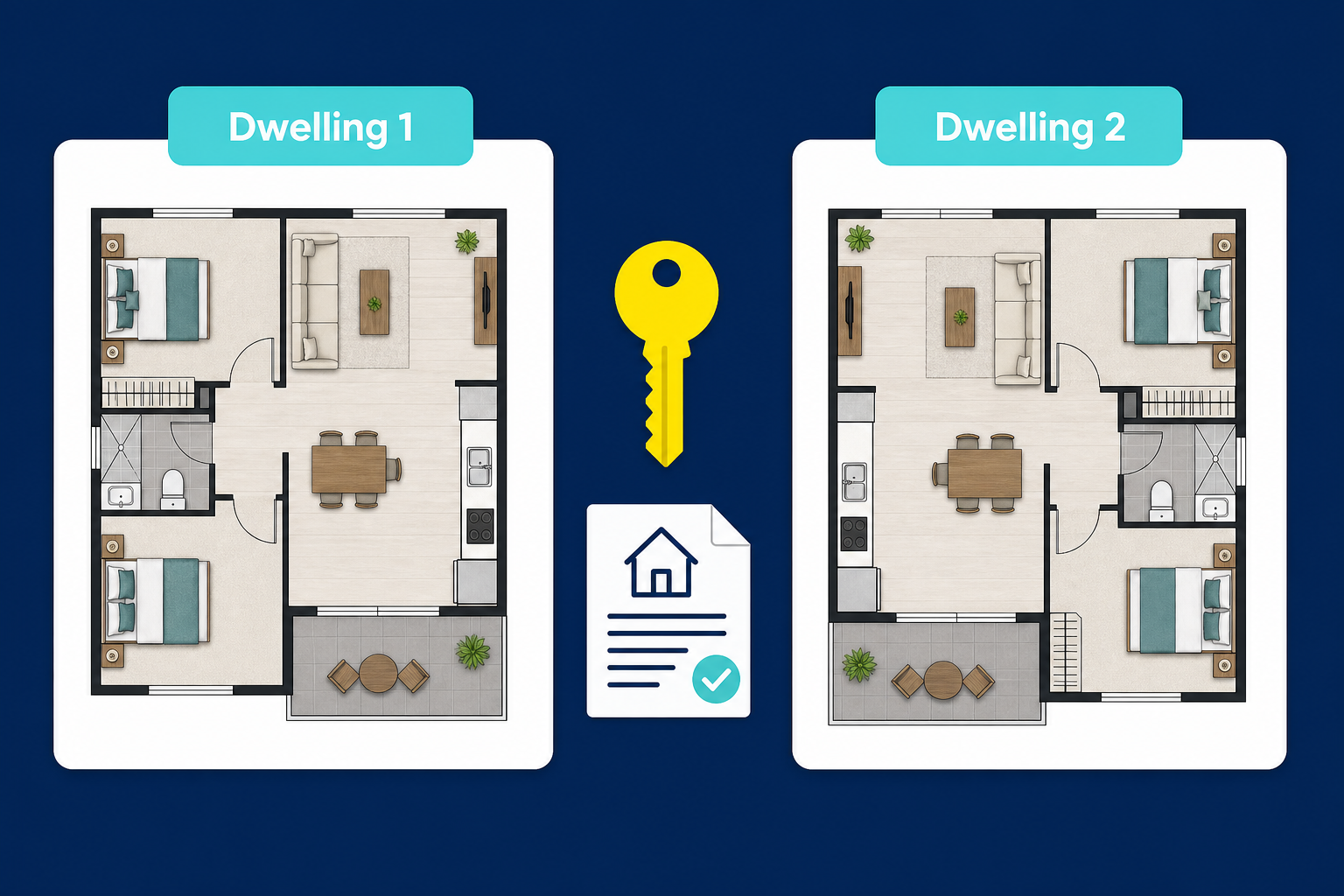
A dual key property is a single dwelling on one legal title that contains two self-contained living spaces, each with its own entrance, kitchen, bathroom, and living area. From the street, it looks like a standard house. Inside, a shared wall or an internal door separates a full-sized dwelling from a smaller attached unit, studio, or one-bedroom apartment.
The name comes from those two keys: each tenant enters independently. Unlike a duplex, which sits on two separate titles (and can be sold individually), a dual key property is purchased and financed as a single asset. Unlike a granny flat, the secondary space is typically built as part of the original structure rather than added to an existing property.
Most dual key stock in Australia has been developed in Queensland and, to a lesser extent, outer-ring suburbs of other capital cities. They have historically been marketed to yield-focused investors, often as off-the-plan products. That marketing context is worth keeping in mind as you evaluate any deal.
For investors exploring dual income property structures more broadly, it helps to understand where dual key fits relative to granny flats, duplexes, and dual occupancy arrangements, each of which operates under different planning, financing, and resale rules.
The main appeal for Australian investors
The core attraction is straightforward: two rental income streams from a single purchase price and a single mortgage. For investors trying to build a property portfolio without doubling their transaction costs or stamp duty exposure, that structure has obvious appeal.
Rental market conditions in 2026 strengthen the income argument. Cotality (formerly CoreLogic) data shows that every capital city recorded a vacancy rate below 2.0% in the March 2026 quarter, with the national rate sitting at 1.6%. Sydney's median rent reached $824 per week in March 2026, up 5.9% year-on-year. In that environment, the prospect of filling two tenancies within one asset carries real weight.
Other reasons investors consider the structure:
- Cash flow buffer. If one tenancy becomes vacant, the second continues generating income. For investors managing serviceability tightly, this partial offset matters.
- Tax deductions. Two kitchens, two bathrooms, and two sets of fixtures mean a quantity surveyor can identify depreciation across a wider range of assets than a standard single dwelling.
- Lower entry than two properties. Buying one dual key property typically costs less than acquiring two separate investment properties in the same suburb, even accounting for the yield premium built into the asking price.
- Multi-generational appeal. In markets where extended families want proximity but not shared living, a dual key can suit both the investor and the eventual occupant market.
None of these benefits are guaranteed, and they need to be stress-tested against location, building quality, and comparable rents rather than the developer's projections.
The risks and trade-offs to watch in 2026
This is where an honest conversation gets important. Dual key properties carry a specific set of risks that are easy to underestimate when the headline yield looks attractive.
Finance and valuation risk
Lenders have historically been cautious with dual key properties. Because the asset trades primarily in an investor-only pool, banks may apply a more conservative loan-to-value ratio (LVR) or value the property below the contract price at settlement. A pre-settlement shortfall can leave you scrambling for additional cash or renegotiating the deal.
From 1 February 2026, APRA has capped high debt-to-income lending at 20% of new loans from authorised deposit-taking institutions. Investors already carrying debt who add a dual key purchase may find their DTI ratio pushes them into restricted territory with major banks, requiring a specialist lender or restructured approach.
Council rules and zoning
Planning approval for dual key and dual occupancy configurations varies significantly by state and local government area. In NSW, 2024 reforms made dual occupancy permissible across more R2 Low Density zones than before, but specific LGAs, heritage overlays, and lot size minimums still apply. Victoria sets minimum land sizes between 500 and 600 square metres in most Melbourne councils, with overlay controls adding further complexity. Queensland rules also differ across LGAs.
For off-the-plan or newly built dual key stock, the approvals are already in place. But if you are considering a property that could be converted or developed into a dual key configuration, checking the relevant local environmental plan or planning scheme is non-negotiable before you spend on due diligence.
Liquidity and resale demand
This is perhaps the most underappreciated risk. Because dual key properties sit on a single title, owner-occupiers have little reason to buy them at resale. The resale pool is almost entirely other investors. That narrows your exit options and can suppress capital growth relative to comparable standard dwellings in the same suburb.
Owner-occupiers represent around two-thirds of the Australian property market. Removing that buyer group at resale is a meaningful structural limitation, one that some analysts describe as the primary capital growth constraint for the asset class.
Maintenance and tenant mix
Two tenancies mean two sets of maintenance requests, two lease cycles, and the added complexity of managing relationships between tenants sharing close proximity. If both units target similar tenant profiles in a tight rental market, the arrangement can work smoothly. If tenant compatibility becomes an issue, the resolution options for a landlord are limited.
| Risk factor | Standard investment property | Dual key property |
|---|---|---|
| Lender appetite | Mainstream | More conservative, may need specialist |
| Resale buyer pool | Owner-occupiers + investors | Investors primarily |
| Capital growth profile | Location-driven | Can lag comparables |
| Cash flow buffer | Single income stream | Partial offset from second tenancy |
| Maintenance complexity | Standard | Higher (two full tenancies) |
| Planning / approval risk | Low for existing dwellings | Variable by LGA and state |
For a deeper look at common property investment mistakes investors make when chasing yield over fundamentals, that context is worth reviewing before committing to any high-yield structure.
Who dual key properties may suit best
Dual key is not a fit for every investor. The structure tends to work best in specific circumstances.
Investors it may suit:
- Cash flow-focused investors who need rental income to offset holding costs while they wait on longer-term equity growth elsewhere in their portfolio.
- Investors in the early portfolio-building phase who want income security and cannot yet absorb a full vacancy on a standard investment property.
- Those buying in high-rental-demand corridors where both tenancies are genuinely likely to stay occupied, particularly near universities, hospitals, or transport infrastructure.
- Investors with a clear exit plan that targets the investor resale pool rather than relying on owner-occupier demand at sale.
Where it is likely not a fit:
- Investors prioritising capital growth above cash flow. Most dual key stock, especially off-the-plan, does not perform at the same growth rate as well-located standard dwellings.
- First-time investors who are drawn primarily by the headline yield figure without stress-testing the valuation, financing, and resale fundamentals.
- Investors who want flexibility to sell to the widest possible buyer pool at any point in their holding period.
A considered property investment strategy always starts with your personal goals, timeframe, and risk profile before it starts with the property type. Dual key is a tool, not a default.
How to assess a dual key property before you buy
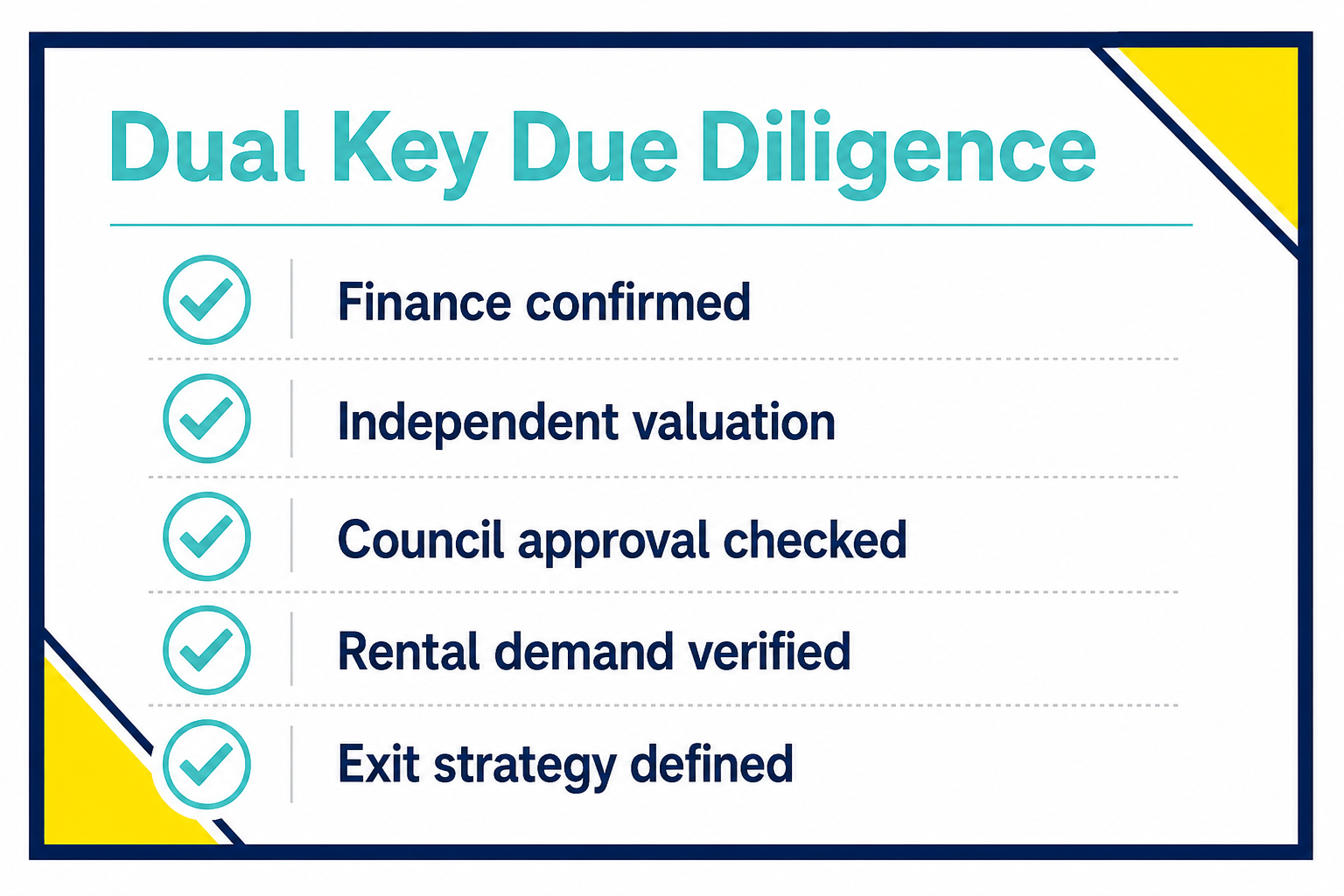
If you are seriously evaluating a dual key property, a structured due diligence process matters more here than with a standard single-tenancy purchase. The following checklist covers the ground that experienced buyers agents work through before recommending or proceeding.
Pre-purchase due diligence checklist
Finance and structure
- Confirm LVR and serviceability with a lender before you are in contract, not after.
- Ask whether the bank will accept the second rental income in serviceability calculations and at what percentage (many lenders shade rental income to 80%).
- Check whether your existing DTI exposure puts you above APRA's 6x income cap threshold.
Valuation and pricing
- Obtain an independent valuation. Off-the-plan dual key properties are frequently sold with a developer margin built in, meaning the day-one valuation may come in below purchase price.
- Compare the asking price with recent sales of comparable standard dwellings in the same suburb. A dual key premium should be justified by the yield, not just the marketing.
Location and rental demand
- Check vacancy rates and days on market for rentals in the suburb. A tight rental market helps; a suburb with rising vacancy does not.
- Look at who the likely tenants are. Is the suburb genuinely attractive to two separate tenant profiles, or are you relying on one type of renter?
- Review current investment hotspots and market conditions across Brisbane, Adelaide, and other outperforming markets before settling on a location.
Council and planning
- Confirm the dual key configuration is council-approved and compliant, not an informal conversion.
- Check whether the property is in a zone where dual occupancy is permitted and whether any overlays apply.
Building quality and maintenance
- Arrange a thorough building and pest inspection that specifically assesses shared walls, plumbing separation, and any areas of deferred maintenance on both dwellings.
- Understand which services (water, electricity, gas) are separately metered and which are shared.
For a comprehensive framework, the property investment due diligence checklist from Buyers Agency Australia provides a step-by-step structure you can apply to any property type.
Questions to ask a buyer's agent before proceeding
Engaging an experienced buyers agent before you commit to a dual key property can surface issues that are not visible in the marketing brochure. Here are the questions worth pressing on.
On strategy fit:
- Does this property type align with my stated investment goals, or am I attracted primarily by the yield number?
- How does this compare to a standard investment property at a similar price point in the same location?
On the numbers:
- What does an independent valuation suggest, and how does that compare to the asking price?
- What comparable dual key sales exist in this suburb, and how have they performed relative to similar standard dwellings over five and ten years?
- What gross yield assumptions are baked into the projections, and are those achievable based on current comparable rents?
On tenant demand:
- Is rental demand in this suburb genuinely strong enough to support two tenancies consistently, including during softer periods?
- What is the likely tenant profile for each unit, and is there any meaningful risk of tenant conflict in close-proximity living?
On the exit:
- If I need to sell in three to five years, who is the likely buyer, and at what discount to market might I need to sell?
- Is there any conversion value if I wanted to return the property to a single dwelling or pursue subdivision at a later point?
On hidden costs:
- What are the ongoing property management fees for two tenancies, and how does that affect net yield?
- Are there any body corporate or shared facility costs that apply to this specific configuration?
Dragan Dimovski, with over 20 years of property investment experience, works through exactly this kind of structured evaluation before recommending any property type to a client. The goal is to match the asset structure to the strategy, not the other way around.
If you want a straight read on whether a buyers agent is worth the cost for this kind of decision, that breakdown covers it clearly.

Final takeaway: strategy first, property second
Dual key properties occupy a legitimate but specific space in the Australian investment market. In the right location, with the right financing structure and a clear-eyed view of the resale profile, they can deliver meaningful cash flow and income stability within a broader portfolio. In the wrong location, or bought primarily on the strength of a developer's yield projection, they can underperform standard dwellings on both income and growth over time.
The structure itself is not the problem or the solution. What matters is whether it fits your specific investment plan, your borrowing position, your holding timeline, and your eventual exit goals. Australia's two-speed property market in 2026 means that location selection within any property strategy carries more weight than ever.
If you are weighing up whether dual key makes sense for your next acquisition, the most useful step is a clear-eyed conversation about your numbers before you fall in love with a property. Book a free strategy session with the Buyers Agency Australia team to map out whether this structure fits your property investment goals, or whether a different approach will do more work for your portfolio.
Ready to move forward? Contact the team at Buyers Agency Australia to get started with a structured, strategy-led acquisition process.
Frequently asked questions about dual key properties in Australia
What is the difference between a dual key property and a duplex?
A duplex sits on two separate titles and can be sold individually. A dual key property is one dwelling on a single title with two self-contained spaces accessed by separate entrances.
Can I get a standard home loan for a dual key property?
Yes, but lenders vary in how they assess them. Some apply a lower LVR or shade rental income, so confirm your financing structure with a lender before exchange, not after.
Do dual key properties have good capital growth?
Generally, dual key properties can lag comparable standard dwellings because the resale pool is limited almost entirely to investors, removing the owner-occupier demand that typically drives prices higher.
Are dual key properties legal in all states of Australia?
Approval depends on local council zoning and state planning rules. Most are built in Queensland, and NSW has recently expanded permissibility in R2 zones. Always verify compliance with your specific LGA before purchasing.
How does a buyer's agent help when assessing a dual key property?
A buyers agent conducts independent valuation checks, comparable sales analysis, rental demand research, and due diligence on council compliance, giving you an objective view before you commit.