
A buyers advocate delivers far more than a shortlist of properties. From accessing deals that never reach the portals to negotiating with precision in quiet sales, the right advocate turns a complex search into a confident, strategic acquisition. Understanding exactly what this role involves — and why it matters in today's supply-constrained market — can be the difference between a good investment and a great one.
Why Off-Market Search Is Harder Than It Looks
Most investors assume that a thorough search means checking Domain and realestate.com.au every day. In reality, a significant share of quality residential transactions in Australia never appear on those portals at all. In premium suburbs across major cities, estimates suggest that between 20% and 40% of properties change hands off-market, transacted quietly through agent networks before a single open home is scheduled.
The challenge is not simply finding these properties. It is finding the right ones, fast enough to act, within a budget that makes strategic sense. An unassisted buyer trying to access this layer of the market faces two immediate obstacles: no relationships with selling agents, and no process for screening what surfaces. Without those foundations, most leads either arrive too late or turn out to be poor quality.
Time pressure compounds the difficulty. With national advertised stock sitting roughly 9.6% below the five-year average in early 2026, competition for quality investment-grade assets is real and ongoing. Buyers who wait for properties to list publicly are, by definition, starting behind everyone who has been briefed already.
This is the environment where a buyers advocate earns their value. The access problem is only solved by sustained, trust-based relationships with selling agents built over years — not a few cold calls to local agencies.
At Buyers Agency Australia, principal Dragan Dimovski has spent more than 20 years building exactly those relationships across Sydney, Melbourne, Brisbane, and other key Australian markets. When quality off-market opportunities emerge, the team receives early notification because agents know they bring qualified buyers who settle. That network is not something a self-directed investor can replicate in a weekend.
For investors who want to understand how this access works in practice, the detail behind the off-market buying process at Buyers Agency Australia is worth reading carefully.
How Advocates Filter Opportunities
Access to off-market properties is only half the equation. The other half is knowing which ones to pursue.
Not every off-market listing is a good deal. Some are overpriced relative to comparable sales. Some have structural issues the vendor has quietly decided not to disclose through a formal campaign. Others simply do not match a client's investment brief in terms of yield, growth trajectory, or hold strategy. A buyers advocate adds value precisely because they filter before the client sees anything.
At Buyers Agency Australia, each opportunity is screened against a defined set of investment criteria before it reaches a client. This includes analysis of 10-year growth projections based on infrastructure and demographic trends, rental yield and tenant demand, comparable sales to determine genuine market value, and building and pest considerations. Only properties that genuinely match a client's goals are presented.
This is a meaningful protection for investors. Consider the alternative: a buyer scrolling listings independently will see the property, fall in love with the suburb or the style, and begin rationalising why it works. Selling agents are trained to read that emotional engagement and extract every dollar from it. A disciplined advocate removes that vulnerability entirely.
| What Self-Directed Buyers Often Miss | What a Buyers Advocate Screens For |
|---|---|
| Overpricing relative to comparable sales | Verified market value against recent settlements |
| Poor rental demand in the target suburb | Vacancy rate trends and tenant profile data |
| Structural risk not obvious at inspection | Building and pest indicators before inspection |
| Misaligned growth potential | 10-year infrastructure and demographic analysis |
| Vendor motivation and timing risk | Settlement terms that protect the buyer's position |
Vendor motivation matters more in off-market deals than in public campaigns. A vendor who is selling for privacy reasons is in a different position to one under financial pressure or managing an estate. Understanding the motivation shapes the entire negotiation posture — including whether to push on price, terms, or settlement timing. This is the kind of contextual intelligence a buyers advocate applies at the very start of a deal, not at the end.
For Melbourne-based investors, the way off-market searches unfold in that market specifically is explained in more depth in the guide on how off-market properties change the search in Melbourne.
The screening process is also what keeps clients out of trouble. How first-time investors avoid costly mistakes through professional advocacy is one of the clearest arguments for engaging a specialist rather than going it alone.
Where Negotiation Matters Most
There is a common misunderstanding about off-market deals: that because there is no public competition, the negotiation is softer. That assumption can be expensive.
In a public auction or listed campaign, buyers at least have visible signals — other bidders, clearance rates, published price guides. In a private off-market transaction, all of that information disappears. The buyer is negotiating without a crowd, which sounds advantageous until they realise the selling agent has far more context about the vendor's position than the buyer does. The information asymmetry is actually greater off-market, not smaller.
This is exactly where a buyers advocate's negotiating experience becomes critical. Off-market negotiations are not softer; they are quieter. And quiet does not mean easy. A skilled advocate knows how to structure an opening offer that creates room to move without insulting a vendor, how to read the agent's responses for signals about reserve expectations, and when to introduce settlement terms — extended or compressed — as tools to bridge a price gap.
For investors who find that terminology useful, property negotiation in this context means far more than offering less money. It includes the deposit amount, settlement length, subject-to-finance clauses, and in some cases, leaseback arrangements. Each of these can be a point of value for the vendor that does not cost the buyer additional purchase price.
Buyers Agency Australia's approach to off-market negotiation is built on the same principles Dragan Dimovski has applied across hundreds of transactions over two decades. The discipline is knowing when the deal is worth fighting for and when the price expectation is simply unrealistic — and having the confidence to walk away when it is the latter.
For investors curious about how advocates locate and then approach these deals across different Australian cities, the tactical detail in how buyers agents find off-market properties before everyone else provides a grounded perspective.
It is also worth noting that the ABS recorded 565,073 dwelling transfers nationally in 2025, a modest 2.6% increase year on year. With volumes rising and quality stock remaining tight, the negotiating discipline an advocate applies at the deal stage is more valuable, not less.
What Buyers Gain From the Process
When an investor works with a buyers advocate through a proper off-market search, three things typically improve: speed, confidence, and decision quality.
Speed matters in a market where good assets move quickly and without fanfare. Rather than spending six to twelve months attending open homes and missing out on listed properties, a client with an active brief at Buyers Agency Australia benefits from the team's daily market activity. Properties are identified, screened, and presented with a clear recommendation — not a dump of options that the client has to evaluate independently.
Confidence comes from knowing the price paid reflects genuine market value. When a buyers advocate presents a comparable sales analysis and a market appraisal alongside the negotiated price, the client knows exactly where they stand. That is a qualitatively different experience from paying what an auction crowd dictated, or what a selling agent managed to extract in a private treaty.
Decision quality improves because the process forces a strategy conversation before the search begins. What yield is the client targeting? What is the hold period? Is the priority cash flow or capital growth? Are there suburb types that fit the brief better than others? These questions shape the search, and a buyers advocate ensures they are answered clearly before any offer is made.
| Benefit | What It Means in Practice |
|---|---|
| Off-market access | Properties seen before public competition begins |
| Independent due diligence | Screening protects against structural and financial risk |
| Negotiation expertise | Price and terms optimised without emotional involvement |
| Time savings | Weeks or months removed from the search timeline |
| Strategic alignment | Every acquisition connects to a broader portfolio plan |
For investors working on property portfolio growth across multiple assets, the cumulative effect of this process is significant. Each acquisition made with better information, at a better price, with terms that suit the buyer's position, compounds over time. The decision to book a free strategy session early — before a search becomes urgent — is often what separates investors who build systematically from those who buy reactively.
For investors thinking about where to focus their next acquisition, the current analysis on top property investment hotspots and strategies for 2026 is a useful starting point for market context before engaging an advocate.
Sydney-focused investors looking for city-specific guidance will also find the Sydney buyers agent guide a practical reference for understanding how advocacy operates in that market.

Frequently Asked Questions
What is the main difference between a buyers advocate and a real estate agent?
A buyers advocate works exclusively for the buyer, not the vendor. A real estate agent represents the seller and is legally obligated to achieve the best outcome for them, not for you.
Can a buyers advocate really access properties that are not listed publicly?
Yes. Advocates with established agent relationships receive early notification of properties before they are advertised, sometimes weeks ahead of any public campaign or not at all.
Is off-market negotiation different from negotiating on a listed property?
Yes. There is no public price guide or visible competition, so the advocate must rely on comparable sales data, vendor context, and relationship intelligence to structure offers correctly.
How long does an off-market property search typically take?
With an active brief, a well-networked advocate can often present suitable off-market properties within weeks. An unassisted buyer searching publicly may take six to twelve months to secure the right asset.
What should I prepare before engaging a buyers advocate?
Have your finance pre-approval confirmed, your budget and yield targets clear, and a rough sense of the markets or property types that suit your strategy. The clearer your brief, the faster the search.
Ready to Access the Off-Market Difference
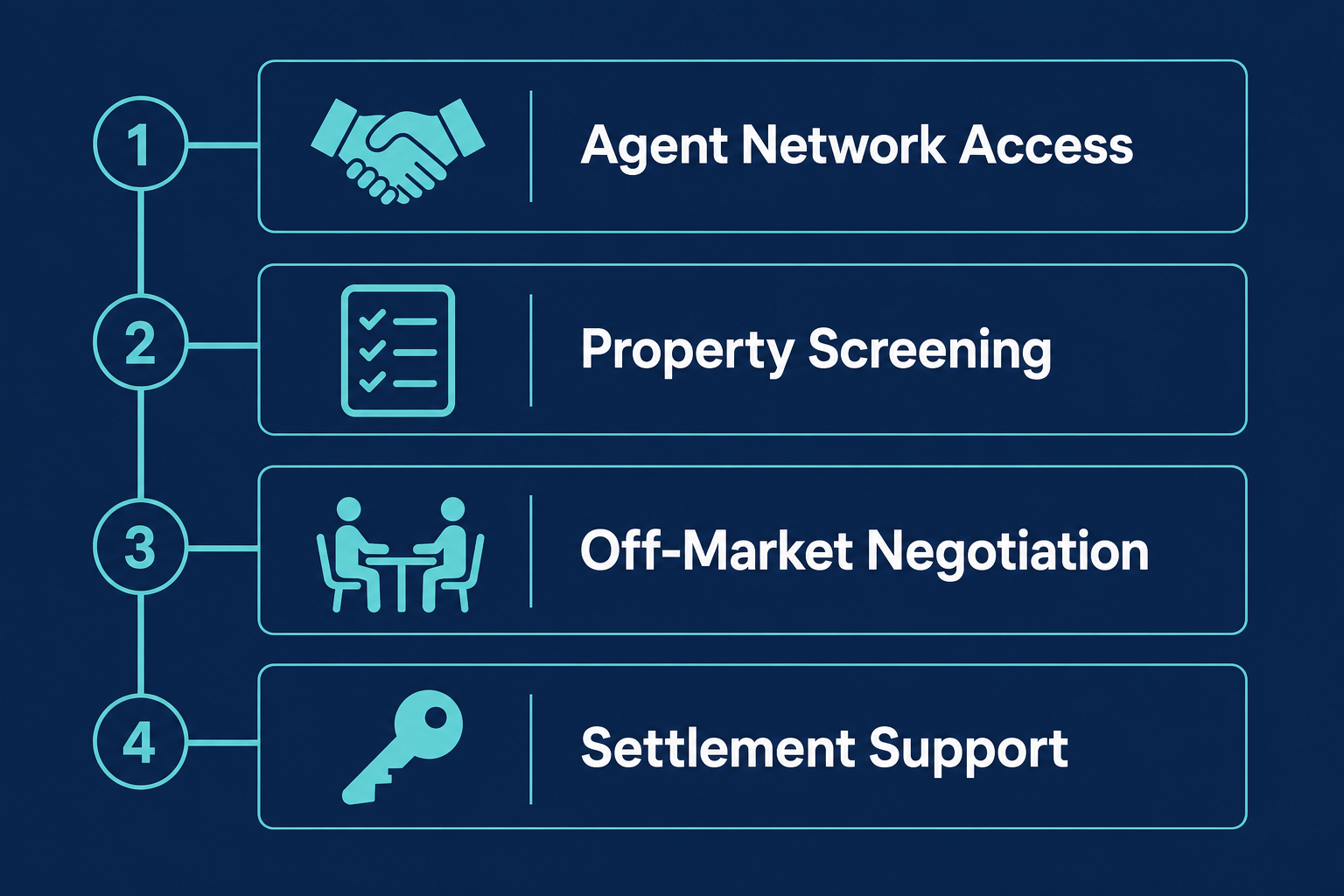
Working with a buyers advocate is not simply about getting help finding a property. It is about entering the market with the same level of information, relationships, and negotiating discipline that experienced operators use every day. Buyers Agency Australia has been built specifically around this model — giving investors structured access to off-market properties, rigorous screening, and end-to-end support from first brief through settlement.
If you are serious about your next acquisition, map out your next property move with the team before the search begins. Or if you are ready to talk specifics, contact the team directly to get started.