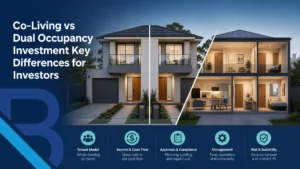
A dual occupancy investment property can be worth considering when both dwellings are lawful, rentable, in demand and supported by conservative numbers. The strategy may improve income diversification, but it also introduces approval, finance, maintenance, insurance, tenant-management and resale complexity. In Australia, the meaning and approval pathway vary by state and council, so verifying the specific property before making an offer is essential.
You have seen a property advertised with two rental incomes and the numbers look attractive. The real question, though, is not whether two rents look good on paper. It is whether the second income is lawful, achievable, financeable and sustainable after all costs are accounted for.
Peeling back that question reveals a strategy that deserves serious scrutiny rather than quick enthusiasm. Two dwellings on one lot are a small operating system. When approval, tenantability, total cost, finance capacity and exit liquidity all work together, the case can be compelling. When even one of those factors is missing, the picture changes quickly.
Buyers Agency Australia provides strategy-led property buying support to investors across Australia, helping clients assess opportunities like this before committing. This guide walks through everything you should understand before deciding whether a dual occupancy asset belongs in your portfolio.
What does dual occupancy mean in Australia?
At its core, a dual occupancy property is two dwellings on one lot of land. The NSW Department of Planning defines dual occupancy as two homes built on one lot, either attached or detached, and notes explicitly that it does not include a secondary dwelling such as a granny flat. The Brisbane City Council similarly requires both planning and building approval pathways to be checked at the property level.
The critical point for investors is that terminology used in marketing and the formal planning classification are not always the same thing. A property advertised as "dual income" may be a legally approved dual occupancy, a secondary dwelling arrangement, a dual-key configuration, or something that has no formal approval at all. Confirming the actual classification before making an offer is non-negotiable.
To understand dual income property structures and how they differ from dual occupancy, it helps to start with the four main configurations investors encounter in the Australian market.
Attached, detached, dual-key and secondary dwelling structures
| Configuration | Dwelling arrangement | Typical title position | Usual tenancy setup | Key verification question |
|---|---|---|---|---|
| Attached dual occupancy (duplex) | Two dwellings sharing a common wall, side-by-side or front-to-back, on one lot | Single or strata/Torrens title, subject to subdivision | Two separate leases | Is development approval current and does it match the current use? |
| Detached dual occupancy | Two freestanding dwellings on the same lot, not sharing a wall | Single or Torrens title, subject to council rules | Two separate leases | Is the second dwelling formally approved as a primary dwelling, not a secondary dwelling? |
| Dual-key property | One building with an internal or external connection between two self-contained sections | Usually single title | Two separate leases or owner plus tenant | Is each section genuinely self-contained with separate access and approval? |
| Secondary dwelling (granny flat) | Primary dwelling plus one smaller secondary dwelling, size-capped by state rules | Single title; secondary dwelling cannot be separately sold | One lease for secondary dwelling | Is the secondary dwelling approved and does local tenancy law permit a separate lease? |

To compare dual-key and dual occupancy configurations in more depth, Buyers Agency Australia has published a dedicated guide covering how each structure works and who it suits.
Why the planning approval pathway matters
Zoning, overlays, minimum lot requirements, development approval, building approval and local planning instruments all interact differently across Australia. Rules that apply in one council area may not apply in the next, and state-level reforms such as NSW's Housing SEPP and Victoria's VC288 amendment mean the landscape is actively changing.

Before relying on any property's income story, confirm the following with current, property-specific evidence:
- Current zoning and whether dual occupancy is permitted with or without consent
- Any overlays (heritage, flood, bushfire, biodiversity) affecting the site
- Whether a development approval and building approval exist and are current
- Title status and whether subdivision has occurred or is possible
- Any easements, covenants or restrictions on the title
- Local tenancy rules for the specific dwelling configuration
Rules differ materially across Australia. Obtain property-specific planning and legal advice, not general guidance, before proceeding.
How can a dual occupancy property generate two rental incomes?
When both dwellings are lawfully approved and genuinely self-contained, each can be leased under a separate residential tenancy agreement to independent tenants. The income structure then looks like two separate investment positions housed within one asset.
In practice, three arrangements are common: both dwellings leased to separate tenants, one occupied by the owner and one leased, or the entire property leased to one tenant or family group. Each arrangement has different income, tax and management implications that should be confirmed with a property manager and accountant.
The key point is that two leases do not automatically mean double income. Rent depends on the quality and size of each dwelling, the local rental market, vacancy conditions and the achievable rate for that specific configuration in that specific suburb. A rental appraisal from a local property manager, supported by comparable leased evidence, is the only reliable starting point for income assumptions.
Two dwellings also share the same land, local economy and broader market conditions. When demand in a suburb weakens, both dwellings can be affected simultaneously. Vacancy correlation is a real risk that is often underplayed in property marketing.
What are the potential benefits for Australian property investors?
The potential advantages of a dual occupancy asset are real, but each comes with a condition that should be understood before treating any benefit as certain.
| Potential benefit | What makes it real | What limits it |
|---|---|---|
| Two income streams from one land purchase | Both dwellings are lawfully approved, self-contained and rentable | Higher purchase or development cost must be justified by net income, not gross rent |
| Income resilience if one dwelling is vacant | Partial income continues during one vacancy | Both dwellings can still be vacant simultaneously if local demand weakens |
| Land utilisation efficiency | One site, two income-producing dwellings | Total acquisition cost, rates, insurance and holding costs are higher than for one standard dwelling |
| Owner-occupier flexibility | Live in one, lease the other | Mixing private and investment use creates tax and depreciation complexity; confirm with an accountant |
| Capital growth potential | Well-located sites with genuine dual-income approval may attract investor demand | Buyer pool may be narrower than for a standard residential property, which can affect resale liquidity |
| Portfolio efficiency | One transaction, two income positions | Concentration risk remains; both dwellings share the same land, planning environment and local market |

As ASIC MoneySmart notes, property investment involves ongoing costs, vacancy exposure and borrowing risk that must be weighed against potential returns. Income diversification within a dual occupancy is not the same as genuine portfolio diversification across different assets or locations.
To build a property investment strategy that accounts for these considerations, it helps to define the role of each asset in your broader portfolio before selecting a property type.
Can two rental streams reduce vacancy risk?
Partially. If one dwelling is vacant, the other may continue producing income, which provides a buffer that a single-dwelling investment does not offer. This is a real and practical advantage in markets with consistent rental demand for both dwelling sizes.
The limitation is that vacancy risk is not eliminated. Both dwellings share the same suburb, the same tenant market and, in many cases, similar tenant profiles. A local economic shift, a poorly designed second dwelling or a prolonged vacancy market can affect both leases at the same time. Manage this risk by checking actual vacancy rates for the specific dwelling types and sizes in the target suburb before relying on any income model.
What are the risks and drawbacks of dual occupancy investing?
A dual occupancy asset is operationally more complex than a standard investment property. Every layer of potential income adds a corresponding layer of cost, management and exposure.
| Risk | Why it matters | Evidence to check | Possible mitigation |
|---|---|---|---|
| Approval and compliance risk | An unapproved or non-compliant dwelling may not be insurable, financeable or legally leasable | Development approval, building approval, certificates of occupancy and council confirmation | Verify before exchange, not after |
| Construction and cost risk | Building or renovating a second dwelling involves cost uncertainty and timeline risk | Qualified builder quotes, planning costs, contingency budget | Obtain independent quantity surveyor or builder assessment |
| Finance and valuation risk | Lenders may value dual occupancy assets differently; serviceability and LVR assumptions may not apply as expected | Current lender or broker assessment, independent valuation | Confirm finance position before making an offer |
| Insurance risk | Multiple dwellings, multiple tenants and any construction phase may affect cover | Current insurer product disclosure statement and written confirmation | Contact an insurance broker experienced with this property type |
| Tenant management complexity | Two tenancy agreements, two maintenance obligations, potential tenant disputes | Property manager with dual-occupancy experience | Factor management fees for both dwellings into the cost model |
| Resale liquidity risk | The likely buyer pool may be narrower than for a standard property | Comparable settled sales for similar dual-occupancy configurations in the area | Define the exit strategy before making an offer |
| Overcapitalisation risk | Development or renovation costs may exceed the value added | Independent valuation before and after proposed works | Do not rely on projected rental income to justify development costs |
| Title and subdivision risk | Relying on future subdivision as an exit strategy without confirmed title eligibility | Title search, council confirmation and conveyancer or solicitor advice | Do not assume subdivision is possible without legal confirmation |
The main risk in a dual occupancy investment is not simply vacancy. It is the interaction between legal status, finance assumptions, operating costs, tenancy arrangements and exit demand. A property that looks good on two-rent gross yield may perform poorly when all of those factors are stress-tested.
Why higher gross rent does not always mean better returns
Gross rental yield (total annual rent divided by purchase price) is a starting figure, not a return figure. The net position after all costs tells a materially different story.
| Cost category | Applies to dual occupancy | Notes |
|---|---|---|
| Purchase price and acquisition costs | Yes | Stamp duty or transfer duty, legal fees, inspection costs, loan establishment fees |
| Loan interest and finance costs | Yes | Typically higher for dual-occupancy assets; confirm with lender or broker |
| Council rates and water charges | Yes | May apply per dwelling in some jurisdictions |
| Landlord insurance | Yes | Confirm cover for multiple dwellings and tenancies |
| Property management fees | Yes | Apply to each tenancy separately |
| Repairs and maintenance | Yes | Two dwellings, two sets of systems, appliances, and wear-and-tear |
| Utilities (if owner-supplied) | Possibly | Confirm meter separation and responsibility |
| Vacancy allowance | Yes | Apply a conservative estimate for each dwelling independently |
| Capital expenditure reserves | Yes | Roof, hot water, structural, two of most items |
Tax deductions reduce the cash cost of some expenses, but they do not eliminate the expense or convert a loss into a gain. Confirm tax treatment with a registered tax adviser and refer to ATO guidance on rental property deductions for the relevant rules.
Is dual occupancy better than a standard investment property?
No single answer applies across all situations. The question depends on the investor's strategy, the specific asset, the market and the numbers.
| Factor | Dual occupancy property | Standard investment property |
|---|---|---|
| Income structure | Two potential rental streams from one site | One rental stream, simpler to manage |
| Acquisition complexity | Higher; may involve planning, building and approval verification | Lower for established single-dwelling assets |
| Approval risk | Present for any construction, conversion or use of unapproved dwelling | Minimal for established, compliant assets |
| Finance | Can be more complex; lenders assess the asset, income and title differently | Generally more straightforward for standard residential |
| Management | Two tenancies, two maintenance obligations, potentially two property managers | One tenancy, one set of obligations |
| Resale | Narrower buyer pool; valuation depends on income story and asset quality | Broader appeal to owner-occupiers and investors |
| Capital growth | Not guaranteed; depends on location, land value and market demand, not dwelling count | Equally uncertain; depends on location and asset quality |
| Portfolio fit | Suited to investors who value income depth and accept operational complexity | Suited to investors who value simplicity and broad resale appeal |
A reasonable decision rule: consider dual occupancy when the extra income remains attractive after conservative costs, when approval is confirmed, and when the investor genuinely accepts the added operational and exit complexity. A standard buy-and-hold investment property may be better suited to investors who prefer simplicity or who have not yet confirmed finance capacity for a more complex asset.
What should you check before buying a dual occupancy property?
A rigorous due diligence process is the single most important step in assessing any dual occupancy investment. Following a disciplined investment process protects you from the most common and most costly errors.
Planning, title and approval checks
- Confirm the formal property classification from the relevant planning authority or council, not from the marketing description.
- Verify current zoning, overlays and whether dual occupancy is permitted at this address.
- Review the title search for easements, covenants, restrictions and existing encumbrances.
- Confirm development approval and building approval documents, approved plans and certificates of occupancy for all dwellings.
- Check whether separate addresses, separate utility meters and separate access exist and are approved.
- Confirm subdivision status and whether separate sale of each dwelling is currently possible.
A property advertised as dual income is not automatically a lawfully approved dual occupancy. Confirm the formal status with current council or state planning evidence, an approved plan set and a title search completed by a conveyancer or solicitor. Do not rely on a rental history or a floor plan as proof of legal classification.
Income, operating cost and tenant-demand checks
| Assumption | Required evidence | Conservative treatment |
|---|---|---|
| Rent for dwelling one | Written rental appraisal from a local property manager, supported by comparable leased evidence | Use the lower end of the range, not the asking rent |
| Rent for dwelling two | Separate written rental appraisal for the second dwelling specifically | Do not apply a combined estimate or assume equal rents |
| Vacancy allowance | Local vacancy rates for each dwelling type and suburb | Apply a conservative rate per dwelling, not zero |
| Property management fees | Written fee schedule for both tenancies | Include letting fees, management fees and periodic inspection costs |
| Repairs and maintenance | Historical data or building condition report | Budget for two dwellings, two hot water systems, two sets of appliances |
| Outgoings and utilities | Council rate notice, water rate notice, utility supplier confirmation | Confirm who pays for shared services or common infrastructure |
| Insurance | Written quote from an insurer covering multiple dwellings and tenancies | Do not assume standard landlord insurance covers all configurations |
Finance, insurance and exit checks
- Finance: Obtain written confirmation from a lender or mortgage broker that the asset is acceptable security, that the rental income will be assessed as expected, and that the LVR and serviceability requirements are met. Do not proceed on the assumption that finance will be available.
- Insurance: Obtain written confirmation from an insurer that cover is available for the specific configuration, number of dwellings and tenancy arrangement. Confirm any construction or vacancy exclusions.
- Exit: Review comparable settled sales for similar dual-occupancy configurations in the same area to understand the realistic buyer pool. Define an alternative exit strategy if the dual-income income story cannot be verified or if market conditions change.
How should an investor test the numbers?
A simple feasibility framework helps translate headline rent into a realistic financial picture. The formulas below use blank fields because no property-specific inputs can be verified without the actual asset, current rental evidence and current finance terms.

Total acquisition cost = Purchase price + Transfer duty or stamp duty + Legal and conveyancing fees + Inspection costs + Loan establishment and other finance costs
Gross annual rent = Verified annual rent for dwelling one + Verified annual rent for dwelling two
Effective income = Gross annual rent – Vacancy allowance for dwelling one – Vacancy allowance for dwelling two – Unrecoverable outgoings
Net operating position = Effective income – Property management fees – Council rates – Water rates – Landlord insurance – Repairs and maintenance – Utilities (if applicable) – Capital expenditure reserve
Cash position after finance = Net operating position – Annual loan interest – Other finance costs
Gross rental yield = (Gross annual rent / Total acquisition cost) x 100
Gross rental yield is not the same as net cash flow, and neither figure equals total return. Total return includes capital growth, which cannot be projected with certainty for any individual property. Complete this framework with real inputs: a written rental appraisal from a local property manager, a current finance assessment from a lender or broker, an insurance quote and a rates notice or estimate from council.
Book a free strategy session with Buyers Agency Australia if you would like a structured framework for assessing a specific opportunity before committing.
Who is dual occupancy investing suitable for?
| Likely to suit | Less likely to suit |
|---|---|
| Investors with a clear portfolio role for the asset and confirmed borrowing capacity | Buyers relying on optimistic or unverified rent projections |
| Investors with cash-flow reserves to cover dual-dwelling operating costs and vacancy periods | Investors who need immediate positive cash flow without verified numbers |
| Investors comfortable with two tenancies, two maintenance obligations and more complex management | Investors who prefer a simple, single-tenancy management structure |
| Investors with a medium-to-long holding horizon who can absorb market cycles | Investors with a short-term resale plan dependent on the dual-income story holding value |
| Investors who have confirmed planning approval, legal classification and finance | Buyers relying on an unapproved second dwelling or verbal council assurances |
| Investors whose accountant has confirmed the tax treatment for their specific ownership structure | Investors expecting guaranteed tax or depreciation benefits without professional confirmation |

The decision to pursue a dual occupancy asset should follow a property investment strategy that defines what role each purchase plays in your broader portfolio. Read more about how to build a property investment strategy that accounts for income, growth, risk and portfolio stage.
How Buyers Agency Australia can help assess the opportunity
Assessing a dual occupancy investment property requires more than comparing gross rents. It requires strategy, research, due diligence coordination and negotiation support from someone acting entirely on the buyer's side.

Dragan Dimovski, presented by Buyers Agency Australia as a property expert with 20+ years of experience, leads a buyer-side approach that works through five stages for investment property clients:
- Strategy and goals: Clarify the investor's objectives, finance position, risk tolerance and the portfolio role the asset is meant to fill. A dual occupancy must fit the strategy, not the other way around.
- Market research: Assess markets and property types against the strategy, looking at tenant demand, vacancy conditions, comparable sales and planning environments in target areas.
- Property sourcing and assessment: Source and assess suitable opportunities, including off-market opportunities where available within the current service scope, and screen each asset against the approval, income and exit criteria that matter.
- Due diligence coordination: Coordinate rental appraisals, building and pest inspections, title reviews, planning verification and other professional checks through the relevant specialists. The buyers agent does not replace a solicitor, town planner, building inspector, mortgage broker, accountant or insurer.
- Negotiation and settlement support: Support the negotiation and transaction process through to settlement, acting only on the buyer's behalf.
Buyers Agency Australia's property investment advisory approach is built around data-led selection, buyer-side representation and a national service footprint.
Disclosure: This article is published by Buyers Agency Australia. The service discussion in this section describes the brand's own stated approach. It is not an independent ranking or recommendation of any provider.
A buyers agent may not be the right fit if you are not yet finance-ready, need personal tax or financial planning advice first, prefer to manage every stage independently, or have not defined a clear service scope and fee arrangement.
If you are ready to plan your next property purchase with a strategy-first framework, the Buyers Agency Australia team is available to help assess whether a dual occupancy opportunity genuinely fits your position.
Frequently asked questions about dual occupancy investment property
What is a dual occupancy investment property?
It is a property containing two dwellings on one lot under the relevant planning framework, used to generate rental income from one or both dwellings. The formal definition and approval pathway vary by state and council.
Is dual occupancy a good investment in Australia?
It can be suitable when the property is lawfully classified, rentable, financeable and financially viable after all costs. It is not automatically better than a standard investment property, and suitability depends on the specific asset and investor circumstances.
Is a duplex the same as a dual occupancy property?
A duplex commonly describes two attached dwellings, while dual occupancy under planning law can include attached or detached forms. Confirm the formal planning terminology for the specific property and jurisdiction.
Is a granny flat the same as a dual occupancy?
No. A granny flat is generally treated as a secondary dwelling under planning law, while dual occupancy refers to two primary dwellings. The legal classification must be confirmed at the property and council level.
Can I rent both dwellings separately?
Possibly, if both dwellings are formally approved and the tenancy arrangement complies with the relevant state or territory residential tenancy rules. Confirm with the relevant council, a property manager and a legal adviser.
Does dual occupancy guarantee higher rental yield?
No. Two potential rental streams do not guarantee a higher net yield or total return. Calculate income after vacancy, finance costs, insurance, management fees and maintenance before drawing conclusions.
Can I sell one dwelling separately?
Only if separate title and subdivision requirements are satisfied under the relevant state and council rules. Confirm title status and approval pathways with a conveyancer or property solicitor before relying on this as an exit strategy.
What approvals do I need for dual occupancy?
The required approvals depend on the state, council, zoning, property configuration and any proposed works. Use current planning authority documentation for the exact property rather than general guidance.
What should I ask before buying a dual occupancy property?
Ask for development approval documents, building approval certificates, title information, separate rental appraisals for each dwelling, total cost assumptions, insurance confirmation and a current lender or mortgage broker assessment. Do not rely solely on the selling agent's description or projected rent.
Can a buyers agent assess a dual occupancy opportunity?
A strategy-led buyers agent can help coordinate market research, property assessment, due diligence and negotiation. The buyers agent does not replace a lender, town planner, property solicitor, accountant, building inspector or insurer.
The decision framework: is dual occupancy worth it for you?
Before making an offer on any dual occupancy investment, work through these five questions honestly:
- Is the property legally approved and correctly classified? Confirmed planning and building approval documents, a current title search and council verification are the minimum standard.
- Are both income streams supported by current rental evidence? Written rental appraisals from a local property manager, supported by comparable leased evidence for each dwelling separately.
- Does the deal work after conservative vacancy and all operating costs? Run the full feasibility framework with real inputs, not advertised rent and headline gross yield.
- Can the investor tolerate the finance, maintenance, insurance and management complexity? Two dwellings mean two of most obligations. If that complexity is not manageable within your current portfolio and capacity, a simpler asset may be a better fit.
- Is there a credible resale or hold strategy if the dual-income assumptions change? Define the exit before entering. Understand the likely buyer pool and whether the property can be sold or held if one income stream fails.
Dual occupancy may suit an investor who values income potential and accepts complexity, but it is not automatically better than a standard investment property. The right decision depends on verified property fundamentals, confirmed approval, honest cost modelling and clear portfolio fit.
If you are at the stage of assessing whether this strategy suits your position, map out your next property move with Buyers Agency Australia through a free strategy session. To speak with the team directly, contact the Buyers Agency Australia team and outline your current investment goals.
General educational information only. Not personal financial, tax, legal, lending, planning, valuation, insurance or construction advice. Speak with the relevant licensed professional for advice specific to your circumstances.