There is no single best suburb for Brisbane property investment in 2026. The right area depends on the investor's budget, portfolio role, target property type, rental demand, supply pipeline and tolerance for flood, finance and holding-cost risk. Greater Brisbane added 58,223 people, or 2.1%, in 2024-25, according to the Australian Bureau of Statistics regional population release. Use that as a demand signal, not a guarantee, then test each property against current rent, vacancy, comparable sales, supply and address-level due diligence.
You can find dozens of Brisbane suburb lists in minutes. The harder question is whether the property inside that suburb fits your budget, tenant strategy and wider portfolio.
This guide will not promise a winning suburb. It will show how to compare established areas, middle-ring locations, transport-linked precincts and growth corridors using the same evidence framework, and how that process connects to strategic property investment guidance for investors who want structured support.
Figures must be checked by date, geography and property type before you act on them. Flood, planning, insurance and body corporate checks happen at property level, not suburb level.
Brisbane Property Investment in 2026: What Investors Should Assess First
No suburb selection process should start with the suburb name. It should start with the investor's own position.
Before researching a single postcode, ASIC Moneysmart advises that investors consider ongoing ownership costs, vacancy exposure, interest-rate sensitivity, entry and exit costs, and the need to match property decisions to personal goals and risk tolerance. Those filters eliminate a large portion of available stock before the suburb question even arises.
Start with the investor's objective, budget and portfolio role
A well-defined investor brief answers at least six questions before suburb shortlisting begins.
- What is the primary portfolio role? Capital growth, rental income, or a balance of both will point toward different suburb types and property formats.
- What is the borrowing capacity and deposit position? A $600,000 budget and an $800,000 budget will access entirely different markets in Greater Brisbane.
- What cash-flow tolerance is sustainable? A negatively geared house in an inner suburb requires a different holding capacity than a townhouse with closer-to-neutral returns.
- What is the intended holding period? Short-term holders face more timing risk. Long-term holders can withstand more supply pressure if fundamentals are sound.
- What does the existing portfolio look like? Concentration in one suburb type, one city or one asset class increases risk.
- What are the exit conditions? Owner-occupier appeal, resale depth and liquidity matter as much at exit as at entry.
Engaging a property investment strategy service before searching for suburbs helps investors answer these questions systematically rather than retrofitting a strategy to a property someone has already emotionally committed to.
The Brisbane investment signals worth verifying
| Signal | What to check | What it does not tell you |
|---|---|---|
| Population growth | ABS SA2 or LGA growth, source (overseas vs internal), geography | Whether new residents can afford local rents or will live near your property |
| Rental vacancy | REIQ sub-region rate, property type, reference quarter | Net yield after costs, or whether your specific property type is in demand |
| Infrastructure status | Official project authority page, project stage (proposed vs funded vs under construction) | Automatic capital growth from proximity |
| Median price and rent | Recognised data provider, reference period, sample size, property type | What an individual property will achieve |
| Supply pipeline | Council approvals, completions, DA pipeline by property type | Whether new stock targets the same tenant profile as your asset |
| Flood exposure | Brisbane City Council FloodWise Property Report at address level | Suburb-wide safety; flood risk is address-specific |
| Zoning and overlays | Brisbane City Plan online, lot-level check | Development potential without a formal planning assessment |
Why Brisbane Remains on Investors' Shortlists
Brisbane has maintained a place on investor shortlists because several demand signals have aligned across population, employment, infrastructure and rental conditions. However, each signal carries a counterpoint that a rigorous investor should test.
Population growth and migration are demand inputs, not guarantees
Greater Brisbane grew by 58,223 people in 2024-25, a rate of 2.1%, making it the second-fastest growing capital city by percentage after Perth, according to ABS regional population data. ABS data identifies Ripley, Morayfield and Greenbank-North Maclean among the fastest-growing SA2 areas in Greater Brisbane during that period.
Population growth increases demand for dwellings. But it also signals future dwelling supply, particularly in outer corridors where greenfield estates and apartment developments are approved to absorb incoming residents. An area with rapid population growth and a matching construction pipeline may not see vacancy tighten; it may simply replace departing tenants with incoming ones at a similar rate. The demand signal must be tested against the supply question before drawing conclusions about an investment property in Brisbane.
Employment hubs, transport and Brisbane 2032 infrastructure
Brisbane's employment base spans the CBD, health precincts at Herston and Woolloongabba, the education corridor around St Lucia and Kelvin Grove, and logistics hubs in outer LGAs. Employment proximity supports tenant demand, particularly for properties targeting working professionals and families.
Cross River Rail is a confirmed, funded and under-construction project that will connect new underground stations at Woolloongabba, Boggo Road, Roma Street, Albert Street and Dutton Park, among others. Transport access near these precincts may support tenant demand, but proximity to a station does not guarantee capital growth and construction periods can create short-term disruption for affected properties.
Brisbane 2032 Olympic and Paralympic Games infrastructure includes planned legacy transport, venue upgrades and economic initiatives. Investors should review official Brisbane City Council sources to distinguish confirmed delivery commitments from aspirational planning documents. Proximity to a Games venue is a connectivity input, not a return guarantee.
Rental demand, affordability and supply pressure
The REIQ June 2026 Quarterly Residential Vacancy Rate Report found Greater Brisbane and the southeast corner remained largely unchanged from the previous quarter, with rental availability still constrained. The statewide vacancy rate was 1.0%, with 29 of 50 tracked regions at or below 1.0%, well below the REIQ's healthy range of 2.6-3.5%.
Constrained vacancy is a positive income signal for investors, but it does not eliminate vacancy risk at the property level. Queensland's rental reforms, including restrictions on rent increases to once per 12 months, have also reshaped holding-cost planning. Gross Brisbane rental yield figures can be further reduced by property management fees, insurance, maintenance, rates, land tax and body corporate costs, sometimes to below 3.5% net in some inner suburbs. Always model net, not gross, returns.
For context on Brisbane's 2026 investment market dynamics, the Brisbane's 2026 investment market resource from Buyers Agency Australia provides additional strategic framing.
The Best Types of Brisbane Suburbs for Different Investment Goals
No suburb type suits every investor. The right category depends on budget, target return, risk appetite and holding period. The table below compares the five main suburb types on dimensions that matter to investors.
| Suburb type | May suit | Entry price context | Key watch-out |
|---|---|---|---|
| Established inner Brisbane | Investors prioritising resale depth, tenant quality and scarcity | Higher relative to Greater Brisbane median | Limited land, higher holding costs, flood check required for some areas |
| Middle-ring locations | Investors balancing yield, land component and affordability | Moderate | Future supply pipeline; check DA approvals and zoning |
| Growth corridors (Ripley, Logan, Moreton Bay) | Investors targeting affordability and longer hold periods | Lower entry point | New competing stock, infrastructure timing risk, tenant depth still developing |
| Transport-linked precincts | Investors focused on tenant depth and commuter demand | Varies by station proximity | Construction disruption, noise, and in some cases new apartment oversupply near stations |
| Lifestyle and coastal-adjacent markets | Investors chasing lifestyle migration demand | Variable | Seasonal demand, holiday-let competition, insurance exposure |
Established inner Brisbane suburbs
Inner Brisbane suburbs typically offer deeper tenant pools, stronger owner-occupier demand and more liquid resale conditions. Scarcity of land and limited new supply can support prices over time. The trade-off is a higher entry price, lower gross yield and, in some riverfront or low-lying areas, meaningful flood exposure that must be checked at address level using the Brisbane City Council FloodWise Property Report.
Middle-ring Brisbane locations
Middle-ring areas often provide a meaningful land component at more accessible entry points than inner suburbs. Owner-occupier demand in these areas creates competition that can support capital values over time. The critical due diligence item here is the development pipeline. Areas zoned for medium-density development can absorb significant new rental stock within a few years of purchase, which affects both vacancy and resale conditions.
Growth corridors in Greater Brisbane
ABS data identifies Ripley (in the Ipswich LGA), Morayfield and Greenbank-North Maclean among Greater Brisbane's fastest-growing SA2 areas in 2024-25. These corridors offer lower entry prices and high population additions. The risk is that supply additions are also concentrated here; greenfield estates and house-and-land packages compete directly with investor stock for the same tenant cohort. Infrastructure timing matters: roads, schools and services that are funded but not yet delivered can leave early investors in properties that are harder to tenant at the anticipated rent.
Transport-linked and lifestyle-focused markets
Suburbs near confirmed Cross River Rail stations, including Woolloongabba, Boggo Road and Dutton Park, may benefit from improved connectivity once the line is operational. These precincts are worth investigating, particularly for properties with genuine land content and resilient tenant profiles. Construction periods create short-term risks for adjacent properties. Transport proximity can also attract medium-density development approvals that increase competing rental stock near stations.
Brisbane Suburbs and Areas to Watch in 2026
This section uses a framework to assess areas, not to rank them. Each area is presented with one reason to investigate and one reason to delay or reject a purchase. Investors should verify all figures against current data sources, qualified advisers and address-level checks before making any decision.
Rail-linked inner-city renewal precincts
Why assess it: Woolloongabba, Boggo Road and Dutton Park are connected to confirmed Cross River Rail stations and sit within established inner Brisbane. Tenant demand in these areas includes health workers (proximity to Princess Alexandra Hospital), students and CBD professionals. Property types include renovated houses, townhouses and medium-density units.
What to verify: Current comparable sales, rental evidence by property type, supply pipeline from council DAs, flood exposure at the specific address using FloodWise, and whether the current entry price reflects construction-period risk.
Potential fit: Investors with a medium-to-long holding period who are comfortable with some construction disruption in exchange for improved connectivity and established tenant depth.
Key risk: New medium-density approvals near proposed stations can increase competing rental stock in the short to medium term. Not all properties near a station will benefit equally.
Established middle-ring areas with multiple demand drivers
Why assess it: Middle-ring suburbs with proximity to employment nodes, schools, retail and multiple transport routes attract a broader tenant and buyer pool. This combination can support both yield and resale depth.
What to verify: Current vacancy data for the specific property type, supply pipeline, land zone and overlay under Brisbane City Plan online, comparable sales in the last six months, and flood category at the specific address.
Potential fit: Investors seeking a balance of rental income and longer-term resale appeal, particularly those buying houses or townhouses with genuine land content.
Key risk: Properties in transition zones can be surrounded by medium-density development applications that change the neighbourhood character and supply balance within the holding period.
Outer and growth corridors with measurable population additions
Why assess it: ABS data places Ripley, Morayfield and Greenbank-North Maclean among the highest-growth SA2s in Greater Brisbane. Lower entry prices and high demand from incoming families can support stable tenancy in well-located stock.
What to verify: Infrastructure delivery timeline (schools, transport, retail), rental evidence specific to the property type and estate, vacancy rates at the postcode level, and whether the comparable sales sample is large enough to be reliable.
Potential fit: Investors with a longer holding period, comfort with greenfield supply risk and a clear view on how the corridor's infrastructure delivery schedule aligns with their hold strategy.
Key risk: New house-and-land completions in the same corridor compete directly with investor stock. If completions outpace population absorption, vacancy can rise and rent growth can stall despite strong population figures.
How to exclude a suburb from the shortlist
An area should be removed from the shortlist when any of the following apply.
- The FloodWise Property Report shows river, creek or overland flow exposure that the investor cannot fully account for in insurance costs and exit conditions.
- Current vacancy data for the relevant property type is above 2.5% and the pipeline shows more supply incoming.
- The property price fails the investor's cash-flow model even using conservative rent and vacancy assumptions.
- Infrastructure that underpins the investment thesis is proposed or announced but not funded.
- Owner-occupier demand in the area is too thin to support resale depth at exit.
- The body corporate (for units or townhouses) has unresolved defects, inadequate sinking fund contributions or a recent special levy.
How to Compare Brisbane Suburbs Beyond Rental Yield
Gross rental yield is calculated by dividing annual rental income by the purchase price, then multiplying by 100. A property renting for $520 per week purchased for $700,000 produces a gross yield of approximately 3.9%. That figure says nothing about net return.
High rental yield is not enough to choose a Brisbane investment property because vacancy, costs, building quality and resale demand can materially change the net result.

Rental yield, vacancy and tenant depth
Net yield accounts for property management fees (typically 7-10% of rent in Queensland), council rates, insurance, maintenance and repairs, land tax where applicable, and body corporate fees for strata properties. ASIC Moneysmart notes that vacancy, interest rates and ongoing costs are key investment risks that investors often underestimate.
The relevant vacancy rate is the one for your specific property type in your specific sub-region, not the Greater Brisbane or statewide average. The REIQ publishes vacancy data at LGA and sub-region level, which allows investors to triangulate more accurately than relying on a single headline figure. For a fuller breakdown of Brisbane investment property considerations, the Brisbane investment property guide from Buyers Agency Australia covers the key evaluation criteria.
Land value, property quality and resale depth
The individual asset can matter more than the suburb median. A house with a poor floor plan, limited parking and dated condition in an otherwise strong suburb may achieve a lower rent, attract a narrower tenant pool and sell at a discount to comparable properties at exit. Owner-occupier appeal is a meaningful long-term protection: when investors exit, the strongest buyers are often owner-occupiers willing to pay a premium for a property they genuinely want to live in.
Land component is a persistent differentiator between houses and apartments in Brisbane. Apartments on titles with a high land-to-improvement ratio are relatively rare; houses on individual lots carry the land appreciation potential directly.
Supply pipeline and competing stock
Check local government development approvals and completions data for the relevant suburb and property type. Apartment markets in some inner Brisbane precincts have experienced periods of oversupply, particularly from 2017 to 2022. While conditions have rebalanced since then, new medium-density approvals in some inner and middle-ring areas continue to add competing stock. A current DA search through Brisbane City Council or a planning professional will reveal what is approved and under construction within the catchment of any property under consideration.
Residential Property Types to Consider in Brisbane
The right property type depends on the portfolio's cash-flow requirements, growth objective, risk tolerance and borrowing position. The table below summarises the key considerations.
| Property type | Land component | Entry price (relative) | Body corporate | Typical tenant | Key risk |
|---|---|---|---|---|---|
| House | High | Highest | None | Families, long-term tenants | Maintenance, insurance, flood at address level |
| Townhouse | Moderate | Moderate | Yes, usually lower fees | Professionals, downsizers, families | Competing supply in same complex; complex-level due diligence required |
| Apartment | Low to none | Lower, though varies by location | Yes, can be significant | Students, singles, couples | Investor concentration, defect risk, new supply, body corporate records |
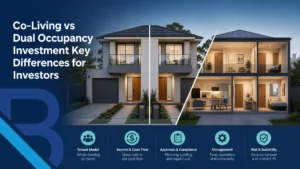
| Dual-income | Varies | Varies | Depends on structure | Multiple tenant cohorts | Zoning, finance complexity, management demands, construction quality |
Houses
Brisbane houses carry the strongest land component and typically attract longer-tenancy family renters. Insurance costs have risen meaningfully across Queensland in recent years. Flood exposure is address-specific: a house on a well-elevated block in an area with mixed flood categories is not the same as one that appears safe from a suburb description. The FloodWise Property Report from Brisbane City Council is the required check, not a suburb label.
Townhouses
Townhouses offer an accessible price point between houses and apartments, with some land component and lower body corporate fees than most apartment buildings. Complex-level due diligence is critical: review the body corporate financials, sinking fund balance, maintenance records and any outstanding special levies. Oversupply risk in a specific complex or street can affect vacancy and resale more than suburb-level conditions suggest.
Apartments
Well-located Brisbane apartments in buildings with a high owner-occupier ratio and sound body corporate records can perform adequately for income-focused investors. The risks are concentrated in older buildings with deferred maintenance, high investor-to-owner ratios and precincts with active development pipelines. Body corporate records, defect insurance history, sinking fund contributions and the owner-occupier percentage are all required reading before an offer.
Dual-income and specialised strategies
Dual-income properties can improve cash-flow on a single title, but they require verified zoning under Brisbane City Plan, correct approvals, appropriate finance structures and experienced property management. They are not automatically superior to a well-selected house. Investors considering this format should obtain independent planning, building, legal and financial advice specific to the property and lot before committing.
Brisbane Investment Risks to Check Before Buying
Property risk is address-specific, not suburb-specific. The table below provides a practical risk register for Brisbane investors.

| Risk | How to check | Why it matters | Who to consult |
|---|---|---|---|
| Flood (river, creek, overland flow) | Brisbane City Council FloodWise Property Report and Flood Awareness Map | Affects insurance, lender appetite, tenant demand and resale | Qualified building professional, insurer, solicitor |
| Zoning and overlays | Brisbane City Plan online | Determines development rights and future supply | Planning professional, solicitor |
| New supply pipeline | Council DA register, ABS building approvals, on-ground inspection | New stock can increase vacancy and reduce rent growth | Buyers agent, planning professional |
| Infrastructure timing | Official project authority pages (Cross River Rail, Brisbane 2032) | Announced projects do not guarantee growth; construction periods create disruption | Independent research, official sources |
| Insurance and holding costs | Current insurer quotes, accountant | Queensland insurance costs have risen; net yield depends on actual cost stack | Insurer, accountant, mortgage broker |
| Rental reforms and conditions | Queensland Government tenancy legislation | Rent increase frequency limits and eviction rules affect management | Solicitor, property manager |
| Borrowing conditions | Lender assessment, RBA cash rate | Serviceability depends on individual finance position | Mortgage broker |
Flood and climate exposure
Brisbane's flood history is well-documented. Risk is not uniform across suburbs, or even across a single street. Brisbane City Council states that the FloodWise Property Report shows property-level flood risk, flood types, historic levels and estimated flood levels. Investors must check the FloodWise report at the specific lot level before making an offer, not at the suburb level.

New supply and infrastructure timing
Cross River Rail is a confirmed and funded project with a delivery authority. Brisbane 2032 involves a mix of confirmed and aspirational commitments. Investors should check official project pages to confirm whether an infrastructure project is under construction, funded, announced or proposed before treating it as a demand driver. Announced projects do not guarantee capital growth.
Insurance, zoning, planning and holding costs
Insurance costs for Queensland investment properties have increased significantly in recent years, partly due to climate-related claims experience. Obtaining a current insurance quote before exchange is a prudent step, not an optional one. Zoning and overlay information from Brisbane City Plan online should be checked at the specific lot address; suburb descriptions and listing agent representations are not a substitute for official planning evidence.
Changing rental and borrowing conditions
Queensland's rental reform legislation restricts rent increases to once per 12 months. This affects the pace at which investors can adjust rents to market in a rising environment. Lending conditions are subject to RBA decisions and individual lender assessments. Investors should obtain current and specific advice from a qualified mortgage broker rather than relying on general market commentary.
A Practical Brisbane Property Investment Shortlist Checklist
The following process moves from investor brief to settlement decision with explicit rejection gates at each step.

Define the brief before searching
- Record your maximum purchase price, available deposit and current borrowing approval.
- Set your target property type, minimum land component (if applicable) and acceptable body corporate range.
- Define your cash-flow tolerance: the maximum weekly shortfall after rent and holding costs that you can sustain.
- Set a minimum acceptable gross yield threshold, then calculate the approximate net yield using realistic costs.
- State the intended holding period and the exit conditions (for example, owner-occupier resale appeal required).
- Record your risk tolerance for flood, new supply, infrastructure timing and renovation requirement.
If this brief is unclear, a property investment advisor support conversation can help clarify the parameters before you start researching suburbs.
Screen the suburb and property
- Check current sub-region vacancy rates from the REIQ for the specific property type.
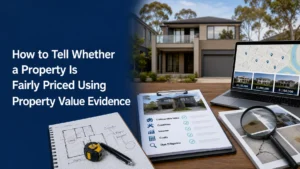
- Review recent comparable sales from a recognised data provider (Cotality, PropTrack or Domain) for the suburb and property format within the last six months.
- Obtain current rental evidence for the specific property type in the sub-region, not suburb medians.
- Run a FloodWise Property Report check at the specific lot address.
- Check zoning, overlays and neighbourhood plan under Brisbane City Plan online for the specific lot.
- Check the development approval pipeline for the precinct through the council DA register.
Rejection gate: Remove any suburb or property that fails flood, supply, zoning or cash-flow screens at this stage.
Test the deal before making an offer
- Model holding costs conservatively: use a vacancy allowance of at least 4 weeks per year, management fees at the local market rate, and insurance at a current quoted figure.
- Obtain an independent building and pest inspection for the property.
- Engage a solicitor or conveyancer to review the contract, title, body corporate records (if applicable) and special conditions.
- Confirm insurance availability and cost from at least one Queensland-licensed insurer.
- Set a maximum offer price based on comparable sales and your cash-flow model, not on vendor asking price.
Before proceeding, it is worth reviewing an investment property buyers agent guide and an Australian property investment strategy framework to confirm the purchase fits a documented plan.
Once you have completed the checklist, book a free strategy session with Buyers Agency Australia to test your shortlist against an independent review before committing to a purchase.
When to Use a Buyers Agent for Brisbane Property Investment
A buyers agent works exclusively for the buyer, not the vendor. In Queensland, real estate agents and buyers agents must hold a current property licence or registration under state legislation, as set out by the Queensland Government property industry licensing requirements.
Buyer-side representation can add value at several points in the process: defining the investment strategy, researching and shortlisting locations, sourcing properties (including those not publicly listed), assessing value and comparable sales, coordinating due diligence professionals, negotiating price and terms, and managing the path to settlement.

The value is process quality and decision discipline, not a guaranteed return or guaranteed access to a winning property.
What strategy-led buyer-side support can cover
Buyers Agency Australia's investment approach is built around a documented, strategy-first process: understanding the investor's goals, budget and risk profile before beginning any suburb research. Dragan Dimovski, a property expert with 20+ years of experience, leads the practice with a focus on data-informed selection, sourcing support and end-to-end acquisition management from planning through settlement.
For investors buying interstate or unfamiliar with Greater Brisbane's sub-markets, Brisbane buyers agent support from a locally active team can reduce the information gap between remote research and on-the-ground conditions.
This section describes Buyers Agency Australia's stated approach and is not an independent ranking or comparison.
A buyers agent does not replace a solicitor, conveyancer, mortgage broker, accountant, building inspector or insurer. Each of those professionals provides independent, regulated advice that buyers agents are not authorised to give.
When a buyers agent may not be the right fit
DIY may suit investors who have current local knowledge of the target suburb, time available to inspect properties repeatedly, a documented investment process, confidence coordinating a professional due diligence team, and direct access to comparable sales and rental evidence through a licensed real estate agent or recognised data provider. A buyers agent is one form of professional support, not the only path to a sound purchase.
Final Takeaway: Choose the Right Property, Not Just a Popular Suburb
The most practical rule for Brisbane property investment in 2026 is this: reject a popular suburb when the specific property fails the evidence test.
A location earns a place on the shortlist only when the investor's financial position, the property's fundamentals and the evidence about the area agree. Suburb momentum in media coverage does not replace a current FloodWise check, a comparable sales review or a cash-flow model built on real costs.
Every purchase should pass three tests: does it fit the investor's portfolio role and financial position, does the location evidence support the investment thesis, and does the specific property clear address-level due diligence on flood, planning, supply and quality grounds.
To map out your next property move with a documented strategy before you start searching, book a free session with the Buyers Agency Australia team. Or, if you are ready to discuss a specific acquisition plan, contact the Buyers Agency Australia team directly.
Frequently Asked Questions About Brisbane Property Investment in 2026
What are the best suburbs to invest in Brisbane in 2026?
There is no single best suburb. The right area depends on your budget, target property type, rental demand evidence, supply pipeline, flood exposure and portfolio role. Use a structured shortlist framework with current data rather than a headline ranking.
Is Brisbane still a good place to invest in property in 2026?
Brisbane retains meaningful demand drivers: Greater Brisbane grew 2.1% in 2024-25 and rental vacancy in the Brisbane LGA remained constrained at around 1.0-1.2% through mid-2026, according to REIQ data. Whether it suits your investment depends on your budget, property type, entry price and risk tolerance.
Which Brisbane areas should investors watch?
Areas connected to Cross River Rail stations such as Woolloongabba, Boggo Road and Dutton Park are worth assessing, alongside established middle-ring locations with multiple demand drivers. ABS-identified growth corridors including Ripley, Morayfield and Greenbank-North Maclean are worth investigating, with careful attention to supply timing.
Is rental yield enough to choose a Brisbane investment property?
No. Gross yield does not account for vacancy, management fees, insurance, maintenance, body corporate costs, rates or land tax. Net yields in some inner Brisbane suburbs can fall below 3.5% once costs are applied. Evaluate net return alongside land value, tenant depth and resale appeal.
Should I buy a house, townhouse or apartment in Brisbane?
It depends on your budget, cash-flow tolerance, desired land component and risk profile. Houses carry the strongest land content but the highest entry price and maintenance exposure. Townhouses offer a middle ground. Apartments require careful assessment of body corporate records, investor concentration and supply pipeline. No format is universally superior.
How do I check flood risk before buying in Brisbane?
Obtain a FloodWise Property Report from Brisbane City Council for the specific lot address before making an offer. Suburb-level flood discussions are not a substitute for address-level technical information. Also review the Flood Awareness Map and discuss the results with a qualified building professional, insurer and solicitor.
Does Cross River Rail guarantee property growth?
No. Cross River Rail is a confirmed and funded infrastructure project that may improve transport connectivity near its stations. Infrastructure investment is a demand input, not a return guarantee. Properties near stations also face medium-density development pressure, which can add competing rental stock.
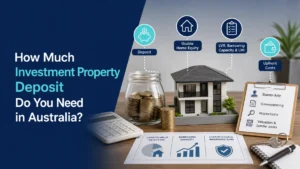
How much deposit do I need for a Brisbane investment property?
Most lenders require a minimum 20% deposit for an investment property purchase without lenders mortgage insurance, though requirements vary by lender, property type and borrower profile. Speak with a qualified mortgage broker for an assessment based on your individual position.
When should I use a buyers agent for Brisbane property investment?
A buyers agent may add value when you are buying interstate, lack the time to inspect properties consistently, need help defining a strategy or negotiating, or want a coordinated due diligence process. DIY may suit investors with current local knowledge, time and a documented process.
What should I check before making an offer on a Brisbane investment property?
At minimum: FloodWise Property Report at the specific lot, Brisbane City Plan zoning and overlays, comparable sales in the last six months, current rental evidence for the property type, body corporate records (for units and townhouses), an independent building and pest inspection, current insurance quotes, a cash-flow model using conservative assumptions, and solicitor review of the contract and title.