Before hiring a buyer’s agent, verify their licence with the relevant state or territory regulator, clarify who they represent and how they are paid, and get the service scope, fees and exit terms in writing. Ask for evidence of relevant experience and how they assess risk for your property type. For commercial property, include the lease, tenant, outgoings and permitted-use checks.
You have found an agent whose pitch sounds convincing. What is harder to see is who actually represents you, what the fee covers and who checks the property’s risks.
That gap is widest in commercial deals. An industrial buyer, for example, has to test the lease, tenant and outgoings as carefully as the building itself. Residential investors face the same decision, just with different documents.
This guide from Buyers Agency Australia sets out the questions to ask a buyers agent, plus the evidence to request with each answer. It is a checklist, not a ranking, and it does not replace advice from a solicitor, valuer, building inspector or financial adviser.
Why should you ask questions before hiring a buyer’s agent?
A buyer’s agent (also called a buyer’s advocate in Australia) acts for the purchaser rather than the vendor. Because you sign an engagement before the search starts, a structured conversation is your best chance to test fit, scope and evidence first.
It cannot promise a better purchase. It can show you how an agent thinks, what they will do and where your own responsibilities begin.
What a useful answer should help you verify
- Who the agent represents, and who pays them.
- Whether their experience matches your asset type and market.
- Which tasks they perform and which they only coordinate.
- The full cost, including how you can exit.
- The documents behind their view of a property.
A vague answer is not proof of poor practice. Treat it as a cue to ask for the detail in writing.
What experience should you ask a buyer’s agent to prove?
Years in the industry say little by themselves. Ask for recent work that resembles your brief, and remember that an agency’s website describes its own service rather than offering independent proof of results.
Do you work with buyers and property types like mine?
- Do you act for commercial investors in office, retail or industrial property, or mostly for residential buyers?
- Which states and markets have you bought in recently?
- Have you worked with buyers in my situation, such as a business owner, an SMSF trustee or a first-time investor?
A national service footprint does not prove depth in every suburb or asset class. Ask where the agent’s recent work actually sits.
What recent work can you show without sharing client-confidential information?
Ask the agent to walk you through one anonymised property they tested against a client brief. Then follow up with three questions: what evidence changed their view, what they rejected, and what would have made them recommend walking away.
If confidentiality blocks an example, ask them to talk through their process on a hypothetical property instead. This is the most revealing step in how to choose a buyers agent, because it tests judgement rather than sales language.
How can you check a buyer’s agent’s licence, independence and conflicts?
Licensing is set by each state and territory, so verify the regulator where the service will be performed. The ACCC explains that state and territory real estate regulation differs by jurisdiction, which is why one national assumption is unsafe.
| Question to ask | Evidence to request | What it tells you |
|---|---|---|
| Which licence do you hold, and in which state? | Full name, business name and licence number to check on the regulator’s register | Whether the person and business are authorised where you are buying |
| Who do you act for in this purchase? | A written engagement stating you are the client | Who the agent owes their duties to |
| Do you act for any vendors or selling agents? | A written statement | Whether interests overlap |
| Do you receive referral fees, commissions or other benefits? | Written disclosure of any payment | Whether recommendations could be influenced |
| Do you have relationships with developers, property managers or brokers? | A written list of relevant relationships | Where a conflict could sit |
Which licence and regulator apply to my purchase?
Ask for the agent’s full name, business name and licence number, then check them yourself. In NSW, you can check an agent’s licence on the NSW Government register. Victoria also publishes a public register, so use the regulator for the state where the property sits.

Do not assume the rules in one state apply in another. A professional membership is also not the same thing as a government licence.
Who pays you, and do you receive any referral benefit?
Ask who pays the agent and whether any referral fee, commission or other benefit connects to the property or a related service. Cover vendors, developers, property managers, finance brokers and other referral partners.
A buyer-side label does not prove independence. Request the answer in writing, and have a solicitor review the agreement for its legal meaning.
What exactly is included from property search to settlement?
Ask for the scope as a sequence: brief, sourcing, inspections, valuation evidence, due diligence, negotiation, auction bidding and settlement. Then ask which steps the agent performs and which they coordinate through other professionals.
Who sources, inspects, assesses, negotiates and coordinates?
- Sourcing: how properties are found, and whether listed, pre-market and off-market stock is included.
- Inspections: who attends, and who reports back to you.
- Assessment: which comparable sales or income evidence the agent uses.
- Negotiation and auctions: who negotiates, and who bids.
- Settlement: who follows the solicitor, lender and reports through to completion.
Coordination is not certification. An agent who books a building inspection has not become the inspector.
Which decisions and approvals stay with me?
Ask for a simple decision-rights map in writing. It should show who sets the price ceiling, who authorises an offer, who holds bidding authority at auction and who signs the contract.

Buyers often assume the agent decides more than they do. A clear map avoids surprises when time is short, such as on auction day.
What should you ask about buyer’s agent fees and the agreement?
Buyers agent fees come in different structures, so compare the whole agreement rather than a headline number. This guide quotes no prices, because amounts, GST treatment and payment triggers must come from a written quote from the agent you are considering.
What is payable, when is it payable, and what is excluded?
- Is the fee fixed or percentage-based, and what is it calculated on?
- Is there an engagement fee, and is it credited later?
- Is there a success fee, and what triggers it?
- Is GST included or added on top?
- Which costs sit outside the fee, such as reports, travel or other disbursements?
- Is the agreement exclusive, and for how long?

Ask for one written schedule that answers every point. If two agents quote differently, compare what each fee includes before comparing the amount.
What happens if I pause, cancel or do not buy?
Ask how you can end the agreement, whether any upfront amount is refundable and what happens if you buy a property the agent did not source. Check the length of any exclusivity period too.
The signed agreement controls your obligations. A solicitor can explain what the terms mean for you.
What evidence supports the agent’s property assessment and due diligence?
A buyer’s agent may coordinate research, but valuations, legal reviews and condition reports belong to qualified specialists. The useful question is simple: which source document supports each material assumption, and who verified it?
For commercial property, how do you test the lease, tenant and permitted use?
Commercial income is a contract, so the lease matters as much as the building. Buyers Agency Australia presents its commercial property acquisition support around office, retail and industrial assets, and these are the questions worth putting to any agent you interview:
- Which lease documents, variations and rent evidence will you review, and who checks their legal meaning?
- How do you assess tenant concentration, lease expiry, outgoings and the assumptions behind the quoted income?
- How do you verify permitted use, zoning and planning controls for this specific property?
- Which valuation and comparable-sales evidence informs your price view?
- Which building, environmental or other specialist reports are needed, and who arranges them?

The agent should not give you legal, valuation, tax or lending answers. Those sit with your solicitor, valuer, accountant and lender, and zoning should be confirmed against the local planning authority’s records.
For residential property, who arranges the relevant reports and checks?
For a residential investment property, ask who orders the building and pest inspection, who reviews strata records where relevant, and which comparable sales support the price view. Ask too who checks planning controls and who reads the contract.
The point is accountability. You should know which checks the agent runs and which you commission from a specialist.
What does off-market access actually mean?
Off-market describes how a property is offered, not whether it is good value. It does not prove a lower price, exclusivity or lower risk.
Ask how the opportunity came to the agent, whether other buyers were approached and how the price was tested against comparable evidence. Then ask what the agent’s off-market claim means in practice, and get any service promise confirmed in writing.
How will communication and client decisions work?
- Who is my named contact, and who covers when they are unavailable?
- How often will I receive updates, and in what format?
- Who attends inspections, and how does interstate support work?
- Who authorises offers, and how are decisions recorded?
- What response times can you put in the agreement?
Do not rely on a verbal promise about response times. If it matters to you, it belongs in the agreement.
What are the red flags before you sign a buyer’s agency agreement?
- Guarantees of returns, or claims that you will never overpay.
- Pressure to sign today.
- Fees that are vague, shifting or explained only verbally.
- Performance claims with no supporting evidence.
- Reluctance to disclose referral payments or benefits.
- An unclear answer on who performs due diligence.
- Advice presented as personal financial advice without the right qualification.
Property investment carries costs and risks, as Moneysmart’s guide to investment property risks explains. A red flag is a warning sign, not proof of misconduct. Pause, ask for clarification in writing and seek independent advice if the answer stays vague.
What should you take into a buyer’s agent interview?
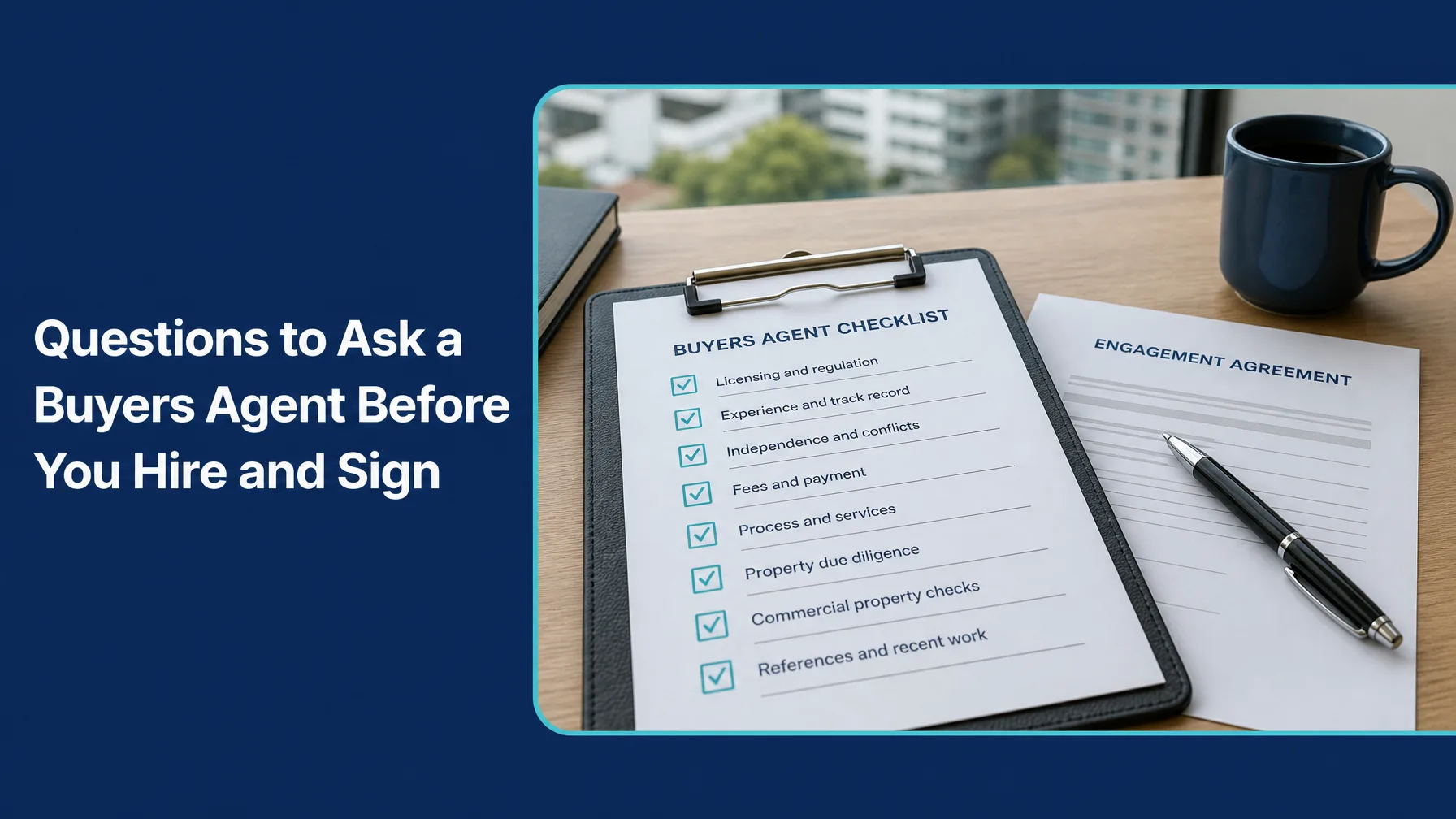
Use this buyers agent checklist as a blank worksheet for one agent at a time. It is also a practical way to organise what to look for in a buyers agent, without turning the conversation into a scorecard.
| Topic | Ask | Evidence or document to check |
|---|---|---|
| Experience | What have you bought for buyers like me? | Anonymised example and decision trail |
| Licence | Which licence do you hold, and where? | Regulator’s public register |
| Conflicts | Who pays you, and what benefits do you receive? | Written disclosure |
| Scope | What do you do, and what do you coordinate? | Written service scope |
| Fees | What is payable, when, and what is excluded? | Fee schedule and GST treatment |
| Due diligence | Which source documents support your view? | Lease, reports and planning records |
| Communication | Who reports, attends and authorises offers? | Named contact and decision map |
| Walk-away | What would make you recommend that I do not buy? | A specific example |
| Responsibility | Which checks are yours to coordinate, and which belong to a specialist? | Named specialist for each check |
When might Buyers Agency Australia fit your buying brief?
This section describes Buyers Agency Australia’s own stated approach. It is not an independent ranking or recommendation.

Buyers Agency Australia is a Sydney-based buyer-side advisory brand that describes a strategy-led approach, with a priority on commercial property acquisition (office, retail and industrial) alongside residential investment support. It also describes data-led selection and end-to-end support from planning through settlement.
Its brand material presents Dragan Dimovski as a property expert with 20+ years of experience. Confirm the current scope, fee terms and licensing details in writing, using the same questions in this guide.
If you would like to talk through your brief, you can book a free strategy session and put the checklist to the team directly.
When this is not the right fit
When this is not the right fit: A buyer who has the time, current local knowledge and confidence to source, assess, coordinate professional due diligence and negotiate independently may not need full-service buyer-side support.
Frequently asked questions about hiring a buyer’s agent
What should I ask a buyer’s agent before hiring them?
Start with representation, relevant experience, written scope, fees, conflicts, licensing and how the agent checks property risks. Ask for the documents behind each answer.
How do I check a buyer’s agent’s licence in Australia?
Check the relevant state or territory regulator’s current register for the person and business. No single register covers the country, so use the regulator where the service occurs.
Should I choose a buyer’s agent who specialises in commercial property?
Choose by asset and task. Commercial buyers should ask for experience with the relevant asset type and for lease and income evidence, rather than relying on a label.
What should a buyer’s agent fee agreement explain?
It should state the exact fee, GST treatment, payment trigger, inclusions, exclusions, term and termination rights. The signed agreement governs, so have a solicitor review it.
How can I check whether a buyer’s agent has a conflict of interest?
Ask who pays them and whether any referral fee, commission or benefit links to the property or a related service. Request the answer in writing.
Does off-market property mean a better price?
No. Off-market describes how a property is offered, not proof of value, discount or lower risk. Test the price against comparable evidence.
Does a buyer’s agent do the building inspection or legal review?
Not necessarily. The engagement may coordinate checks, but confirm who performs each report and engage independent specialists, such as a solicitor and building inspector.
Can a buyer’s agent guarantee property investment returns?
No. A service promise is not a guaranteed outcome, and property investment carries costs and risks. Treat any guarantee as a red flag.
Do I need a buyer’s agent if I already know the local market?
Not necessarily. It depends on your time, relevant experience, the deal’s complexity and which tasks you want to manage yourself.
Decide what to verify before you engage
Verify the licence, confirm representation and conflicts in writing, match experience to your asset, understand the full fee and exit terms, and confirm who performs each due-diligence task. Those are the questions to ask a buyers agent before you hand over any authority.
If you want a second set of eyes on your brief, map out your next property move with Buyers Agency Australia, with no pressure and no promised outcomes.