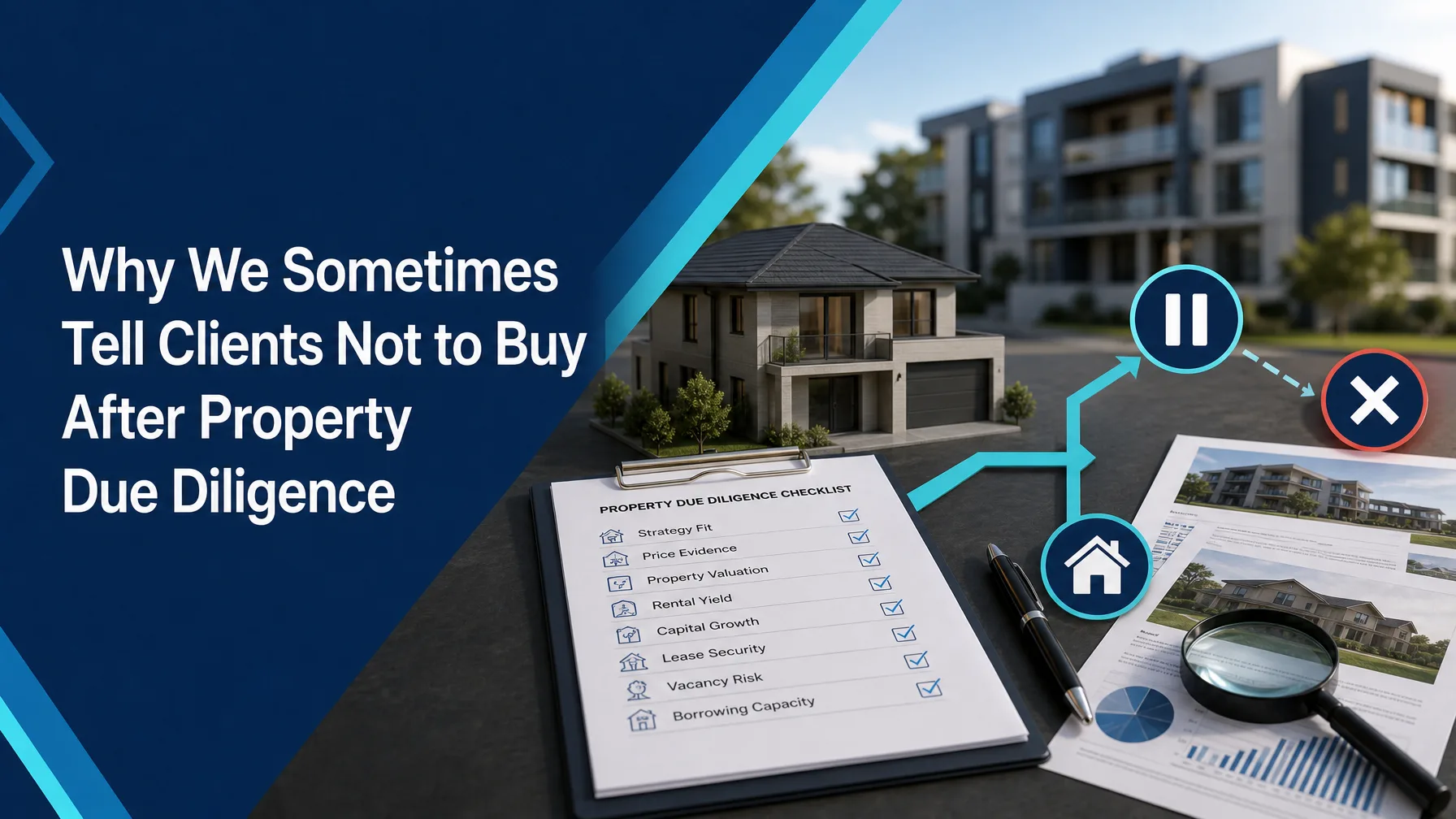
A buyer-side adviser may recommend not buying when a property does not fit the buyer’s strategy, its price or income assumptions fail to hold up, or material risks remain unresolved. The decision is rarely a simple yes or no. It usually sits across four paths: proceed, investigate further, renegotiate, or walk away.
You like the property. The listing looked fine, and then a lease clause, an inspection note or a valuation question made you hesitate.
That hesitation deserves respect. The real question is not whether the property can be bought, but whether the evidence supports buying it for you, and property due diligence is how that evidence gets tested.
This article explains how Buyers Agency Australia’s buyer-side approach treats a no-buy recommendation across commercial and residential property. It is general education only, and it does not replace your solicitor, valuer, building inspector, broker, accountant or insurer.
Why might a buyer’s agent recommend walking away?
A buyer’s agent works for the buyer, so the job is not to complete a transaction at any cost. It is to test each candidate property against the client’s agreed brief. When a property fails that test, the honest advice can be no.
That advice tends to come from three places. The property may miss the brief on budget, asset type, location or purpose. New evidence from a lease, inspection or valuation may change the risk picture, or key assumptions such as rent or condition may be impossible to substantiate.
Property due diligence findings do not make an asset bad for every buyer. A property that suits one investor’s strategy and risk tolerance can be wrong for another. In our approach, the test is suitability for this buyer, not whether a deal can be closed.
When does a property fail to fit the buyer’s strategy?
Strategy fit is where most no-buy decisions begin, often long before property due diligence starts. A practical fit test asks five questions:
- Funding: Can the buyer fund the purchase and the realistic holding costs?
- Asset type: Does the asset type match the brief?
- Location: Does the location suit the buyer’s intended use?
- Portfolio role: Does this acquisition serve a defined role, such as income, growth or diversification?
- Risk and time horizon: Can the buyer tolerate the identified risks over their intended timeframe?

None of these questions assumes a property will deliver capital growth or rental yield. They test fit, not forecasts. Any borrowing capacity conclusion belongs to your lender or broker, and a sound property for one strategy may simply be the wrong one for yours.
What property due-diligence red flags should make buyers pause?
Property due diligence is the process of checking title, planning, condition, hazards and, where relevant, leases and income before you commit. Consumer Affairs Victoria’s due diligence guidance for buyers covers areas such as planning, title restrictions, hazards and building inspections. That is Victorian guidance, so check the official source for your own state or territory.
The useful distinction is between three decision states. Investigate when evidence is missing or incomplete. Renegotiate only when a concern is understood and a workable price or contract response exists, and reject when a material issue remains unacceptable to you after relevant professional review.
Uncertainty is not proof of failure. It is a reason to pause, not an automatic reason to walk.
Investigate, renegotiate, or reject?
This table uses generic issue types as a guide. It is not a legal rule or a universal threshold.
| Finding | What is still unknown | Who should verify it | Possible next step |
|---|---|---|---|
| An inspection report raises a concern | Cause, scope and repair approach | Qualified building inspector | Investigate, then renegotiate or reject |
| Lease or income documents differ from advertised income | Actual rent, outgoings and lease terms | Commercial solicitor and valuer | Investigate, then renegotiate if resolved |
| The asking price looks hard to support | Relevant, dated comparable evidence | Qualified independent valuer | Renegotiate or reject |
| A title, planning or hazard query appears | Restrictions, permitted use, insurability | Solicitor or conveyancer, council, insurer | Investigate, then reject if unacceptable |
Why is a good deal not always the right property?
A lower negotiated price feels like a win. But a discount answers only a price question, and says nothing about whether the asset suits your brief.
An attractive advertised yield works the same way. The figure has to be tested against relevant comparable sales, actual costs, condition, lease terms where applicable and your objectives. A qualified property valuation, plus dated sales and rental evidence, is what supports a specific number.

A price adjustment can address a price issue. It does not automatically resolve legal, physical, income, location or strategy risks, and it never replaces property due diligence on the asset itself. We prefer evidence language to deal language: a property is either supported by the evidence for this buyer, or it is not.
What commercial property warning signs can change the decision?
Commercial property due diligence leans heavily on lease and income evidence. If you are weighing office, retail or industrial assets, commercial property buying support can help structure both the search and the evidence you gather.
The table compares the questions that matter, not which asset type is better.
| Asset type | Key questions | Evidence to review |
|---|---|---|
| Office | Tenant and lease terms, reletting exposure, building condition | Lease, building report, valuation |
| Retail | Lease terms, outgoings, permitted use, actual income | Lease, financial records, council records |
| Industrial | Tenant use, lease terms, access and building suitability, zoning | Lease, building inspection, planning records |
Across all three, advertised yield has to be checked against the actual rent, outgoings, lease and valuation basis. Sustainable income is what counts, and no single threshold suits every asset. Vacancy risk and lease security depend on the documents, not the marketing.
The Commonwealth Department of Finance’s property disposal guide for agencies lists checks such as leases, valuation, building condition, flood assessment, title and planning. It is written for Commonwealth disposals, so it illustrates the breadth of checks rather than setting private-buyer rules. For zoning, Business Victoria’s advice on checking zones and overlays with council is a Victorian example, and other states differ.
What residential property warning signs matter to an investor?
Residential risks are often narrower, but they still change decisions. Residential property due diligence usually comes down to three themes:
- Condition: What the building and pest inspection report raises, and what repair scope it implies. Only the right inspector can size that, and our guide to property defect risks that need specialist review covers the technical side.
- Location and demand: Whether rental demand, owner-occupier appeal and local hazards suit the brief. Check planning and hazard information for the actual address.
- Costs and motives: Whether holding costs and rent assumptions fit the plan, or the purchase is being driven by emotion rather than evidence.
Consumer Affairs Victoria suggests considering an independent building inspection before buying and checking relevant permits. Rules differ between states and territories, so confirm yours.
How does Buyers Agency Australia reach a stop-or-proceed recommendation?
This section describes Buyers Agency Australia’s stated approach. It is a first-party explanation, not an independent assessment of the service or a promise of results. The brand’s published profile describes Dragan Dimovski as having more than 20 years of personal property investing experience, which is context rather than proof of any outcome.
The sequence runs from brief to evidence to decision:
- Define the brief: budget, asset type, location, purpose and risk tolerance.
- Assess the candidate property against that brief.
- Identify the evidence needed, from lease and income documents to inspection, title and planning records.
- Coordinate or review relevant checks with qualified specialists such as solicitors, valuers and building inspectors.
- Compare the evidence with price and strategy, so property due diligence findings are weighed against what the buyer actually wants.
- Present the available paths: proceed, investigate, renegotiate or walk away.

Legal, valuation, building and lending conclusions stay with the qualified professionals, and the scope for your situation is worth confirming directly with the team. If you would like to test a shortlisted property against your brief, you can book a free strategy session.
What should buyers do when the answer is no?
A no is a decision, not a failure. Keep your property due diligence notes and use them:
- Record why the property did not fit.
- Separate confirmed facts from open questions.
- Update the search brief if the process exposed a gap.
- Keep assessing alternatives, and resist a compromise purchase made to avoid starting again.
- If your finances have changed, speak with your lender or broker about borrowing capacity.
Walking away does not automatically preserve capacity, lift returns or guarantee a better purchase later. It simply avoids committing to something the evidence did not support.
When may Buyers Agency Australia not be the right fit?
Some buyers are comfortable running their own research, inspections, specialist coordination and negotiation. If that is you, managing the process yourself may suit you better.
A buyer-side adviser also cannot offer guaranteed returns or a guaranteed purchase, and cannot stand in for legal, tax, lending or insurance advice. Service scope and locations can vary, so confirm what applies to your situation before relying on any description here.
Frequently asked questions
Why would a buyer’s agent tell a client not to buy?
Because the property may not fit the client’s brief, price evidence, risk tolerance or due-diligence findings. The reason always depends on the individual property and buyer.
Does a building defect automatically mean a property should be rejected?
No. Cause, severity, cost, timeframe, insurance implications, contract position and the buyer’s risk tolerance all need assessment by the relevant specialists first.
What is the difference between investigate, renegotiate, and walk away?
Investigate means material information is unresolved. Renegotiate means a verified issue may be addressed on acceptable terms. Walk away means the remaining risk or mismatch is unacceptable to that buyer.
Can a lower price make a risky property a good purchase?
Not by itself. A lower price may address a price concern, but it does not show that condition, income, lease, planning or strategy risks are acceptable.
What commercial lease issues can change a buy decision?
Lease term, expiry, options, rent, outgoings, tenant obligations and reletting exposure can all affect income assessment. A commercial solicitor should review the actual lease.
Does off-market mean a property is a better deal?
No. Off-market describes a sourcing route, not verified value, quality or lower risk. Apply the same evidence checks you would to a listed property.
Who should review commercial lease and contract terms?
A qualified commercial property solicitor should review legal terms. A qualified valuer and relevant building or finance professionals handle their own specialist questions.
What should a buyer do after deciding not to proceed?
Record the reason, note what it teaches your brief, and reassess options with your lender, broker or solicitor where needed. A better outcome is not guaranteed.
Final decision checklist: proceed, investigate, renegotiate, or walk away?
- Does the property fit the agreed strategy? If not, reject it or revisit the brief.
- Are price and income assumptions supported by evidence? If unproven, investigate; if a price gap is understood, renegotiate.
- Have condition, lease, title, planning and insurance questions been addressed by the right specialists? If any remain open, investigate.
- Is the remaining risk acceptable to this buyer? If yes, proceed; if not, walk away.
Strong property due diligence ends with a decision you can explain, not a purchase you feel obliged to defend. If you want a second view on a shortlisted property, ask about a free strategy session and contact the team.