Key Takeaways
- Off-market commercial property needs the same due diligence as a listed asset: private access changes how information reaches you, not the evidence you need before committing.
- Reconcile the executed lease, rent ledger and outgoings against the seller's headline income before you trust any yield.
- Test independent value and asset-specific risks (building, permitted use, contamination) with the right specialists.
- Set a lawyer-reviewed decision point, then proceed, negotiate or stop based on evidence rather than the seller's deadline.
Table of Contents
- Quick answer: How should a buyer assess a private opportunity?
- Before you start: What should be ready?
-
- Identify how the opportunity is being offered
-
- Request the records that support the income
-
- Reconcile the yield and test the asking price
-
- Inspect the asset and verify permitted use
-
- Review the contract, funding and specialist reports
-
- Decide whether to proceed, negotiate or stop
- What commonly goes wrong with a private commercial opportunity?
- When to get help assessing a commercial property
- FAQ
- Make the evidence, not the deadline, the decision point
- Resources
A selling agent calls about an office, retail or industrial asset that is not on the market yet. The presentation is polished, the yield looks strong, and a decision is wanted within days.
This guide is for commercial investors, including interstate buyers, weighing an off-market commercial property that has just landed in their inbox. It gives a practical sequence for testing the evidence, plus a worked yield example and a decision gate.
The goal is simple: know whether to proceed before the timetable decides for you. This is general information, not legal, tax or financial advice, so obtain advice suited to the property and jurisdiction. Information current as of November 2026.
Quick answer: How should a buyer assess a private opportunity?
Request the documents first, then verify income and value, inspect the physical and legal position, and decide with your advisers. The executed lease and its supporting records are the most important early check. Allow for lead times: one Ipswich planning search alone is listed at 10 working days, which is not the total transaction timeframe.
Before you start: What should be ready?
Gather six things before the seller's deadline starts driving the process:
- A written acquisition brief (asset type, location, price range, minimum income)
- An indicative funding position from your lender or broker
- A budget for searches and reports
- The seller's information memorandum and any lease documents already offered
- A commercial solicitor you can call the same day
A longer commercial property due diligence checklist for investors covers the full document set.
Plan for lead times. Ipswich City Council, for example, lists a standard planning and development property search at $1,580 per rateable lot and 10 working days, excluding approvals issued under the Economic Development Act 2012. That is one local search, not the cost or length of complete due diligence, so ask each adviser for a property-specific quote and schedule before you commit.
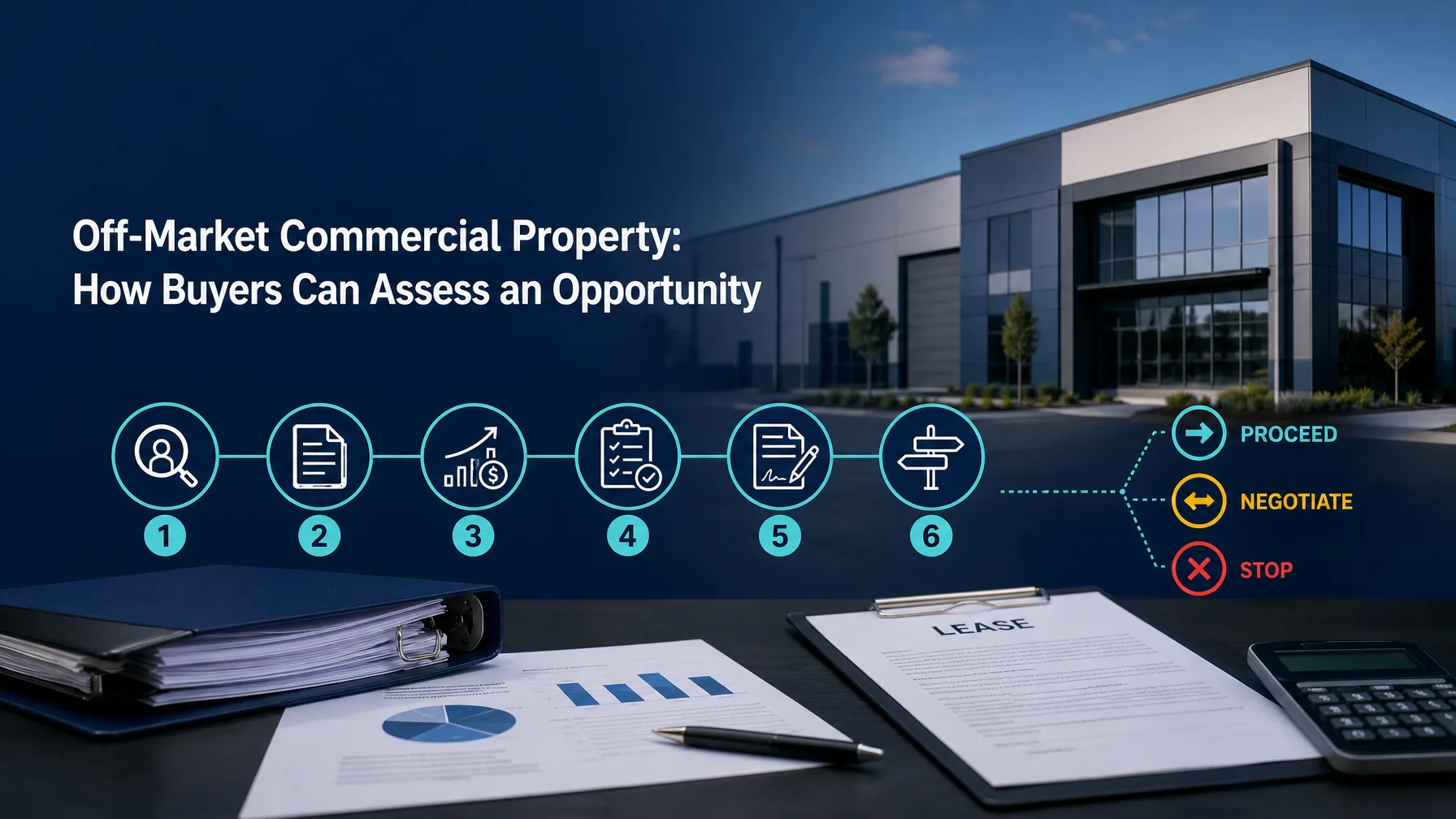
1. Identify how the opportunity is being offered
Ask four questions. Is the property offered privately throughout, or shared before a public campaign? Who represents the seller? Which documents are available now? When does the seller expect a decision?
A private commercial opportunity may reach you through selling-agent relationships, networks or a direct owner approach, while pre-market stock usually heads to a later public campaign. This guide on how to find off-market commercial property covers sourcing. Access is not evidence of exclusivity, a lower price or better quality, and other buyers may see the same asset.
Warning: do not accept a deadline that prevents legal review. Ask for the timetable in writing.
2. Request the records that support the income
Ask for the executed lease, all variations and side agreements, the current rent schedule, the rent ledger and the outgoings reconciliation. A brochure or agent's lease summary cannot establish enforceable income; the signed documents can.

Have your solicitor review expiry, options, rent reviews, incentives, make-good obligations and outgoings recoveries. The Property Council of Australia's due diligence guidance groups lease, finance, legal and technical checks together for this reason. Assess tenant information, such as financials or guarantees, only where it is lawfully available to you.
Tip: keep a running list of missing documents, who is obtaining each one and by when. A gap in the paper trail is a finding in itself.
3. Reconcile the yield and test the asking price
Start with the advertised rent, then subtract the costs the owner actually bears. Example only, not a market result: $120,000 annual rent on a $2 million price is a 6% gross yield. If the owner bears $20,000 of annual costs, net income is $100,000, a 5% net yield before finance, tax and capital expenditure. Write down every input so each figure can be audited.

Next, ask an independent valuer for comparable sales and lease evidence, matching asset type, location and lease characteristics. Model vacancy and future works in a separate cash-flow scenario, not inside the net yield.
Warning: a headline yield is not an independent valuation.
4. Inspect the asset and verify permitted use
Arrange a property-specific building inspection. Interstate buyers should appoint an independent local inspector, and commercial buyer's agent support for interstate investors can coordinate this. Have your solicitor check title and access, and confirm planning controls with the relevant authority.

Match the checks to the asset. For industrial, test loading, truck access and power. For retail, check access and permitted use. For office, review building services and fit-out.
Where site history raises environmental concerns, engage an environmental consultant. The NSW EPA's contaminated land planning certificate review notes that land absent from its record may still be contaminated. A clear register search is a starting point, not proof of a clean site.
5. Review the contract, funding and specialist reports
Ask your solicitor to explain the contract before you sign: the deposit, agreed conditions, evidence deadlines and what happens if one is missed. Never assume a due-diligence condition or a right to withdraw exists; it depends on the signed contract.
Confirm funding, insurance, acquisition costs and GST treatment with your broker, accountant and solicitor. Understanding how commercial property loans work in Australia helps you anticipate what lenders assess, including the lease and valuation.
In Queensland, the seller disclosure scheme applies to commercial property from 1 August 2025, subject to exceptions, and the statement is Form 2. It does not require matters such as structural soundness, flooding history or previous building approvals, so it cannot replace your own inspection.
6. Decide whether to proceed, negotiate or stop
List each material finding beside its evidence, the responsible adviser and a deadline. This decision register is your gate.
Proceed only when the property fits your acquisition brief and the remaining risks are acceptable. Seek a price or condition change where the evidence supports one. Stop when material evidence or a workable contract position is unavailable. Any right to withdraw depends on the signed contract, so take legal advice before relying on one. If you want a second opinion on your register, book a free strategy session.
What commonly goes wrong with a private commercial opportunity?
Most problems come from process, not the property. Pressure to move fast pushes buyers past the checks, and a tidy summary replaces the documents that prove the income.
Not every red flag is a deal-breaker. A missing document is a prompt to ask; a refusal to supply the executed lease is a reason to reconsider.
- Urgency replacing investigation: return to Step 1 and ask for the timetable in writing.
- Relying on a lease summary: obtain the executed lease and variations (Step 2).
- Confusing gross yield with income after owner costs: rebuild the net figure (Step 3).
- Assuming a register search proves a clean site: commission specialist advice where history warrants it (Step 4).
- Missing a contract deadline: have your solicitor diarise every date (Step 5).
When to get help assessing a commercial property
Buyer-side support becomes useful when you cannot inspect in person, when documents arrive from several parties, or when negotiation needs someone who handles commercial deals regularly. Buyers Agency Australia describes strategy-led commercial property investment support across office, retail and industrial assets, led by property expert Dragan Dimovski, who has more than 20 years of experience.

Its commercial acquisition service for office, retail and industrial covers sourcing, due diligence coordination, lease analysis and negotiation support. You still need independent legal, valuation, finance, building and environmental advice as the asset requires; buyer-side support coordinates the evidence rather than replacing the specialists.
FAQ
Can an off-market property still be shown to other buyers?
Yes. Private circulation does not establish exclusivity. Ask the seller's representative how many parties have received the information and how the sale process will run.
Does a long lease remove tenant risk?
- Review the firm term, tenant evidence, security and expiry exposure as separate questions; a long lease is only as reliable as the tenant behind it.
Can a seller's disclosure replace a building inspection?
- Queensland's Form 2 does not require structural soundness or flooding history, and inspection scope is property-specific, so commission your own inspection.
What if the buyer cannot inspect from interstate?
Appoint an independent local inspector and relevant specialists, then review their scope and findings before the decision deadline.
Make the evidence, not the deadline, the decision point
Progress only when the income, price, physical condition and contract position are supported well enough for your risk tolerance. An off-market introduction puts the asset in front of you; it does not prove anything about it.
Separate a negotiable issue from missing evidence. A rent-review clause that weakens future income can justify a price conversation. An unseen lease leaves you unable to decide at all, and that cannot be priced. If the seller's timetable will not let the evidence arrive, a pause or a pass is a legitimate result, and often the cheapest one.
For buyer-side support from Buyers Agency Australia, you can map out your next property move with a free strategy session, or contact the team.
Resources
Internal resources
- commercial property due diligence checklist for investors
- how to find off-market commercial property
- how commercial property loans work in Australia
- commercial buyer's agent support for interstate investors
- commercial property investment support
- book a free strategy session
- contact the team
External resources