
Key Takeaways
- Property due diligence can lead an investor to walk away when strategy, price or material risk cannot be reconciled with their limits.
- A scoped, quoted and documented problem usually supports renegotiation; an unresolved or uncostable risk supports a pause or a rejection.
- Commercial income is only as reliable as the executed lease, rent ledger and outgoings schedule behind it.
- Contract timing is a separate decision: in NSW, an auction purchase carries no cooling-off period.
- Pausing to investigate is not a legal right to withdraw; a solicitor must confirm what the contract allows.
Table of Contents
- Short answer: When should a buyer walk away?
- Does the property fit the investment strategy?
- Do the numbers still work under pressure?
- What can building, title and planning checks uncover?
- Which commercial property risks change the decision?
- Can the seller or sales process prevent a sound decision?
- Does the deal depend on too many assumptions?
- When is renegotiation better than walking away?
- A practical walk-away checklist for buyers
- How Buyers Agency Australia protects the decision
- FAQ
- Make the decision before the pressure does
- Resources
The listing looks right. The yield is attractive, the photos are clean and the agent says other buyers are interested, yet three questions about the lease, the building or the price are still unanswered.
This guide is for Australian investors weighing office, retail, industrial or residential assets. It shows how property due diligence separates problems you can manage from reasons to stop, so you can proceed, renegotiate, pause or walk away with a clear reason.
This article is general information only. Get advice from a solicitor, conveyancer and finance adviser for your property and state.
Short answer: When should a buyer walk away?
Walk away when a property cannot meet your strategy and your downside limits, even at a better price. Next, walk away when legal, physical or income risks stay unresolved while the contract clock is running. The mistake to avoid is treating a strong advertised return or a rival bidder as evidence; neither answers a question about the documents.
Does the property fit the investment strategy?
A property can pass every inspection and still be the wrong purchase. Strategy fit comes first because a sound asset in the wrong role still weakens the portfolio. Check location, asset type (office, retail, industrial or residential), budget, yield needs, capital-growth objectives and how easily the asset could be re-let or sold later.
The practical test is a written investment brief, completed before the first inspection: target return, maximum price, holding period, tenant profile and exit plan. Score the property against it line by line. SMSF trustees should also confirm the purchase fits the fund's investment strategy with their adviser.
Good sign: you can explain the asset's role without relying on a hoped-for change.
Red flag: the deal only fits after you have rewritten your original objective, such as accepting a lower yield because the street feels promising.
Ask: "What job must this property do in the portfolio?"
Do the numbers still work under pressure?
Numbers fail quietly, usually through the assumptions around them. Test comparable sales, rent evidence, purchase costs, holding costs, the valuation and finance terms before trusting a headline yield. The guide to rental yield and cash flow covers the underlying maths.
Example: on a hypothetical $1 million purchase, $80,000 annual rent less $20,000 of owner-borne operating expenses leaves $60,000, or 6% of the price. Lose two months of rent with expenses unchanged and the result drops to about $46,667, or 4.67%. Both figures exclude finance, tax, capital expenditure and acquisition costs, so treat them as arithmetic, not a market return. That 1.33 point gap shows how thin an attractive return can be.

Good sign: the downside remains affordable after vacancy and costs.
Red flag: the deal needs immediate rent growth, or ignores costs.
Ask: "What happens to cash flow if rent stops for two months?"
What can building, title and planning checks uncover?
Inspection reports narrow physical risk, but each has limits. In NSW, a building report can identify visible termite damage, yet it does not establish whether timber pests are still present; a pest inspection is a separate check, as the NSW Government inspection report guidance explains.
Read the title for easements and encumbrances, and the strata or owners corporation records for levies and obligations. Confirm zoning and overlays against your intended use. Consumer Affairs Victoria's due diligence checklist lists zoning, overlays, title encumbrances, contamination and owners corporation duties for Victorian buyers; other states have their own rules. Read about property defects that change decisions before pricing any repair.
An unresolved restriction is not automatically fatal, but it needs the relevant specialist and an acceptable remedy, including insurance.
Good sign: each finding has a named specialist, a cost and a remedy.
Red flag: a contamination, flood or title issue stays unassessed as the deadline approaches.
Ask: "What has not been inspected or legally confirmed?"
Which commercial property risks change the decision?
These commercial property risks sit in documents, not in the listing. For office, retail and industrial assets, reconcile the executed lease and any variations with the rent ledger and the outgoings schedule. Then check expiry, rent reviews, incentives, make-good obligations, outgoings recoveries, specialised fit-outs and how much income depends on one tenant.
Tenant strength is a question for evidence such as payment history and financial information, not instinct. Weighted average lease expiry (WALE) shows how long income is secured across tenants, but only if the leases behind it are verified. A short lease over a specialised fit-out can bring vacancy, make-good disputes and re-letting costs that an advertised yield never shows.

Good sign: lease terms reconcile with the income model.
Red flag: the model assumes recoveries or continued occupancy without document support.
Ask: "What does the owner receive and owe if this tenant leaves?"
Can the seller or sales process prevent a sound decision?
Yes, when material questions go unanswered and the timetable leaves no room to test the answers. Missing documents, inconsistent information, restricted access, pressure to commit and price expectations without sales evidence all limit your ability to decide. Ask for records in writing, request access for inspectors and allow time for professionals to review.
Treat pressure as a deadline to plan around, not as proof of misconduct. Contract timing is the part that is fixed by law. In NSW, an auction purchase has no cooling-off period, and the successful bidder must sign and pay the deposit on the spot, according to the NSW Government auction guidance. Other states differ, so have a solicitor confirm the position before you bid.
Good sign: material questions are answered in writing.
Red flag: a material question remains unanswered before commitment.
Ask: "Which documents will I have, and how long before I am bound?"
Does the deal depend on too many assumptions?
Yes, when success needs several events that nobody has confirmed. Separate current evidence from projections: capital growth, future rent rises, redevelopment approval and repair estimates. Redevelopment upside in particular depends on planning approvals outside the buyer's control.
Keep an assumption register with three columns: the source of each assumption, the downside if it fails and the date by which you must decide. A rent rise tied to a lease review clause has a source; a rent rise tied to a suburb "improving" does not. The register is a decision tool, not a prediction.
Good sign: the current-use case is affordable on its own.
Red flag: success requires several unconfirmed events.
Ask: "Would the property still meet the brief if the proposed change never happened?"
When is renegotiation better than walking away?
Renegotiate when the issue is scoped, quoted and acceptable; walk away when it cannot be costed, accepted or resolved. A roof repair with a written scope and a contractor's quote supports a documented price adjustment or contract protection. An unresolved title restriction or an unassessed contamination finding does not.
Before suggesting an amendment or termination, ask a solicitor what the contract actually permits. A price conversation is a request; an exit right exists only where the contract or law provides one. Documented scope, quote and contract review turn a worry into a negotiable item.

Good sign: a written repair scope, a quote and adviser-reviewed terms.
Red flag: a verbal promise stands in for a remedy.
Ask: "What does the contract allow if this issue is not resolved?"
A practical walk-away checklist for buyers
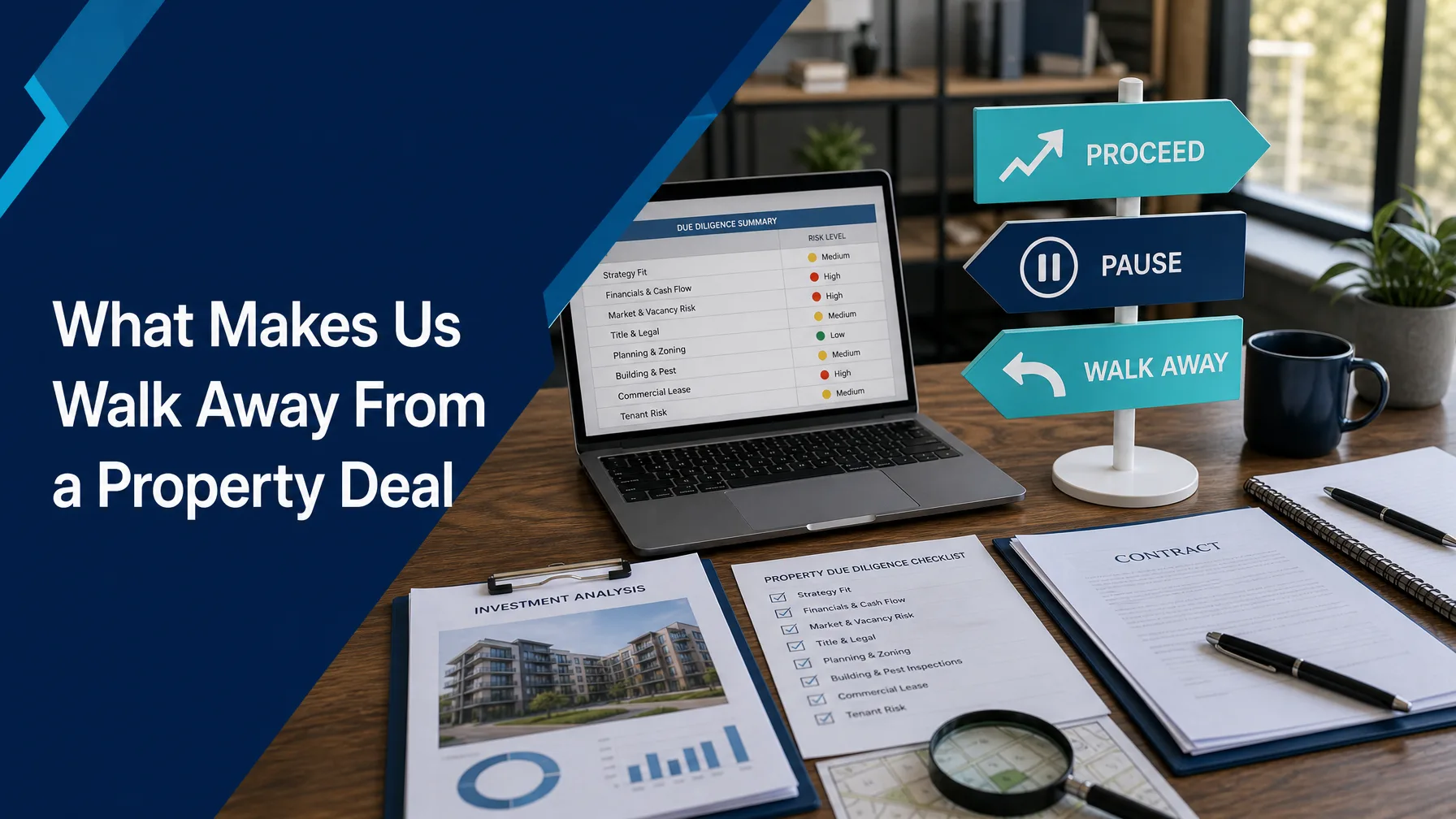
Use a decision register rather than a gut feeling. Mark each item acceptable, unresolved or unacceptable, then assign the next action and the adviser responsible. Pausing to investigate is not the same as holding a contractual right to withdraw, so note which applies. Buyers Agency Australia's property investment due diligence checklist describes a proceed, renegotiate or walk-away gate that fits this approach.
- Strategy: the asset meets the written brief without a hoped-for change.
- Price: supported by comparable sales and a valuation.
- Condition: building and pest findings are costed.
- Title and planning: use, easements and overlays are confirmed.
- Income and tenant: lease, ledger and outgoings reconcile.
- Finance: lender terms and valuation hold under stress.
- Contract timing: deadlines and rights are checked with a solicitor.
- Exit: the asset can be sold or re-let if plans change.
How Buyers Agency Australia protects the decision
Buyers Agency Australia is a buyer-side property advisory firm that now prioritises commercial acquisitions. Its commercial property buying support covers search, research, negotiation and purchase of office, retail and industrial assets. Founder Dragan Dimovski has more than 20 years of property investment experience.

The company's published due diligence guide frames each opportunity as a decision gate: proceed, renegotiate or walk away. That maps onto the strategy, numbers, lease and contract tests above, and it keeps negotiation tied to evidence instead of urgency.
Specialist building and pest inspections, valuations and legal advice stay with qualified professionals. The team's job is to coordinate them, test the assumptions and hold the line on price; it does not guarantee an outcome.
FAQ
Does a building report establish whether termites are still active?
- In NSW, a building report can identify visible damage, but active timber pests need a separate pest inspection.
Can a buyer walk away after signing a contract?
Only where the contract or law gives an available right. Ask a solicitor or conveyancer to assess the document and deadline before acting.
Is a property defect always a deal breaker?
- The cause, cost, timing, insurance cover and your own limits decide whether it is manageable.
Does a strong advertised yield settle the commercial purchase decision?
- Check the lease, actual income and owner-borne expenses before judging the return.
Make the decision before the pressure does
Proceed when the evidence supports your strategy and your downside limits. Renegotiate when the issue is understood, affordable and documented. Pause when material evidence is missing, and reject the deal before commitment when the risk exceeds your limits. Walking away on those terms is investment discipline, not a failed acquisition.
If a contract is already signed, get legal advice before taking any action; the right to withdraw depends on the contract and the state.
Investors who want a second set of eyes on a shortlist can ask Buyers Agency Australia to test an opportunity against their brief. The team's role is to question assumptions and keep negotiation disciplined, not to promise a risk-free result.
The next step is simple: write down your limits today, and if a deal still feels unresolved, contact the property investment team before the deadline decides for you.
Resources
Internal resources
- commercial property buying support
- rental yield and cash flow
- property defects that change decisions
- property investment due diligence checklist
- contact the property investment team
External resources