The right Australian property investment strategy is not determined by the highest budget. A $500k budget may prioritise flexibility and serviceability; $700k may widen the choice of locations and asset types; while $1M may improve asset selection but increase concentration and financing risk. Compare the full deposit, transaction costs, net cash flow, due diligence and portfolio consequences before choosing the budget.
Many investors arrive at a budget figure, then start searching for properties that fit it. The real question is rarely what a given amount can buy. It is what each budget allows an investor to do next, including whether they can still service the debt, maintain a cash buffer, and position themselves for the following acquisition.
The Australian property market in 2022/23 counted approximately 2.3 million individual housing investors, equivalent to roughly 10 per cent of the working-age population, according to the Reserve Bank of Australia. Most of those investors made budget decisions without a documented strategy behind them. A property investment strategy framework built around goals, borrowing capacity and portfolio sequencing changes what that number means for you personally.
All financial examples in this article are illustrative only. Transfer duty rates, lending conditions and acquisition costs vary by state, territory, transaction type and individual circumstances. This article is general education and is not personal financial, tax, legal, lending or investment advice. Please seek qualified professional advice before making any property decision.
Why your property budget changes the investment strategy
Purchase price is one input, not the whole equation. A higher budget increases the deposit, raises the loan amount, adds to transaction costs, widens the available location set and typically increases holding-cost exposure. Each of those variables affects serviceability and the investor's capacity to fund the next acquisition.

ASIC Moneysmart notes that property investment decisions should account for goals, risk tolerance, rental shortfalls, buying and selling costs, rental demand, vacancy and ongoing expenses. A lender's maximum approval is not automatically the investor's safe spending limit, and APRA's serviceability guidance confirms that assessment rates, income, existing debt and rental income assumptions each shape how much a borrower may access.
The comparison below uses three budget bands as a decision framework, not as a ranking of quality.
Methodology note: This comparison evaluates budget bands against deposit burden, upfront costs, borrowing pressure, cash-flow resilience, asset choice, due diligence and portfolio sequencing. Figures are illustrative and use transparent assumptions. This is not a lender quote, valuation, property recommendation or personal borrowing assessment.
| Budget | Central strategic question | Common risk |
|---|---|---|
| $500k | Can this asset generate sustainable income while preserving borrowing flexibility? | Thin tenant demand, maintenance exposure, or limited resale depth in the chosen market |
| $700k | Does the extra capital unlock a measurable improvement in asset quality or location? | Higher debt and deposit need without proportional evidence of stronger demand or yield |
| $1M | Can the investor manage concentration risk while maintaining serviceability and buffers? | Large capital tied to a single asset, higher transaction costs and commercial finance complexity |
What can a $500k investment property budget look like?
A $500k budget is a real starting point for residential property investment in parts of Australia, but it demands precise market and asset selection. The lower purchase price preserves borrowing flexibility for a subsequent acquisition, provided the asset chosen meets the investor's income, condition and tenant-demand criteria.
The trade-off is that lower-priced markets can carry higher vacancy risk, older building stock, or weaker resale depth if the economic base is narrow. Choosing the cheapest available property in a market without documented tenant demand is not a strategy. ASIC Moneysmart recommends assessing rental demand and vacancy risk before committing to any purchase.
The rejection rule at this price point is simple: if the rental evidence, comparable sales and local employment base cannot support the investment case independently of price, the budget is better preserved than deployed.
| What $500k may support | What it requires you to test |
|---|---|
| Residential property in selected outer-metro or regional markets | Current rental vacancy and comparable lease evidence for the specific location |
| Portfolio flexibility for a second acquisition sooner | Confirmed serviceability after purchase, including buffers |
| Lower deposit and transaction cost exposure | Asset condition, body corporate obligations and building age |
Next-purchase test: After settlement at $500k, can the investor still service the debt, maintain a cash buffer of three to six months of holding costs, and retain enough borrowing capacity for the next strategic step?
What changes with a $700k investment property budget?
The additional capital at $700k may widen the location set and improve access to better-quality residential stock, but it does not automatically buy a better investment. Every marginal dollar of purchase price increases the deposit required, the loan amount, the transfer duty and the holding-cost obligation. Those costs need a corresponding improvement in asset quality, tenant demand or yield to justify the step-up.
A $700k budget still requires current comparable sales, rental evidence and building-quality assessment for any specific market. Stating that $700k reaches an established inner-metro suburb requires location-specific evidence and is not a universal fact. The investor should identify the specific strategic improvement the extra budget is funding, whether that is stronger tenant demand, better building quality, improved liquidity or portfolio fit.
| What the extra budget may change | What it does not solve |
|---|---|
| Access to a broader range of residential property types or locations | Weak tenant demand in the chosen market |
| Potential for stronger resale liquidity in better-evidenced markets | Building condition and strata or body corporate risk |
| Ability to target assets with more documented rental history | Serviceability pressure from the higher loan amount |
Next-purchase test: A $700k acquisition should preserve enough equity, income and borrowing capacity to fund the next intended step, whether that is a second residential property or a commercial acquisition.
What does a $1M investment property budget make possible?
A $1M ceiling may expand access to higher-value residential assets in established locations, or open a conversation about selected commercial opportunities including office, retail and industrial property. That expansion of options comes with proportionally larger deposits, higher transaction costs, greater debt exposure and concentration risk from holding a significant portion of capital in a single asset.
Price alone does not prove quality, yield or finance suitability. APRA's APS 112 notes that where commercial loan repayment depends on property cash flow, lenders must consider the tenancy profile relative to loan maturity. A $1M budget changes the asset-class conversation, but it does not remove the obligation to assess lease terms, tenant quality, building condition, valuation and finance structure before proceeding.
| What $1M may make possible | What it introduces |
|---|---|
| Access to higher-value residential assets in selected locations | A 20% deposit of $200k before transaction costs |
| A preliminary conversation about commercial property types | Commercial finance requirements, including tenancy profile review |
| Potentially stronger building quality and asset longevity | Concentration risk from committing large capital to one asset |
| Greater negotiation scope in some markets | Larger transfer duty obligation and higher ongoing holding costs |
How much deposit and cash do you need at each budget?
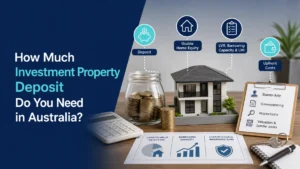
The deposit is the starting point, not the total capital required. Transfer duty, legal fees, conveyancing, building and pest inspections, lender costs and a cash buffer all form part of the acquisition capital. The investment property deposit requirements vary by lender, loan structure and state.
The table below uses illustrative 10% and 20% deposit scenarios. At 20% loan-to-value ratio (LVR) contribution, the example deposits are calculated as a percentage of purchase price only. A 10% deposit scenario may involve Lenders Mortgage Insurance (LMI) or other lender conditions. These figures are arithmetic examples and are not a lender quote or universal requirement. Transfer duty varies by state, territory, property type, ownership structure and transaction date. Check the Revenue NSW transfer duty guide, State Revenue Office Victoria or Queensland Revenue Office for current state-specific figures.
| Budget | 20% deposit (illustrative) | 10% deposit (illustrative) | Approximate additional costs* |
|---|---|---|---|
| $500,000 | $100,000 | $50,000 | $15,000 to $30,000+ |
| $700,000 | $140,000 | $70,000 | $20,000 to $40,000+ |
| $1,000,000 | $200,000 | $100,000 | $35,000 to $60,000+ |
Additional costs include transfer duty (state-specific), legal and conveyancing fees, building and pest inspections, lender valuation, lender costs and a recommended cash buffer. These are indicative ranges only. Confirm current rates with a qualified mortgage broker and the relevant state revenue office before relying on any figure.
Why borrowing capacity matters more than the purchase-price ceiling
Borrowing capacity is the amount a lender may assess you can repay, not a recommendation that you spend that amount. It is lender-specific and is shaped by income, living expenses, existing debt, the conservative assessment of expected rental income and the lender's applicable assessment rate buffer.
APRA's serviceability guidance requires lenders to assess repayment capacity including allowances for non-occupancy and investment property expenses. An investor can receive a higher approval than their own financial plan supports. Setting a personal risk limit below any maximum approval is a separate and equally important step.
Key serviceability factors:
- Total household income after tax
- Existing debt commitments, including other mortgages and credit facilities
- The lender's assessment rate buffer above the actual loan rate
- Conservative treatment of rental income (typically 70 to 80 per cent of expected rent)
- Living expense assessment against benchmarks
How budget affects yield, growth and cash flow
Gross rental yield is calculated by dividing annual rent by the purchase price and expressing the result as a percentage. That number tells an investor very little on its own. Net cash flow requires deducting vacancy allowances, property management fees, insurance, council rates, strata or body corporate levies, repairs and maintenance, and the cost of financing from the gross rental income.

ASIC Moneysmart confirms that ongoing ownership costs including vacancy are material factors that affect the real return from any investment property. The ATO's guidance on deductible rental expenses clarifies that tax treatment depends on individual circumstances, and tax deductions are not an investment return.
The model below uses clearly fictional inputs to illustrate how each budget band's cash flow position may differ. These are not market averages, forecasts or returns.
| Budget | Illustrative annual rent | Illustrative gross yield | Illustrative net yield after costs* | Sensitivity check |
|---|---|---|---|---|
| $500,000 | $26,000 | 5.2% | Lower after vacancy, management, rates, insurance, repairs, finance costs | If vacancy extends by 4 weeks or costs rise by 10%, net position worsens materially |
| $700,000 | $35,000 | 5.0% | Similar after the same cost categories | Higher absolute holding costs in dollar terms despite similar gross yield |
| $1,000,000 | $47,000 | 4.7% | Reduced further by higher finance cost and any outgoings | Concentration in one asset means a single vacancy event has a larger portfolio impact |
All figures are fictional illustrations only. Actual yields, costs and cash flow depend on the specific property, location, market conditions, finance structure, tax position and individual circumstances.
Capital growth potential is a separate question from yield and depends on location, supply and demand fundamentals, infrastructure, employment and asset quality. Historical trends do not guarantee future results and should not be treated as a forecast.
Which budget is best for building a property portfolio?
There is no universal winner. According to RBA research published in May 2026, investor portfolios and concentration patterns carry financial stability implications, particularly where a single asset represents a large share of total exposure. The right budget for building a property portfolio depends on the investor's objective, time horizon, available equity, borrowing capacity and the intended next acquisition.

For national property investment guidance and portfolio-sequencing support, the framework below offers a starting decision matrix.
| Investor objective | Budget fit | Priority test |
|---|---|---|
| Start a portfolio and preserve flexibility for a second purchase | Lower budget where asset quality meets the evidence threshold | Serviceability and cash buffer must survive after settlement |
| Balance asset quality with portfolio diversification | Middle budget where the step-up is justified by evidence | Can the investor fund a second acquisition within a defined time horizon? |
| Improve asset quality or access selected commercial options | Higher budget where concentration risk is actively managed | Is the investor comfortable with the portfolio impact of a single large asset? |
The next-purchase test applies at every budget level: after this acquisition, can the investor still fund their buffers and pursue the next strategic step without compromising the existing portfolio?
Residential versus commercial property at $500k, $700k and $1M
Commercial property, including office, retail and industrial assets, introduces a different due diligence burden compared to residential property. Lease terms, tenant quality, outgoings structures, vacancy risk, zoning, building condition, valuation methodology and finance structure all differ materially from a residential transaction.

For investors whose budget or objectives point toward office, retail or industrial assets, dedicated commercial property acquisition support and professional lease, legal and finance advice are required before proceeding. APRA confirms that where commercial loan repayment depends on property cash flow, lenders must factor in the tenancy profile relative to loan maturity. The commercial property buying process is meaningfully more complex than residential conveyancing.
| Factor | Residential property | Commercial property |
|---|---|---|
| Typical lease term | 6 to 12 months | 3 to 10 years, depending on asset and negotiation |
| Outgoings | Usually included in rent or strata levy | Often recoverable from tenant, but varies by lease structure |
| Vacancy risk | Linked to rental demand in the local residential market | Linked to tenant financial position, lease expiry and market conditions |
| Finance structure | Standard residential mortgage for eligible properties | Commercial loan with different LVR and assessment requirements |
| Due diligence scope | Building, pest, strata records, title, zoning | Building, environmental, lease, tenant financials, zoning, valuation and business covenant |
| Budget feasibility note | $500k can support residential entry in selected markets | $1M may open selected commercial options but feasibility depends on asset, lease, finance and evidence |

A $1M budget may create commercial property options, but whether a specific commercial asset is feasible depends on the lease, tenant quality, building condition, valuation, finance structure and the investor's personal risk tolerance and experience. It is not a budget guarantee.
Common mistakes when increasing your property budget
Budget escalation introduces specific risks that are separate from the general risks of buying an investment property. The following mistakes are common when investors move from a lower to a higher purchase-price commitment:
- Stretching to the lender's maximum approval. Approval and safe spending are different thresholds. Pause until a personal serviceability test is completed separately from the lender's assessment.
- Spending the full cash reserve on the deposit and transaction costs. A depleted buffer leaves no margin for vacancy, repairs or rate changes. Pause until a three-to-six-month holding-cost reserve is confirmed.
- Chasing expensive suburbs on price prestige alone. Price does not equal quality, demand or yield. Pause until comparable rental evidence and recent sales confirm the investment case.
- Ignoring total outgoings. Headline yield is gross yield before management, vacancy, rates, insurance, strata or body corporate, repairs and finance costs. Pause until the net cash flow position is modelled using full costs.
- Treating tax deductions as investment returns. Deductions reduce taxable income but do not create equity. The ATO and a registered tax adviser should be consulted for personal tax treatment.
- Assuming a higher purchase price guarantees better capital growth. Capital growth depends on location-specific supply, demand and economic fundamentals, not on price alone.
- Failing to test the next purchase. If the current acquisition exhausts borrowing capacity and buffers, the portfolio cannot grow. Pause and model the post-settlement position before committing.
A practical checklist before choosing your property budget
Use this checklist as a sequencing guide before finalising any acquisition budget. Link it to the step-by-step investment property guide for the full acquisition process.

- Confirm finance pre-approval with a qualified mortgage broker, including assessment of income, existing debt, and the lender's current assessment rate buffer.
- Calculate the full usable budget: deposit plus transfer duty (state-specific), legal and conveyancing fees, building and pest inspection, lender costs and a three-to-six-month cash buffer.
- Define the investment objective: income, capital growth, diversification, portfolio sequencing or a combination.
- Set a written rejection criterion before inspecting any property. Document the minimum rental yield, building age, vacancy rate, and comparable sales evidence required.
- Screen markets against current tenant demand, vacancy data, economic base and infrastructure evidence rather than price alone.
- Assess the specific asset against the written criteria. Obtain a current building and pest inspection report, strata or body corporate records, and comparable lease evidence.
- Commission an independent valuation where required, particularly for commercial property or off-market transactions.
- Obtain current tax and legal advice specific to the transaction structure, state and ownership entity.
- Test the post-settlement position: serviceability, buffer adequacy and remaining borrowing capacity for the next intended acquisition.
- Engage a conveyancer or solicitor before signing any contract. Do not rely on the vendor's agent for independent advice.
How Buyers Agency Australia approaches budget-led property selection
Buyers Agency Australia takes a strategy-first approach to every acquisition, beginning with the investor's goals, constraints and portfolio objectives rather than a list of available properties. Led by Dragan Dimovski, a property expert with 20+ years of investing experience, the team works through research, sourcing, property analysis, negotiation and settlement support on behalf of the buyer.

The stated approach covers residential investment property and commercial property acquisition, including office, retail and industrial assets, through a dedicated commercial buyers agent approach. For investors comparing budget bands and asset classes, investment property buyer-side support can help translate a budget into documented acquisition criteria, market research and negotiation positioning.
Important limitation: the service cannot replace a lender, accountant, solicitor, conveyancer, valuer, building inspector or financial adviser. Each of those professionals plays a distinct role in any property transaction and should be engaged independently.
When this may not be the right fit: Investors who are not yet finance-ready, who need independent financial or tax advice before choosing a strategy, who prefer to manage every step of the acquisition themselves, or who are not yet clear on their acquisition brief should address those issues first before engaging any buyer-side service.
Service scope and availability were checked in September 2026. Reconfirm current details directly with Buyers Agency Australia before engaging. This section describes Buyers Agency Australia's own approach and is not an independent ranking.
When the brief is clear and finance is confirmed, book a free strategy session to work through what each budget band means for your specific objectives.
Frequently asked questions about property investment budgets
Is $500k enough to buy an investment property in Australia?
$500k may be enough to purchase an investment property in some Australian markets, but suitability depends on the property, location, finance position and strategy. The evidence for tenant demand and building condition must support the case independently of price.
Is a $700k investment property better than a $500k property?
A $700k property is not automatically better. The additional budget may improve choice while also increasing debt, deposit and holding-cost exposure. The step-up is only justified when the asset evidence supports the difference.
What can a $1M property investment budget make possible?
A $1M budget may expand access to higher-value residential or selected commercial assets, subject to finance, due diligence and the specific lease, tenant and building evidence for commercial property.
How much deposit do I need for a $500k investment property?
The deposit depends on the lender, LVR and loan structure. Use a verified lender assessment rather than a universal percentage. A 20% deposit on $500k represents $100,000 before transfer duty, legal fees and other transaction costs.
Do I need more than the deposit to buy an investment property?
Yes. Buyers also need funds for transfer duty (state-specific), legal and conveyancing fees, building and pest inspections, lender costs, valuation and a cash buffer for ongoing holding costs.
Does a higher property price mean higher rental yield?
No. Rental yield depends on rent relative to purchase price and ownership costs, not on price alone. In many markets, higher-priced assets carry lower gross yields than lower-priced residential properties.
Should I buy one $1M property or more than one lower-priced property?
The better structure depends on serviceability, diversification, risk tolerance, management capacity and portfolio objectives. Spreading capital across two assets reduces concentration risk but increases management complexity.
Can I buy commercial property with a $1M budget?
A $1M budget may create commercial property options, but feasibility depends on the asset, lease, tenant quality, valuation, finance structure and the investor's due diligence findings. It is not a guarantee of access to any particular asset class.
When should I speak with a buyers agent about my budget?
Speak with a buyers agent when your goals, finance position and acquisition brief are sufficiently clear to assess whether buyer-side support is appropriate for your next step.
Match the budget to the strategy
$500k, $700k and $1M are not quality rankings. They are different strategic constraints, each carrying its own deposit burden, debt exposure, asset-type options and portfolio consequences. The investor who chooses the right budget for their current objective and evidence position is better placed than the one who simply spends the maximum available.
Before finalising any property budget, work through three steps:
- Define what the purchase must achieve: income, capital growth, diversification or the next step in a planned portfolio sequence.
- Confirm the full usable budget with a qualified mortgage broker and relevant advisers, separating purchase price from total acquisition capital including transfer duty, transaction costs and cash buffers.
- Reject any property that fails the tenant evidence, finance, due diligence or next-purchase test, regardless of price.
If the decision framework above has clarified where your current budget sits, the next step is to map out what that means for your specific goals and market. Map out your next property move with Buyers Agency Australia through a free strategy session, or contact the Buyers Agency team to discuss your acquisition brief directly.