
Property depreciation is a non-cash tax deduction allowing Australian investors to claim the declining value of their building structure and removable assets over time. Investors can deduct thousands annually through Division 43 (capital works at 2.5% for 40 years) and Division 40 (plant and equipment based on effective life), significantly improving cash flow without spending extra money.
If you're searching for ways to reduce your taxable income and improve the returns on your investment property, property depreciation Australia strategies represent one of the most powerful yet underused tools available.
Here's the thing: the Australian Taxation Office recognises that buildings and the assets inside them lose value over time due to wear and tear. Rather than letting this value evaporate, savvy investors claim it as a legitimate tax deduction, often recovering thousands of dollars each year.
This guide explains how property depreciation works, what you can claim, who can prepare your schedule, and how to maximise every dollar you're entitled to under current ATO rules.
What Is Property Depreciation and How Does It Work in Australia?
Property depreciation refers to the ATO-approved deductions you can claim for the gradual decline in value of your investment property's structure and its internal assets.
Unlike most rental property expenses such as interest, insurance, or maintenance, depreciation is a non-cash deduction. You don't need to spend a cent in the current year to claim it, yet it directly reduces your taxable income and increases your refund or lowers your tax bill.
The Two Pillars of Property Depreciation
The ATO divides depreciation into two distinct categories:
Division 43: Capital Works Deductions
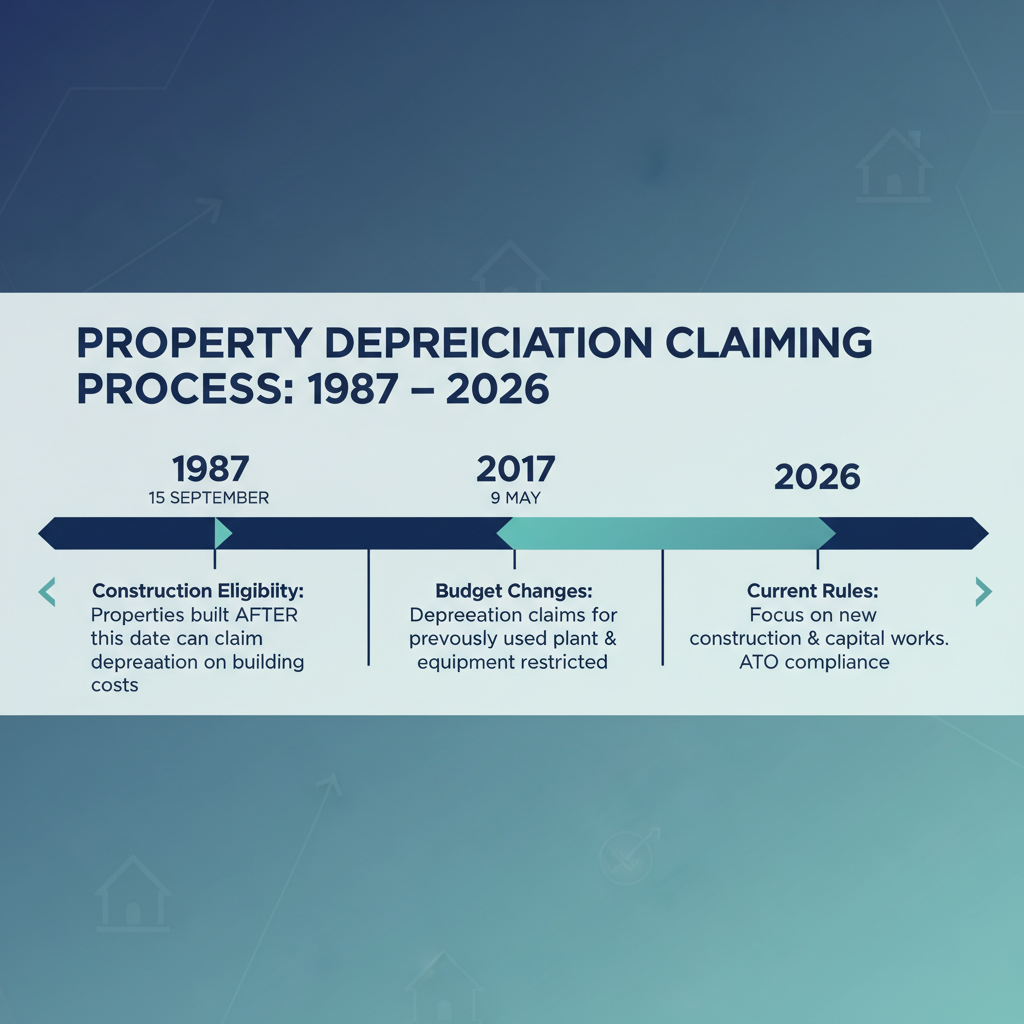
This covers the structural elements of your property—walls, floors, roof, foundations, doors, and permanently fixed items like built-in cupboards. For residential properties where construction commenced after 15 September 1987, you claim 2.5% of the original construction cost per year for up to 40 years.
Division 40: Plant and Equipment Depreciation
This covers removable or mechanical assets inside the property—carpets, blinds, dishwashers, air conditioners, hot water systems, ovens, and ceiling fans. Each asset depreciates over its ATO-determined effective life, ranging from a few years to more than a decade.
How Depreciation Improves Cash Flow
Because depreciation creates a "paper loss" without impacting your wallet, it's particularly valuable for negatively geared investors. Your property might be appreciating in market value while simultaneously generating tax deductions based on wear and tear, giving you the best of both worlds.
According to industry data, residential property investors found an average of over $12,000 in deductions in the first full financial year alone when working with qualified quantity surveyors.
Division 43 Capital Works: The Structural Foundation of Your Claim

Division 43 capital works deductions apply to the "bones" of your investment property—the permanent, structural components that make up the building itself.
What Qualifies Under Division 43?
- Foundation, structural walls, and load-bearing elements
- Roof, gutters, and drainage systems
- Floors, ceilings, and structural staircases
- Permanently attached fixtures like built-in wardrobes
- Structural renovations and extensions completed after 27 February 1992
How Much Can You Claim?
For most residential properties built after 15 September 1987, you claim 2.5% of the original construction cost annually for 40 years.
If the construction cost of your property was $400,000, you can claim $10,000 per year in capital works deductions—$400,000 in total deductions over the property's life.
Important Eligibility Rules
- Properties must have construction commenced after 15 September 1987 (or 18 July 1985 for some commercial properties)
- The deduction is based on construction cost, not purchase price
- Even older properties can qualify if substantial renovations were completed after the eligibility dates
- Only a qualified quantity surveyor can estimate construction costs for ATO compliance
Unlike Division 40 deductions, the 2017 legislative changes did not affect Division 43. Subsequent owners can still claim capital works deductions regardless of when they purchased the property.
Division 40 Plant and Equipment: Maximising Removable Asset Claims
Division 40 plant and equipment depreciation covers the removable fixtures and fittings inside your rental property that have a limited effective life.
Common Division 40 Assets
- Air conditioning units and ducted systems
- Carpets, vinyl flooring, and floor coverings
- Blinds, curtains, and window treatments
- Ovens, cooktops, dishwashers, and rangehoods
- Hot water systems and instantaneous heaters
- Ceiling fans and light fittings
- Smoke alarms and security systems
The 2017 Budget Changes: What Investors Must Know
From 9 May 2017, significant legislative changes altered how Division 40 deductions work for second-hand residential properties.
New properties purchased or constructed:
You can claim depreciation on all plant and equipment assets, whether installed before or after settlement, provided no one has lived in the property before you.
Established properties purchased after 9 May 2017:
You can only claim Division 40 deductions on assets you personally purchase and install. Pre-existing second-hand items like old carpets, air conditioners, or dishwashers are no longer claimable.
Properties purchased before 9 May 2017:
You can continue to claim depreciation on all plant and equipment under the previous rules.
Despite these changes, investors can still claim substantial deductions through capital works and any new assets they install during ownership, such as replacing carpets, upgrading appliances, or installing new air conditioning.
How to Get a Property Depreciation Schedule: The Quantity Surveyor Process

A depreciation schedule is a detailed report prepared by a qualified quantity surveyor that outlines every claimable deduction for your investment property, year by year, for up to 40 years.
Step 1: Engage a Qualified Quantity Surveyor
The ATO specifically requires that only qualified quantity surveyors estimate construction costs for depreciation purposes. Attempting to self-assess or having your accountant guess these values can trigger audits and penalties.
Quantity surveyors hold professional qualifications and are registered with the Tax Practitioners Board (TPB). They're recognised under ATO Tax Ruling 97/25 as one of the few professions with the construction costing expertise required.
Step 2: Property Inspection and Documentation
The quantity surveyor conducts a thorough site inspection, measuring rooms with laser equipment, photographing assets, recording brand and model numbers, and documenting all structural components and renovations.
For new builds, the surveyor may work from construction contracts, architectural plans, and schedules of finishes if a physical inspection isn't required.
Step 3: Receive Your Depreciation Schedule
Within approximately 5 business days, you receive a comprehensive report separating Division 43 capital works from Division 40 plant and equipment. The schedule provides annual deduction amounts for each financial year, often spanning 40 years.
Your accountant uses this schedule each year at tax time to claim the correct deductions in your annual return, reducing your taxable income and improving cash flow.
What Does a Depreciation Schedule Cost?
A professionally prepared depreciation schedule typically costs between $385 and $770 depending on property type, location, and complexity.
This one-time fee is 100% tax-deductible and usually pays for itself in the first year. According to recent data, a typical schedule generates $5,000 to $15,000 in first-year deductions, delivering 10x return on investment or more.
Most reputable quantity surveyors offer guarantees—if they don't find double their fee in deductions in the first full financial year, the report is free.
How Depreciation Interacts with Capital Gains Tax
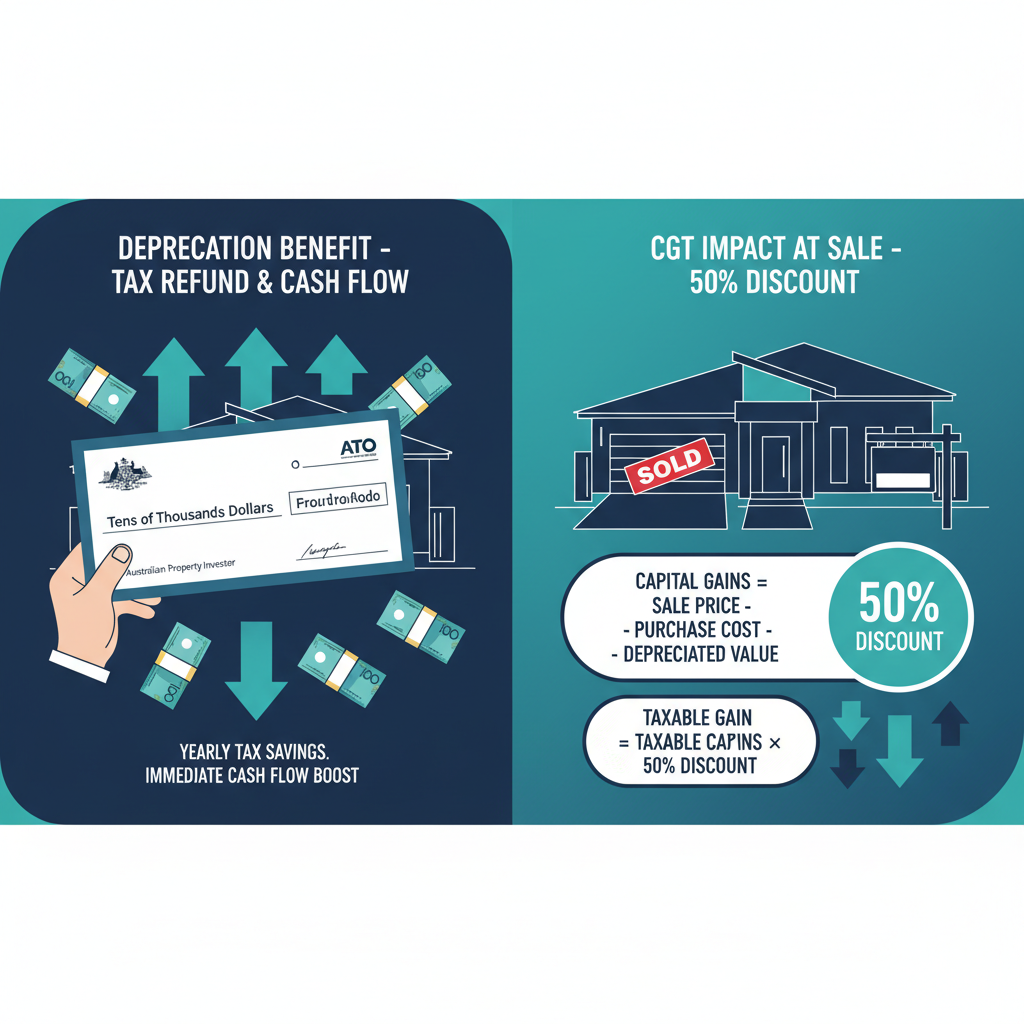
One common concern investors raise is how depreciation affects capital gains tax (CGT) when selling the property.
Division 43 and Your Cost Base
Capital works deductions claimed under Division 43 reduce your property's cost base, which increases the gross capital gain when you sell.
However, the tax benefit received during ownership typically far outweighs the additional CGT liability at sale, especially when the 50% CGT discount applies for properties held over 12 months.
For example, if you claimed $85,000 in Division 43 deductions over 10 years and received $38,250 in tax refunds (at a 45% marginal rate), but faced an additional $19,125 in CGT at sale (after the 50% discount), your net benefit is still $19,125 plus the time value of money.
Division 40 and Balancing Adjustments
Division 40 plant and equipment deductions are governed by separate balancing adjustment rules and don't directly reduce your CGT cost base in the same way.
Always consult your accountant before selling to confirm your specific CGT position based on your entity structure, holding period, and capital improvements.
Maximising Your Property Depreciation Claims: Practical Strategies
Even if you've owned your investment property for several years, it's not too late to benefit from depreciation.
Backdating Your Depreciation Claims
The ATO allows you to amend up to two previous tax returns to claim missed depreciation deductions. This means you can retrospectively recover thousands in unclaimed deductions even if you didn't obtain a schedule at purchase.
Claiming Depreciation on Renovations
If you've completed structural renovations or capital improvements, you can claim Division 43 deductions on the renovation costs at 2.5% per year. You can also claim Division 40 deductions on any new items you install, such as new carpets, appliances, or air conditioning.
Keep detailed records of all renovation invoices and receipts. A quantity surveyor can prepare an updated schedule incorporating these costs alongside the original building depreciation.
Avoid Common Mistakes That Trigger ATO Audits
- Never attempt to estimate construction costs yourself or rely on generic industry averages
- Don't claim depreciation on second-hand plant and equipment in properties purchased after 9 May 2017 unless you installed them
- Ensure your quantity surveyor is TPB-registered and provides ATO-compliant reports
- Keep your depreciation schedule and all supporting records for at least five years
The ATO is deploying advanced data-matching technology in 2026 to identify fraudulent depreciation claims. Ensuring your schedule is bulletproof protects you from audits and penalties.
How Buyers Agency Australia Helps Investors Identify High-Depreciation Properties
When evaluating potential investment properties, depreciation potential should form part of your pre-purchase due diligence—not an afterthought.
Buyers Agency Australia works with investors to identify properties that maximise both capital growth potential and tax efficiency. Properties constructed after 1987, newer builds with substantial plant and equipment, or properties with recent high-quality renovations can deliver significantly higher depreciation benefits.
By incorporating 10-year portfolio modeling and transparent, fixed-fee structures, Buyers Agency Australia ensures investors understand the complete tax and cash flow implications before committing to a purchase. Whether you're a first-home buyer navigating the complexities of negative gearing or a time-poor professional building a multi-property portfolio, expert guidance ensures you're not leaving thousands of dollars on the table each year.
To explore how property depreciation fits into your investment strategy, book a free strategy session with the team.
Frequently Asked Questions
Can I claim depreciation on a property built before 1987?
You can claim Division 43 if substantial renovations occurred after 1987. Division 40 may apply to new items you install.
Do I need a quantity surveyor for depreciation?
Yes. The ATO requires qualified quantity surveyors to estimate construction costs and prepare compliant depreciation schedules.
Is the depreciation schedule cost tax-deductible?
Yes. The full cost of obtaining a depreciation schedule is 100% tax-deductible in the year you pay for it.
Can I claim depreciation on holiday homes?
Only when the property is genuinely available for rent. Days used for personal purposes must be apportioned and excluded from deduction claims.
What happens if I don't claim depreciation?
The ATO still counts it as if you did for CGT purposes, meaning you could pay recapture tax without ever benefiting from the deduction.
Final Thoughts: Depreciation Is the Second-Largest Deduction After Interest
Property depreciation Australia strategies represent the second-largest tax deduction available to investors, trailing only behind loan interest.
Yet thousands of investors either under-claim or miss it entirely, leaving tens of thousands of dollars in unclaimed deductions on the table over the life of their property.
By understanding Division 43 capital works and Division 40 plant and equipment deductions, engaging a qualified quantity surveyor, and maintaining ATO-compliant records, you transform your investment property from a simple asset into a high-performing, tax-efficient wealth-building tool.
Whether you're purchasing your first investment property or managing an established portfolio, professional depreciation advice ensures you claim every dollar you're entitled to while staying compliant with current ATO rules.
Contact Buyers Agency Australia to discuss how depreciation fits into your long-term property investment strategy, or attend a FastTrack event to learn more about data-driven investment approaches that prioritise tax efficiency and capital growth.