
Key Takeaways
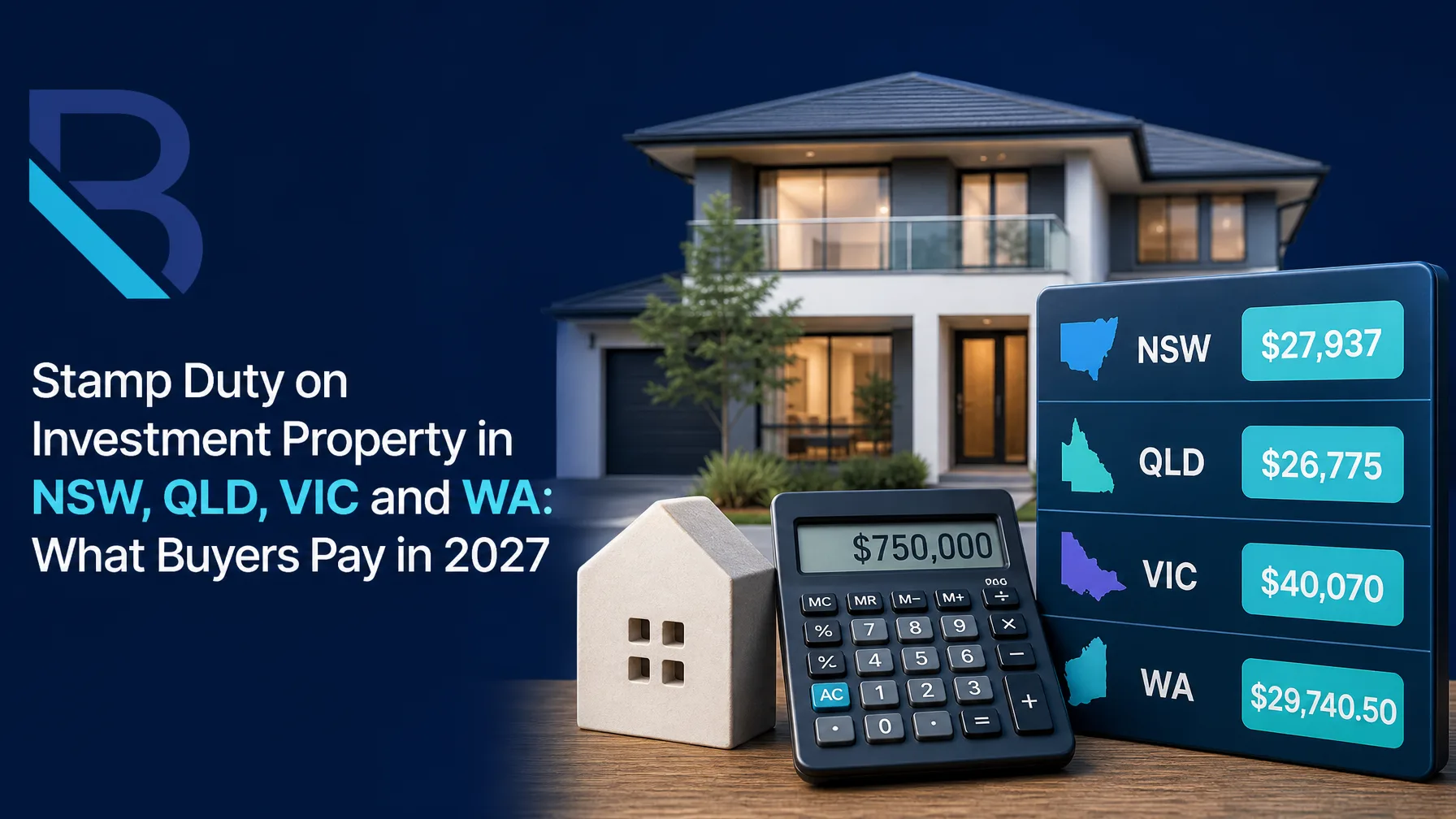
- On a $750,000 established residential investment purchase, estimated duty runs from $26,775 in Queensland (QLD) to $40,070 in Victoria (VIC), with New South Wales (NSW) at $27,937 and Western Australia (WA) at $29,740.50.
- Every figure assumes an arm's-length sale, an Australian purchaser and no concession, using scales checked in November 2026. They are estimates, not confirmed full-year 2027 liabilities.
- QLD is $13,295 lower than VIC in this example only; the gap shifts with price.
- Buyer status and property use can change the bill, from 7% to 9% foreign surcharges to Victoria's commercial transition rules.
- Duty is one cost among several, so budget separately for conveyancing, inspections and finance.
Table of Contents
- How much is investment-property stamp duty across the four states?
- What changes the duty on an investment property?
- How is the $750,000 duty estimate calculated in each state?
- What other purchase costs and concessions should investors check?
- How Buyers Agency Australia prices acquisition support
- How should an investor budget before making an offer?
- Frequently asked questions
- Decide your acquisition budget before you bid
- Resources
On a $750,000 established residential investment purchase, the four-state transfer duty estimate runs from $26,775 to $40,070. That range uses the scales checked in November 2026 and applies to this one scenario, not every purchase or a confirmed full-year 2027 liability.
Two investment properties at the same price can carry very different upfront bills depending on the state. This guide is for Australian investors comparing acquisition budgets across NSW, QLD, VIC and WA, with stamp duty known officially as transfer duty.
Below you will find a side-by-side table, the arithmetic behind each figure and a short process for budgeting before you make an offer.
Prices checked in November 2026. General information only, not personal tax or legal advice.
How much is investment-property stamp duty across the four states?
Every figure below assumes an established residential property, an arm's-length purchase where dutiable value equals the $750,000 price, an Australian purchaser who pays no foreign surcharge, and no concession. Duty and the total of price plus duty exclude all other costs.
| State | Estimated duty | Price plus duty | Rate source |
|---|---|---|---|
| NSW | $27,937 | $777,937 | Revenue NSW transfer duty rates |
| QLD | $26,775 | $776,775 | Queensland Revenue Office rates |
| VIC | $40,070 | $790,070 | State Revenue Office Victoria rates |
| WA | $29,740.50 | $779,740.50 | Revenue WA transfer duty fact sheet |
QLD is $13,295 lower than VIC here, but that reflects this price and these scales, not a universal ranking. Duty is a state charge, so none of it goes to a lender or buyers agent.
What changes the duty on an investment property?
Three inputs move the bill most: the price that sets dutiable value, who is buying, and how the property is used. Each can shift the figures in the table by thousands of dollars.
Purchase price and dutiable value
Dutiable value is the base every state's scale works from. Revenue NSW uses the higher of the price and market value, so a low contract price does not reduce the base below market value; other states set their own valuation rules, so check each authority.

Duty then builds in brackets. At $750,000, the NSW formula is $11,602 plus $4.50 per $100 above $387,000, which gives $27,937. Each extra $10,000 of price adds $450 in that NSW bracket and $600 in VIC's 6% band, so small price differences move the bill by hundreds of dollars, not thousands.
Buyer status and concessions
The table assumes an Australian purchaser, so it excludes foreign surcharges and any owner-occupier or first-home relief. Published residential surcharge rates are 9% in NSW, 8% in QLD, 8% in VIC and 7% in WA, each subject to the state's eligibility rules and exemptions. In NSW, a 9% surcharge on $750,000 is $67,500 on top of the $27,937 duty, where it applies.
Concessions work the other way, but they depend on occupation and statutory conditions, so an investor should not assume first-home or owner-occupier benefits. Victoria's foreign purchaser additional duty rules set out who is caught.
Property use and transaction structure
Property type, buyer entity and transaction details all need checking before a number is final. Victoria adds a commercial twist: a qualifying entry transaction can start a 10-year transition to commercial and industrial property tax, and later qualifying transactions may be exempt from transfer duty. Entry is not automatic, and the annual tax follows the transition period.

The State Revenue Office's commercial and industrial property tax guidance explains the conditions. That is an exception to the residential comparison, not a replacement estimate. Office, retail and industrial buyers should also weigh commercial property ownership structures such as trusts and companies before signing.
How is the $750,000 duty estimate calculated in each state?
The shared assumptions above apply to all four examples, which show duty and price plus duty and exclude other costs.
NSW: $27,937 duty
Example: NSW duty on a $750,000 purchase is $27,937, and price plus duty is $777,937. The price sits in the $387,001 to $1,290,000 band, so the formula is $11,602 plus $4.50 per $100 above $387,000. The excess is $363,000, or 3,630 lots of $100, and 3,630 × $4.50 is $16,335. Add the $11,602 base to reach $27,937. The published scale covers 1 July 2026 to 30 June 2027, so contracts later in 2027 need a fresh check.

QLD: $26,775 duty
Example: QLD duty is $26,775, and price plus duty is $776,775. For $540,000 to $1 million, duty is $17,325 plus $4.50 for each $100 or part above $540,000. The excess is $210,000, or 2,100 lots, and 2,100 × $4.50 is $9,450. Adding the $17,325 base gives $26,775. The 'or part' wording matters: a price of $750,050 would count the extra $50 as a full $100.

VIC: $40,070 duty
Example: VIC duty is $40,070, and price plus duty is $790,070. Above $130,000 to $960,000, general duty is $2,870 plus 6% of the value above $130,000. The excess is $620,000, 6% of which is $37,200, giving $40,070 with the base. Above $960,000 to $2 million, Victoria switches to 5.5% of the whole value, which is a different formula, not the 6% marginal rate used here.

WA: $29,740.50 duty
Example: WA duty is $29,740.50, and price plus duty is $779,740.50. Above $725,000, general duty is $28,453 plus $5.15 for each $100 or part above $725,000. The excess is $25,000, or 250 lots, and 250 × $5.15 is $1,287.50. Keep the cents: the total is $29,740.50. As in Queensland, a part-$100 amount counts as a full lot.
What other purchase costs and concessions should investors check?
Transfer duty is only one line in the acquisition budget. Quotes for the items below depend on the provider and property, so get each in writing.
- Conveyancing or legal fees, including contract review
- Searches, plus building and pest inspections
- Registration fees charged by the state land registry
- Finance costs such as lender and valuation fees
- A buyer's-agent fee, if you use one
Owner-occupier and first-home benefits depend on occupation and other statutory conditions, so an investment purchase should not be budgeted as if it qualifies. For the cash side, a guide to investment property deposit requirements shows how much to set aside, and the property investment buying services page outlines what acquisition support covers.
How Buyers Agency Australia prices acquisition support
Government revenue offices charge duty; Buyers Agency Australia does not collect it. What the agency prices is acquisition support: strategy, market research, property assessment, negotiation and help securing the purchase. Its site describes client-specific fixed-fee quotes after a discovery call, while its commercial property acquisition support page for office, retail and industrial buyers also mentions a percentage option.

No single fee applies to every client. Whichever model you are quoted, read the written quote for scope, payment triggers, GST treatment and exclusions, and see how fixed and percentage buyer's-agent fees compare.
How should an investor budget before making an offer?
Duty is easiest to budget when you run the same checks in the same order before every offer.

- Establish the property's use, the contract price and your estimate of market value.
- Identify the purchaser, including any entity, and whether a surcharge or concession could apply.
- Calculate duty using the relevant state revenue office's rates or calculator.
- Add separately quoted buying costs, such as conveyancing, inspections and finance.
- Ask a conveyancer to check liability and timing before you sign.
- For a commercial asset in Victoria, check transition status, and consider commercial buyers agency support for office and industrial assets.
Buyers Agency Australia's investment approach starts with this kind of cost clarity, and property contract due diligence checks confirm what you are signing. To test the numbers against your plan, book a free strategy session.
Frequently asked questions
Can I claim purchase stamp duty against rental income?
Generally no. Acquisition costs are generally not rental-income deductions, though relevant costs may form part of the property's CGT cost base, per the ATO rental expense guidance.
When is NSW transfer duty due?
Generally by the earlier of settlement or three months after the contract or other liability date, as Revenue NSW payment timing guidance explains.
Is transfer duty the same as annual land tax?
No. Transfer duty applies to the acquisition, while land tax is a separate annual charge where applicable, as the NSW Government investment-property tax overview explains.
Does Queensland charge mortgage duty on a new mortgage?
No. Queensland abolished mortgage duty in 2008, although duty can still apply to transfers of a mortgage, according to the QLD rate page.
Decide your acquisition budget before you bid
Start with the duty on your actual transaction, using the state revenue office's own rates, then add each quoted cost before you set an offer ceiling. Two properties at the same price can leave you with very different cash requirements at settlement, and a surcharge or commercial-use rule can move the number again.
A low duty bill in one example is not a verdict on the investment. Yield, vacancy risk, tenant quality and growth prospects decide whether a property earns its place in a portfolio; duty is simply the entry fee.
If you want help testing a purchase against your budget, Buyers Agency Australia works with investors on strategy, research and acquisition support. Contact the team about your plans, or map out your next property move in a free session.
Resources
Internal resources
- Buyers Agency Australia's investment approach
- commercial property acquisition support
- property investment buying services
- commercial property ownership structures such as trusts and companies
- fixed and percentage buyer's-agent fees
- investment property deposit requirements
- property contract due diligence checks
- book a free strategy session
- Contact the team about your plans
External resources
- Revenue NSW transfer duty rates
- Queensland Revenue Office rates
- State Revenue Office Victoria rates
- Revenue WA transfer duty fact sheet
- foreign purchaser additional duty rules
- commercial and industrial property tax guidance
- ATO rental expense guidance
- Revenue NSW payment timing guidance
- NSW Government investment-property tax overview