
Property as a Wealth Vehicle Why Property Is the Smartest Path to Long Term Wealth
Property creates long-term wealth through leverage, tax advantages, rental income, and proven capital growth that consistently outperforms inflation. Unlike shares, cash, or bonds, property allows investors to borrow 70-90% of the purchase price while controlling a high-value asset that generates passive income and compounds capital gains over decades.
We've all heard the advice: buy property to build wealth. But here's the thing—most people don't understand why property is the smartest vehicle for wealth creation in Australia.
You're not chasing quick wins or speculating on price spikes. You're building a portfolio that generates rental income, grows in value, and provides tax-deductible expenses.
This guide explains exactly how property outperforms other asset classes, why Buyers Agency Australia helps investors identify investment-grade properties, and how to structure your first or next purchase for maximum long-term returns.
Why Property Outperforms Other Asset Classes for Wealth Building
The Four Pillars of Property as a Wealth Vehicle
Property doesn't rely on a single mechanism to build wealth. It combines leverage, income, capital growth, and tax advantages into one package.
Here's how each pillar contributes:
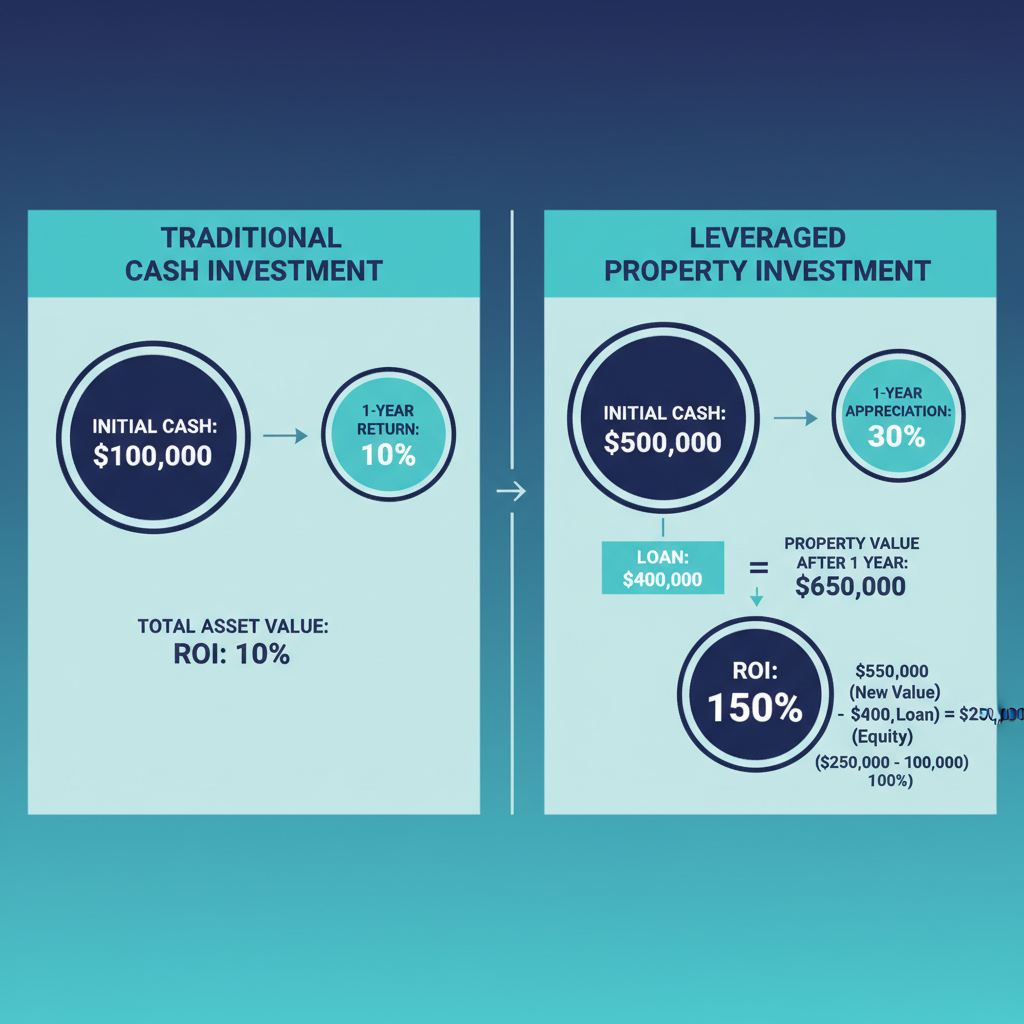
Leverage: You control a $600,000 asset with a $120,000 deposit (20% LVR). The bank funds the rest. When the property grows 6% in a year, you gain $36,000 in equity—a 30% return on your actual cash invested.
Rental Income: Tenants pay down your mortgage. Even negatively geared properties build equity through forced savings while you claim tax deductions on the shortfall.
Capital Growth: Australian property prices have averaged 6.4% annual growth over 30 years. A $600,000 property becomes $1.07 million in 10 years at that rate, according to CoreLogic data.
Tax Advantages: Negative gearing, depreciation, and the 50% CGT discount (for assets held over 12 months) reduce your tax liability and improve after-tax returns.
How Property Compares to Shares, Bonds, and Cash
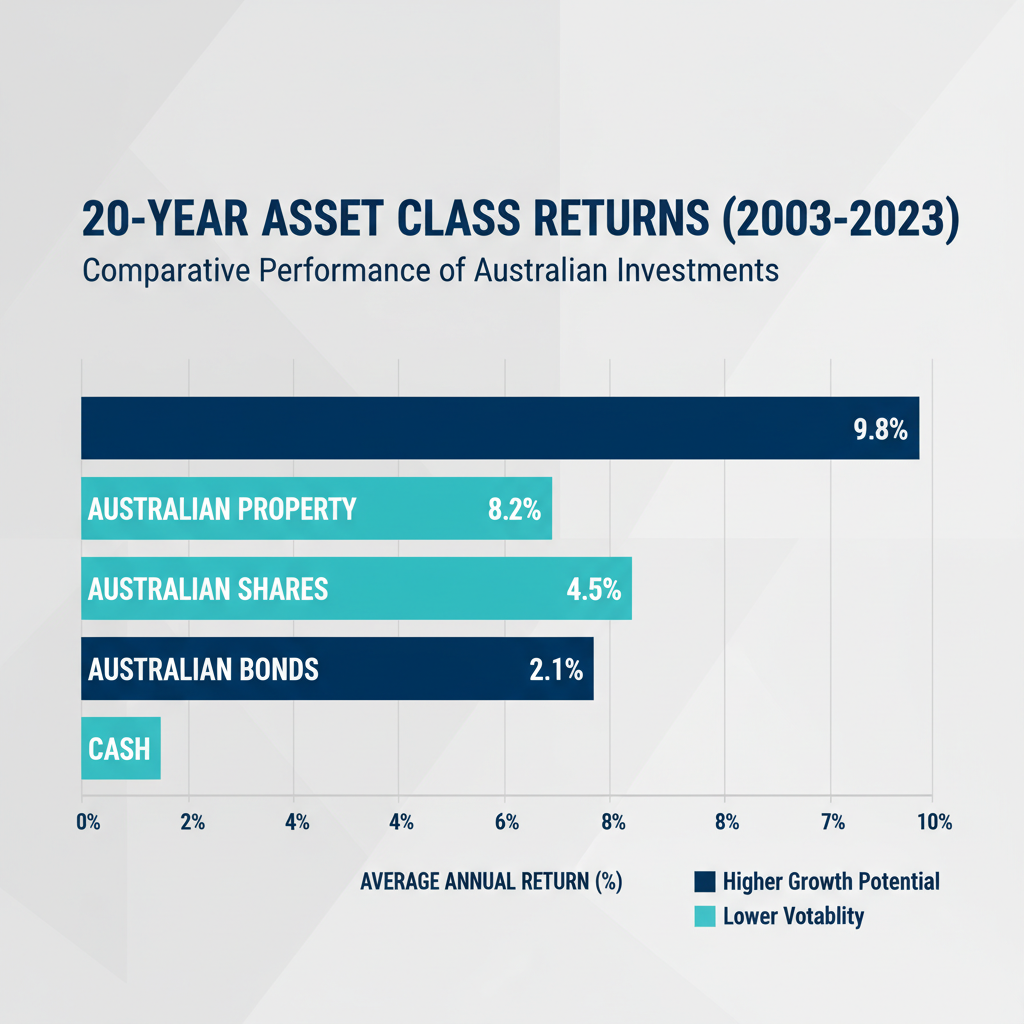
Recent analysis from Livewire Markets shows that over 20 years, Australian residential property delivered consistent returns with far less volatility than equities.
While Australian shares averaged 10% annually since 1994, property's lower volatility and leverage opportunity make it more accessible for everyday investors.
Shares require you to invest 100% cash upfront. Property lets you borrow 80-90% of the purchase price. That's a fundamental difference when compounding returns over decades.
Cash and bonds can't keep pace with inflation in 2026. Fixed-income yields sit around 3-4%, while property prices nationally rose 7-10% in 2025.
The Compounding Effect of Property Over 10-20 Years
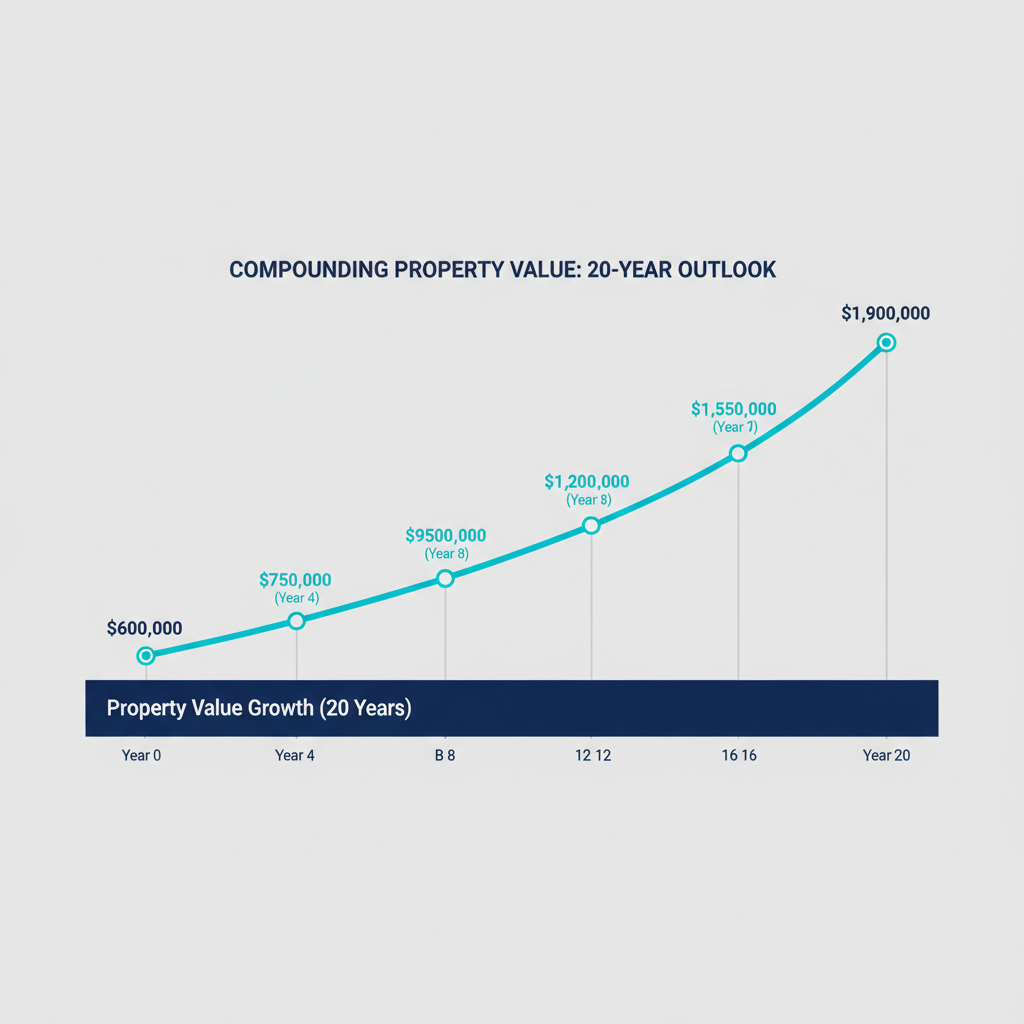
Compounding is the most powerful force in wealth creation. Property rewards patience.
A standard Australian house has tripled in value every 20 years since WW2, according to Propertyology's 2026 market outlook.
That requires an average annual growth rate of 6%. Five out of eight capital cities achieved that milestone in 2025.
Here's what that looks like:
- Year 1: $600,000 property grows to $636,000
- Year 10: $1,074,000
- Year 20: $1,924,000
You didn't need to time the market. You held an investment-grade property in a growth corridor and let time do the work.
The Power of Leverage Using Other People's Money to Build Wealth
How Leverage Amplifies Property Returns
Leverage is the single biggest advantage property has over other asset classes.
You can't borrow 80% to buy shares. You can borrow 80-90% to buy property.
Here's how the math works:
- You invest $120,000 (20% deposit on a $600,000 property)
- The property grows 6% in Year 1: $36,000 in equity
- Your return on actual cash invested: 30%
That's the power of leverage. You're earning capital growth on the full asset value, not just your deposit.
Buyers Agency Australia helps investors structure their borrowing capacity to acquire multiple properties using equity release from existing assets.
The Risk-Reward Balance of Borrowing for Property
Leverage magnifies gains. It also magnifies losses if property values decline.
That's why buying investment property requires due diligence, cash flow planning, and risk assessment.
Successful investors mitigate risk by:
- Buying in suburbs with strong rental demand (vacancy rates under 2%)
- Holding a cash buffer of 6-12 months' expenses
- Fixing interest rates or stress-testing at 7-8%
- Diversifying across multiple properties and cities
Property isn't risk-free. But it's far less volatile than shares, and you can insure it.
How to Calculate Your True Return on Investment with Leverage
Most investors focus on gross rental yield (4-5%). That's the wrong metric.
Your true ROI combines:
- Capital growth (equity gained)
- Rental income (after expenses)
- Tax savings (depreciation + negative gearing)
- Loan principal paid down by tenants
Example:
- $600,000 property, 20% deposit ($120,000)
- Capital growth: 6% = $36,000
- Net rental income: -$3,000 (negatively geared)
- Tax refund from negative gearing: $1,200
- Loan principal paid down: $4,000
- Total wealth increase: $38,200
- ROI on your $120,000: 31.8%
That's the power of leverage and forced equity.
Rental Income Building Passive Cash Flow While Someone Else Pays Your Mortgage
How Rental Yield Contributes to Wealth Accumulation
Rental income serves two purposes: it offsets holding costs and forces equity accumulation.
In high-demand markets, rental yields in Australia remain stable at 3-5%, providing steady cash flow alongside capital growth.
Even negatively geared properties build wealth. Here's why:
- You claim tax deductions on the rental loss
- Tenants pay down your loan principal
- The property appreciates in value
Over 10 years, a negatively geared property can deliver higher after-tax returns than a positively geared property in a low-growth suburb.
Positive Gearing vs Negative Gearing Which Builds Wealth Faster
Positive gearing means rental income exceeds expenses. You pay tax on the profit.
Negative gearing means expenses exceed rental income. You offset the loss against your taxable income.
Neither is inherently better. It depends on your income, tax bracket, and investment goals.
Negative gearing works best for:
- High-income earners (marginal tax rate 37-45%)
- Investors prioritizing capital growth
- Those holding properties long-term (10+ years)
Positive gearing suits:
- Retirees with low income
- Investors seeking immediate cash flow
- Regional or high-yield markets (5-6% yields)
Dragan Dimovski's 20+ years of experience shows that most wealth-building strategies combine both: negatively geared metro properties for capital growth, and positively geared regional properties for cash flow.
How to Increase Rental Income Without Major Renovations
Small upgrades deliver outsized returns:
- Fresh paint and landscaping: $2,000 spend, $20-30/week rental increase
- Split-system air conditioning: $3,000 spend, $15-25/week increase
- Dishwasher: $800 spend, $10-15/week increase
- Security system: $1,200 spend, attracts higher-quality tenants
These improvements also reduce vacancy periods. A property that sits empty for 4 weeks costs more than a $3,000 upgrade.
Buyers Agency Australia sources properties with rental optimization in mind—high ceilings, natural light, modern finishes that tenants pay a premium for.
Capital Growth The Silent Wealth Multiplier Over Time
Historical Property Growth Rates in Australia 1995-2025
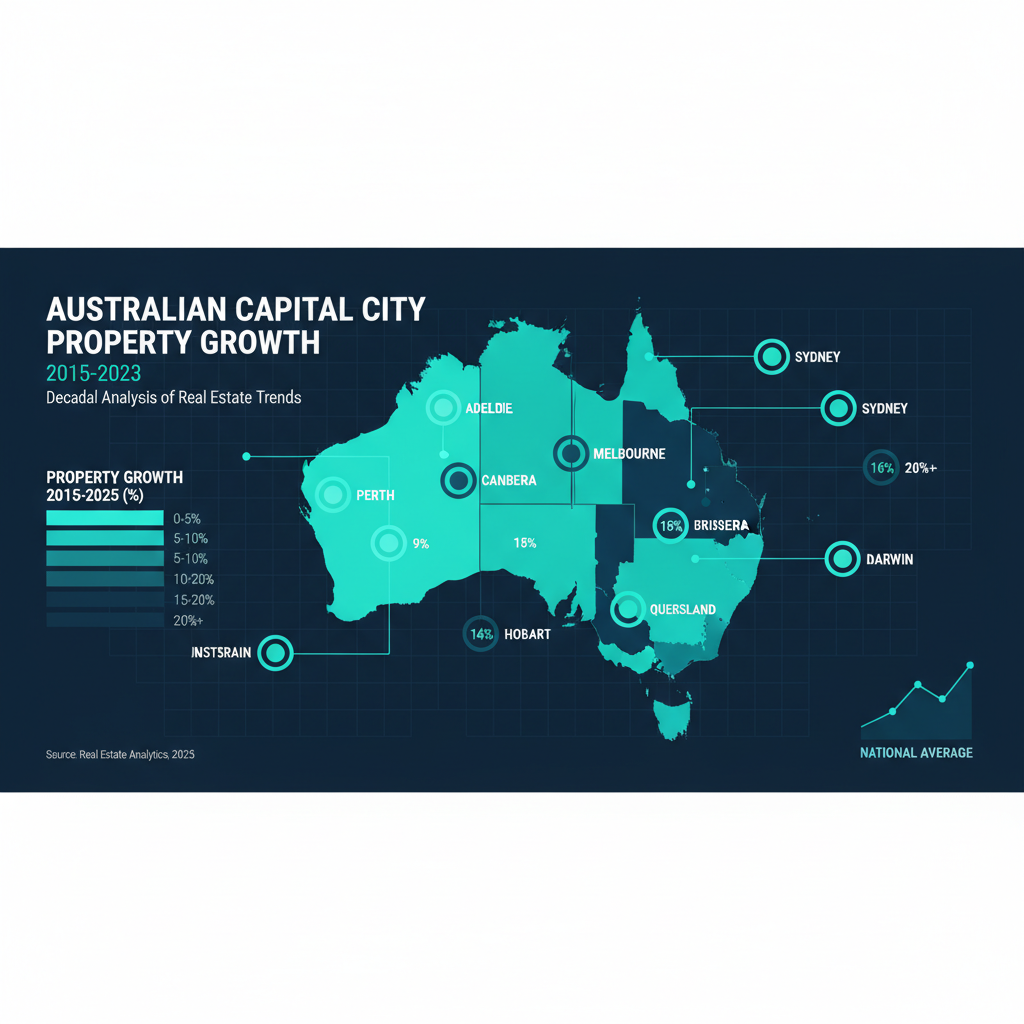
Australian property prices have more than doubled over the last 20 years, driven by population growth, limited supply, and infrastructure investment.
According to Australian Bureau of Statistics, the strongest annual growth on record was 23.7% in December 2021.
Over the long term, CoreLogic data shows:
- Sydney and Melbourne: 80-100% growth over 10 years
- Brisbane and Adelaide: 90% growth (Perth cycles separately)
- National median: 6.4% annual average over 30 years
That compounding effect turns a $500,000 property into $895,000 in 10 years at 6% growth.
What Drives Capital Growth in Property Markets
Capital growth isn't random. It's driven by supply-demand imbalances.
Key drivers:
- Population growth: Australia's population grew from 20 million in 2005 to 27 million in 2025
- Infrastructure investment: New rail lines, hospitals, and employment hubs increase desirability
- Housing supply shortfall: Australia needs 225,400 new dwellings annually to meet demand. We're building far less.
- Affordability migration: Buyers priced out of Sydney/Melbourne move to Brisbane, Perth, Adelaide
Investors who understand these cycles buy early in gentrifying suburbs before the market catches up.
How to Identify High Growth Suburbs Before the Market Does
Buyers Agency Australia uses a data-driven framework to identify growth corridors:
- Median price under $850,000 (affordability sweet spot)
- Vacancy rates under 2% (tight rental market)
- Infrastructure pipeline (government announcements for rail, schools, hospitals)
- Median household income growth (tracks employment strength)
- Days on market under 30 (competitive buyer demand)
Suburbs that tick all five boxes typically outperform by 2-3% annually.
Dragan Dimovski's $10M+ personal portfolio is built on this exact methodology.
Tax Advantages That Make Property the Most Tax Effective Investment
Negative Gearing Explained How Losses Reduce Your Tax Bill
Negative gearing allows you to offset rental losses against your taxable income.
Here's how it works:
- Your salary: $100,000
- Rental income: $20,000
- Property expenses (interest, rates, insurance, depreciation): $28,000
- Rental loss: $8,000
- New taxable income: $92,000
You save $2,960 in tax (at 37% marginal rate).
According to Australian Treasury data, nearly 70% of people with negatively geared property had taxable income under $80,000.
Negative gearing isn't just for the wealthy. It's a wealth-building tool for middle-income earners.
Property Depreciation How to Claim Thousands in Tax Deductions
Depreciation is a non-cash deduction that reduces taxable income without impacting cash flow.
Two types:
- Capital works deduction: Structure and fixed assets (2.5% per year over 40 years for properties built after 1987)
- Plant and equipment depreciation: Removable items (carpet, air conditioning, appliances)
A brand-new $600,000 property can deliver $8,000-12,000 in annual depreciation deductions for the first 5 years.
Investors who purchase second-hand properties after May 2017 can only claim depreciation on new items they install, according to ATO regulations.
Buying new or substantially renovated properties maximizes depreciation benefits.
Capital Gains Tax Discount Why Holding Property Long Term Pays Off
Australia's 50% CGT discount rewards long-term investors.
If you sell a property after holding it for more than 12 months, you only pay tax on 50% of the capital gain.
Example:
- Purchase price: $600,000
- Sale price (after 10 years): $1,074,000
- Capital gain: $474,000
- Taxable gain (50% discount): $237,000
- Tax payable (at 37% marginal rate): $87,690
Without the discount, you'd pay $175,380 in tax. The discount saves you $87,690.
That's why flipping properties short-term is rarely optimal. Hold for 10-20 years and maximize the CGT discount.
How Buyers Agency Australia Helps Investors Build Property Wealth Portfolios
Why Most DIY Investors Overpay or Buy in the Wrong Suburbs
Most investors make one of three mistakes:
- Buying emotionally ("I love the kitchen!")
- Chasing advertised hotspots (after prices have already spiked)
- Ignoring rental demand and days-on-market data
These mistakes cost $50,000-100,000 in lost capital growth over 10 years.
Buyers Agency Australia eliminates emotion from the process. You get data-driven suburb selection, off-market access, and negotiation expertise.
Dragan Dimovski's team sources properties before they hit the market, giving you first-mover advantage.
The Buyers Agency Australia 10 Year Portfolio Modeling Approach
Most buyers agents help you buy one property. Buyers Agency Australia builds a 10-year wealth plan.
The process:
- Wealth goal setting: What's your target portfolio value in 10 years?
- Borrowing capacity analysis: How many properties can you afford?
- Suburb selection: Which markets will outperform?
- Property acquisition: Off-market and pre-market deals
- Portfolio review: Annual check-ins to release equity and scale
This isn't one-and-done. It's a long-term partnership to build generational wealth.
Fixed Fee Transparency No Hidden Costs or Commissions
Buyers Agency Australia charges a fixed fee, not a percentage of the purchase price.
Why does this matter?
Percentage-based fees incentivize agents to push you toward higher-priced properties. Fixed fees align incentives with your goals.
You pay the same whether the property is $600,000 or $700,000. The focus stays on finding the best investment, not the most expensive.
Frequently Asked Questions
How much deposit do I need to start buying investment property?
Most lenders require 20% deposit to avoid Lenders Mortgage Insurance (LMI). Some allow 10% with LMI or use equity from your home.
Is property still a good investment in 2026?
Yes. National property prices are forecast to grow 6-10% in 2026, according to SQM Research and PropTrack.
Should I buy in Sydney or regional areas for better returns?
Brisbane, Perth, and Adelaide are tipping for strongest growth in 2026. Sydney offers stability but lower yields. Diversify across multiple cities.
Can I use negative gearing if I'm not a high income earner?
Yes. 70% of negatively geared investors earn under $80,000. The tax refund improves cash flow at any income level.
How does Buyers Agency Australia find off market properties?
Through 20+ years of industry relationships with agents, developers, and private sellers. Off-market properties avoid bidding wars and sell 5-10% below market value.
Key Takeaways
Property is the smartest wealth vehicle because it combines leverage, rental income, capital growth, and tax advantages into one asset class.
You can't borrow 80% to buy shares. You can borrow 80% to buy property. That leverage magnifies your returns when you buy in growth corridors.
Negative gearing, depreciation, and the 50% CGT discount reduce your tax liability and improve after-tax returns.
Buyers Agency Australia helps investors build 10-year portfolio plans using data-driven suburb selection, off-market access, and fixed-fee transparency.
The best time to start was 10 years ago. The second-best time is today. Book your free strategy session and map your path to long-term wealth.