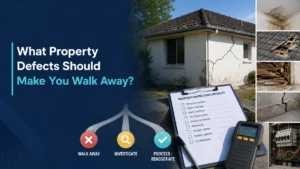
In the first 15 minutes, work through four questions: does the location work, does the layout suit the intended use, are there visible signs of water, structural or maintenance risk, and does the property fit the buyer's strategy? Use this property inspection checklist to decide whether to proceed, pause for evidence or walk away for now. It is an initial screen, not a substitute for building and pest, strata, contract or zoning checks.
Inspection days are rushed. Styled furniture, fresh paint and a friendly agent can pull your attention away from real risk, and three properties later the details blur together.
The first walkthrough is not about diagnosing every defect. Its job is to decide whether a property deserves deeper investigation, and a simple property inspection checklist keeps that decision disciplined.
Buyers Agency Australia approaches this from the buyer's side, with strategy-led property buying support that starts with the brief before the property. The 15-minute sequence below is a practical screening framework, not a legal or industry standard. Every observation is a prompt for questions and professional reports, not a final diagnosis.
Why the first 15 minutes of an inspection matter
The first visit shows you basic fit and visible condition. It should tell you whether deeper investigation is justified, not whether you have diagnosed the property. Think of it as screen, verify, decide: screen on the day, verify with evidence, then decide.
Consumer Affairs Victoria's inspection guidance points buyers to visible clues such as access, damp, cracks and roof condition, while still recommending professional reports. It is Victorian guidance, so terminology and rules may differ in other states. NSW Government inspection guidance takes a similar approach for NSW buyers.
| What you notice | What it may indicate | What it cannot prove |
|---|---|---|
| Stain on a ceiling | Possible moisture or a past leak | The source, whether it is active, or the repair scope |
| Crack in a wall or floor | Movement, settlement or ageing | The cause or structural significance |
| Musty smell | Poor ventilation or damp | Where the moisture comes from |
| Fresh paint on one patch | A cosmetic refresh or a concealed repair | What sits beneath the paint |
| Constant road noise | A lifestyle or tenant-appeal issue | How noise changes by time of day |
What should I check first when inspecting a property?
Start outside. Location and access shape everything else, and they are the hardest things to change.
Minutes 0-3: Assess the location and first impression
A good property inspection checklist starts at the boundary, before you step inside. Walk the street, watch how traffic and pedestrians move, and notice whether the property feels consistent with your brief. Record conditions that shift with time of day, weather or weekday, and consider a second visit at a different hour.
The first five external checks:
- Access: driveway, street width, entry and safe approach.
- Noise: traffic, trains, flight paths and neighbouring uses.
- Parking: for residents, visitors and any tenants.
- Surrounding uses: neighbours, commercial activity and nearby development sites.
- Hazard context: slope, waterways and vegetation as prompts only.
Ask the agent about the street, recent works nearby and how long the property has been listed. Verify later: flood, bushfire, zoning and planning controls cannot be judged by eye. Use the planning portal or council for the property's state, such as the NSW Planning Portal, and do not treat one state's portal as a national authority.
Minutes 3-6: Check the property's layout and liveability
Walk the floor plan in the order a family or tenant would actually live in it. Look for awkward circulation, unusable corners, weak separation between spaces, limited storage, overlooking from neighbours and blocked light. Note orientation, natural light and ventilation, remembering they influence comfort and appeal but do not guarantee rental demand or resale value.
Then run a change test. Ask what would need to change for the property to work, and whether that change is cosmetic, structural, approval-dependent or simply impossible. This one question can save you from falling for a property that only works with renovation you cannot realistically do.

Owner-occupiers should picture daily routines. Investors should picture the broadest sensible tenant. Either way, a property viewing checklist works best when the layout is judged against a purpose, not a feeling.
What are the biggest visible warning signs during a property inspection?
Minutes 6-10: Look for visible condition and maintenance issues
Slow down here. The visible clues listed by Consumer Affairs Victoria include damp walls, cracks, mould, pooling water and roof damage. The same guidance recommends qualified inspection before you commit to a contract.

Any property inspection checklist should treat each of these as a prompt, not a diagnosis. A stain may point to moisture, but only an appropriately qualified professional can establish the source and the remedy. A practical first inspection should look for:
- Water: stains, musty odours, bubbling paint, lifting tiles, sagging ceilings and pooling after rain.
- Structure: significant or widening cracks, sticking doors and windows, and uneven floors.
- Roof and drainage: damaged roof materials, blocked gutters and ground that appears to direct water toward the building.
- Pests: soft or hollow-sounding timber and mud trails. Termite activity can be concealed, so a building and pest inspection remains essential.
- Services and ventilation: ageing switchboards, patched plumbing and poor subfloor ventilation.
- Works and repairs: repeated patching, or additions with no obvious approvals.
None of these is a defect until a suitable professional confirms it. Calm observation, written down, beats guesswork.
How should an investor judge whether a property deserves further investigation?
Minutes 10-13: Consider the property's investment potential
For an investment property inspection, the question shifts from would I live here to would this suit the intended tenant or business user. Consider privacy, storage, parking, local convenience, adaptability and the visible maintenance that could raise holding costs. A walkthrough cannot establish rent, yield, capital growth or vacancy, so verify those with current local evidence.
ASIC MoneySmart's investment property guidance highlights costs such as vacancy, insurance, rates and repairs. Use your observations to frame questions:
- Tenant appeal: does the layout suit the intended renter or business user?
- Adaptability: could the space be reconfigured without approvals or major cost?
- Maintenance exposure: what visible wear might affect holding costs?
- Strategy fit: does the asset suit your broader plan?
For office, retail or industrial assets, add access, loading, frontage, services, tenant operations, permitted use and lease questions. These need asset-specific verification, not a visual guess. The rule is simple: a property should not move forward just because it looks attractive if condition or strategy fit is unresolved.
How can I tell if a property needs further investigation?
Minutes 13-15: Decide whether to investigate further
Use a three-way decision aid. It is a practical tool, not legal advice.
- Go: the property fits your brief, no obvious disqualifier is visible, and you can name the next evidence you need.
- Pause: a material question is unresolved, such as moisture, cracking, drainage, unapproved work, poor access, unclear permitted use or uncertain investment fit.
- Walk away for now: the property fails a non-negotiable requirement, shows an unacceptable visible safety concern, or cannot be investigated within the transaction timeframe.

Treat uncertainty as a reason to pause. The absence of visible defects is not a clean result, and an area you could not see remains an open question. Write down every question and note whether it goes to the agent, an inspector, a solicitor or conveyancer, or the council.
For help judging severity, read how to assess property defects, which explains why evidence and specialist follow-up matter. If you would like a second set of eyes on your shortlist, book a free strategy session and talk through your next step.
What a first property inspection cannot tell you
Is a visual inspection enough? No. Official guidance recommends independent building and pest inspections, and no property inspection checklist replaces them.
Strata, owners corporation or body corporate records, vendor disclosure, auction and cooling-off rules also vary by state and territory. Check the relevant state authority before acting on any legal point. Here is who should verify what:
- Hidden defects, concealed pests, cause of cracking: building and pest inspector or engineer.
- Strata or body corporate finances and rules: strata report, reviewed with a solicitor or conveyancer.
- Zoning, permitted use, flood, bushfire: the relevant planning authority or council.
- Title, contract terms, approvals: solicitor or conveyancer.
- Value, insurance and rent: valuer, insurer and current local rental evidence.
One more point: if a report marks an area as inaccessible, treat it as unverified, not as clear. For the full legal, physical, planning and financial picture, use a property due diligence checklist as your next resource.
A printable property inspection checklist for the first 15 minutes
Print this property inspection checklist and carry it on a clipboard. Fill in what you saw, then note what needs verifying and who verifies it.
| Time | Check | What I saw | Verify, and who |
|---|---|---|---|
| 0-3 | Access, parking and traffic | ____ | Re-visit at another time |
| 0-3 | Noise and surrounding uses | ____ | Agent, council |
| 0-3 | Flood, bushfire or slope context | ____ | Planning authority mapping |
| 3-6 | Layout and room flow | ____ | Your own brief |
| 3-6 | Light, orientation, ventilation | ____ | Re-visit in different light |
| 3-6 | Storage and privacy | ____ | Your own brief |
| 3-6 | Change test (cosmetic, structural, approval) | ____ | Builder, council |
| 6-10 | Moisture, mould, stains | ____ | Building inspector |
| 6-10 | Cracks and floor movement | ____ | Inspector, engineer |
| 6-10 | Roof, gutters, drainage | ____ | Building inspector |
| 6-10 | Pest prompts | ____ | Pest inspector |
| 6-10 | Services and patched repairs | ____ | Licensed trades |
| 6-10 | Signs of unapproved work | ____ | Council, solicitor |
| 10-13 | Tenant or business-user appeal | ____ | Local rental evidence |
| 10-13 | Maintenance and holding costs | ____ | Inspector, finance adviser |
| 13-15 | Proceed, pause or walk away for now | ____ | Decide and list evidence |
How Buyers Agency Australia can fit into the next step
Buyers Agency Australia describes its approach as strategy-led and buyer-side, with support across sourcing, assessment, negotiation and settlement coordination. Founder Dragan Dimovski is a property expert with more than 20 years of experience. A buyer-side process can help turn your inspection notes into a shortlist, an evidence request, a due diligence plan and a negotiation brief.
This is the brand's own stated approach. It is not an independent ranking or a guarantee of any property outcome.
It may not be the right fit if you only want a DIY property viewing checklist for now. A buyers agent also does not replace a solicitor, conveyancer, building inspector, pest inspector, valuer, finance professional, tax adviser or planning authority.
Frequently asked questions about property inspections
What should I check first when inspecting a property?
Start with location, access, noise, parking and surroundings before cosmetic details. They are hard to change and shape every other decision.
What can I realistically assess in 15 minutes?
You can screen location, layout, visible condition and broad investment fit. You cannot confirm hidden defects, legal compliance or value.
What are the biggest red flags during a property inspection?
Visible moisture, unexplained cracking, drainage problems, roof damage, significant mould or unauthorised-work concerns should prompt further investigation.
How do I check for drainage problems during a viewing?
Look for pooling water, staining, damp smells and ground that appears to direct water toward the building. Then arrange professional checks.
Is a visual property inspection enough before buying?
No. It is an initial screen. Follow it with the reports and professional checks relevant to the property and its state or territory.
Do I need a building and pest inspection after an open home?
Buyers should usually consider an independent building and pest inspection before becoming unconditionally committed, subject to the contract and state requirements.
What should investors look for during an inspection?
Assess tenant appeal, adaptability, maintenance exposure and strategy fit. Verify rent, vacancy, costs, lease terms and valuation separately.
When should I pause or walk away from a property?
Pause when a material question is unresolved. Walk away for now when it fails a non-negotiable requirement or the risk cannot be accepted.
Your next step after the first inspection
The first inspection decides whether a property deserves more evidence, and a property inspection checklist keeps that call honest. Record your observations, request the right evidence, then decide whether to proceed, renegotiate or walk away.
If you want help turning that into a plan, map out your next property move with strategy-led property buying support. Ready to talk? Contact the Buyers Agency Australia team.