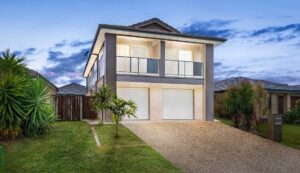
Building $200,000 in annual passive income through property investment requires owning 4-7 strategically selected properties that balance high rental yields (5-6%) with capital growth, combined with smart leverage and equity recycling over 10-15 years. Most successful Australian investors achieve this by focusing on dual-income properties, regional high-yield markets, and systematic portfolio expansion rather than speculative timing.
If you're searching for a genuine path to financial freedom, property remains one of the most reliable vehicles for building passive income in Australia. With rental yields averaging 4.7% nationally in 2026 and strategic markets offering 5-6%+ returns, the math becomes compelling when you understand how to scale correctly.
The key isn't chasing quick wins or betting on the next boom suburb. It's about building a diversified portfolio across proven markets, using the equity you create in each property to fund the next purchase, and holding long enough for compounding to do the heavy lifting. This article breaks down exactly how investors structure portfolios to reach six-figure passive income, with realistic numbers, property types, and timelines you can model for your own journey.
Understanding Passive Income Through Property Investment
What Qualifies as Passive Income from Property
Passive income from property refers to rental earnings that continue flowing regardless of your active work schedule. Unlike wages that stop when you stop working, rental income keeps arriving monthly once the tenant agreements are in place and the property is managed.
According to Statista research, approximately 47% of Australians earn some form of passive income in 2022. For property investors, this means weekly rent payments minus holding costs (mortgage interest, rates, insurance, management fees, and maintenance).
The critical distinction is between gross rental income and net passive income. A property generating $600 per week in rent might only deliver $150-200 weekly in true passive profit after all expenses. Smart investors focus on the net figure when calculating how many properties they need.
How Many Properties Do You Need for $200K Annually
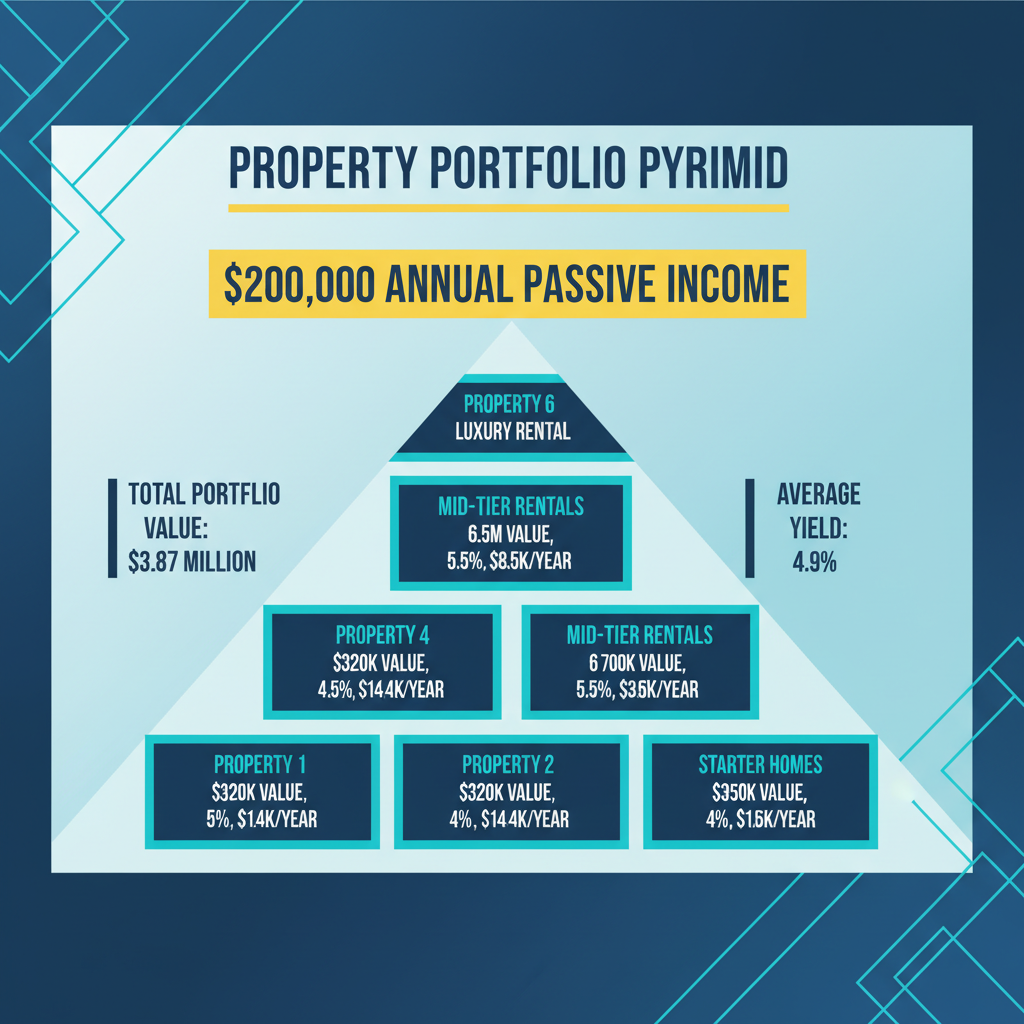
To generate $200,000 in passive income annually, you need approximately $3,846 per week before tax. The exact number of properties required depends entirely on your strategy and the markets you target.
A single person starting in their late 20s can build a portfolio generating $130,000 per year (around $2,500 weekly) with just 3 investment properties plus their primary residence over a 30-year timeframe.
For $200K annual income, most investors need 5-7 strategically selected properties depending on rental yields. Properties generating net yields of 4-5% on a $600,000 value deliver approximately $24,000-30,000 annually each. Seven properties at $28,000 average annual net income reach $196,000 total.
The Math Behind Property Portfolio Income
The mathematics of passive property income relies on three key variables: property value, rental yield, and net holding costs. Here's how it works in practice.
A property purchased for $650,000 with a 5% gross rental yield generates $32,500 annually in rent. With typical holding costs consuming 30-40% of rental income (interest, rates, insurance, management, maintenance), the net passive income sits around $19,500-22,750 per year.
According to SQM Research, national rental vacancy rates hover around 1-2% in early 2026, creating strong rental demand. This tight market supports consistent rental returns and reduces vacancy risk across most markets.
The key insight is that reaching $200K requires either more properties at moderate yields or fewer properties at exceptional yields (6%+). Most investors find the sweet spot combining 5-7 properties across different price points and yield profiles.
Rental Yield vs Capital Growth Strategy
High-Yield Markets vs Growth Markets
The fundamental choice every investor faces is whether to prioritize immediate cash flow (high rental yield) or long-term wealth building (capital growth). Smart investors understand these aren't mutually exclusive but require different strategies.
According to Savings.com.au data, Darwin offers the highest rental yields among capital cities at 6.6% for houses and 7.8% for units in 2026. Regional Western Australia dominates the top yield markets, with some suburbs exceeding 12% gross yields.
However, high-yield properties often sacrifice capital growth potential. As CoreLogic research notes, Perth properties offering 5% yields delivered 13% capital growth in 2025, while Brisbane balanced 4.5% yields with 12% growth.
The strategic approach involves building a balanced portfolio with both property types. Your first 2-3 properties might target capital growth in Brisbane or Perth to build equity quickly. Properties 4-6 focus on regional high-yield markets to boost cash flow.
Calculating Your Target Rental Yield
Understanding rental yield calculations is essential for evaluating whether a property moves you closer to your $200K income goal. Gross yield is calculated as: (Annual Rent ÷ Property Value) × 100.
For example, a $500,000 property generating $480 weekly rent ($24,960 annually) delivers a 4.99% gross yield. But gross yields are misleading because they ignore holding costs.
Sydney averages 3% gross yield, Melbourne 3.5%, Brisbane 4.5%, Perth 5.3%, and Adelaide 4.8% in 2026. Regional areas frequently achieve 5-7%+ yields.
Net yield is the figure that matters for passive income planning. After deducting mortgage interest, council rates, strata fees, insurance, management (7-8% of rent), and maintenance (typically 1% of property value annually), your net yield might be 1-3% lower than gross.
A property with 5% gross yield and $400,000 loan at 6% interest will see most rental income consumed by interest alone. This is why investors targeting passive income focus on paying down debt strategically or selecting properties where rent substantially exceeds interest costs.
Balancing Cash Flow and Long-Term Wealth
The most successful investors don't choose between yield and growth. They sequence their purchases to balance immediate cash flow needs with long-term equity building.
Starting with growth-focused properties in appreciating markets lets you build equity quickly. Adelaide, Brisbane, and Perth are expected to deliver 6%+ capital growth in 2026, with Perth potentially reaching 10%+.
Once you've built $150,000-200,000 in usable equity across 2-3 properties over 5-7 years, you can access that equity to purchase higher-yield properties in regional markets. These boost your cash flow while your earlier purchases continue appreciating.
Buyers Agency Australia helps investors identify markets offering optimal yield-growth combinations. With Dragan Dimovski's expertise in portfolio modeling, you can structure purchases that compound both income and equity systematically.
A balanced portfolio might include: Brisbane growth property ($650K, 4.5% yield, 8% growth), Adelaide growth property ($580K, 4.8% yield, 7% growth), Regional QLD high-yield ($420K, 6.2% yield, 4% growth), and Regional WA high-yield ($380K, 6.8% yield, 5% growth). This combination delivers strong total returns.
Using Leverage to Scale Your Property Portfolio
How Property Leverage Multiplies Returns
Leverage is the single most powerful tool for building wealth through property investment. It allows you to control assets worth substantially more than your initial capital, amplifying both rental income and capital growth.
With a $100,000 deposit and 80% LVR (loan-to-value ratio), you can purchase a $500,000 property. If that property grows 10% annually, you've gained $50,000 on a $100,000 investment, a 50% return on your capital.
Australian investors typically use 80% LVR to avoid Lenders Mortgage Insurance (LMI). This means every $100,000 in savings controls $500,000 in property assets.
The leverage effect applies to rental income as well. Your $500,000 property generating $25,000 annual rent represents a 25% return on your $100,000 deposit (ignoring expenses for this calculation). Even after mortgage costs, your return on invested capital far exceeds what the property's total yield suggests.
Understanding this mathematical advantage explains why property investors can build substantial passive income portfolios faster than those saving cash alone. The bank essentially funds 80% of your income-producing asset.
Accessing Equity to Buy Your Next Property
Equity recycling is how investors scale from one property to a portfolio generating $200K+ passive income. As your properties appreciate, you can borrow against the increased value to fund additional purchases without selling.
Here's how it works in practice. You purchase a property for $600,000 with a $120,000 deposit and $480,000 loan at 80% LVR. Five years later, the property appreciates to $780,000 through 5.4% annual growth.
Your usable equity is now: ($780,000 × 80%) – $450,000 (remaining loan) = $174,000. According to Real Estate Business analysis, investors in 2026 are refinancing more conservatively at 70-75% LVR to maintain buffers.
At 75% LVR, your usable equity from that $780,000 property is approximately $135,000, sufficient to purchase your next $600,000 property with $120,000 deposit plus $15,000 for stamp duty and costs.
Buyers Agency Australia structures equity access strategies that maintain healthy buffers while maximizing growth velocity. Dragan's portfolio modeling identifies optimal timing for equity pulls based on market conditions and your serviceability position.
The key constraint is serviceability. Lenders assess whether your income can service all loans even if interest rates rise 3%. This typically limits most investors to 5-8 properties depending on income, existing debt, and rental returns.
Managing Debt Strategically for Maximum Income
Debt isn't inherently good or bad. It's a tool that requires strategic management to build passive income systematically. The goal is using debt to acquire income-producing assets while maintaining comfortable serviceability buffers.
Smart debt management means keeping loan structures flexible with offset accounts and splits. This lets you redirect income strategically as your portfolio matures.
According to API Magazine research, investors in 2026 are focusing on cash flow resilience over speculative growth. Many use fixed-rate tranches to protect against rate volatility while maintaining variable portions for flexibility.
A typical strategy involves paying interest-only on investment loans to maximize cash flow during accumulation phase (years 1-15), then switching to principal-and-interest once your portfolio is complete. This lets you direct surplus cash flow toward debt reduction systematically.
For a $200K passive income goal, most investors maintain 4-6 properties with mortgages while paying off 1-2 completely. The debt-free properties provide secure base income ($40,000-60,000 annually) while mortgaged properties deliver smaller net returns but greater total income.
The transition to genuine passive income happens as loans are progressively reduced. A portfolio generating $280,000 gross rent with $80,000 in interest costs and $30,000 other expenses delivers $170,000 net. As you pay down $200,000 in debt, you free up approximately $12,000 annually in interest costs.
Property Types That Generate Highest Returns
Dual-Income and Dual-Key Properties
Dual-income properties offer one of the fastest paths to building substantial passive income because they generate two separate rental streams from a single asset. These properties significantly boost cash flow compared to standard single dwellings.
A dual-income property features two self-contained living spaces within a single building structure or on one title. This might be a main house with a self-contained granny flat, a dual-key apartment with two separate entrances, or a duplex on a single title.
Dual-income properties can deliver rental yields of 6%+ in high-growth NSW, QLD, VIC, and WA markets. The combined rent from two dwellings typically exceeds what a single larger home generates.
For example, a $580,000 dual-income property in regional Queensland might generate $380 weekly from the main dwelling and $280 weekly from the secondary dwelling, totaling $660 weekly or $34,320 annually. This delivers a 5.9% gross yield compared to 4.5% for a standard home at the same price point.
The advantage compounds when building a portfolio. Instead of needing 7 standard properties to reach $200K income, you might achieve the same with 5 well-selected dual-income properties.
Buyers Agency Australia specializes in identifying dual-income opportunities in growth corridors. Book a free strategy session to discover how these properties can accelerate your passive income timeline.
Regional High-Yield vs Metro Properties
The choice between regional high-yield properties and metropolitan assets fundamentally shapes your passive income timeline. Regional markets offer superior cash flow, while metros provide greater capital growth and stability.
According to Duo Tax analysis, Western Australia leads rental yields with several regional suburbs exceeding 12% gross returns. Queensland regional centers and South Australian regional markets consistently deliver 6-8% yields.
A $400,000 regional property generating 7% gross yield ($28,000 annually) might deliver $18,000-20,000 net passive income after expenses. That same $400,000 in Sydney or Melbourne generates 3.5-4% gross yield ($14,000-16,000), with net income potentially neutral or negative after mortgage costs.
The tradeoff is capital growth and liquidity. According to Cotality data, Perth houses grew 13% and Brisbane 9% in 2025, substantially outperforming regional averages. Metro properties also sell faster with deeper buyer pools.
The optimal strategy combines both property types. Your first 2-3 purchases might target Brisbane, Adelaide, or Perth outer suburbs offering 4.5-5.5% yields with 7-10% growth potential. These build equity quickly.
Once you've established $300,000+ usable equity, purchase 2-3 regional high-yield properties in markets like Toowoomba QLD, Geraldton WA, or Port Augusta SA. These boost cash flow immediately while your metro holdings continue appreciating.
Dragan Dimovski's 20+ years of market analysis helps investors identify regional markets with sustainable rental demand beyond mining booms. His due diligence filters out high-risk cyclical markets while finding genuine cash flow opportunities.
Townhouses vs Houses vs Units for Investors
Property type selection significantly impacts both rental yields and capital growth trajectories. Each asset class serves different purposes within a passive income portfolio.
Houses on land consistently deliver the strongest long-term capital growth but often lower initial rental yields. Houses appreciate substantially more than units over 20-year periods, with the gap widening over time.
A typical house in a growth suburb might deliver 4.2% gross yield but 7-9% annual capital growth. A unit in the same area offers 5.0% yield but only 4-6% growth. Over 10 years, the house builds far more usable equity for portfolio expansion.
Townhouses occupy the middle ground with yields typically 0.5-1.0% higher than houses but lower strata costs than units. They appeal to families seeking low-maintenance living, supporting stable tenancy and good capital growth.
Units deliver the highest immediate rental yields, especially in capital cities. A unit in Perth averages 5.7% yield compared to 4.3% for houses. However, units face higher vacancy risk, body corporate fees (reducing net yield), and slower capital growth.
For a $200K passive income strategy, the optimal mix might include 3 houses in growth suburbs for equity building, 2 townhouses for balanced returns, and 2 dual-income properties or regional houses for high cash flow.
Contact Buyers Agency Australia to discuss which property types align with your passive income timeline and risk tolerance. Their market analysis identifies the specific suburbs where each property type delivers optimal returns.
Building Your Portfolio Systematically
The 5-Year Plan to Your First Three Properties
Building substantial passive income requires a systematic approach rather than opportunistic purchases. Most investors reach their first three properties within 5-7 years with disciplined execution.
Year 1: Purchase your first investment property using saved deposit ($80,000-120,000) or equity from your primary residence. Target a growth market property in Brisbane, Adelaide, or Perth outer suburbs. Focus on serviceability and rental coverage.
Years 2-3: Let your first property appreciate while you save additional funds and improve serviceability. A property purchased at $600,000 growing 7% annually reaches $686,000 after 3 years, creating approximately $109,000 usable equity at 80% LVR (minus remaining loan).
Year 4: Purchase your second property using the equity from property one plus any additional savings. Target a similar growth-focused property or consider a higher-yield regional option if cash flow is limiting serviceability.
Years 4-5: Both properties appreciate while generating rental income. The combined equity growth from two properties appreciating 7% annually builds substantial borrowing capacity.
Year 5: Purchase your third property using accumulated equity from properties 1-2. At this stage, many investors shift toward higher-yield properties to improve cash flow and serviceability for future purchases.
Investors who buy 3-4 properties over 10-15 years and hold can generate $130,000+ passive income by retirement through appreciation and debt reduction.
How to Use Equity Recycling to Scale Faster
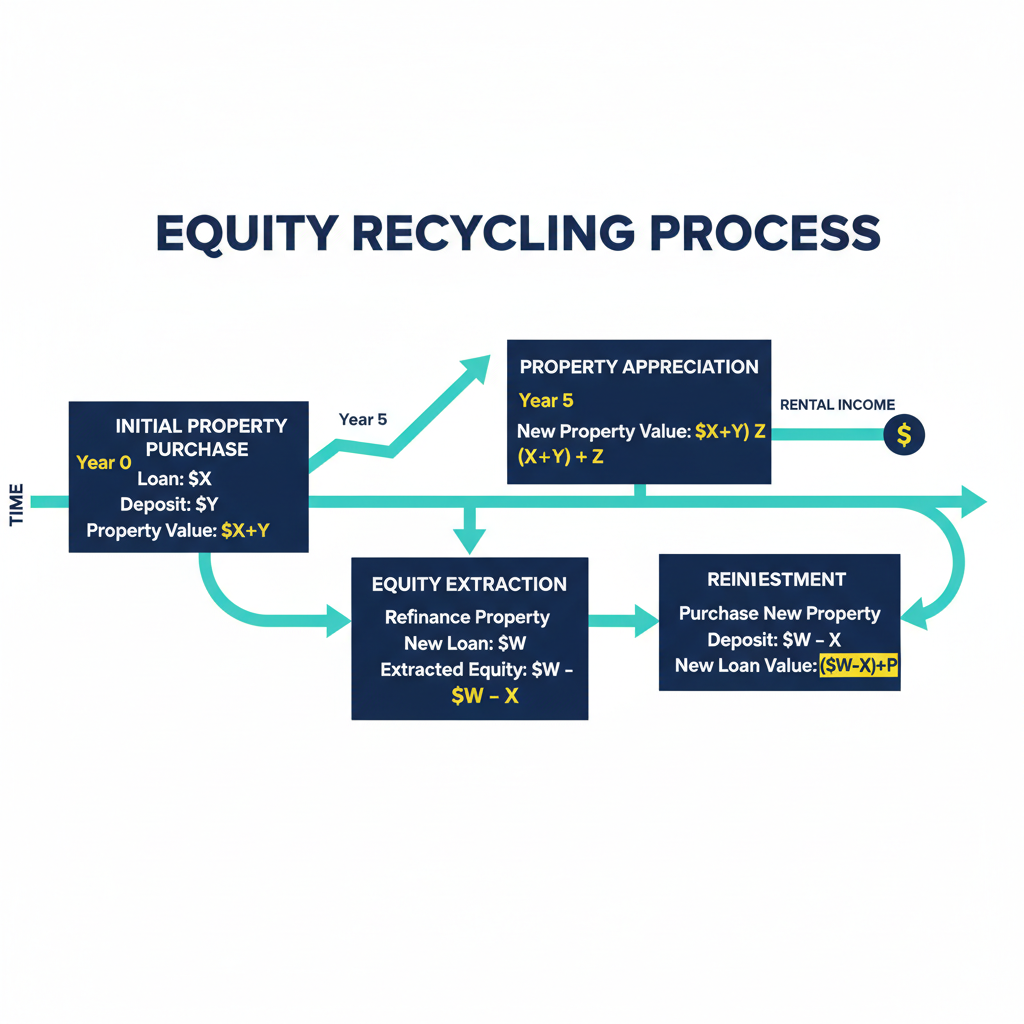
Equity recycling is the technique that separates investors who build one or two properties from those who construct portfolios generating $200,000+ passive income. It requires understanding both the mechanics and optimal timing.
The equity recycling cycle works like this: Buy property with 80% LVR, Hold 3-5 years while property appreciates, Refinance to access equity growth, Use equity as deposit for next purchase, Repeat while maintaining serviceability.
lenders typically allow you to borrow up to 80% of current property value. If your property worth $800,000 has a $550,000 loan, you have approximately $90,000 usable equity ($640,000 x 80% minus $550,000).
The critical factor is timing your equity pulls to align with market conditions and your income growth. Pulling equity during soft markets means getting lower valuations and less borrowing capacity.
Dragan Dimovski's portfolio modeling at Buyers Agency Australia helps investors plan optimal purchase sequences. His FastTrack program maps your specific path from current position to $200K passive income, identifying when to access equity and which markets to target.
The typical equity recycling timeline sees investors purchase every 2-3 years during accumulation phase. Property 1 at year 0, Property 2 at year 3, Property 3 at year 5, Property 4 at year 7, Properties 5-6 at years 9-12. By year 15, you're managing 5-6 properties with substantial equity positions.
Serviceability eventually limits further purchases. Most investors hit their borrowing ceiling at 5-8 properties depending on income and rental returns. At that point, the strategy shifts to debt reduction and cash flow optimization rather than portfolio expansion.
When to Stop Buying and Start Debt Reduction
The transition from acquisition mode to consolidation mode is critical for converting portfolio equity into actual passive income. Many investors miss this shift and either overbuy or stop too early.
You should consider stopping portfolio expansion when you've reached serviceability limits (banks won't lend more), Your portfolio generates sufficient gross rent to hit $200K net after debt paydown, or Market conditions shift to favor debt reduction over new purchases.
Smart investors are buying below long-term borrowing ceilings and focusing on manufacturing equity through renovations rather than continued acquisition.
A portfolio of 6 properties with total value $3.5 million and $2.2 million debt generates approximately $175,000 gross rent at 5% average yield. After $132,000 in interest costs (6% rate) and $35,000 other expenses, net income is just $8,000 annually.
However, if you stop buying and redirect all cash flow toward debt reduction, you might pay off $400,000 over 5-7 years. This eliminates $24,000 in annual interest costs, converting to additional passive income. Your net jumps from $8,000 to $32,000 annually.
The optimal strategy often involves paying off 1-2 properties completely while maintaining mortgages on higher-value properties. Debt-free properties generate $30,000-45,000 each in passive income while mortgaged properties contribute smaller amounts that grow as debt reduces.
Dragan Dimovski's portfolio modeling includes debt paydown simulations showing your passive income trajectory under different scenarios. This helps you make informed decisions about when to shift from growth mode to consolidation mode.
Advanced Strategies for Accelerating Income
Co-Living and Rooming House Opportunities
Co-living properties represent an advanced strategy for investors seeking to maximize rental income per square meter. These properties generate substantially higher yields than traditional rentals but require more active management.
A co-living property involves renting individual rooms within a house to separate tenants who share common areas. A 4-bedroom house renting for $550 weekly as a whole might generate $180-220 per room when rented individually, totaling $720-880 weekly.
Co-living arrangements in Brisbane can generate $900+ weekly from properties worth $600,000-700,000, delivering gross yields exceeding 7%.
The risks include higher tenant turnover, increased wear and tear, more complex management, and regulatory requirements in some states. Many councils restrict rooming houses or require special permits.
For investors willing to accept higher management intensity, 1-2 co-living properties within a portfolio can significantly boost overall cash flow. A $650,000 co-living property generating $42,000 annually ($808 weekly) might deliver $28,000-30,000 net passive income.
This strategy works best for investors who've already established 3-4 traditional properties and understand property management fundamentals. Adding co-living properties at the portfolio's tail end can push you over the $200K threshold faster.
Value-Add Renovations That Boost Rent
Strategic renovations offer one of the fastest ways to increase passive income without buying additional properties. The key is targeting improvements that tenants will pay extra rent for relative to renovation costs.
High-return renovations include fresh paint (interior and exterior), updated kitchen with modern appliances, renovated bathrooms, new flooring (hybrid timber or quality carpet), improved outdoor areas and landscaping, and energy-efficient additions (solar panels, insulation).
A $30,000-40,000 renovation on a property currently renting for $450 weekly might justify a $50-70 weekly rent increase. That additional $60 weekly equals $3,120 annually, representing a 7.8% return on your $40,000 investment plus boosted cash flow permanently.
According to API Magazine analysis, investors in 2026 are increasingly using value-add renovations to manufacture equity and boost rental returns in a market where capital growth is moderating.
The renovation strategy particularly suits investors who've reached borrowing limits. Instead of buying property 7, you might invest $150,000 renovating properties 1-5, increasing total rent by $250-350 weekly. This additional $13,000-18,000 annual income requires no additional debt.
Buyers Agency Australia's due diligence process identifies properties with value-add potential during initial purchase. Dragan's renovation network includes trusted trades who execute improvements cost-effectively, maximizing your return on renovation investment.
The key is renovating to the suburb's rental market standard, not overcapitalizing. A property in a $500 weekly rental market doesn't justify $80,000 in luxury finishes. Target renovations that lift your property to the suburb's top 25% rental band.
Tax Strategies to Maximize After-Tax Income
Tax planning significantly impacts your actual passive income because all rental earnings face tax at your marginal rate. Strategic structuring and deduction maximization can save $15,000-30,000 annually on a substantial portfolio.
Key tax strategies include claiming depreciation on building structure (2.5% annually for 40 years on post-1985 construction) and plant/equipment assets, deducting all interest on investment loans, claiming council rates, insurance, property management fees, maintenance, and repairs, and utilizing negative gearing to reduce taxable income during accumulation phase.
According to ATO guidelines, Australian investors can claim $8,000-15,000 annually in depreciation on newer properties, providing tax-free cash flow improvement.
A quantity surveyor depreciation schedule costs $600-800 but typically identifies $40,000-100,000 in claimable depreciation over the property's life. For an investor in the 37% tax bracket, this saves $14,800-37,000 in tax over time.
Ownership structure matters significantly once portfolios exceed 3-4 properties. Many investors start in personal names to benefit from negative gearing against personal income, then consider trust structures for asset protection and tax distribution as portfolios grow.
Buyers Agency Australia's podcast features interviews with tax specialists who explain optimal structuring for different investor situations. Dragan's network includes trusted accountants specializing in property investment tax planning.
The transition to positive cash flow changes your tax position substantially. Investors generating $200K passive income face tax liabilities of $60,000-70,000 annually depending on other income and deductions. Planning for this tax obligation is essential to maintaining your desired lifestyle.
How Dragan Dimovski Helps Investors Reach $200K Income Goals

Portfolio Modeling and 10-Year Projections
Reaching $200,000 in passive income isn't about buying random properties and hoping for the best. It requires detailed modeling of purchase sequences, market selection, equity growth, and cash flow trajectories over 10-15 year horizons.
Buyers Agency Australia provides comprehensive portfolio modeling that maps your specific path from current position to your income goal. Dragan Dimovski's modeling incorporates your current equity, income, expenses, and serviceability to determine realistic purchase timing and property selection.
The modeling process identifies how many properties you need, which markets to target in which sequence, when to access equity for each purchase, projected rental income and capital growth for each property, debt paydown schedules, and your passive income trajectory year by year.
This evidence-based approach removes guesswork and emotional decision-making. You can see exactly how long it takes to reach $200K passive income under different scenarios (conservative 5% growth vs moderate 7% growth vs strong 9% growth).
Many investors discover they need fewer properties than expected when targeting the right markets. A portfolio of 5 well-selected properties in high-yield markets with strong growth can outperform 8 randomly chosen properties.
Book a free strategy session to receive your personalized portfolio roadmap. Dragan's team analyzes your situation and provides a detailed acquisition timeline showing your path to $200K passive income.
Identifying High-Yield Markets Before They Peak
Timing your market entry significantly impacts both rental yields and capital growth. Buying into markets early in their growth cycle maximizes total returns, while entering at peak means accepting lower yields and potential short-term stagnation.
Dragan Dimovski's 20+ years of market analysis has developed a systematic process for identifying markets offering optimal yield-growth combinations before mainstream investors flood in. This early identification creates the best opportunities for building passive income portfolios.
The analysis examines economic indicators (employment growth, business investment, infrastructure spending), supply-demand dynamics (dwelling approvals vs population growth, vacancy rates, days on market), affordability metrics (price-to-income ratios, rental yields compared to historical averages), and migration patterns (interstate and overseas migration trends).
Adelaide, Brisbane, and Perth offer the strongest fundamentals in 2026 with anticipated 6%+ capital growth. Regional markets in Queensland and Western Australia provide superior cash flow opportunities.
Buyers Agency Australia's research process filters through Australia's 400+ markets to identify the 20-30 suburbs offering optimal risk-adjusted returns for passive income investors. This focused approach ensures you're buying in markets with sustainable rental demand and growth catalysts.
Dragan's $10M+ personal portfolio demonstrates his ability to identify markets early. His investments consistently outperform because they're grounded in fundamental analysis rather than speculation or media hype.
End-to-End Buyer Advocacy and Negotiation
Identifying the right markets and properties is only half the equation. Successful passive income building requires securing properties at or below market value to maximize equity position and rental returns from day one.
Buyers Agency Australia provides comprehensive buyer advocacy services including property search aligned with your portfolio strategy, detailed due diligence (building inspections, pest reports, rental appraisals, title searches), market value assessments using comparable sales analysis, expert negotiation to secure below-market purchases, and auction bidding when required.
Dragan Dimovski's negotiation expertise consistently saves clients $20,000-50,000 per purchase. Over a 6-property portfolio, this represents $120,000-300,000 in additional equity created through purchasing power alone.
For time-poor professionals, the end-to-end service is particularly valuable. You don't need to spend weekends attending inspections or researching comparable sales. Buyers Agency Australia handles all research, due diligence, and negotiation while keeping you informed at each decision point.
The fixed-fee model provides transparency without conflicts of interest. Unlike commission-based agents who benefit from higher prices, Buyers Agency Australia's incentive aligns with yours—securing the best properties at the best prices to maximize your passive income potential.
Contact Buyers Agency Australia to discuss how their buyer advocacy services can accelerate your path to $200,000 passive income. With offices serving all major Australian capital cities, they provide boots-on-the-ground expertise regardless of where you're targeting investment.
Frequently Asked Questions
How long does it take to build $200K passive income?
Most investors require 10-15 years to build $200K passive income, acquiring 5-7 properties with equity recycling and allowing time for capital appreciation and partial debt paydown.
What deposit do I need to start building a portfolio?
You need $80,000-120,000 deposit for your first investment property, or sufficient equity in your home. Subsequent properties use equity from earlier purchases as deposits.
Can I reach $200K income with negatively geared properties?
Yes, negative gearing during accumulation phase builds equity through growth. As debt reduces over 10-15 years, properties transition to positive cash flow, generating passive income.
What rental yield do I need for $200K income?
Target average 5-5.5% net yields across 6-7 properties worth $600,000 each, generating $30,000-33,000 annually per property after debt paydown, totaling $200K+ income.
How does Buyers Agency Australia charge for services?
Buyers Agency Australia uses a transparent fixed-fee model. Contact them for a detailed fee schedule based on your purchase locations and portfolio strategy.