
Co Living Investment Strategy Using Standard Houses Not Purpose Built Co Living Properties Australia
Co-living investment using standard residential houses (not purpose-built) can deliver rental yields between 7% and 15% by converting existing properties into multi-tenant arrangements, offering investors a higher cash-flow alternative to traditional single-family rentals while addressing Australia's affordable housing shortage.
If you're an investor who's hit the wall with traditional rental properties delivering 3-4% yields, you're not alone. Standard buy-and-hold strategies often leave portfolios cash-flow negative for years.
Co-living conversions flip that script. By renting individual rooms in a standard house with shared common areas, you can double or triple rental income from the same property. But here's the thing: doing this right means understanding state regulations, tenant management, and property selection criteria that most agents won't tell you about. Buyers Agency Australia works with investors nationwide to identify properties suitable for co-living conversion and navigate the compliance minefield so you can build genuine cash-flow from day one.
What Co Living Really Means for Standard Residential Houses
Co-living isn't just share-house chaos. It's a structured rental model where tenants rent private bedrooms (often with ensuites) and share communal spaces like kitchens, lounges, and laundry facilities.
The Three Core Co Living Models in Australia
Standard houses can be configured three ways, depending on your budget and council rules.
Standard share house (3 tenants maximum): Most Australian states allow up to three unrelated tenants in a Class 1a residential dwelling without additional approvals. Each tenant signs a separate lease. Weekly rent per room typically ranges from $250 to $400 depending on location. A three-bedroom house renting for $500/week as a single tenancy can generate $900-$1,200/week when rented per room.
Modified co-living (3-5 tenants with minor renovations): Adding ensuites or lockable pantries increases appeal and rent. In Queensland, properties with up to five bedrooms and five occupants can operate under streamlined approvals until December 2026. This model suits growth corridors near universities or employment hubs.
Rooming house (5+ tenants with Class 1b certification): Properties with more than five lettable rooms require council approval, Class 1b building certification, operator licensing (in Victoria and South Australia), and compliance with rooming accommodation standards. Yields can hit 10-15% but setup costs and ongoing management are higher.
Why Investors Choose Normal Houses Over Purpose Built Co Living
Purpose-built co-living developments hit the market at $1.2M+ in metro areas. Converting an existing $700K house in a high-demand suburb costs $50K-$150K for compliant renovations and still delivers superior yield.
You also retain flexibility. If co-living regulations tighten or market conditions shift, a converted house can revert to traditional rental or owner-occupier use. Purpose-built facilities can't.
Dragan Dimovski from Buyers Agency Australia notes that investors often overlook the exit strategy. A standard house in a strong capital growth suburb gives you dual income streams: high rental yield today and solid appreciation over 10 years.
Rental Yield Comparison Traditional vs Co Living Investment Properties
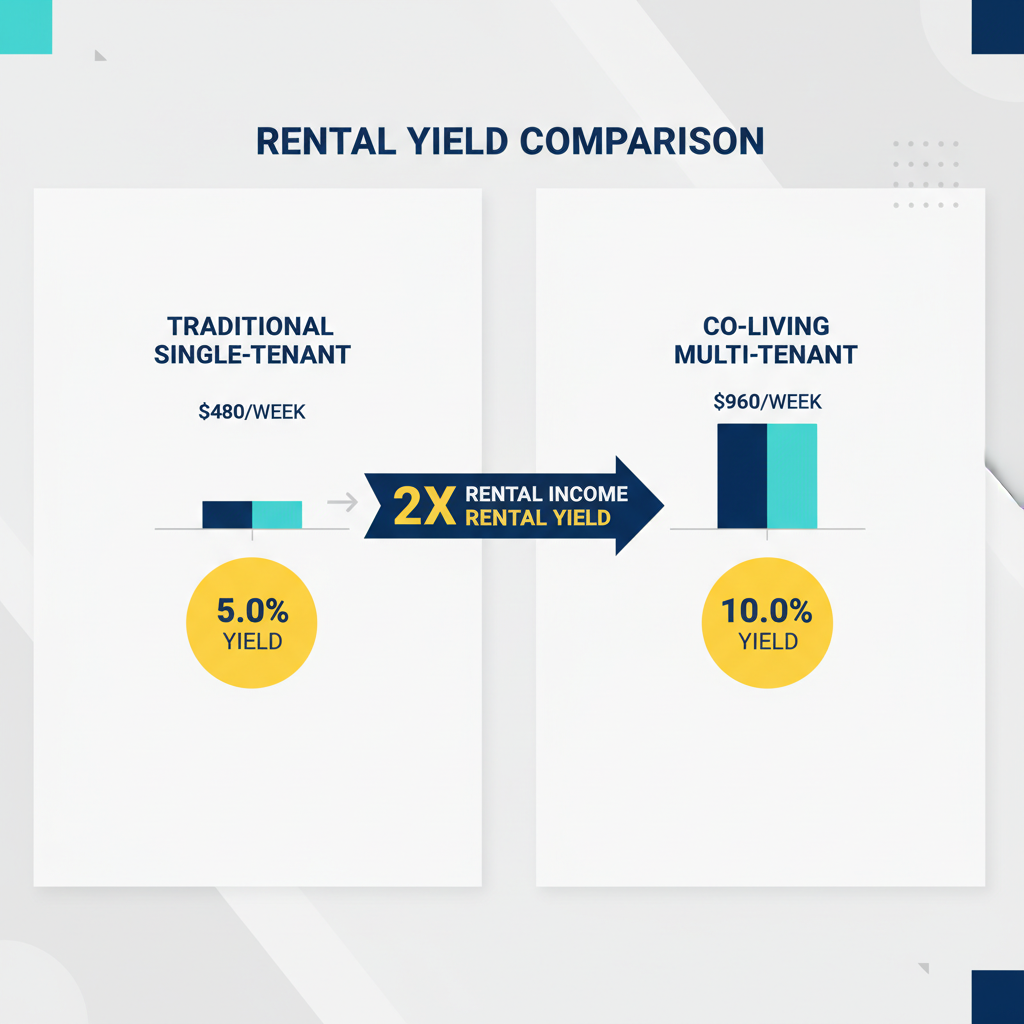
The numbers tell the story. Let's compare a three-bedroom house in Melbourne's outer growth corridor (Pakenham, Cranbourne, Werribee) under both rental models.
Traditional Single Tenancy Model
- Purchase price: $650,000
- Weekly rent: $480
- Annual rental income: $24,960
- Gross rental yield: 3.8%
- Vacancy risk: High (one tenant departure = 100% income loss)
Co Living Multi Tenancy Model (Three Separate Leases)
- Purchase price: $650,000
- Renovation costs (ensuites, lockable pantries): $80,000
- Total investment: $730,000
- Weekly rent per room: $320 x 3 = $960
- Annual rental income: $49,920
- Gross rental yield: 6.8%
- Vacancy risk: Lower (one tenant departure = 33% income loss)
That's an 80% increase in rental income for a 12% increase in total investment. Even accounting for higher management fees (10-12% vs 7-8%) and utility costs, net yield still exceeds 5.5%.
For investors using equity from existing properties, the cash-flow difference can fund the next deposit within 18-24 months instead of waiting five years.
High Yield Suburbs for Co Living Conversions in 2026
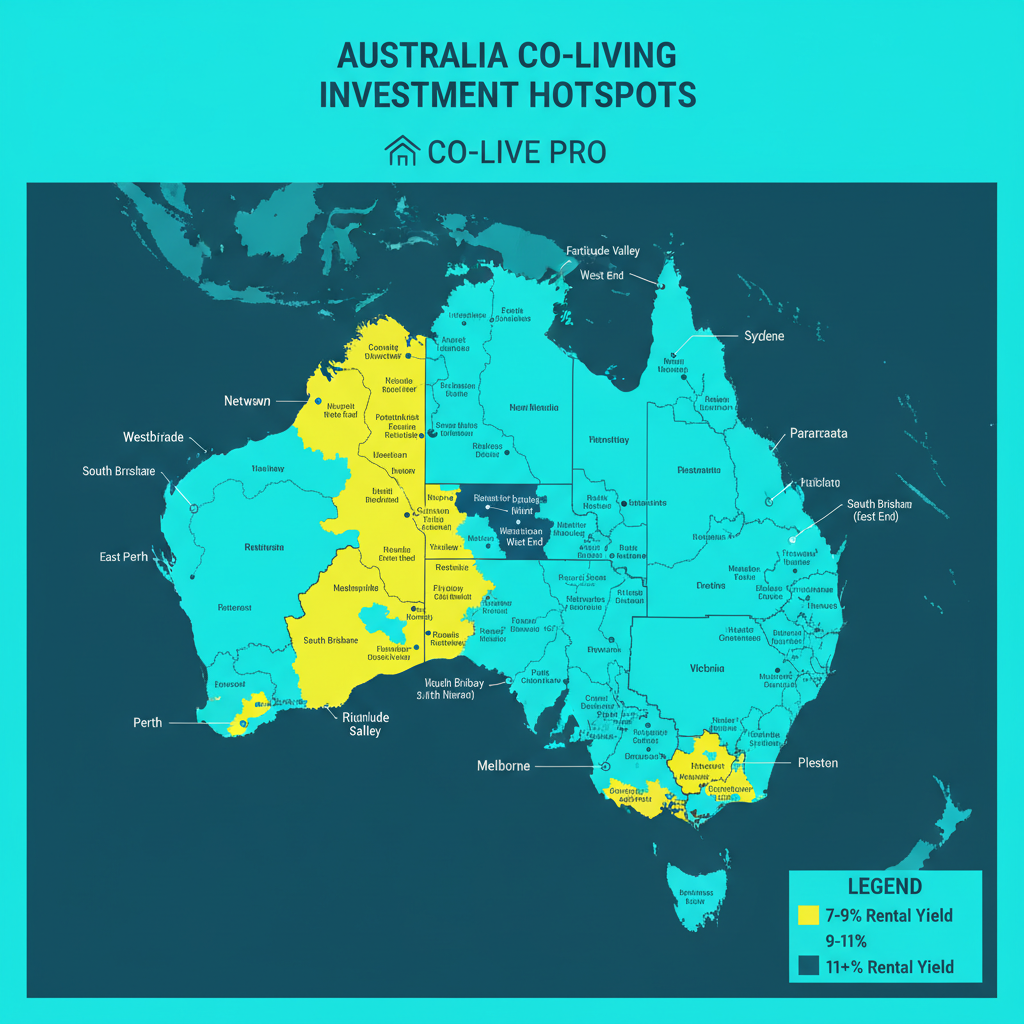
Not every suburb works for co-living. You need strong tenant demand, low vacancy rates, and proximity to employment or education hubs.
Regional mining towns like Karratha (WA) deliver 10.7% yields but tenant turnover is high. Inner-city Melbourne suburbs like Carlton offer 7-8% yields with stable tenant pools (university students, young professionals). Brisbane growth corridors (Caboolture, Ipswich) and Perth outer suburbs (Baldivis, Byford) sit in the sweet spot: 7-9% yields with improving infrastructure and population growth.
According to SQM Research, national rental vacancy rates sat at 1.2% as of August 2025. Tight vacancy keeps upward pressure on rents, making multi-tenant strategies even more attractive. When supply is constrained, landlords who can house three tenants in one property instead of one household gain a structural advantage.
State by State Co Living Regulations for Standard Houses
This is where most investors trip up. Co-living rules vary wildly across Australia, and what's allowed in NSW won't fly in Queensland.
New South Wales Co Living Rules
NSW doesn't recognise "rooming houses" as a distinct category. Instead, properties fall under "boarding houses" (which require community housing provider management for affordable housing) or standard residential tenancies.
For standard houses, you can rent to up to three unrelated tenants without additional approvals. Each tenant signs a separate Residential Tenancy Agreement. Properties with four or more tenants may trigger boarding house provisions under the State Environmental Planning Policy (Housing) 2021, requiring a manager on-call 24/7 and a plan of management.
Most investors stick to three-tenant models in NSW to avoid regulatory complexity. Inner-west suburbs (Newtown, Redfern, Surry Hills) and areas near universities (Kensington, Randwick) show strong demand.
Queensland Rooming Accommodation Regulations
Queensland offers the most investor-friendly framework. Under the Planning Amendment Regulation 2025, small-scale rooming accommodation (up to five bedrooms, five occupants) doesn't require planning approval in lower-density residential zones until December 2026.
You still need building code compliance (fire safety, ventilation, egress) and must meet prescribed landscaping requirements. If your property exceeds five lettable rooms, you'll need council approval under the local planning scheme.
Queensland's Residential Tenancies Authority (RTA) administers rooming accommodation agreements. Landlords must provide house rules, manage common areas, and ensure resident safety. If you live on-site and rent fewer than four rooms, the Residential Tenancies Act doesn't apply, but bond provisions still do.
Brisbane, Gold Coast, and Sunshine Coast suburbs near universities and hospitals are prime targets. Investors should act before December 2026 when the streamlined approval pathway may expire.
Victoria Rooming House Licensing and Registration
Victoria has the strictest regime. Rooming houses (properties with four or more residents in separate rooms) require:
- Rooming House Operator's License from Consumer Affairs Victoria (three-year term, covers multiple premises)
- Council registration as prescribed accommodation under the Public Health and Wellbeing Act 2008
- Building compliance with NCC Class 1b standards (fire safety, egress, amenity)
- Adherence to rooming house minimum standards (privacy, security, room size, ventilation)
Operators must provide the Rooming House Residents Guide to all tenants. Council Environmental Health Officers conduct periodic inspections.
For properties with three or fewer tenants, standard residential tenancy rules apply. No license required. This is why most Victorian investors target three-bedroom conversions with ensuites.
Melbourne's inner suburbs (Carlton, Fitzroy, South Yarra) and outer growth corridors (Werribee, Pakenham, Craigieburn) both work, but for different tenant demographics. Inner suburbs attract students and young professionals; outer suburbs suit tradespeople and essential workers.
Victoria also offers a land tax exemption for registered rooming houses providing low-cost accommodation (tariffs capped at 70-105% of Commonwealth aged pension rates). If you're targeting affordable housing, this exemption can save $8,000-$15,000 annually.
South Australia Co Living Registration Requirements
South Australia requires rooming house registration for properties with five or more bedrooms rented to unrelated occupants. Proprietors pay an annual fee to Consumer Business Services (CBS) and must meet prescribed accommodation standards.
Properties with four or fewer tenants operate under standard residential tenancy agreements. Adelaide suburbs near universities (Unley, Norwood, Prospect) and the CBD show consistent demand. Rental yields in Adelaide typically range 5-7% for co-living conversions.
Western Australia and Other States
Western Australia and other states generally allow up to three unrelated tenants in standard residential properties without additional approvals. Perth's FIFO worker market creates strong demand in suburbs like Baldivis, Byford, and Ellenbrook. Yields can exceed 8% in these areas.
Always check local council planning schemes. Some councils impose additional requirements through local laws or development approval conditions.
How to Convert a Standard House into a Compliant Co Living Property
Converting a house isn't just slapping locks on bedroom doors. You need compliant design, quality tradespeople, and a clear budget.
Essential Renovation Requirements for Multi Tenant Properties
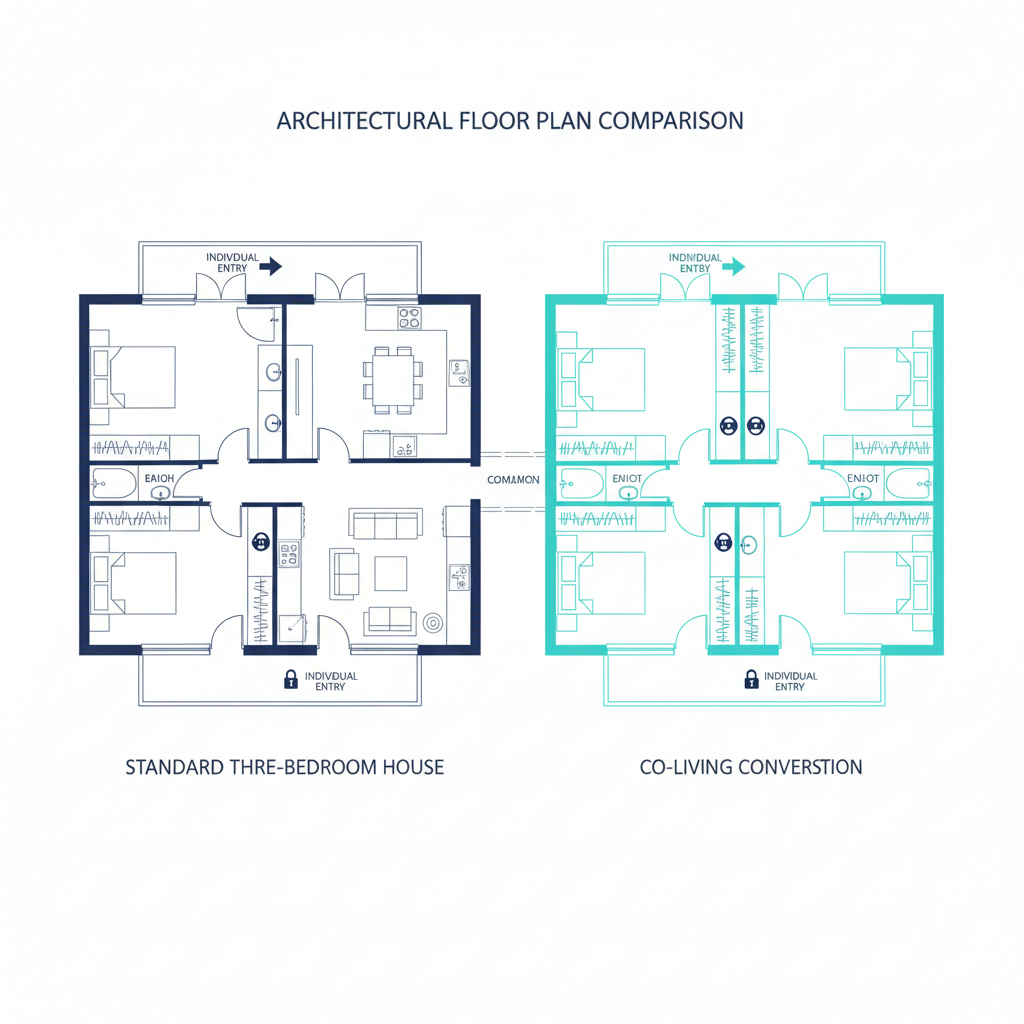
Here's what a typical three-tenant conversion involves.
Ensuites for each bedroom: Tenants pay premium rent for private bathrooms. Budget $18,000-$28,000 per ensuite including plumbing, tiling, fixtures, and ventilation. Prefab bathroom pods can reduce costs to $15,000-$22,000.
Lockable pantries in shared kitchen: Prevents food disputes and increases tenant satisfaction. Custom cabinetry with individual locks costs $2,500-$4,500. Off-the-shelf lockable storage units are cheaper but less elegant.
Split-system air conditioning per bedroom: Essential in hot climates. Budget $1,200-$2,000 per unit installed.
Fire safety upgrades: Smoke alarms in each bedroom and common areas (interconnected if building standards require). Some councils mandate fire blankets in kitchens and fire extinguishers in common areas. Budget $800-$1,500.
Separate utility meters (if practical): Allows tenants to pay their own electricity. Not always feasible but can reduce landlord costs and disputes. Expect $1,200-$2,500 for separate meter installation.
Secure entry and individual bedroom locks: Quality deadbolts for bedrooms and secure main entry. Budget $600-$1,200.
Adequate parking: Council may require one car space per tenant. Check local parking overlays before purchasing.
Total renovation budget for a compliant three-tenant conversion: $50,000-$90,000. For five-tenant rooming houses with Class 1b certification, costs can reach $120,000-$180,000.
Building Compliance and Council Approvals
Engage a building surveyor early. They assess whether your proposed use requires a building permit and whether the existing structure can meet NCC requirements.
For Class 1a properties (standard residential) with three or fewer tenants, you typically don't need planning approval. Renovations may require building permits.
For Class 1b rooming houses (four or more tenants), you'll need building permit, council planning approval (in some states), and ongoing inspections. Work with architects and builders experienced in rooming house compliance.
Don't cut corners. Operating a non-compliant rooming house in Queensland risks fines exceeding $125,000 and up to two years imprisonment. Victoria's penalties are similarly severe.
Choosing the Right Property for Co Living Conversion
Not every house suits co-living. Buyers Agency Australia helps investors identify properties with conversion potential before purchase.
Target property characteristics:
- Three or four bedrooms minimum (preferably four)
- Large living areas that can accommodate shared space
- Existing bathroom count (two bathrooms make ensuite addition easier)
- Block size allowing compliant setbacks for extensions
- Zoning permitting multi-tenant use (check local planning scheme)
- Proximity to employment, universities, hospitals, or transport hubs
- Low-maintenance exteriors (reduces ongoing costs)
Avoid:
- Properties in heritage overlays or bushfire management zones (approval complexity)
- Blocks too small for compliant extensions
- Areas with high owner-occupier concentration (tenants prefer rental-dense suburbs)
- Properties requiring major structural work (costs blow out)
Buyers agents with co-living expertise can run the numbers before you make an offer. A property that looks like a bargain can turn into a money pit if council won't approve your intended use.
Property Management for Multi Tenant Co Living Arrangements
Standard property managers charge 7-8% of rent. Co-living specialist managers charge 10-12% but earn their fee.
Why You Need Specialist Co Living Property Management
Managing three separate tenants in one property means:
- Three times the lease administration
- Coordinating move-in/move-out dates to minimise vacancy
- Mediating housemate disputes
- Managing common area maintenance
- Handling utility payments (unless separately metered)
- Ensuring house rules compliance
Generalist property managers struggle with this. Co-living specialists maintain databases of pre-screened tenants, match housemates based on lifestyle compatibility, and handle tenant turnover within 24-48 hours.
Top-tier co-living managers maintain 98%+ occupancy rates. That's the difference between a 7% yield and a 9% yield. The extra 2-4% management fee pays for itself.
Some co-living management firms offer value-added services: cleaning of common areas, Wi-Fi provision, and community events. These justify premium rents and improve tenant retention.
Tenant Matching and House Rules
Successful co-living depends on compatible housemates. Specialist managers screen tenants for:
- Employment stability
- Rental history
- Lifestyle preferences (quiet vs social, early riser vs night owl)
- Cleanliness standards
House rules should cover:
- Quiet hours
- Guest policies
- Common area cleaning rosters
- Smoking/vaping policies
- Pet policies (if applicable)
- Waste disposal
In Queensland, house rules are prescribed under the Residential Tenancies Regulation. Landlords must provide written house rules before signing the rooming accommodation agreement.
Managing Vacancy Risk and Tenant Turnover
Co-living reduces vacancy risk. If one tenant leaves, you still collect 67% of rent (in a three-tenant model). Compare that to traditional rentals where one tenant departure equals zero income.
Target tenant turnover is 12-18 months. Students turnover faster (6-12 months, tied to academic year). Young professionals stay longer (18-24 months). Matching property location to tenant demographic improves retention.
Marketing should start 6-8 weeks before a tenant departure. Experienced managers list upcoming vacancies early and pre-screen applicants so new tenants move in the same week the previous tenant vacates.
How Buyers Agency Australia Identifies High Yield Co Living Investment Properties

Most real estate agents sell houses. Buyers agents who understand co-living identify opportunities others miss.
Dragan Dimovski and the team at Buyers Agency Australia evaluate over 118 data points before recommending a property for co-living conversion. That includes employment diversity, rental demand trends, council approval rates, property manager capacity, and 10-year infrastructure plans.
The Buyers Agency Australia Co Living Property Selection Framework
Our process starts with your portfolio goals. How much usable equity do you have? What's your risk tolerance? Are you targeting cash-flow or balanced growth?
We then identify suburbs across Brisbane, Melbourne, Adelaide, and Perth where:
- Rental vacancy rates are below 2%
- Tenant demographics align with co-living (students, young professionals, FIFO workers)
- Council planning schemes permit multi-tenant use
- Infrastructure investment is driving population growth
- Property managers with proven co-living track records operate in the area
We avoid oversupplied markets. Brisbane's co-living boom has created pockets of oversupply. Buying in the wrong suburb means competing with 50 other landlords for the same tenant pool.
Once we identify target suburbs, we source off-market and pre-market properties with conversion potential. Our network includes developers, builders, and selling agents who alert us to opportunities before they hit the portals.
End to End Support from Property Search to Tenant Placement
Buyers Agency Australia doesn't just find the property. We coordinate:
- Building and pest inspections with co-living compliance in mind
- Builder and architect referrals for renovation design
- Finance brokers who understand co-living serviceability calculations
- Property manager introductions (we only refer managers with 98%+ occupancy)
- Handover to management including first tenant placement
Our fixed-fee model means no surprises. You know exactly what you're paying upfront, and we're incentivised to find properties that deliver genuine return, not just close deals.
Case Study Melbourne Investor Doubling Cash Flow Through Co Living Conversion
A Melbourne-based IT professional approached us in 2024 with three negatively geared properties. Annual cash-flow drain: $28,000. He needed positive cash-flow to fund his next purchase.
We identified a four-bedroom house in Werribee (outer Melbourne growth corridor) listed at $680,000. Property had existing ensuite in master bedroom and two bathrooms. Block size allowed compliant conversion to three-tenant co-living.
We negotiated purchase at $655,000. Renovation budget: $65,000 (two additional ensuites, lockable pantries, air conditioning, fire safety upgrades). Total investment: $720,000.
Post-renovation rental: $1,080/week ($360 per room x 3 tenants). Annual rental income: $56,160. Gross yield: 7.8%. Net cash-flow (after loan repayments, management, maintenance): +$8,400 annually.
He went from $28,000 cash-flow negative to $8,400 cash-flow positive on one property. That swing freed up borrowing capacity to acquire two more properties within 18 months.
That's the power of strategic co-living investment with proper guidance.
Co Living Investment Risks and How to Mitigate Them
No investment is risk-free. Here's what can go wrong and how to protect yourself.
Regulatory Risk and Changing Legislation
Queensland's streamlined approval pathway expires December 2026. If not extended, new co-living conversions may face council approval requirements, adding time and cost.
Mitigation: Purchase and convert properties before the deadline. If you're already operating under the current framework, you have ongoing development rights for two years post-completion.
Victoria periodically updates rooming house minimum standards. Compliance costs can increase.
Mitigation: Build buffer into renovation budgets. Work with builders who understand current and anticipated standards.
Tenant Dispute and Housemate Conflict
Multi-tenant arrangements increase conflict potential. Disputes over noise, cleanliness, and shared space use are common.
Mitigation: Robust tenant screening, clear house rules, and experienced property management. Having a manager who mediates disputes quickly prevents tenant departures.
Higher Management and Maintenance Costs
Co-living properties require more hands-on management. Common areas wear faster with multiple occupants.
Mitigation: Budget 10-12% of rent for management and 1.5-2% of property value annually for maintenance. Use hard-wearing finishes (vinyl plank flooring, high-grade paint, durable benchtops).
Market Saturation Risk
If too many investors flood a suburb with co-living properties, vacancy rises and rents fall.
Mitigation: Work with buyers agents who track local supply. Avoid suburbs where co-living already represents more than 15% of rental stock. Diversify across multiple suburbs or cities.
Exit Strategy Considerations
Co-living conversions may narrow your buyer pool when selling. Some owner-occupiers prefer standard layouts.
Mitigation: Choose properties in dual-use suburbs (strong rental and owner-occupier demand). Ensure renovations can be easily reversed or repurposed. Properties in capital-growth suburbs retain value regardless of configuration.
Financing Co Living Investment Properties
Banks assess co-living differently than standard rentals. Understanding serviceability calculations is critical.
How Lenders View Multi Tenant Rental Income
Most lenders will assess rental income for co-living properties, but they may apply a discount (shading) of 20-30% to account for higher vacancy risk and management complexity.
Some lenders won't accept rental income from properties with more than three tenants. Others require specialist property management agreements before approving the loan.
Work with mortgage brokers experienced in investment lending. They know which lenders are co-living friendly and can structure your application to maximise borrowing capacity.
Using Equity from Existing Properties
Many investors fund co-living conversions by drawing equity from existing properties. If you have $200,000-$220,000 in usable equity (after allowing for 20% deposit and purchase costs), you can acquire and convert a property without selling anything.
Refinancing to release equity may increase your loan-to-value ratio (LVR). Ensure you maintain a buffer below 80% LVR to avoid lenders mortgage insurance (LMI) on the new loan.
Tax Deductions and Depreciation Benefits
Renovation costs for co-living conversions are depreciable. A quantity surveyor can prepare a depreciation schedule capturing:
- Building renovations (plant and equipment, structural improvements)
- Furniture and appliances (if you furnish the property)
- Fixtures and fittings (lockable pantries, air conditioning units)
Depreciation deductions can add $8,000-$15,000 annually to your tax return in the first five years post-renovation.
Interest on borrowings, property management fees, repairs, insurance, council rates, and utilities (if landlord-paid) are all deductible. Negative gearing still applies if deductions exceed rental income, though the goal with co-living is positive cash-flow.
Consult a property-savvy accountant to structure ownership (individual, trust, company) for your tax situation.
Frequently Asked Questions Co Living Investment Using Standard Houses
Is co-living legal in all Australian states?
Yes, but regulations vary. Most states allow three unrelated tenants without additional approvals. More tenants trigger rooming house rules.
What rental yield can I expect from co-living conversions?
Typically 7-10% gross yield for three-tenant models, 10-15% for rooming houses with five or more tenants. Location and property selection matter.
Do I need a special license to operate co-living properties?
In Victoria and South Australia, rooming houses with four or more tenants require operator licensing. Other states don't require licenses for small-scale co-living.
How much does it cost to convert a standard house?
Budget $50,000-$90,000 for three-tenant conversions. Rooming houses with Class 1b certification can cost $120,000-$180,000. Costs vary by location and scope.
Can I manage a co-living property myself?
You can, but specialist managers deliver better occupancy rates and tenant retention. The 2-4% extra fee pays for itself through reduced vacancy and faster turnovers.
Take Your Next Step in Co Living Investment Strategy
Co-living isn't a get-rich-quick scheme. It's a structured investment strategy that delivers genuine cash-flow when executed correctly.
If you're serious about building a portfolio that funds your lifestyle (not drains it), co-living conversions deserve a place in your strategy. The key is working with professionals who understand the regulations, the numbers, and the risks.
Buyers Agency Australia offers a free strategy session to assess whether co-living suits your portfolio goals. We'll review your equity position, discuss target markets, and outline a realistic path to positive cash-flow.
No fluff. No sales pitch. Just honest advice from buyers agents who've helped investors across Australia build wealth through property.
Book your free strategy session here or contact our team to discuss your co-living investment questions. If you want to hear more about property investment strategies, check out Dragan Dimovski's insights on the Passive with Property podcast.