
The Australian property market is forecast to deliver solid growth through 2026, driven by chronic housing shortages, strong migration demand and limited supply. Despite the RBA increasing rates to 3.85% in February 2026, property prices are tipped to rise between 4.8% and 7.7% nationally, with Perth, Brisbane and Adelaide leading the charge.
If you’re watching the 2026 Australian property market wondering whether now is the time to buy, you’re not alone.
Recent headlines have been pulling in two directions. One week it’s rate hikes and affordability warnings. The next, it’s record auction clearance rates and analysts calling another growth year.
So what’s actually happening? Is the market about to boom again, or are we heading for a slowdown? The truth is more nuanced than either narrative suggests. Buyers Agency Australia has been tracking every indicator, every forecast and every regional variation to help investors make smarter, more confident decisions in what’s shaping up to be one of the most complex property cycles in recent memory.
What’s Driving the 2026 Property Market Outlook
The 2026 Australian property market isn’t being shaped by one factor. It’s the collision of multiple structural forces that don’t always move in the same direction.
Let’s break them down.
Interest Rates: The February Shock and What’s Next
At its February 2026 meeting, the Reserve Bank of Australia raised the cash rate by 25 basis points to 3.85%, marking the first increase since November 2023.
The decision came after inflation picked up materially in the second half of 2025. Headline inflation rose to 3.8% in the year to December 2025, up from 3.4% in November. Underlying trimmed mean inflation increased 0.9% over the quarter and 3.4% over the year.
The RBA stated that “inflation is likely to remain above target for some time” and flagged that financial conditions eased over 2025, making it uncertain whether policy remains restrictive.
Market watchers now expect another rate hike in May 2026. Commonwealth Bank economists revised their outlook, stating the RBA will likely take the cash rate to 4.10% if inflation stays elevated.
What does this mean for buyers? Each 0.25% rate rise reduces borrowing capacity by approximately $12,000 for an average income earner. That’s a meaningful constraint, especially at the $1 million+ price points now common in Sydney, Brisbane and Melbourne.
But here’s the thing: rate movements aren’t the only driver of property prices. In fact, structural supply and demand forces often matter more.
Housing Supply Shortage: The 200,000-Home Deficit
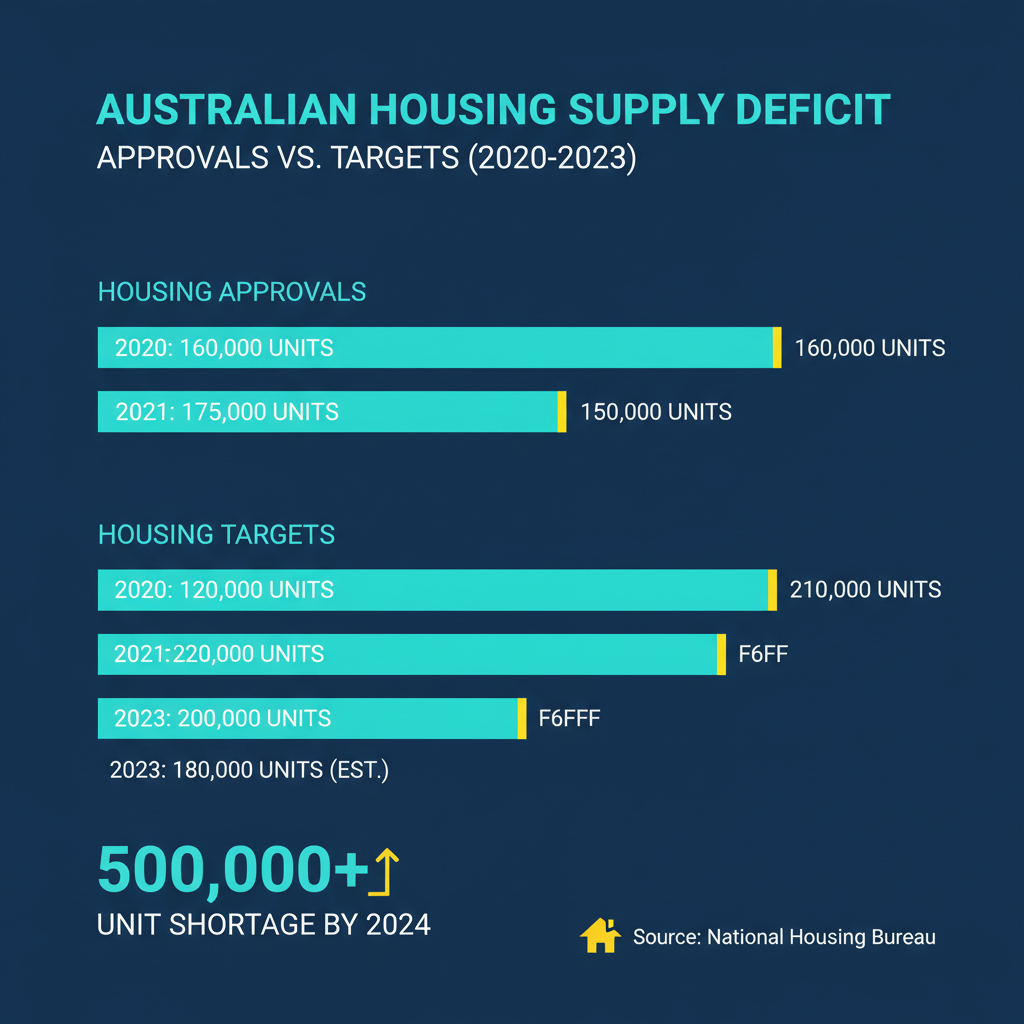
Australia’s housing crisis isn’t easing.
According to AMP Chief Economist Shane Oliver, Australia faces a cumulative housing shortage of between 200,000 and 300,000 homes.
The federal government’s Housing Accord target is to build 1.2 million homes over five years. But approvals are tracking well below the 240,000 annual run rate needed. In 2025, just 195,700 dwellings were approved, a shortfall of 44,000.
Over the first 18 months of the Housing Accord (to December 2025), 287,200 dwellings were approved. That’s 72,800 (20%) fewer than the 360,000 target.
The National Housing Supply and Affordability Council forecasts 938,000 new dwellings will be built by June 2029, implying a shortfall of 262,000 against the Housing Accord target. After accounting for demolitions, net new supply will be 825,000, which is 79,000 dwellings fewer than expected demand.
Why isn’t supply catching up? Labour shortages, high material costs, elevated interest rates, restrictive planning systems and rising construction timelines are all contributing.
For property investors, this supply crunch is a tailwind. When demand consistently outpaces supply, prices rise.
Migration and Population Demand
Australia’s net overseas migration remains a major demand driver.
In the year ending 30 June 2024, overseas migration contributed a net gain of 446,000 people. While that’s down from the record 536,000 the previous year, it’s still well above the long-run average.
Treasury forecasts suggest net migration will stabilise around 260,000 to 335,000 annually. But actual monthly data is tracking closer to 500,000 annualised, according to AMP analysis.
New arrivals typically enter the rental market first, tightening vacancy rates and pushing up rents. This creates demand for both rental properties and starter homes once these households transition to ownership.
Interstate migration is also reshaping regional property markets. Perth, Brisbane and Adelaide have all seen strong population inflows, driven by affordability and lifestyle factors. Melbourne’s return to positive interstate migration is a major signal for its housing market recovery.
The bottom line: population growth creates housing demand. And right now, that demand is running well ahead of supply.
Rental Market Tightness and Investor Activity
Australia’s rental vacancy rate sits near historic lows at around 1.6% nationally, according to NAB’s Housing Monitor.
Advertised rents rose 5.9% on a six-month annualised basis in December 2025. In some capital cities, median rents are forecast to grow 24% between 2025 and 2030.
Tight rental markets are driving investor activity. The share of new mortgage finance secured for investment property purchases hit 42% of overall housing loans in late 2025, a historically high level. The last time investment lending reached these levels, APRA intervened with macroprudential controls.
For property investors, this environment offers opportunity. High rental yields, low vacancy and capital growth expectations make investment-grade property an attractive asset class, especially in supply-constrained markets.
Dragan Dimovski, founder of Buyers Agency Australia, has spent over 20 years identifying these high-yield opportunities. His approach focuses on 10-year portfolio modeling to ensure long-term wealth creation, not short-term speculation.
Property Price Forecasts for 2026: What the Experts Say
Forecasters are broadly aligned: the Australian property market will deliver another year of growth in 2026, though the pace will be more moderate than 2025.
Here’s what major institutions are predicting.
ANZ: 4.8% National Growth
ANZ forecasts national home prices will rise 4.8% in 2026, down from 7.3% in 2025.
ANZ expects Brisbane, Perth, Darwin and Adelaide to lead with growth above 6%. Darwin is forecast at 13.7%, Perth at 10.9%, Brisbane at 9.5% and Adelaide at 6.1%.
Sydney and Melbourne are expected to see more modest growth as affordability constraints weigh on demand. ANZ notes that uncertainty around interest rates is likely to “take some heat out of the market.”
KPMG: 7.7% National Growth
KPMG forecasts house prices across Australia will increase 7.7% in 2026.
KPMG’s Chief Economist Dr Brendan Rynne says “momentum in the property market is expected to continue in 2026, despite ongoing speculation about where rates are heading.”
Brisbane is tipped for almost 11% house price growth and nearly 8% for units. Melbourne houses are forecast to rise 6.8%, Sydney 5.8%, Adelaide 8.2%.
KPMG notes that first-home buyer incentives and housing supply shortages will sustain demand.
Domain: Two-Speed Market in 2026
Domain forecasts a two-phase cycle for 2026.
The first half will see strong momentum as rate cuts from 2025, rising incomes and policy support flow through. The second half will see a natural slowdown as affordability limits re-emerge, particularly in Brisbane, Adelaide and Perth.
Domain expects combined capital city house prices to rise 6% and units 5% in 2026.
Sydney is forecast to deliver the strongest house price growth, reaching a median of around $1.92 million by year-end. Melbourne will stage a full recovery to $1.17 million.
Domain highlights the expanded First Home Guarantee Scheme as the single most influential demand driver in 2026, potentially lifting prices by 3.5% to 6.6% in the first year.
SQM Research: 6-10% National Growth
SQM Research forecasts dwelling values will rise between 6% and 10% nationally in 2026.
Brisbane, Perth, Adelaide and Darwin could see values rise by up to 16% under SQM’s base case.
SQM expects the momentum from late 2025, driven by strong migration, earlier rate cuts and changes to the First Home Buyer Deposit Scheme, to carry into 2026.
What This Means for Investors
While forecasts vary, the consensus is clear: 2026 will deliver positive price growth, but the market will be fragmented.
A-grade assets in supply-constrained, high-demand locations will outperform dramatically. B- and C-grade properties risk underperformance as the market moderates.
This is not a cycle that rewards FOMO buying or chasing hotspots. It rewards strategic, evidence-based decisions.
That’s where Buyers Agency Australia adds value. Dragan Dimovski’s team uses transparent, fixed-fee structures and data-driven investment strategies to help clients identify investment-grade properties before the crowd catches on.
Is Now a Good Time to Buy Investment Property
The question every investor is asking: should I buy now, or wait?
Here’s the honest answer: there’s never a “perfect” time to buy. Every market phase has trade-offs.
But let’s look at the factors that make 2026 compelling for investors who are finance-ready and strategically focused.
Why 2026 Offers Opportunity
1. Supply shortage won’t be solved quickly
Even with government incentives, construction approvals are running 20% below target. It will take years to close the 200,000-300,000 home deficit. That means upward price pressure will persist.
2. Migration demand remains strong
Net overseas migration is still running above pre-COVID levels. New arrivals need somewhere to live, and rental vacancy rates are near historic lows.
3. Interest rate peaks are likely priced in
While the RBA may hike again in May 2026, most economists believe we’re near the top of the rate cycle. Once inflation moderates, rates will stabilise or ease, which will support property prices.
4. First-home buyer stimulus is pulling demand forward
The expanded First Home Guarantee Scheme allows purchases with just 5% deposit and no lenders mortgage insurance. Domain estimates this will bring up to 20,000 first-home buyers into the market in the first year, equivalent to 125 basis points worth of rate cuts.
5. Investors can still find positive cash flow opportunities
In select markets, Brisbane, Perth and regional Queensland, investors can secure properties with rental yields above 5%, offering both cash flow and capital growth potential.
The Risks to Consider
No investment is risk-free. Here’s what could go wrong.
Affordability constraints may slow demand
With median home prices at $900,000 nationally and mortgage serviceability stretched, many buyers are priced out. If incomes don’t keep pace with price growth, demand will soften.
APRA may introduce macroprudential controls
Investor lending is at historically high levels. If regulators become concerned about financial stability, they could introduce lending caps or tighten serviceability buffers, which would reduce borrowing capacity.
Interest rates could stay higher for longer
If inflation remains above target, the RBA may hold rates at restrictive levels for an extended period, dampening buyer sentiment.
Global economic uncertainty
Geopolitical risks, trade tensions and recession fears in major economies could flow through to Australia, affecting confidence and demand.
The Strategic Approach: Quality Over Timing
Instead of trying to time the market, focus on buying the right asset.
Here’s what that looks like:
- Location: Target suburbs with strong infrastructure, employment hubs, population growth and limited supply.
- Property type: Favour detached houses or townhouses in family-friendly suburbs over high-density apartments.
- Rental demand: Look for areas with low vacancy rates, strong rental yield and tenant stability.
- Capital growth drivers: Identify suburbs in the early stages of gentrification or benefiting from major infrastructure projects.
- Affordability relative to income: Ensure the property remains accessible to a broad pool of future buyers.
This is exactly the framework Buyers Agency Australia applies when shortlisting properties for clients. Dragan’s 20+ years of experience and $10M+ personal portfolio give him a boots-on-the-ground understanding of what separates investment-grade assets from speculative punts.
If you’re serious about building wealth through property in 2026, book a free strategy session to see how a data-driven approach can stack the odds in your favour.
Capital City Breakdown: Where to Invest in 2026

Not all markets are created equal. Here’s how the major capital cities are shaping up for 2026.
Sydney: Modest Growth, High Barriers
Sydney is forecast to record house price growth of 5-6% in 2026, pushing the median to around $1.92 million by year-end.
Sydney’s market has always led the cycle in response to interest rate changes. But affordability is now a major constraint. Even with strong income growth and ongoing migration, fewer buyers can afford entry.
Opportunities exist in outer-suburban areas with strong transport links and in suburbs benefiting from infrastructure upgrades like the Sydney Metro.
For investors, Sydney offers stability and long-term capital growth but lower rental yields than other capitals.
Melbourne: Recovery Mode
Melbourne is forecast to see house prices rise 6-7% in 2026, finally surpassing pre-pandemic highs and reaching a median of around $1.17 million.
Melbourne’s return to positive interstate migration is a major signal. The city’s comparatively lower price base compared to Sydney provides room for growth.
However, Victoria’s land tax regime continues to weigh on investor activity. Rental yields are lower than Brisbane or Perth, making cash flow harder to achieve.
Melbourne offers medium-term capital growth for patient investors, but it’s not the strongest cash flow market.
Brisbane: The Goldilocks Market
Brisbane is forecast to deliver house price growth of 9-11% in 2026, with units rising 8%.
Brisbane has seen strong population inflows, driven by affordability and lifestyle migration from Sydney and Melbourne. The 2032 Olympics is driving infrastructure investment, and supply remains tight.
Brisbane offers a rare combination: positive cash flow (rental yields above 4.5%), strong capital growth and relative affordability.
For investors building a portfolio, Brisbane is one of the best risk-adjusted opportunities in 2026.
Perth: The Breakout Star
Perth is forecast to see house price growth of 10-11% in 2026, extending a multi-year run of outperformance.
Perth has the tightest supply conditions in Australia. Homes are selling in 7-8 days, and listings are more than 50% below normal.
Perth also has the strongest income growth, driven by the mining and resources sector, and the highest population growth rate of any state.
Rental yields in Perth are above 5% in many suburbs, making it highly attractive for investors seeking cash flow and capital growth.
Perth is no longer “underestimated.” It’s one of the most compelling investment markets in the country.
Adelaide: Moderating But Still Strong
Adelaide is forecast to see house price growth of 6-8% in 2026, moderating from recent highs but still solid.
Affordability issues are starting to emerge, which may temper demand. However, supply has also picked up, which will keep growth at a more moderate pace.
Adelaide offers good value compared to the east coast, and rental yields remain attractive.
Regional Markets: The Hidden Gems
Regional markets like Geelong, Ballarat, Sunshine Coast, Gold Coast and Cairns are offering more affordable options with strong growth potential.
These markets are benefiting from lifestyle migration, infrastructure investment and relative affordability.
For investors willing to look beyond the major capitals, regional markets can deliver strong rental yields and capital growth.
How Buyers Agency Australia Helps Investors Navigate 2026
The 2026 property market isn’t straightforward. It’s fragmented, complex and requires a disciplined, data-driven approach.
That’s where Buyers Agency Australia makes the difference.
Dragan Dimovski founded Buyers Agency Australia to bridge the gap between expensive corporate agencies and impersonal data firms. His approach is transparent, results-oriented and built on 20+ years of real-world investing experience.
Here’s how Buyers Agency Australia helps investors succeed in 2026:
10-Year Portfolio Modeling
Instead of chasing short-term gains, Buyers Agency Australia focuses on long-term wealth creation. Every property is assessed using 10-year portfolio modeling to ensure it meets cash flow, capital growth and risk-adjusted return targets.
Transparent, Fixed-Fee Pricing
No commissions. No hidden costs. Buyers Agency Australia operates on a transparent, fixed-fee model, so your interests are always aligned.
Nationwide Coverage, Local Expertise
With boots-on-the-ground presence across all major Australian capital cities, Buyers Agency Australia can identify opportunities in Brisbane, Perth, Adelaide, Sydney and Melbourne, as well as high-growth regional markets.
Access to Off-Market Deals
Many of the best investment-grade properties never hit the public market. Buyers Agency Australia’s network provides access to off-market opportunities before the competition even knows they exist.
End-to-End Property Search and Negotiation
From suburb selection to settlement, Buyers Agency Australia handles every step of the buying process. For time-poor professionals and interstate investors, this removes the stress and uncertainty of DIY property buying.
Data-Driven, No-Fluff Advice
Dragan’s philosophy is simple: specificity over hype, evidence over emotion. If a property doesn’t meet the investment criteria, he’ll tell you. If a market is overheated, he’ll steer you away.
That honesty has built a reputation for integrity and results.
If you’re ready to make 2026 the year you build serious property wealth, book a free strategy session with Buyers Agency Australia. You’ll walk away with a clear, actionable plan tailored to your financial goals.
Frequently Asked Questions
Will Australian property prices crash in 2026?
No major forecaster predicts a crash. Structural housing shortages, strong migration and limited supply will support prices despite interest rate rises.
Should first-home buyers wait for prices to drop?
Waiting may cost more. Supply won’t catch up quickly, and prices are expected to rise 5-10% in 2026. Use the expanded First Home Guarantee Scheme.
What is the best city to invest in 2026?
Brisbane and Perth offer the best combination of cash flow and capital growth. Sydney and Melbourne offer stability but lower yields.
How much will interest rates rise in 2026?
The RBA increased rates to 3.85% in February 2026. Most economists expect one more rise to 4.10% if inflation stays elevated.
Are buyers agents worth the cost?
Yes. Buyers agents save investors time, negotiate better prices and identify off-market opportunities. The ROI often exceeds the fee in the first year.
Final Thoughts: 2026 Rewards Strategic Investors
The Australian property market in 2026 isn’t about boom or bust.
It’s about strategy, discipline and evidence-based decision-making.
Property prices will continue rising, but not uniformly. A-grade assets in supply-constrained, high-demand locations will outperform. B- and C-grade properties will lag.
Interest rates may rise slightly, but the structural forces driving property prices, supply shortages, migration demand and rental market tightness, are more powerful.
For investors who are finance-ready, who understand market fundamentals and who are willing to take a long-term view, 2026 offers genuine opportunity.
But it’s not a market for speculation, FOMO or guesswork.
If you want to make 2026 the year you build long-term property wealth, work with experts who’ve been through multiple market cycles and who put your interests first.
Book a free strategy session with Buyers Agency Australia today. Dragan Dimovski and his team will show you exactly how to navigate the 2026 market with confidence, clarity and a clear path to results.
You can also explore Dragan’s insights on the Passive with Property podcast or get in touch via the contact page.
The 2026 property market is moving. The question is: will you move with it?