
Property remains the most reliable foundation for long-term wealth creation in Australia in 2026, offering 6–10% annual growth, powerful leverage through borrowing, and tax advantages unavailable to shares or crypto. While shares provide diversification and crypto promises high-risk speculation, property delivers tangible assets, stable returns, and proven wealth-building through capital growth and negative gearing.
If you're deciding where to invest your money in 2026, you're not alone. Australians are sitting on record savings, property prices are climbing again after a short pause, and the crypto market is maturing with regulatory oversight.
The question isn't whether you should invest—it's where. Property offers stability, leverage, and tax breaks. Shares give you liquidity and diversification. Crypto dangles the promise of moonshot returns with stomach-churning volatility.
This guide breaks down all three asset classes for Australian investors in 2026. We'll compare historical returns, risk profiles, tax treatment, liquidity, and who each investment suits best. By the end, you'll have a clear framework to build a portfolio anchored in property, diversified with shares, and (if you're brave) spiced with crypto.
Why Property Remains the Foundation for Australian Investors in 2026
Property isn't sexy. It doesn't 10x overnight. But it's the asset class that has built generational wealth for Australian families since the 1950s.
In 2025, Australian property delivered strong returns across most capital cities, with Perth up 13%, Brisbane up 12%, and Adelaide up 9%. National dwelling values rose 7.5% according to PropTrack, and most forecasters expect 6% growth in 2026 in cities like Perth, Brisbane, Adelaide, and Sydney.
But the real magic of property isn't just price growth. It's leverage, tax treatment, and stability.
Leverage Amplifies Your Returns
Property is the only mainstream asset class where banks will lend you 80–90% of the purchase price at sub-6% interest rates. If you put down $100,000 and borrow $400,000 to buy a $500,000 property, and it grows 6% in a year, you've made $30,000 on a $100,000 deposit—a 30% return on your cash.
Try getting a bank to lend you $400,000 to buy shares. It won't happen.
Buyers Agency Australia works with investors every week who use equity in their first property to fund deposits on their second and third. This compounding leverage is how you build a $3 million portfolio on a $150,000 salary over 15 years.
Negative Gearing Cuts Your Tax Bill
Australia's negative gearing rules allow you to offset rental losses against your taxable salary. If your investment property costs you $15,000 more per year than it earns in rent, and you're in the 37% tax bracket, you'll save approximately $5,850 in tax.
That's cash back in your pocket every year. Shares don't offer this. Crypto doesn't either. Around 1 million Australians use negative gearing across 2 million investment properties, claiming an average $8,700 annual deduction.
When you sell, you pay capital gains tax (CGT), but if you've held the property for more than 12 months, you get a 50% CGT discount. That means only half your profit is taxed. Negative gearing on the way in, discounted CGT on the way out—this is why property is the tax-efficient backbone of wealth-building.
Stability and Tangibility
Property doesn't swing 15% in a week. You can't panic-sell at 2am because Elon Musk tweeted. The Australian property market is less volatile than shares, driven by long-term economic trends, interest rates, and local supply-demand imbalances.
You can live in it, rent it out, renovate it, and pass it to your kids. It's real. For most Australians, that psychological security matters as much as the spreadsheet.
The Case for Buyers Agency Australia
Buying the right property in the right location is the difference between 3% growth and 10% growth. Buyers Agency Australia specializes in data-driven investment strategies, analyzing 10-year portfolio modeling, infrastructure pipelines, and rental yield fundamentals to ensure your property delivers long-term wealth creation.
With over 20 years of experience and a transparent fixed-fee model, the team cuts through hype to find properties that work financially—not emotionally.
Shares Offer Diversification and Liquidity but Higher Volatility
Shares are the second pillar of a diversified portfolio. They're liquid, easy to buy, and give you access to businesses you could never afford to own outright.
In 2024, the ASX 200 delivered total returns (including dividends) of approximately 11%, slightly behind property. Over the past 10 years, the ASX 200 has returned an average of 9–10% per annum, including dividends and franking credits.
But here's the catch: that return comes with daily price swings, no leverage, and no tax deductions on holding costs.
Liquidity is a Double-Edged Sword
You can sell shares in seconds. That's great when you need cash fast. But it's also a psychological trap.
Property forces patience. You can't check the price 20 times a day. You can't sell in a panic. Shares tempt you to trade emotionally, and most retail investors underperform the index because they buy high and sell low.
Dividends and Franking Credits Add Value
Australian shares pay dividends, often with franking credits attached. For an investor in the 37% tax bracket, franking credits can boost effective returns by 1–2% per year.
But dividends aren't guaranteed. Companies cut them in downturns. Rent doesn't disappear as easily.
Lower Barriers to Entry
You can start investing in shares with $500. Property needs $50,000–$100,000 for a deposit. That accessibility is powerful for younger investors or those building their first portfolio.
But accessibility also means less commitment, less discipline, and often lower long-term results.
Shares vs Property: Historical Performance
Looking at long-term data, Australian shares returned 7.8% per annum from 1870 to 2015, while property returned 6.3% over the same period. But leverage changes that calculation.
A 6% property return with 80% leverage translates to a 30% return on your deposit. Shares can't match that without margin loans—which are expensive and risky.
Over the past 20 years, residential property returned 10.2% per annum, compared to 8.8% for shares, according to the 2018 Russell Investments/ASX Long-term Investing Report.
Crypto is High-Risk Speculation, Not a Wealth-Building Foundation
Cryptocurrency is the newest kid on the block, and it's polarizing. Advocates call it the future of finance. Skeptics call it digital tulips.
In 2025, Australia's crypto adoption rate hit 31%, up from 28% in 2024. Bitcoin traded in the $90,000–$110,000 AUD range through early 2026, and regulatory frameworks are maturing with ASIC's Digital Asset Platform (DAP) licensing.
But let's be clear: crypto is not a wealth-building foundation. It's a high-risk satellite holding for investors who can afford to lose the entire position.
Volatility is Extreme
Bitcoin has fallen 30% in a month more than once. Altcoins can lose 80% in a week. If you can't stomach that, crypto isn't for you.
Property might fall 5–10% in a bad year. Shares might drop 15–20%. Crypto can halve overnight. Volatility has calmed slightly compared to 2020–2022, but it's still 3–5x more volatile than shares.
No Income, No Tax Benefits
Crypto doesn't pay rent. It doesn't pay dividends. It just sits there, hoping to go up. You can stake some coins for yield, but that adds complexity and risk.
You can't negative gear crypto. You can't leverage it at 80% LVR. And every trade triggers a capital gains tax event, even if you're just swapping Bitcoin for Ethereum.
The ATO treats crypto as property for tax purposes, but without the tax benefits of actual property.
Regulatory Risk is Real
Crypto is now more regulated in Australia, but it's still evolving. Exchanges must hold an AFSL and DAP approval by mid-2026. Some platforms will fail to meet the bar. Others will exit the Australian market.
You also face global regulatory risk. If the US cracks down, Bitcoin doesn't care about ASIC's rules.
When Does Crypto Make Sense?
Crypto makes sense as 5–10% of your portfolio if:
- You have a stable property and share portfolio already
- You're comfortable with total loss
- You're investing with a 10+ year horizon
- You believe in the long-term adoption of blockchain technology
If you're hoping to flip crypto in six months to fund a house deposit, you're gambling, not investing.
Risk Profiles: Property vs Shares vs Crypto in 2026
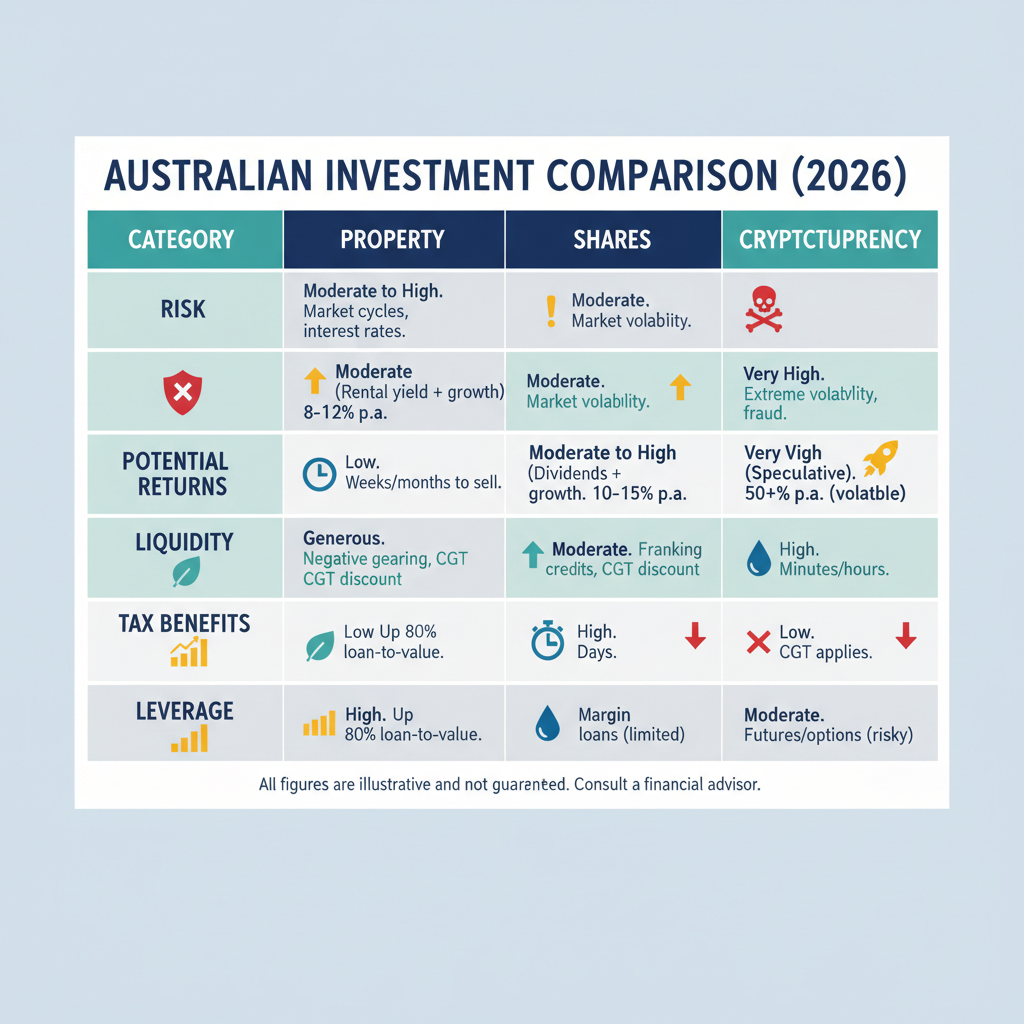
Let's compare the three asset classes across key risk dimensions.
| Risk Factor | Property | Shares | Crypto |
|---|---|---|---|
| Volatility | Low—5–10% swings over years | Moderate—15–20% swings annually | Extreme—30–80% swings in months |
| Liquidity | Low—takes 6–12 weeks to sell | High—sell in seconds | High—sell in minutes |
| Leverage available | 80–90% LVR at 5–6% interest | 50% LVR at higher interest | Not available from banks |
| Income generation | Rental yield 3–6% | Dividend yield 3–5% | None (unless staking) |
| Tax benefits | Negative gearing, 50% CGT discount | Franking credits, 50% CGT discount | None, full CGT on every trade |
| Regulatory risk | Low—well-established frameworks | Low—ASX is 125 years old | Moderate—evolving ASIC/ATO rules |
| Inflation hedge | Strong—rents and values rise with CPI | Moderate—depends on sector | Weak—no intrinsic link to inflation |
Property wins on stability, tax benefits, and leverage. Shares win on liquidity and diversification. Crypto wins on… nothing, unless you're speculating.
Tax Treatment: Negative Gearing, CGT, and Franking Credits
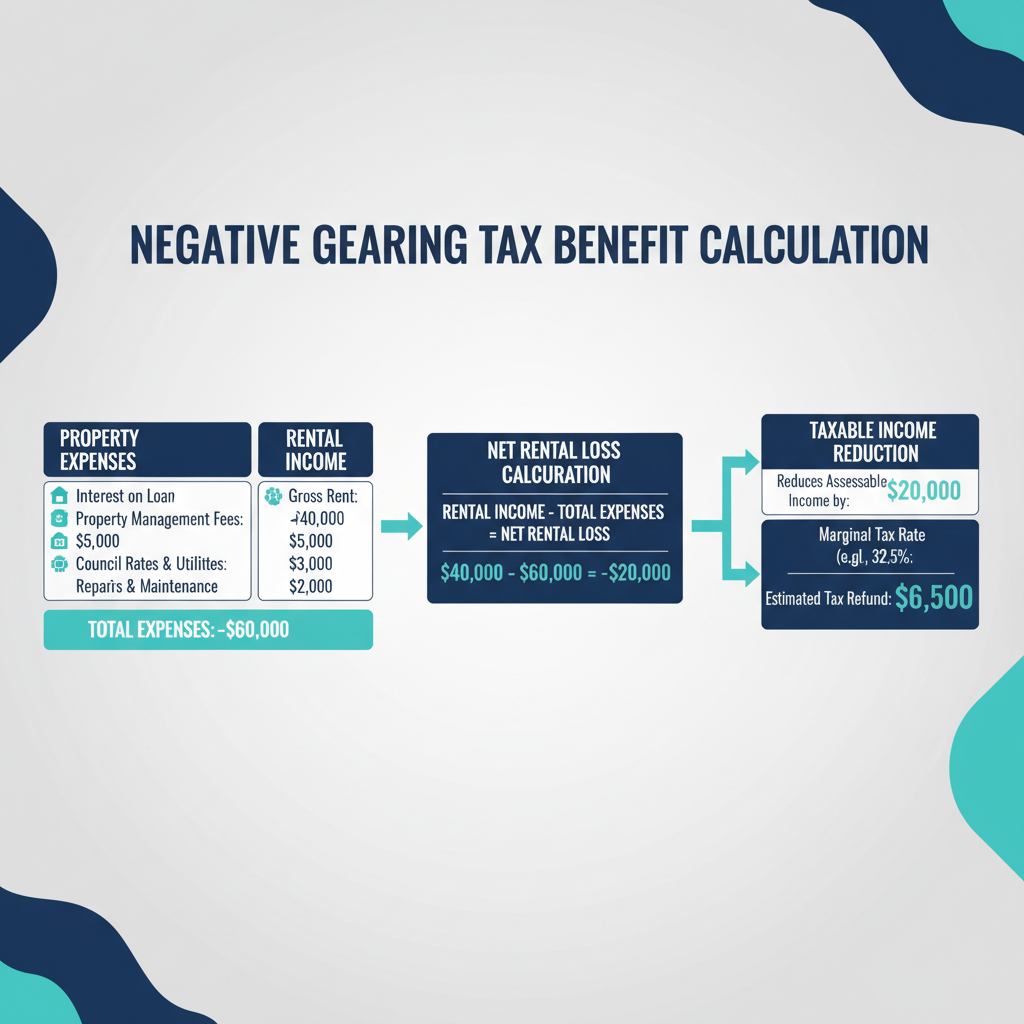
Tax is where property pulls ahead in Australia.
Negative Gearing for Property
Negative gearing allows you to offset rental losses against your salary. If your property costs $22,000 per year (interest, rates, insurance) and earns $18,000 in rent, you have a $4,000 loss. At the 37% tax rate, that's $1,480 back in your pocket.
Around 950,000 Australians use negative gearing, and 60% earn less than $100,000. It's not just for the wealthy—it's for teachers, nurses, and tradies building long-term wealth.
Capital Gains Tax (CGT) Discount
Both property and shares enjoy the 50% CGT discount if held for more than 12 months. Crypto does too, but you'll trigger CGT every time you trade one coin for another.
If you buy a property for $500,000 and sell it for $700,000, you've made a $200,000 gain. Only $100,000 is taxable. At the 37% rate, you pay $37,000 in tax—not $74,000.
Franking Credits for Shares
Australian shares pay dividends with franking credits attached, boosting after-tax returns by 1–2% per year. Crypto has nothing comparable.
Summary: Property Wins on Tax
Property gives you negative gearing on the way in and the 50% CGT discount on the way out. Shares give you franking credits and the CGT discount. Crypto gives you… a tax bill on every trade.
Liquidity, Accessibility, and Time Commitment
Investing isn't just about returns. It's about how much time, cash, and stress each asset demands.
Property: High Commitment, High Reward
Property needs a $50,000–$100,000 deposit, 6–12 weeks to buy, and ongoing management (or a property manager for 7–10% of rent). It's illiquid—you can't sell half a bedroom if you need cash.
But that illiquidity is a feature, not a bug. It forces long-term thinking. And with Buyers Agency Australia, you outsource the search, due diligence, and negotiation to experts who live and breathe property data.
Shares: Low Commitment, Moderate Reward
You can start with $500, buy in 30 seconds, and sell just as fast. No maintenance, no tenants, no council rates.
But that ease encourages overtrading, emotional decisions, and underperformance. Most retail investors underperform the index because they trade too much.
Crypto: Low Commitment, High Stress
Crypto is easy to buy—download an app, verify your ID, deposit AUD. But watching your portfolio swing 15% in a day is exhausting.
Crypto demands constant attention if you're actively trading. If you're holding long-term ("HODLing"), you still face the psychological toll of volatility.
Who Should Invest in What?
Here's a simple framework based on your financial position and goals.
You Should Prioritize Property If:
- You're a high-income earner (above $90,000) and can benefit from negative gearing
- You have $50,000–$100,000 saved for a deposit
- You're focused on long-term wealth (10–20 years)
- You want leverage to amplify returns
- You value stability and tangible assets
- You're prepared to hold through short-term rate rises or price dips
Book a free strategy session with Buyers Agency Australia to build a portfolio grounded in data, not hype.
You Should Add Shares If:
- You want liquidity and diversification
- You have a smaller starting capital (under $10,000)
- You're comfortable with daily price swings
- You want exposure to global growth (US tech, Asia, Europe)
- You're disciplined enough to hold through volatility
You Should Only Touch Crypto If:
- You already have a stable property and share portfolio
- You're allocating 5–10% of your portfolio at most
- You can afford total loss without impacting your financial goals
- You're investing with a 10+ year horizon
- You believe in the long-term adoption of blockchain technology
If you're betting your house deposit on crypto, you're gambling, not investing.
How Buyers Agency Australia Helps Investors Build Long-Term Property Portfolios

Buying property isn't hard. Buying the right property is.
Most investors overpay for emotionally appealing properties in stagnant suburbs. They chase "hot tips" from mates, buy off-the-plan apartments with zero capital growth, or stretch their budgets so far they can't survive a rate rise.
Buyers Agency Australia eliminates those mistakes. The team uses 10-year portfolio modeling, infrastructure mapping, and rental yield analysis to identify properties that deliver capital growth and cash flow over the long term.
Dragan Dimovski brings over 20 years of experience and a successful personal portfolio. He's lived through multiple property cycles, understands the nuances of every Australian capital city, and runs the 'Passive with Property' podcast to share no-fluff insights.
The fixed-fee model means no conflicts of interest. You get honest advice, not a sales pitch. Whether you're buying your first investment property or scaling to your fifth, Buyers Agency Australia builds portfolios designed for long-term wealth, not short-term hype.
FAQs: Property vs Shares vs Crypto in Australia 2026
Which investment has the highest historical returns in Australia?
Over 20 years, residential property returned 10.2% per annum, shares returned 8.8%, and crypto's history is too short to measure reliably.
Is property still worth it with high interest rates in 2026?
Yes—negative gearing offsets holding costs, and long-term capital growth outweighs short-term rate pain. Most forecasters expect 6% growth in 2026.
Can I use negative gearing for shares or crypto?
No—negative gearing only applies to income-producing assets like rental property. Shares and crypto don't qualify.
Should I sell property to buy shares or crypto?
No—property is your foundation. Add shares and crypto as diversification, but never at the expense of your property portfolio.
What's the minimum amount I need to start investing in each asset class?
Property: $50,000–$100,000 deposit. Shares: $500. Crypto: $100.
Final Verdict: Property is the Foundation, Shares are Diversification, Crypto is Speculation
If you're serious about building long-term wealth in Australia in 2026, property is your foundation. It offers leverage, tax benefits, stable growth, and tangible security that shares and crypto can't match.
Shares belong in your portfolio for liquidity, diversification, and exposure to global growth. But they're the second layer, not the base.
Crypto is a speculative satellite—5–10% of your portfolio at most, only if you've already secured your property and share positions.
The investors who build $2 million+ portfolios over 15 years don't chase crypto moonshots. They buy quality property in growth corridors, hold through cycles, and let leverage and negative gearing do the heavy lifting.
Ready to start building?
Book a free strategy session with Buyers Agency Australia and get a personalized 10-year portfolio roadmap designed for your income, goals, and risk tolerance. No sales pitch. No fluff. Just data-driven property investment that builds generational wealth.
Your property portfolio is the foundation. Everything else is diversification. Start with the foundation first.