Dual-income properties—duplexes, granny flats, and dual-key homes—are generating 6-8% rental yields in 2026, often doubling the income of traditional single-tenancy investments while offering protection against interest-rate pressure and vacancy risk.
Interest rates remain elevated in early 2026, and single-dwelling rental yields are struggling to cover holding costs for most investors. The national vacancy rate sits at just 1.2%, but landlords with only one income stream face mortgage stress when rates climb or tenants leave.
That's why search volume for "dual-income property" has jumped 140% year-on-year. Investors are pivoting to configurations that deliver two rental streams from one asset: granny flats behind existing homes, side-by-side duplexes, or dual-key layouts with lockable internal doors.
Buyers Agency Australia helps clients identify these high-yield opportunities across Brisbane, Melbourne, Sydney, and Perth, where zoning reforms have opened thousands of previously restricted blocks to dual-occupancy development.
The Yield Gap: Single-Tenancy vs Dual-Income in 2026
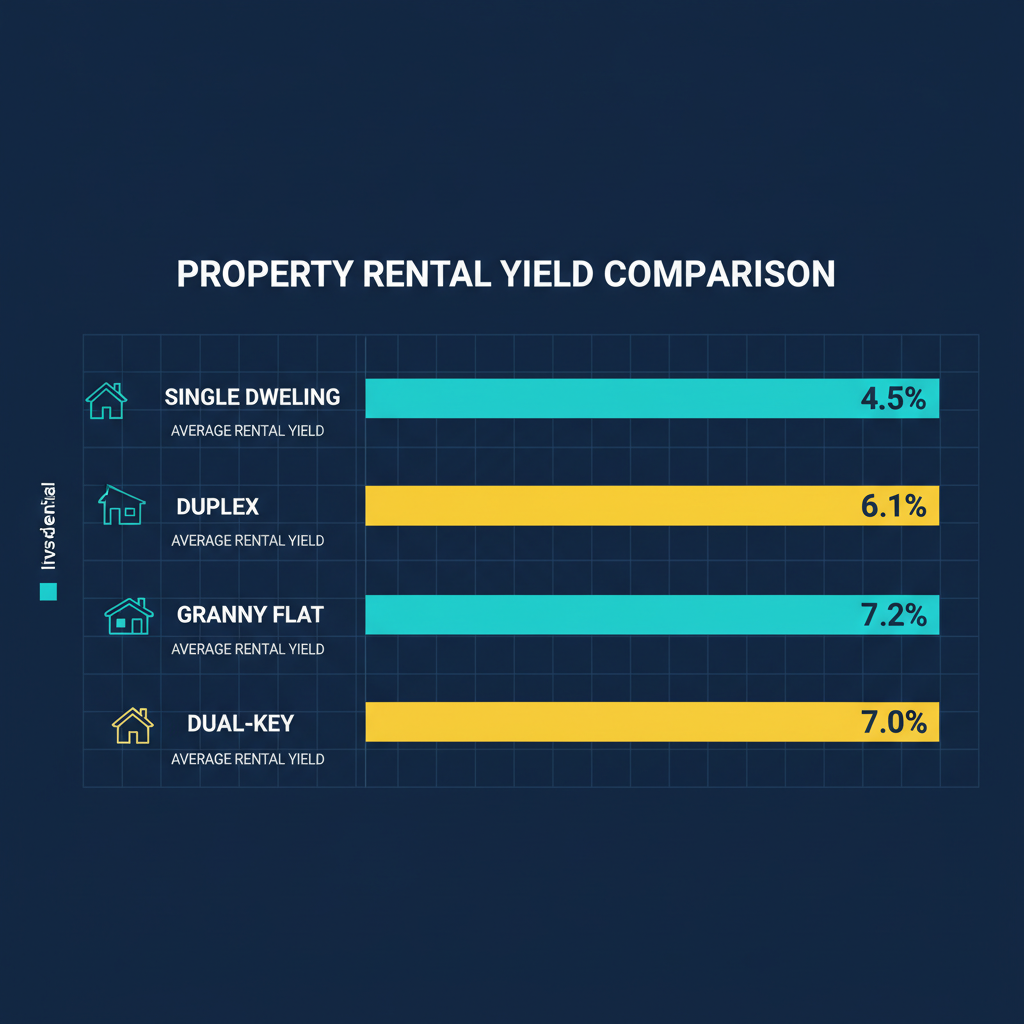
The numbers tell the story. A $700,000 house renting for $600/week delivers a 4.5% gross yield. A $850,000 dual-occupancy property renting for $1,000/week combined delivers 6.1%—and eliminates total vacancy risk.
Rental yields across Australia average 5-6% nationally, according to Elders Real Estate. But dual-income configurations consistently outperform:
- Granny flats: 6.5-8% yields in growth corridors
- Duplexes: 6-7% yields with lower per-unit build costs
- Dual-key homes: 7% yields in high-demand metro areas
A single property renting for $650/week generates $33,800 annually. Two well-designed units on the same land can bring in $1,100-$1,300 combined—that's $57,200 to $67,600 per year, often with shorter vacancy periods.
Why Single-Tenancy Yields Are Under Pressure
Holding costs have climbed. Even with rental growth of 3.9% for houses in 2025, mortgage repayments on investment loans have risen faster. Property taxes, insurance, and maintenance eat into cash flow.
When your sole tenant vacates, income stops completely. With dual-income properties, one unit can remain occupied while the other turns over, maintaining cash flow continuity.
Rental demand is strong—vacancy rates remain tight—but single-dwelling investors can't access the same income diversification that dual configurations provide.
The Dual-Income Advantage: Two Streams, One Title
Dual-income properties sit on a single land title, which means:
- One set of council rates
- One property insurance policy
- No body corporate fees (unlike strata duplexes)
- Simplified financing compared to two separate purchases
You're effectively creating two income-producing assets without doubling your land cost. In Brisbane's outer suburbs, a $700,000 block with a house and granny flat can generate $1,050/week combined—$54,600 annually—while a single $700,000 house might rent for $600/week ($31,200 annually).
That's a $23,400 annual income difference, or 75% more cash flow from the same land value.
Top 3 Dual-Income Configurations for 2026
Not all dual-income properties are created equal. Here's how the three main configurations stack up for yield, cost, and investor suitability.
Duplexes: Side-by-Side or Attached Units
A duplex features two separate dwellings on one block, typically sharing a common wall (attached) or built side-by-side (detached). Each unit has its own entrance, kitchen, bathroom, and living areas.
Yield Profile
Duplexes deliver 6-7% gross yields across Melbourne suburbs, according to recent market data. A $1.2 million duplex development (two 3-bedroom units) can generate $1,200-$1,400/week combined.
Construction Costs
Building a duplex costs $700,000 to $1.2 million in Melbourne, or $2,000-$3,800 per m². Total investment including land often exceeds $1.5-$2 million in established suburbs.
Attached configurations reduce costs by 10-15% compared to detached layouts. Detached duplexes offer better tenant privacy and easier future strata subdivision.
Best For
Investors with larger capital bases ($300,000+ deposit) seeking capital growth plus income. Duplexes attract families and long-term tenants, reducing turnover.
You can live in one unit while renting the other, or rent both for maximum cash flow. Future subdivision allows separate sale of each unit if market conditions favour it.
Granny Flats: Secondary Dwellings Behind the Main House
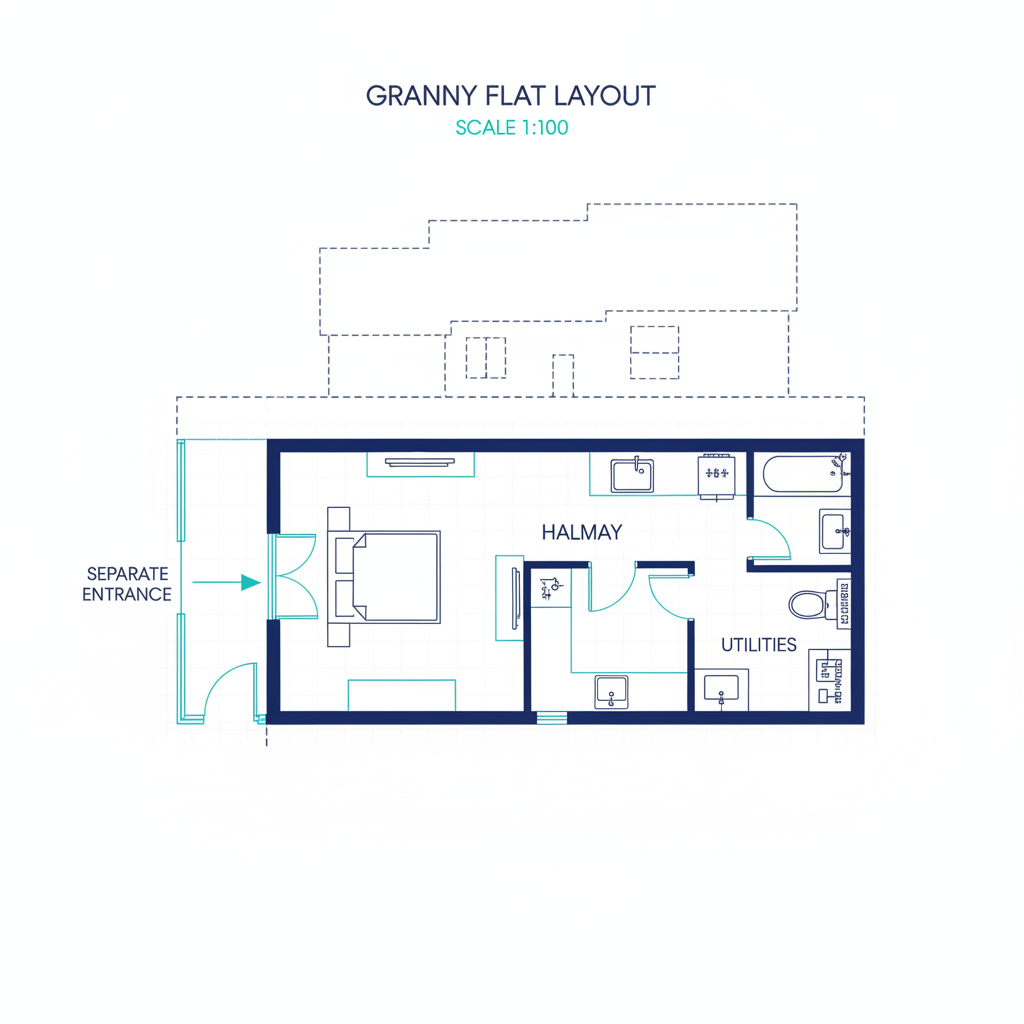
A granny flat is a self-contained secondary dwelling built on the same lot as an existing primary residence. It must remain subordinate to the main house and cannot be sold separately.
Yield Profile
Granny flats deliver 6.5-8% yields, with some setups generating $400-$550/week in high-demand areas. A 60m² granny flat costing $180,000 to build can generate $20,000-$28,000 annually.
Building a granny flat can boost overall property value by 20-30%, according to CoreLogic 2019 data still cited as relevant in 2026 markets.
Construction Costs
A quality granny flat costs $150,000-$200,000 for a compact one-bedroom design. Two-bedroom or custom layouts range $180,000-$250,000 depending on site conditions and finishes.
Fast-track approvals in NSW (Complying Development Certificate pathway) mean 8-12 week approval times versus 4-6 months for traditional Development Applications.
Victoria's December 2023 reforms allow granny flats under 60m² on properties over 300m² with streamlined approvals, no longer requiring full council consent.
Best For
Investors with existing properties on suitable blocks (typically 450m²+) who want to add income without selling. You can retain your primary residence CGT exemption on the main house while claiming depreciation on the granny flat.
Granny flats payback within 10-15 years from rental income alone, faster when factoring property value uplift.
Dual-Key Homes: Shared Entry, Separate Lockable Units
A dual-key property is a single building divided into two self-contained units, typically with one shared front entrance or foyer leading to separate lockable doors. Think of it as a house with an attached granny flat under one roof.
Yield Profile
Dual-key properties deliver around 7% yields, with higher returns in metro areas facing housing affordability pressure. A $750,000 dual-key home can rent for $580/week (main unit) + $400/week (secondary unit) = $980/week combined ($51,000 annually).
Construction Costs
Dual-key homes cost more per square metre than single dwellings because you're duplicating kitchens, bathrooms, and plumbing. Expect $350,000-$500,000 build costs depending on size and finishes.
However, you're building two income streams under one roof, which is more cost-efficient than purchasing two separate properties.
Best For
First-time investors seeking strong cash flow without massive capital outlays. Owner-occupiers can live in the larger unit while renting the smaller one, using tenant income to cover 40-60% of mortgage repayments.
Dual-key homes appeal to multi-generational families, young professionals, and downsizers, creating broad tenant appeal.
Resale Considerations
Dual-key properties have a narrower resale market than traditional homes. Owner-occupiers (67% of Australian buyers) typically prefer standard houses with full backyards. However, in high-density growth corridors, dual-key homes are gaining traction as affordable housing solutions.
Some investors convert dual-key properties back to single dwellings before resale to broaden buyer appeal and maximise capital growth.
Council Secrets: Relaxed Zoning Laws Opening Dual-Income Opportunities
Zoning reforms across Australia have unlocked thousands of previously restricted blocks for dual-occupancy development. Understanding these changes is critical to identifying viable investment opportunities.
NSW: R2 Zone Dual-Occupancy Reforms (July 2024)
The State Environmental Planning Policy (Housing) Amendment 2024 now permits dual occupancies and semi-detached dwellings with development consent in R2 Low Density Residential zones across NSW.
This applies to Greater Sydney, Central Coast, Illawarra, and Hunter regions—but excludes Bathurst, Hawkesbury, Blue Mountains, and Wollondilly councils.
Key Requirements
- Minimum lot size: 400m² or council-specified minimum
- Minimum lot width: 12 metres
- Each dwelling must face a public road (except corner blocks)
- One off-street parking spot per dwelling
- Compliance with Low Rise Housing Diversity Design Guide
Thousands of R2 properties previously locked out of dual-occupancy development are now viable. However, dual occupancies permitted under this SEPP are not eligible for Complying Development (fast-track approval)—you'll need a full Development Application.
Victoria: Secondary Dwelling Reforms (December 2023)
Victoria's planning reforms allow granny flats under 60m² on residential lots over 300m² without full council approval, provided they meet state design standards.
This fast-tracks approval timelines from 4-6 months to 6-8 weeks, reducing holding costs and accelerating rental income commencement.
Queensland: Ancillary Dwellings and Dual Occupancy
Queensland allows dual-occupancy developments in residential zones, provided minimum lot sizes and planning guidelines are met. In some cases, secondary dwellings (granny flats) can be built without full development approval.
However, rental restrictions vary by council—some areas require family connections between main house and granny flat tenants, limiting investment utility. Always verify local regulations before purchasing.
Western Australia: Ancillary Accommodation Flexibility
WA councils are increasingly allowing flexible ancillary dwelling designs under R-Codes. Perth's 2025 reforms expanded dual-occupancy eligibility across suburban zones, with some councils eliminating planning approval requirements for compliant designs.
Ancillary dwellings must be associated with a single house and remain on the same lot, but can be rented independently in most council areas.
How to Verify Your Block's Dual-Income Eligibility
Before purchasing any property for dual-income conversion:
- Check the property's zoning on your council's planning portal
- Request a copy of the Development Approval (DA) or Planning Permit if the property already has a secondary dwelling
- Verify minimum lot size, width, and setback requirements
- Confirm rental permissibility—some granny flats cannot be rented to non-family members
- Factor in approval timelines: 8-12 weeks for CDC pathways, 4-6 months for DAs
Buyers Agency Australia conducts full zoning and feasibility assessments as part of our property search service, identifying blocks with hidden dual-income potential.
The ROI Blueprint: Modeling Dual-Income Returns
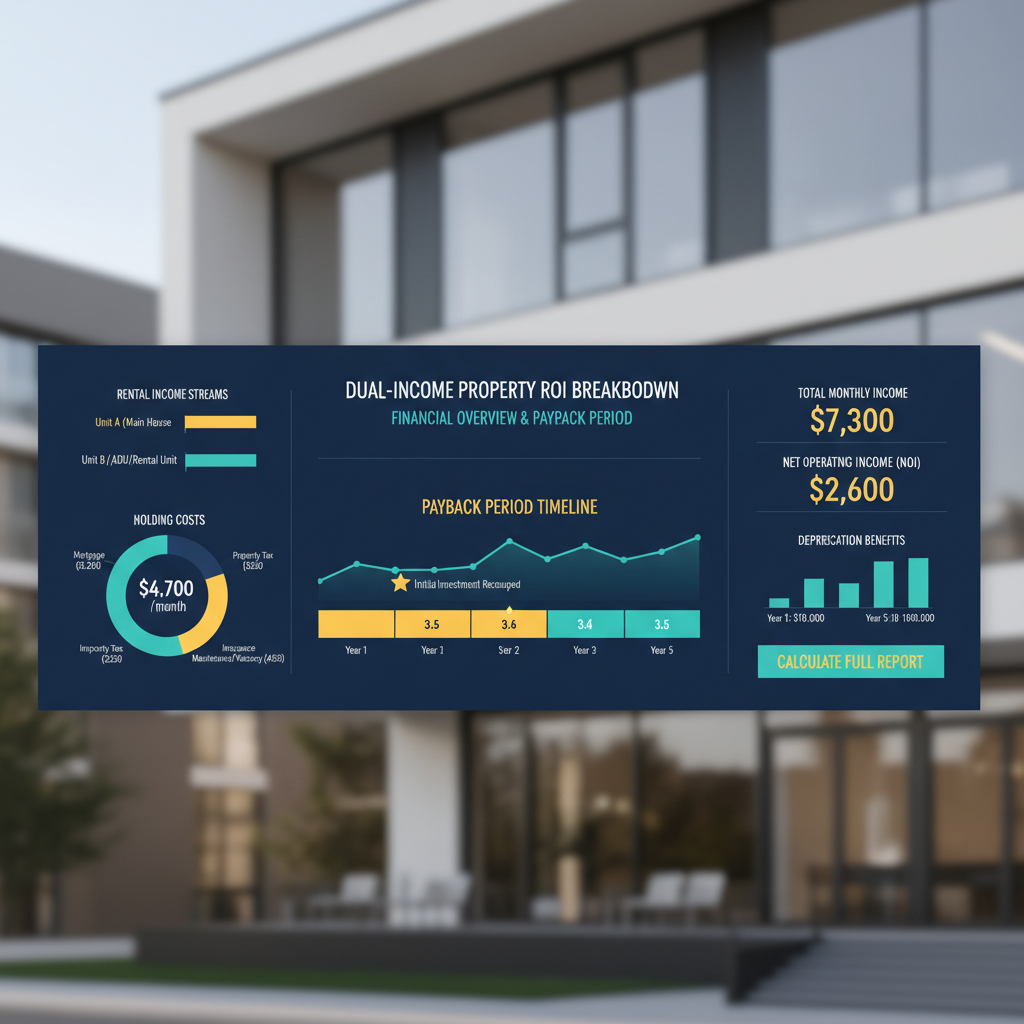
Running the numbers before purchase is non-negotiable. Here's how to model dual-income property returns accurately.
Gross Rental Yield Calculation
Gross rental yield = (Annual Rent / Property Cost) × 100
Example: Granny Flat Addition
- Existing property value: $650,000
- Granny flat build cost: $180,000
- Total investment: $830,000
- Main house rent: $550/week ($28,600/year)
- Granny flat rent: $400/week ($20,800/year)
- Combined annual rent: $49,400
- Gross yield: ($49,400 / $830,000) × 100 = 5.95%
A single $830,000 house might rent for $650/week ($33,800/year) = 4.07% yield. The dual-income configuration delivers 46% more cash flow.
Net Yield: Factoring in Holding Costs
Net rental yield accounts for expenses:
- Council rates: $2,200/year
- Insurance: $1,800/year
- Maintenance: $4,000/year (both dwellings)
- Property management: 8% of rent ($3,952/year)
- Total expenses: $11,952/year
Net yield = ($49,400 – $11,952) / $830,000 × 100 = 4.5%
Still significantly higher than single-dwelling alternatives in the same price range.
Payback Period Analysis
How long until the granny flat build cost is recovered?
Granny flat generates $20,800/year in rent. Build cost: $180,000.
Payback period = $180,000 / $20,800 = 8.7 years
Factor in depreciation deductions (approx. $8,000/year for first 5 years), and the effective payback drops to 6-7 years.
After payback, that $20,800 becomes pure cash flow, plus the property's capital value has increased by 20-30% due to the granny flat addition.
Depreciation Boost: Maximising Tax Deductions
New granny flats and dual-key homes qualify for depreciation deductions on:
- Building structure (Division 43): 2.5% per year for 40 years
- Plant and equipment (Division 40): Appliances, fixtures, fittings depreciate faster (higher deductions in early years)
A $180,000 granny flat can generate $16,000 annually in depreciation for the first several years, reducing taxable income and improving after-tax returns.
A qualified quantity surveyor prepares a depreciation schedule, maximising claimable amounts. This is one of the biggest tax deductions available to property investors after loan interest.
Capital Growth Comparison: Dual-Income vs Single Dwelling
Dual-income properties often experience stronger capital growth than single dwellings due to:
- Higher rental yields attracting investor demand
- Increased property utility (two dwellings vs one)
- Scarcity—dual-income configurations remain relatively rare
Properties with granny flats sell for around 30% more than comparable homes without secondary dwellings, according to CoreLogic data.
A $650,000 property adding a $180,000 granny flat (total $830,000) can see market value jump to $900,000-$950,000 immediately due to dual-income potential—that's instant equity of $70,000-$120,000.
How Buyers Agency Australia Identifies High-Yield Dual-Income Deals

Dragan Dimovski and the Buyers Agency Australia team specialise in uncovering dual-income opportunities that most investors miss. With 20+ years of experience and a $10M+ personal portfolio, Dragan applies a systematic approach to property selection.
The 3-Filter Dual-Income Assessment
Filter 1: Zoning and Feasibility
We analyse council zoning overlays, minimum lot sizes, and planning policies to confirm dual-occupancy eligibility. Many properties marketed as "granny flat potential" fail basic zoning tests—we eliminate these before you waste time on inspections.
Filter 2: Yield Modeling
We run full ROI calculations including build costs, rental income projections, depreciation schedules, and holding costs. If the numbers don't deliver 6%+ net yields, we move on.
Filter 3: Capital Growth Indicators
Dual-income properties must also offer long-term capital appreciation. We assess:
- Suburb infrastructure pipelines (transport, schools, retail)
- Median house price growth trends (5-10 year view)
- Rental demand indicators (vacancy rates, population growth)
- Development activity levels
This ensures you're buying in areas where both yield and growth converge.
Off-Market Dual-Income Opportunities
Many of our best dual-income acquisitions never hit the open market. We access off-market listings through our agent network across Brisbane, Melbourne, Sydney, and Perth.
Off-market properties avoid bidding wars, deliver better negotiation outcomes, and often come with existing DAs or completed granny flats—accelerating your path to rental income.
End-to-End Dual-Income Project Management
For clients adding granny flats to existing properties, we coordinate:
- Zoning feasibility reports
- Architect and builder selection
- Council approval navigation (CDC or DA pathways)
- Quantity surveyor engagement for depreciation schedules
- Property management setup
You get a turnkey dual-income asset without project management headaches.
Book a free strategy session to discuss your dual-income investment goals and see how we can accelerate your portfolio growth.
Dual-Income Financing: Structuring Loans for Maximum Serviceability
Banks assess dual-income properties differently than single dwellings. Understanding financing nuances ensures you secure optimal loan terms.
Rental Income Shading
Lenders typically shade (discount) rental income by 20% when calculating serviceability. If your dual-income property generates $1,000/week combined, banks use $800/week in serviceability tests.
However, having two income streams reduces vacancy risk perception, which can improve lending appetite.
Construction Lending for Granny Flats
If you're building a granny flat on an existing property, you'll need a construction loan. Banks lend 80-95% of the property's value (including the main house), but only 65-70% if you demolish the house first.
Retaining the existing house maintains higher borrowing capacity and serviceability.
Lenders Who Prefer Dual-Income Properties
Some lenders view dual-income configurations favourably due to enhanced cash flow and risk diversification. Working with a mortgage broker experienced in dual-income financing ensures you access the best rates and terms.
Interest-Only Loans for Dual-Income Investors
Many dual-income investors use interest-only loans to maximise cash flow during the early years. This allows rental income to cover more of the mortgage, improving after-tax returns.
After 5-7 years, the property's capital growth and rent increases typically support a switch to principal-and-interest repayments without cash flow strain.
Case Study: Brisbane Duplex Delivering 6.4% Yield
Let's walk through a real-world example of how dual-income properties outperform single-dwelling alternatives.
Property: Knockdown-rebuild duplex in Brisbane's Northside
Land cost: $550,000 (existing house demolished)
Build cost: $700,000 (two 3-bedroom units)
Total investment: $1,250,000
Rental income:
- Unit 1: $600/week ($31,200/year)
- Unit 2: $600/week ($31,200/year)
- Combined: $1,200/week ($62,400/year)
Gross yield: ($62,400 / $1,250,000) × 100 = 5.0%
Holding costs:
- Council rates: $2,800/year
- Insurance: $2,200/year
- Maintenance: $5,000/year
- Property management: 8% of rent ($4,992/year)
- Total: $14,992/year
Net yield: ($62,400 – $14,992) / $1,250,000 × 100 = 3.8%
Depreciation deductions: $18,000/year (first 5 years)
Capital growth: Brisbane median house prices grew 12.6% in regional areas in 2025. Applying conservative 8% annual growth:
- Year 1 value: $1,350,000 (10% uplift due to new dual-income build)
- Year 5 value: $1,980,000 (8% compound growth)
- Equity gained: $730,000
Compare to Single Dwelling
A $1,250,000 single house in the same suburb might rent for $750/week ($39,000/year) = 3.1% gross yield. After expenses, net yield drops to ~1.9%.
The duplex delivers 61% more annual cash flow ($62,400 vs $39,000) and stronger capital growth due to higher investor demand for dual-income assets.
Common Dual-Income Mistakes That Kill ROI
Even high-yield dual-income properties can fail if you make these critical errors.
Mistake 1: Ignoring Rental Permissibility Rules
In some Queensland and Victorian council areas, secondary dwellings (granny flats) cannot be rented to non-family members. This restriction eliminates investment utility.
Always verify rental eligibility before purchasing. Properties marketed as "dual occupancy" may actually be primary + secondary dwellings with rental restrictions.
Mistake 2: Underestimating Build Costs
Budget granny flats advertised at $120,000-$150,000 typically exclude permits, site preparation, and quality fixtures. Actual completed costs often match honest builders' all-inclusive pricing ($180,000-$200,000).
Get fixed-price contracts covering all works, permits, and site costs. Factor in 10-15% contingency for unforeseen issues.
Mistake 3: Choosing Yield Over Growth
Dual-income properties in mining towns or remote areas may deliver 10%+ yields, but offer zero capital growth and high vacancy volatility when industry cycles turn.
Focus on dual-income opportunities in established growth corridors with infrastructure pipelines, population growth, and diversified employment bases.
Mistake 4: Poor Tenant Privacy Design
Granny flats or dual-key homes with inadequate privacy (shared driveways, overlooking windows, poor soundproofing) struggle to attract quality tenants and command lower rents.
Invest in thoughtful design: separate entrances, strategic fencing, landscaping buffers, and soundproofing. Well-designed dual-income properties rent faster and retain tenants longer.
Mistake 5: Skipping Depreciation Schedules
New dual-income properties generate substantial depreciation deductions ($16,000-$18,000 annually), but you need a quantity surveyor's depreciation schedule to claim them.
This costs $600-$800 but saves thousands in tax annually. Skipping this step leaves money on the table.
Your 2026 Dual-Income Action Plan
Ready to pivot from single-tenancy to dual-income investing? Here's your step-by-step roadmap.
Step 1: Define Your Dual-Income Strategy
Are you:
- Adding a granny flat to an existing property?
- Buying a block to build a duplex?
- Purchasing a completed dual-key home?
- Acquiring off-market properties with dual-income potential?
Your strategy determines budget, timeline, and property search criteria.
Step 2: Run the Numbers
Model gross yield, net yield, depreciation benefits, and capital growth projections for your target configuration. Use conservative rental income estimates and factor in 10-15% build cost contingencies.
A good dual-income property should deliver 6%+ net yield and sit in a suburb with 5-year compound annual capital growth above 6%.
Step 3: Verify Zoning and Approvals
Check council zoning, minimum lot sizes, and rental permissibility for every potential property. Properties in R2 zones (NSW), residential zones with secondary dwelling allowances (VIC, QLD, WA), or areas with recent planning reforms offer the best opportunities.
If buying an existing granny flat or dual-key property, request the Development Approval or Planning Permit to confirm legal compliance.
Step 4: Engage the Right Buyer's Agent
Buyers Agency Australia specialises in dual-income property acquisitions across Brisbane, Melbourne, Sydney, and Perth. We identify off-market opportunities, conduct full feasibility assessments, and negotiate purchase terms that protect your downside.
Our fixed-fee structure means no percentage-based commissions—you get transparent pricing and aligned incentives.
Step 5: Secure Pre-Approval for Dual-Income Financing
Work with a mortgage broker experienced in dual-income lending. Banks assess these properties differently, and you'll need lenders who recognise the income diversification benefits.
If building a granny flat, ensure your lender offers construction loan products with favourable LVR ratios.
Step 6: Execute and Track Performance
Once you've acquired or built your dual-income property, track actual vs projected performance:
- Rental income (compare to initial projections)
- Vacancy periods (should be shorter with two units)
- Holding costs (watch for cost creep)
- Depreciation claimed (ensure quantity surveyor schedule is maximised)
- Capital growth (annual valuations)
Use property management software or financial dashboards to monitor cash flow and ROI in real-time.
FAQs: Dual-Income Property Investing in 2026
Can I rent a granny flat to non-family members in all states?
No. Some QLD and VIC councils restrict granny flat rentals to family members only. Always verify local regulations before purchase.
Do dual-income properties qualify for first home buyer grants?
Yes, if you intend to live in the primary dwelling. Grants typically apply to the main house value, not the secondary dwelling.
What's the minimum lot size for a dual-income property?
It varies by council. NSW R2 zones require 400m² minimum. VIC granny flats need 300m²+ blocks. Always check local planning schemes.
Are dual-income properties harder to sell than single dwellings?
Dual-key homes face narrower buyer markets, but duplexes and granny flat properties often sell faster to investors seeking high yields. Location matters most.
Can I claim negative gearing on both dwellings?
Yes. Both rental incomes and expenses (including depreciation) are claimable on your tax return if both units are investment properties.
Final Word: The Dual-Income Shift Is Here
The 2026 property market rewards investors who think beyond single-tenancy configurations. Dual-income properties—granny flats, duplexes, and dual-key homes—deliver superior cash flow, downside protection, and capital growth in an environment where holding costs are squeezing traditional landlords.
Zoning reforms across NSW, VIC, QLD, and WA have unlocked thousands of previously restricted blocks. Rental demand remains strong, vacancy rates tight, and investor appetite for high-yield assets is accelerating.
If you're still relying on single-tenancy rentals to build wealth, you're leaving 40-75% of potential income on the table.
Book a free strategy session with Buyers Agency Australia to identify dual-income opportunities in your target market and start doubling your rental yield in 2026.