
Negative gearing occurs when the expenses of owning an investment property, including mortgage interest, maintenance, and council rates, exceed the rental income it generates. Under Australian tax law, investors can deduct this net loss against their wage or business income, reducing their overall tax liability and creating short-term cash flow relief while banking on long-term capital growth.
If you're an investor trying to build a property portfolio in 2026, you've probably heard the phrase "negative gearing" thrown around at dinner parties and in headlines. But here's the thing: with the Federal Government reviewing negative gearing ahead of the May 2026 budget, the strategy that once seemed bulletproof is now under scrutiny.
For decades, negative gearing has been a cornerstone of Australian property investment. Yet rising interest rates, proposed policy caps, and affordability debates mean investors need to understand not just what negative gearing is, but how to use it strategically without getting burned. That's where Buyers Agency Australia comes in, guiding investors through the noise to build portfolios that stand the test of time.
What Is Negative Gearing and How Does It Work in Australia?
The Basic Mechanics of Negative Gearing
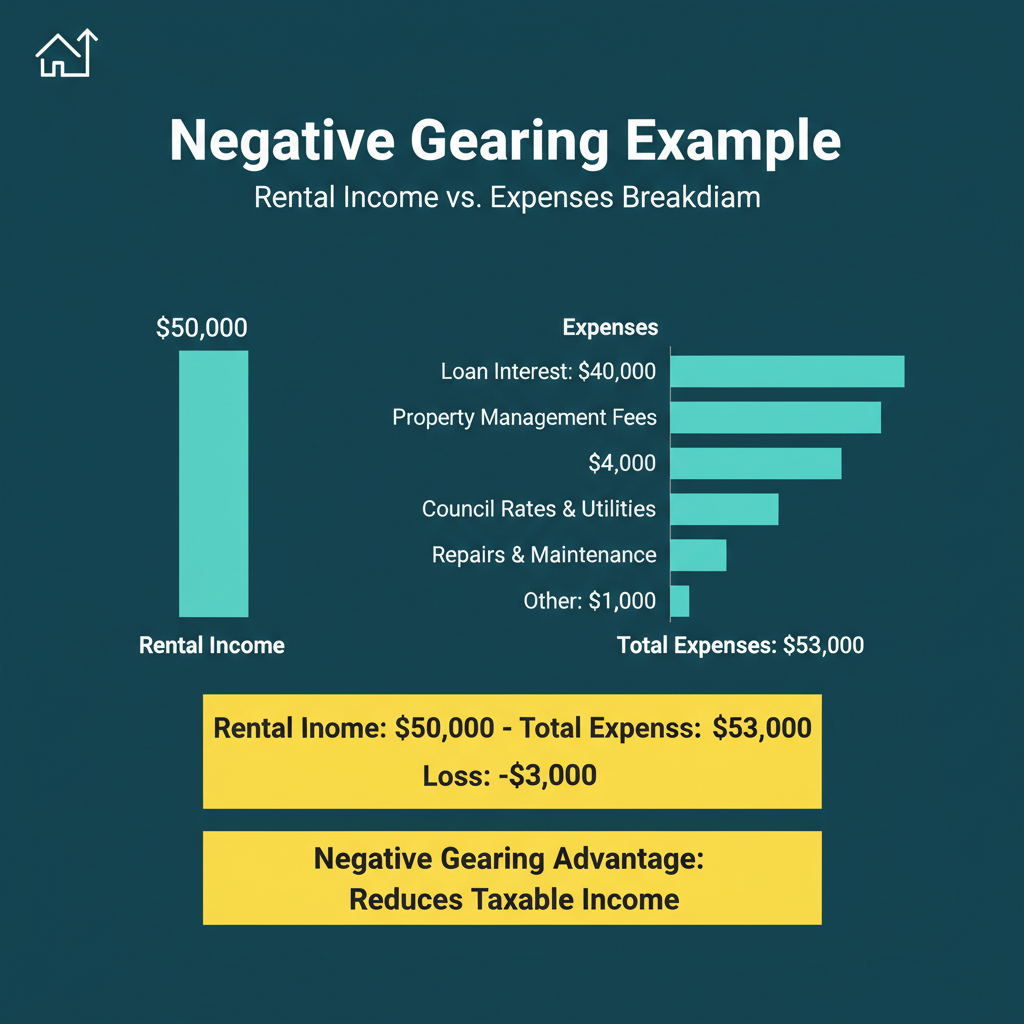
Negative gearing happens when you borrow money to buy an investment property and the cost of owning it outweighs the rental income it produces. Think mortgage interest, insurance, property management fees, repairs, and council rates.
When your deductible expenses exceed your rental income, you're left with a net rental loss. The Australian tax system allows you to offset this loss against other income sources like your salary, effectively lowering your taxable income.
Here's a simple example. You purchase a $600,000 investment property with a $480,000 loan at 6.5% interest. Your annual interest bill is $31,200. Add another $8,000 for rates, insurance, maintenance, and property management, and your total annual expenses hit $39,200. But your rental income is only $28,000.
You're losing $11,200 per year. If you're in the 37% tax bracket (including the Medicare Levy), that $11,200 loss saves you roughly $4,144 in tax. You're still out of pocket $7,056, but the tax relief softens the blow while you wait for the property to appreciate.
Why Investors Choose Negative Gearing
Investors don't chase losses for fun. Negative gearing is a calculated bet on future capital growth. The strategy assumes that over 7 to 10 years, the property's value will rise enough to offset the accumulated cash flow losses.
According to CoreLogic, national median dwelling values grew 6.3% in the 12 months to March 2026, with Brisbane and Perth leading at 8.1% and 7.4% respectively. That kind of compounding growth can turn a negatively geared asset into a profitable exit.
But here's the catch: negative gearing only works if three conditions hold. First, property values must appreciate. Second, you need stable income to cover the shortfall. Third, tax laws must remain favorable. In 2026, all three are under pressure.
The Australian Tax Treatment of Negative Gearing
Australia's tax system treats negative gearing generously compared to most OECD countries. According to the Australian Treasury, investors can deduct rental losses against any form of income, not just property income.
This is different from the UK, where rental losses can only offset future rental profits. It's also more generous than the US, where loss deductions are capped based on income and active participation.
The Australian Taxation Office (ATO) confirms that eligible deductions include loan interest, repairs and maintenance, property management fees, insurance, and depreciation. Capital expenses like renovations must be depreciated over time, not claimed immediately.
For high-income earners in the top tax bracket (47% including Medicare Levy), every dollar of rental loss generates 47 cents in tax savings. For doctors, IT professionals, and business owners, this makes negative gearing a powerful tool for wealth accumulation.
The 2026 Policy Debate: What's Changing?
Proposed Caps on Negative Gearing
Treasurer Jim Chalmers confirmed in early 2026 that the government is modelling targeted reforms to negative gearing ahead of the May budget. Rather than scrapping the policy entirely, Treasury is considering a cap that would limit negative gearing deductions to a maximum of two investment properties per person.
The Grattan Institute estimates that reducing the capital gains tax discount from 50% to 33% and capping negative gearing could save the federal budget billions annually. The Parliamentary Budget Office confirms this revenue windfall could exceed $10 billion over the next decade.
Supporters argue the current system favors wealthy multi-property investors over first-home buyers. Critics, including the Property Council of Australia, warn that reducing tax incentives could push investors to raise rents or exit the market, worsening rental supply.
How the Proposed Changes Could Impact Investors
If the two-property cap becomes law, investors with three or more properties would lose the ability to offset losses from properties three, four, and beyond. This doesn't mean you can't own more than two properties. It means you can't claim tax deductions on rental losses beyond your first two.
For portfolio builders, this changes the math. Suddenly, positive cash flow and capital growth take priority over tax minimization. Investors will need to target high-yield suburbs, renovate for better rents, or shift strategies entirely.
At Buyers Agency Australia, founder Dragan Dimovski has spent 20+ years helping investors navigate policy shifts like this. His advice? Don't rely on tax breaks alone. Build portfolios that work with or without negative gearing, focusing on long-term fundamentals like location, infrastructure, and rental demand.
Capital Gains Tax Discount Under Review
The second reform under consideration is a reduction in the capital gains tax (CGT) discount. Currently, if you hold an investment property for more than 12 months, you pay CGT on only 50% of the capital gain. The government is exploring a reduction to 33%.
This matters because capital growth is the endgame for negative gearing. If you sell a property for a $200,000 profit after 10 years, today you'd pay CGT on $100,000. Under the proposed 33% discount, you'd pay CGT on $134,000, a significant hit.
For investors in the 47% tax bracket, that's an extra $15,980 in tax on a $200,000 gain. It doesn't kill the strategy, but it tightens margins and makes property selection even more critical.
The Real Risks of Negative Gearing in 2026
Cash Flow Pressure and Interest Rate Risk
Negative gearing demands stable income. If you lose your job, face unexpected repairs, or can't find a tenant, the shortfall becomes a serious problem. In 2026, with interest rates sitting around 3.85% (down from a 2023 peak of 4.35%), many investors are still carrying loans at elevated rates.
A 1% rate increase on a $500,000 loan adds $5,000 per year in interest. That's an extra $416 per month you need to cover. If your property is already negatively geared by $10,000 annually, a rate hike pushes your out-of-pocket loss to $15,000.
According to Westpac, negatively geared properties carry additional cash flow risk because investors must regularly cover the shortfall. Unexpected vacancies, maintenance costs, or market downturns can quickly turn a manageable loss into financial stress.
Property Value Stagnation and Market Volatility
Negative gearing only works if the property appreciates. If values stagnate or fall, you're left holding a loss-making asset with no exit strategy. Between 2017 and 2019, when Labor floated similar reforms, property prices in Sydney and Melbourne fell by 11.5%, according to the Grattan Institute.
That kind of correction can wipe out years of capital growth. If you bought at the peak in 2022 and values haven't recovered, you're underwater. Selling means crystallizing a loss. Holding means bleeding cash.
This is why Buyers Agency Australia focuses on buying below market value in high-growth corridors. Dragan's team uses data from CoreLogic, SQM Research, and boots-on-the-ground intel to identify suburbs with strong fundamentals, infrastructure investment, and supply constraints.
Tax Law Changes and Policy Uncertainty
Governments can and do change tax rules. If the two-property cap becomes law, investors with larger portfolios face a sudden reduction in deductions. If negative gearing is abolished entirely (as New Zealand did in 2021 before reversing it in 2023), the entire strategy collapses.
Policy risk is real. Smart investors don't build portfolios that depend on a single tax break. They diversify income sources, target high-yield assets, and structure ownership (trusts, companies, personal names) to maximize flexibility.
Who Benefits Most from Negative Gearing?
High-Income Earners in Top Tax Brackets
Negative gearing delivers the biggest tax savings to high-income earners. If you're in the 47% tax bracket, every dollar of rental loss saves you 47 cents. If you're in the 32.5% bracket, the same loss saves only 32.5 cents.
According to ATO data, approximately 1.3 million Australian taxpayers claimed a net rental loss in 2022-23, collectively deducting over $10.2 billion. However, nearly 70% of negatively geared investors earn less than $80,000 per year, according to the Australian Treasury.
This challenges the narrative that negative gearing only benefits the wealthy. Teachers, nurses, and tradespeople use the strategy to enter the market and build retirement wealth. But the largest dollar benefits still accrue to top earners who can absorb cash flow losses and hold assets long-term.
Investors with Stable, Predictable Income
Negative gearing suits investors with reliable salaries, low debt, and financial buffers. Doctors, IT professionals, and business owners with consistent income can weather short-term losses while waiting for capital growth.
It's a terrible strategy for those with irregular income, high debt, or tight cash flow. If you can't cover the shortfall for 5 to 10 years, don't negatively gear.
Portfolio Builders Targeting Long-Term Wealth
Negative gearing is a long game. You're trading short-term cash flow for long-term equity. Over 10 years, a $600,000 property growing at 6% per year becomes a $1.07 million asset. That $470,000 gain (minus CGT) can more than offset a decade of $10,000 annual losses.
But you need patience, discipline, and the right property. Buyers Agency Australia helps investors build 5 to 10-year roadmaps, modeling tax benefits, cash flow, and exit strategies to ensure every purchase aligns with long-term goals.
Alternatives to Negative Gearing: Positive and Neutral Gearing Explained
Positive Gearing: Immediate Cash Flow
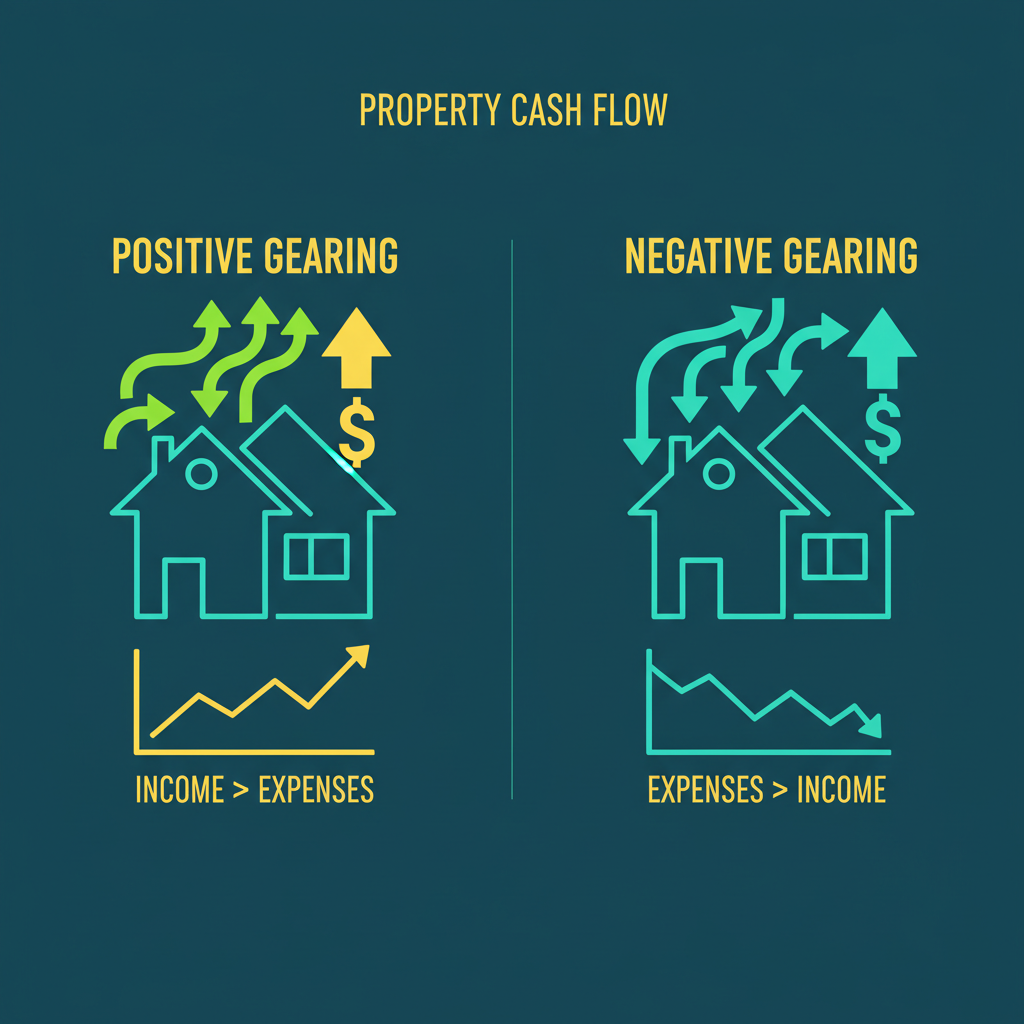
Positive gearing occurs when rental income exceeds all property expenses, including loan interest. You're making money from day one. The downside? You pay tax on the surplus income, and positively geared properties often sit in lower-growth regional areas.
For retirees or investors seeking passive income, positive gearing is ideal. For wealth-builders chasing capital growth, it's less attractive.
Neutral Gearing: Breaking Even
Neutral gearing is the sweet spot where rental income exactly matches expenses. You're not losing money, but you're not making money either. The property holds itself while appreciating.
Neutral gearing is rare in 2026 due to high interest rates. But as rates fall and rents rise, many negatively geared properties naturally transition to neutral or positive over time.
Blended Portfolio Strategies
Smart investors don't put all their eggs in one basket. They blend negatively geared growth assets (Sydney, Melbourne) with positively geared cash flow properties (regional Queensland, Perth). This balances tax benefits, cash flow, and capital growth.
Dragan Dimovski's 10-year portfolio modeling at Buyers Agency Australia helps investors map out these blended strategies, ensuring financial sustainability and long-term wealth creation.
How Buyers Agency Australia Helps Investors Navigate Negative Gearing

Data-Driven Property Selection for Tax Efficiency
Not all negatively geared properties are created equal. Buying a high-maintenance apartment in an oversupplied market is a recipe for disaster. Buying a well-located house in a gentrifying suburb with infrastructure investment is a wealth-building machine.
Buyers Agency Australia uses CoreLogic, SQM Research, and 20+ years of market intel to identify properties with strong rental demand, low vacancy rates, and capital growth potential. The goal isn't just to negatively gear. It's to negatively gear the right asset in the right market at the right price.
Fixed-Fee Transparency in a Commission-Driven Industry
Traditional buyers agents charge 2% to 3% of the purchase price. On a $600,000 property, that's $12,000 to $18,000. Buyers Agency Australia operates on a fixed-fee model, eliminating conflicts of interest and ensuring every recommendation is about your outcome, not their commission.
This matters when buying negatively geared properties. You need an advocate who'll walk away from a bad deal, not someone incentivized to close at any cost.
10-Year Portfolio Modeling and Tax Strategy
Buyers Agency Australia doesn't just find properties. They build portfolios. Using 10-year modeling, they forecast rental income, capital growth, tax deductions, and exit strategies. This lets you see exactly how negative gearing fits into your wealth plan.
For investors worried about 2026 policy changes, this modeling is critical. It shows how your portfolio performs with or without negative gearing, giving you confidence to buy now or wait.
Practical Tips for Using Negative Gearing Strategically in 2026
Only Negatively Gear If You Can Cover the Shortfall
This sounds obvious, but it's the most common mistake. If a $10,000 annual loss will strain your budget, don't do it. Build a 12-month cash buffer before buying.
Target High-Growth Locations with Strong Fundamentals
Negative gearing only works if the property appreciates. Focus on suburbs with infrastructure investment, population growth, and constrained supply. Avoid oversupplied apartment markets and speculative regional towns.
Claim Every Eligible Deduction
The ATO allows deductions for loan interest, repairs, property management, insurance, council rates, and depreciation. Miss one, and you're leaving money on the table. Work with a property-savvy accountant to maximize claims.
Structure Ownership for Flexibility
Buying in personal names, trusts, or companies each have tax implications. Trusts can distribute income to lower-earning family members. Personal names qualify for the 50% CGT discount. Companies pay flat 30% tax but don't get the CGT discount. Structure matters.
Review Your Portfolio Annually
Markets change. Interest rates move. Policy shifts. Review your portfolio every 12 months to ensure negative gearing still makes sense. If cash flow pressure is mounting, consider selling underperforming assets or refinancing to lower rates.
Don't Rely on Negative Gearing Alone
Build portfolios that work with or without tax breaks. Focus on rental yield, capital growth, and asset quality. If negative gearing is abolished tomorrow, your investments should still make sense.
Frequently Asked Questions About Negative Gearing
What is negative gearing in simple terms?
Negative gearing means your investment property costs more to own than it earns in rent, and you can deduct that loss against your taxable income.
Is negative gearing still worth it in 2026?
Yes, if you're a high-income earner with stable cash flow, buying in high-growth locations, and prepared to hold long-term. Policy changes may tighten benefits.
Can I claim negative gearing on my first investment property?
Yes. There's no minimum number of properties required. If your first property is negatively geared, you can claim the loss against your income.
What happens if negative gearing is abolished?
You'd lose the ability to offset rental losses against other income. Properties would need to be positively or neutrally geared to remain viable for most investors.
How do I calculate negative gearing?
Subtract all deductible expenses (interest, rates, insurance, management, repairs) from rental income. If the result is negative, that's your deductible loss.
Final Thoughts: Making Negative Gearing Work in 2026
Negative gearing isn't dead, but it's evolving. With 2026 policy reforms looming, investors need to be smarter, more strategic, and more disciplined than ever. The days of buying any property and banking on tax breaks are over.
The winners in 2026 will be investors who focus on fundamentals: location, rental demand, capital growth, and asset quality. They'll work with experts like Buyers Agency Australia to build portfolios that deliver long-term wealth, with or without negative gearing.
If you're ready to build a tax-efficient, future-proof property portfolio, book a free strategy session with Buyers Agency Australia today. Let's turn market uncertainty into opportunity.