Positive cash flow property in Australia is an investment where annual rental income exceeds all ownership costs including mortgage, rates, and expenses after tax deductions, creating weekly passive income instead of draining your household budget.
We’ve all been frustrated watching property prices climb while rental yields shrink. Most investors accept negative gearing as the cost of entry, tipping in $200 to $500 every month just to hold an asset.
But here’s what the data shows: properties delivering 5% to 8% yields exist right now across Brisbane, Perth, Adelaide, and regional centres. The investors finding them aren’t chasing mining towns or taking wild risks. They’re using proven strategies like co-living conversions, granny flat additions, and dual occupancy builds that turn standard homes into multi-income assets. Buyers Agency Australia helps investors nationwide source these opportunities through data-driven market analysis and 20+ years of boots-on-the-ground experience.
What Positive Cash Flow Property Actually Means
Let’s cut through the confusion. Positive cash flow means the property puts money in your pocket every week, not the other way around.
The Real Definition vs Marketing Hype
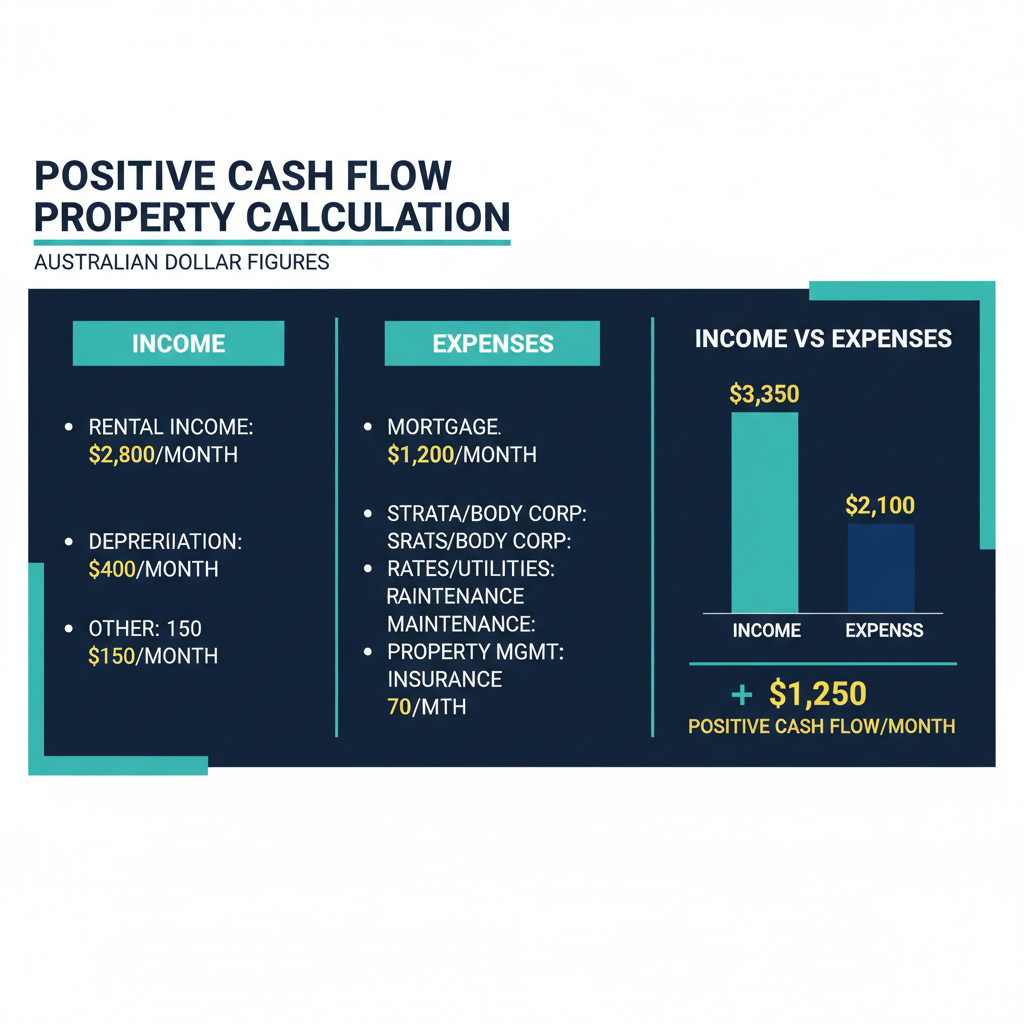
A genuine positive cash flow property generates annual rent that covers your loan interest, council rates, insurance, maintenance, property management, and still leaves surplus income. After you claim depreciation and tax deductions, you’re ahead financially.
Most properties marketed as “positive cash flow” fail this test. They might be positively geared (rental income covers the mortgage payment) but ignore the $4,000 annual rates bill, the $2,500 insurance premium, and the $1,800 agent fees.
You need to run the full numbers before signing anything.
How Interest Rates Change the Equation
In 2024, interest rates sitting at 6.5% to 7% made positive cash flow harder to achieve than the 2020-2021 period when rates hovered near 2%.
Here’s the maths: a $500,000 property renting for $600 per week ($31,200 annually) with a $400,000 loan at 6.8% generates $27,200 in annual interest alone. Add $5,000 in other costs and you’re $1,000 negative before depreciation.
The same property at 3% interest? You’d be $10,000 ahead annually.
This is why strategies that boost rental income (co-living, granny flats, dual occupancy) matter more now than they did four years ago. You can’t rely on cheap debt to make the numbers work.
Capital Growth vs Cash Flow
Property investors face a persistent trade-off. High capital growth markets (Sydney, inner Melbourne) typically deliver 2.5% to 3.5% rental yields. High cash flow markets (regional Queensland, mining towns, converted multi-tenant properties) deliver 6% to 12% yields but slower price appreciation.
The smart play? Build a portfolio that includes both.
Use cash flow properties to fund serviceability for your next purchase. Use capital growth properties to build equity you can access for renovations or conversions that boost yield.
Dragan Dimovski built a $10M+ portfolio using this exact approach – buying growth assets in Brisbane and Sydney while converting underperforming properties into high-yield co-living and dual occupancy investments.
Why Standard Investment Properties Drain Your Cash
Most Australians never buy a second investment property. They purchase one, watch it cost them $300+ monthly, and decide property investing isn’t worth the stress.
Here’s what’s actually happening.
The Hidden Costs Nobody Warns You About
Your property manager quotes “8% to 10% of rent plus GST.” That sounds reasonable until you calculate the real number.
$500 weekly rent equals $26,000 annually. At 8.8% (8% + GST), that’s $2,288 in management fees. Add council rates ($2,200), water rates ($800), insurance ($1,400), repairs and maintenance ($1,500 conservative estimate), and you’re paying $8,188 annually in non-mortgage costs.
That’s $157 per week before you’ve paid a cent of interest or principal.
If your loan is $400,000 at 6.8%, you’re paying $520 weekly in interest. Total weekly cost: $677. Your $500 rent covers 74% of expenses.
You’re tipping in $177 weekly or $9,204 annually.
Most investors underestimate these figures by 30% to 40% because they forget to include vacancy periods, letting fees when tenants change, or one-off repairs like a broken hot water system.
Vacancy Periods That Kill Returns
The Australian average vacancy rate in 2025 sits around 1.2% to 1.5% nationally according to SQM Research. That sounds tight, but vacancy rates tell you market conditions, not your individual property’s performance.
Your property will sit empty during tenant transitions. Budget for two to three weeks annually in strong markets, four to six weeks in softer markets.
Three weeks empty on a $500 weekly property costs you $1,500 in lost rent plus re-letting fees (typically one week’s rent) for a $2,000 total hit.
If you’re already negative $9,000 annually, that vacant period pushes your loss to $11,000.
Why 70% of Investors Never Buy Property Two
Banks assess your borrowing capacity on your current income minus your current expenses. When your investment property costs $9,000 annually to hold, that’s $173 weekly the bank deducts from your serviceability.
To borrow another $400,000, you need to demonstrate you can service an additional $520 weekly in interest. Your income needs to cover $693 weekly ($520 new interest + $173 existing shortfall) plus your personal living expenses.
For someone earning $100,000, that’s extremely difficult once you factor in personal loan repayments, credit cards, or family expenses.
Positive cash flow properties solve this problem because they add income to your serviceability instead of subtracting it.
7 Strategies to Create Positive Cash Flow
Let’s get practical. These strategies work in 2026 and they’re backed by current rental data.
Strategy 1: Co-Living Property Conversions
Co-living properties deliver 10% to 15% rental yields in the right locations by leasing individual rooms instead of the entire dwelling.
Here’s how it works: A standard three-bedroom house in regional Victoria rents for $350 to $400 weekly. Convert that same property into a purpose-built co-living home with three fully self-contained rooms (each with ensuite, kitchenette, and private access) and you can charge $200 to $250 per room.
Three tenants at $225 weekly equals $675 total weekly rent – a 70% income increase on the same property.
The conversion typically costs $80,000 to $120,000 depending on the existing layout. You need council approval, Class 1B certification in most states, and specialist property managers who understand multi-tenant coordination.
Buyers Agency Australia works with clients nationwide to identify properties suitable for co-living conversion, particularly in growth corridors around Melbourne, Adelaide, and Perth where demand from young professionals, students, and essential workers remains strong.
Where Co-Living Works Best
Not every property suits co-living. You need:
- Block size of 500m² minimum for adequate parking and outdoor space
- Location within 5km to 10km of universities, hospitals, or major employment centres
- Council zoning that permits rooming accommodation or multi-tenant dwellings
- Floor plan that allows three to five separate rooms without compromising communal areas
Geelong, Ballarat, and outer Melbourne suburbs like Werribee and Cranbourne deliver strong co-living returns. Brisbane’s outer suburbs and Adelaide’s northern growth corridor also show solid demand.
The Risks and How to Manage Them
Co-living carries operational complexity. You’re managing multiple tenancies, coordinating move-ins and move-outs, and ensuring communal areas stay clean and functional.
Partner with property managers who specialise in co-living. The best maintain 98%+ occupancy rates and can place new tenants within 24 to 48 hours when a room becomes vacant.
Don’t attempt co-living without proper certification. Properties operating as rooming houses without Class 1B approval face fines exceeding $125,000 and potential jail time in some jurisdictions.
Strategy 2: Granny Flat Construction for Dual Income
Granny flats offer one of the fastest paths to positive cash flow by adding a second dwelling to your existing property.
Rental income ranges from $350 to $600 weekly depending on location and quality. In Sydney’s western suburbs, a well-designed two-bedroom granny flat can achieve $450 to $500 weekly. Perth granny flats in established suburbs rent for $400 to $600 weekly according to recent REIWA data.
Construction costs sit between $120,000 and $200,000 for a compliant 60m² dwelling, with timelines of 12 to 20 weeks from approval to completion.
The return on investment calculation looks like this: $150,000 construction cost generating $450 weekly rent equals $23,400 annually. After management fees, rates, and insurance (approximately $4,000), you’re netting $19,400 – a 12.9% cash-on-cash return.
State-by-State Size Limits
Regulations vary significantly:
- NSW and Victoria: Maximum 60m² floor area
- Western Australia and South Australia: Up to 70m²
- Tasmania and Northern Territory: Maximum 80m²
- Queensland: 60m² under Complying Development, larger sizes require Development Application
Check with your local council before planning. Some councils impose additional setback requirements, parking mandates, or heritage overlays that restrict development.
Best Suburbs for Granny Flat ROI
Look for suburbs where:
- Main house values sit between $600,000 and $900,000 (you need equity to fund construction)
- Rental demand remains strong with vacancy rates below 2%
- Median rents for granny flats exceed $400 weekly
- Council approval processes are streamlined
Sydney’s western suburbs (Blacktown, Mount Druitt, Campbelltown) and Brisbane’s northern growth corridor (Caboolture, Morayfield, Narangba) tick these boxes.
Strategy 3: Dual Occupancy
Dual occupancy properties place two separate dwellings on one title, generating two rental incomes while avoiding subdivision costs and body corporate fees.
Modern dual occupancy designs feature a main three-bedroom house alongside a two-bedroom secondary unit. Total construction costs range from $600,000 to $900,000 on suitable land.
The rental equation works like this:
- Main dwelling: $550 weekly
- Secondary dwelling: $450 weekly
- Combined income: $1,000 weekly or $52,000 annually
With total acquisition and construction costs of $850,000 and an 80% LVR loan ($680,000 at 6.8% interest), you’re paying $888 weekly in interest. Add $200 weekly in non-mortgage costs and your total outgoings are $1,088 weekly.
The numbers are tight, but depreciation and tax deductions typically push you into positive territory by year two or three.
Where to Build Dual Occupancy
Target growth corridors where:
- Land costs remain under $400,000 for blocks between 600m² and 800m²
- Council zoning explicitly permits dual occupancy
- Infrastructure investment is driving population growth
- Rental demand supports two separate tenancies
Melbourne’s outer west (Wyndham Vale, Tarneit), Brisbane’s south (Logan, Beenleigh), and Perth’s northern suburbs (Baldivis, Byford) offer strong opportunities.
Buyers Agency Australia maintains relationships with builders specialising in dual occupancy construction and can negotiate fixed-price contracts that protect you from cost blowouts.
Strategy 4: Regional High-Yield
Regional markets deliver rental yields of 5% to 8%+ without requiring property modifications.
According to CoreLogic data, Western Australia dominates high-yield rankings. Mining towns like Pegs Creek, Baynton, and Newman show yields above 9% to 12%. Queensland regional centres including Dysart, Moranbah, and Gladstone deliver 8% to 11% yields.
These returns come with trade-offs. Mining towns experience cyclical demand tied to commodity prices. When iron ore or coal prices drop, rental demand falls and vacancy periods extend.
Balancing Yield with Capital Growth
Don’t build a portfolio entirely in high-yield regional markets. Use them strategically to boost serviceability while maintaining exposure to capital growth markets.
A balanced portfolio might include:
- 40% in capital growth markets (Brisbane, Adelaide, Perth metro)
- 40% in moderate-yield regional centres (Geelong, Toowoomba, Ballarat)
- 20% in high-yield but higher-risk markets (mining towns, remote regional)
This structure gives you income to fund acquisitions while building long-term equity.
Due Diligence for Regional Properties
Before buying regional, verify:
- Local employment diversity (avoid single-industry towns)
- Population trends over the past five years
- Infrastructure projects planned or underway
- Vacancy rates and median rent levels
- Historical property price movements
Sources like SQM Research and Domain rental reports provide suburb-level data. Buyers Agency Australia conducts on-ground inspections to verify property condition and rental potential before recommending regional acquisitions.
Strategy 5: Dual Key Investment Properties
Dual key properties feature two self-contained residences under one roof on a single title. Unlike duplexes (which can be sold separately), both dwellings remain together.
A typical layout includes a three-bedroom main residence and a one-bedroom studio, each with separate entrances, kitchens, and bathrooms.
Rental income potential:
- Main residence: $500 to $550 weekly
- Studio: $350 to $400 weekly
- Combined: $850 to $950 weekly
Purchase prices in growth corridors range from $650,000 to $850,000. With an 80% loan ($680,000 at 6.8%), weekly interest costs sit at $888. Combined with $180 weekly in other expenses, you’re cash flow neutral or slightly positive from day one.
The major advantage? You’re paying one set of council rates, one insurance premium, and managing one property title.
Depreciation Benefits
Dual key properties attract significant depreciation deductions because they contain two kitchens, two bathrooms, and duplicate fixtures and fittings.
Annual depreciation typically ranges from $12,000 to $18,000 in the first decade, creating tax refunds of $4,000 to $7,000 annually for investors in the 37% tax bracket.
Work with quantity surveyors like BMT Tax Depreciation to maximise your deductions.
Resale Considerations
Dual key properties appeal primarily to investors, not owner-occupiers. With Australia’s owner-occupier rate at 67%, you’re marketing to a smaller buyer pool at resale.
This can limit capital growth compared to traditional family homes. Balance this risk by ensuring the property sits in an area with strong rental fundamentals and infrastructure growth.
Strategy 6: Off-Market Opportunities
Off-market properties aren’t advertised publicly. They’re sold through agent networks, buyer’s agents, or direct vendor approaches before hitting Domain or realestate.com.au.
Why does this matter for cash flow? Off-market deals typically sell 5% to 10% below market value. That discount improves your yield calculation immediately.
Example: A property worth $550,000 purchased for $500,000 and renting for $450 weekly shows a 4.69% yield on market value but a 4.68% yield on purchase price. Over time, that $50,000 equity buffer provides refinancing capacity or renovation funds to boost income further.
Buyers Agency Australia accesses off-market listings across Brisbane, Sydney, Melbourne, Perth, and Adelaide through established relationships with agents and developers. Many sellers prefer off-market to avoid public auction pressure or lengthy marketing campaigns.
How to Access Off-Market Deals
Three pathways exist:
- Engage a buyer’s agent with strong networks and track record. They see opportunities before they’re listed.
- Build relationships with local agents in your target suburbs. Let them know your criteria and budget.
- Direct mail campaigns to property owners in target streets, though this requires time and persistence.
The first option delivers the fastest results if you’re time-poor or investing interstate.
Strategy 7: Renovate to Increase Rental Income
A strategic renovation can boost weekly rent by $50 to $150, dramatically improving cash flow without buying additional property.
High-impact renovations include:
- Kitchen and bathroom updates: Replacing dated cabinetry, benchtops, and fixtures can add $40 to $80 weekly rent
- Additional bedroom: Converting large living areas or garages into compliant bedrooms adds $60 to $100 weekly
- Outdoor entertaining areas: Decking, pergolas, and landscaping can add $30 to $50 weekly in family-focused suburbs
- Split-system air conditioning: Essential in Brisbane, Perth, and Adelaide – adds $20 to $40 weekly
Renovation costs range from $30,000 to $80,000 for comprehensive updates. The yield improvement often justifies the investment within three to five years.
Renovation ROI Calculation
A $50,000 renovation that increases rent by $75 weekly ($3,900 annually) delivers a 7.8% return on the renovation capital. Combined with existing cash flow, this can turn neutral or negative properties into positive performers.
Always obtain rental appraisals from three property managers before committing to renovation. They’ll tell you which improvements matter in your specific suburb and which don’t justify the cost.
How Dragan Dimovski Identifies Cash Flow Opportunities

Buyers Agency Australia uses a systematic approach to source positive cash flow properties that most investors never see.
The 118-Point Property Analysis System
Every potential acquisition undergoes detailed evaluation across:
- Economic drivers: Employment diversity, population growth, infrastructure investment
- Supply and demand: Vacancy rates, days on market, rental listing volumes
- Property-specific factors: Land size, floor plan, renovation potential, council zoning
- Financial modelling: Cash flow projections across multiple interest rate scenarios
This process filters out approximately 85% of opportunities, leaving only properties with genuine positive cash flow potential and acceptable long-term growth prospects.
Boots on the Ground Verification
Data analysis identifies candidates. On-ground inspection confirms whether they’re actually worth buying.
Dragan personally inspects properties in target markets, assessing:
- Street appeal and neighbourhood quality
- Property condition and immediate maintenance requirements
- Tenant appeal (would quality renters choose this property?)
- Comparable rental evidence from nearby properties
This combination of data and local knowledge prevents costly mistakes like buying in areas where high yields reflect underlying risk rather than genuine opportunity.
Negotiation That Protects Your Position
Buyers Agency Australia negotiates fixed-price contracts for new builds and achieves purchase prices 3% to 8% below asking price on established properties.
Those savings compound over time. A $30,000 discount on a $550,000 property is $30,000 you didn’t need to borrow, saving $2,040 annually in interest at 6.8%.
Across a 10-property portfolio, that’s $20,400 annually in interest saved – money that can fund your next deposit or boost cash flow.
Ongoing Portfolio Strategy
Property investing isn’t a one-time transaction. It’s a decade-long wealth-building strategy requiring regular reviews and adjustments.
Buyers Agency Australia clients receive:
- Annual portfolio reviews assessing performance against objectives
- Refinancing strategies to access equity for next purchases
- Renovation recommendations to boost yield on existing holdings
- Market updates on emerging opportunities in target locations
This ongoing support ensures your portfolio adapts as your financial situation evolves and market conditions change.
Where to Find Positive Cash Flow Properties in 2026
Brisbane and South East Queensland
Brisbane’s outer suburbs and regional centres offer strong cash flow potential:
- Logan and Beenleigh: Median house prices $550,000 to $650,000, rents $450 to $550 weekly, yields 4% to 4.5%
- Caboolture and Morayfield: Strong rental demand from young families, yields 4.5% to 5%
- Toowoomba: Regional centre with economic diversity, yields 5% to 6% on houses under $500,000
Dual occupancy and granny flat strategies work exceptionally well in these markets due to streamlined council approvals and strong tenant demand.
Perth and Regional WA
Western Australia dominates high-yield rankings:
- Baldivis and Byford: Growth corridors south of Perth, yields 4.5% to 5.5%
- Mandurah: Established regional city, strong retiree and family demand, yields 5% to 6%
- Mining towns (higher risk): Pegs Creek, Baynton, Newman showing yields 9% to 12%
Perth’s rental market tightened significantly in 2024-2025 as interstate migration increased and construction slowed. This created strong yield opportunities across metro and regional locations.
Adelaide Growth Corridors
Adelaide offers Australia’s most affordable capital city entry point with improving yields:
- Munno Para and Smithfield: Northern growth corridor, median prices $450,000 to $550,000, yields 4.5% to 5%
- Mount Barker: Hills location with lifestyle appeal, yields 5% to 5.5%
- Port Adelaide: Gentrifying inner suburb, yields 4% to 5% with capital growth potential
Co-living conversions perform well in Adelaide’s northern suburbs where demand from healthcare workers and university students remains strong.
Regional Victoria and NSW
Selective regional markets offer cash flow without extreme remoteness:
- Geelong (VIC): Second-largest Victorian city, yields 4% to 5% on houses, 6% to 7% on units
- Ballarat (VIC): University and healthcare employment, yields 5% to 6%
- Tamworth (NSW): Regional centre with economic diversity, yields 5.5% to 6.5%
These locations balance yield with capital city proximity (60 to 120 minutes drive) and employment diversity that reduces single-industry risk.
Taking Action: Your Next Steps
Knowledge without execution doesn’t build wealth. Here’s how to start.
Step 1: Clarify Your Investment Goals
Be specific about what you’re trying to achieve:
- How many properties do you want to own?
- What annual passive income target are you working toward?
- What timeline are you working with (5 years, 10 years, retirement date)?
- How hands-on do you want to be with property management?
Answers to these questions determine whether co-living conversions (higher involvement, higher returns) or turnkey granny flat packages (lower involvement, moderate returns) suit you better.
Step 2: Assess Your Financial Position
Before property shopping, know your borrowing capacity:
- Total household income after tax
- Existing debts (home loan, car loans, credit cards)
- Available deposit and costs capital (20% deposit plus 5% to 7% costs)
- Current property equity if you already own
Most investors can borrow 5 to 6 times their net household income. A couple earning $180,000 combined can typically borrow $900,000 to $1,080,000 depending on existing debts and living expenses.
Step 3: Choose Your Strategy
Based on your goals and capacity, select 1-2 strategies to focus on:
- New investors with owner-occupied property: Start with granny flat construction on your existing land
- Investors with equity but limited time: Off-market established properties in high-yield regional centres
- Experienced investors seeking maximum yield: Co-living conversions or dual occupancy new builds
Step 4: Engage Professional Support
Successful property investors rarely work alone. Build your team:
- Buyer’s agent: Sources and negotiates acquisitions
- Finance broker: Structures loans for maximum serviceability and tax efficiency
- Accountant: Optimises tax strategies and depreciation claims
- Property manager: Handles tenant placement and ongoing management
Buyers Agency Australia offers end-to-end support or can recommend trusted partners in each category for clients who prefer to manage parts of the process themselves.
Step 5: Start with One Property
Don’t try to build a 10-property portfolio in year one. Buy one property, get it settled and tenanted, learn the process, then move to property two within 12 to 18 months.
This measured approach builds confidence, demonstrates to lenders that you can manage investment properties successfully, and allows you to refine your strategy based on real-world results.
Common Mistakes That Destroy Cash Flow
Avoid these traps that turn promising properties into financial drains.
Buying in Mining Towns Without Exit Strategy
Mining towns deliver spectacular yields during boom periods. Moranbah houses rented for $1,500+ weekly in 2022.
Then commodity prices drop, mines reduce staff, and those same houses sit vacant or rent for $400 weekly.
If you invest in mining-dependent locations, budget for 30% to 50% vacancy assumptions and plan to hold through full mining cycles (typically 7 to 10 years).
Underestimating Renovation Costs
Co-living conversions quoted at $80,000 often finish at $110,000. Granny flats quoted at $140,000 end up costing $165,000.
Contingency buffers of 15% to 20% are essential. If you don’t have this buffer, don’t start the project.
Incomplete renovations that run out of money before finishing cost you rental income while you scramble for additional funding.
Ignoring Council Approval Requirements
Operating rooming houses without proper certification exposes you to:
- Fines exceeding $125,000 in Queensland
- Forced tenant evictions
- Insurance policy voiding
- Difficulty selling the property later
Never skip approval processes to save time or money. The risks far exceed any short-term savings.
Overleveraging Your Portfolio
Positive cash flow properties reduce but don’t eliminate risk. If interest rates rise another 1.5% to 2%, your positive property might become neutral or slightly negative.
Maintain emergency funds covering 6 to 12 months of expenses and avoid borrowing at maximum capacity. Leave buffer room for rate increases, unexpected repairs, or extended vacancy periods.
Frequently Asked Questions
What rental yield is considered positive cash flow in Australia?
Properties yielding 5.5% to 6%+ gross rental return typically achieve positive cash flow after expenses and tax deductions, though the exact threshold depends on your loan size, interest rate, and ownership costs.
Can first home buyers invest in positive cash flow properties?
Yes, but strategy matters. First home buyers can purchase dual occupancy or granny flat properties, live in the main dwelling, and rent the secondary dwelling to offset mortgage costs while accessing first home buyer grants and concessions.
Are granny flats worth building for investment purposes?
Granny flats delivering $400+ weekly rent typically provide 12% to 15% returns on construction costs, making them one of the highest-yield property investments available in 2026 across Perth, Brisbane, Sydney, and Adelaide growth corridors.
How do buyers agents help find positive cash flow properties?
Buyers agents access off-market listings, conduct detailed cash flow analysis across multiple scenarios, negotiate purchase prices 3% to 8% below asking, and verify rental potential through local market knowledge before recommending acquisitions.
What are the risks of co-living property investments?
Co-living requires specialist management, Class 1B certification compliance, higher maintenance costs from multiple tenancies, and operates in a smaller resale market, though these risks are offset by 10% to 15% rental yields in suitable locations.
Start Building Your Positive Cash Flow Portfolio
Positive cash flow property isn’t a myth or marketing fiction. It’s a systematic strategy used by investors who understand that rental income comes from smart property selection, strategic improvements, and local market knowledge.
You don’t need to accept negative gearing as the only path to wealth.
Buyers Agency Australia has helped hundreds of investors across Australia identify and acquire properties that fund their lifestyle instead of draining it. Whether you’re targeting co-living conversions in Melbourne, granny flats in Perth, or high-yield regional properties in Queensland, the team brings 20+ years of experience and a proven track record.
Book your free strategy session to discuss your specific situation and discover which positive cash flow strategies align with your goals. Or contact the team to discuss your investment criteria and timeline. The Passive with Property podcast also features case studies and interviews with investors who’ve successfully built cash flow portfolios – access episodes here.
The properties delivering 6% to 12% yields exist. The question is whether you’ll find them before other investors do.