How to Build a Million Dollar Property Portfolio: The Proven Framework Successful Investors Use
Building a million-dollar property portfolio isn’t about luck or perfect timing. It’s about following a proven framework that combines strategic property selection, compounding growth, equity release, and the right professional team to accelerate wealth creation over 10-20 years.
Most Australians dream of financial freedom through property, but very few understand the exact steps needed to get there. While 71% of Australian property investors never get past their first property, a small group quietly builds portfolios worth millions by following a systematic approach.
The difference isn’t capital, connections, or market timing. It’s having a repeatable framework that turns one property into two, two into four, and eventually creates genuine wealth through strategic compounding.
Why Most Property Investors Never Scale Beyond One Property
Here’s the uncomfortable truth about property investing in Australia.
According to Australian Tax Office data, around 71% of property investors own just one property. Another 19% own two properties, and only 6% ever build a portfolio of three or more investment properties.
Why do so few investors scale successfully?
The answer comes down to three fundamental mistakes. First, they buy emotionally instead of strategically, choosing properties based on personal preference rather than investment fundamentals. Second, they fail to understand how equity works as the fuel for portfolio growth. Third, they operate without a clear 10-20 year framework.
Buyers Agency Australia has spent over 20 years helping investors avoid these pitfalls through data-driven property selection and portfolio modeling.
Property investing is measured in decades, not quarters. The investors who build million-dollar portfolios understand that success comes from patient, strategic execution.
The Real Cost of Waiting
Every year you delay costs thousands in lost compounding.
Consider two investors: Sarah starts at 30 with one $600,000 property growing at 6% annually. Michael waits until 35 to start with the same property and growth rate. By age 60, Sarah’s property is worth $2.44 million. Michael’s property? Just $1.82 million.
That five-year delay costs Michael over $620,000 in wealth. Time in the market always beats timing the market.
The Borrowing Capacity Trap
Most investors hit a wall after their first or second property because they don’t structure their loans correctly from day one.
Banks assess your borrowing capacity based on income, expenses, and existing debt. If your first property generates negative cash flow of $400 per month, that reduces your borrowing power by approximately $100,000 for your next purchase.
Successful portfolio builders focus on properties that move toward positive cash flow within 3-5 years through rental growth. This keeps their borrowing capacity intact for the next acquisition.
The Power of Compounding Growth in Property Investment
Compounding is the single most powerful wealth-building force available to property investors.
Albert Einstein reportedly called compounding the eighth wonder of the world, and for good reason. When applied to property investment, compounding means earning returns on both your original investment and the returns you’ve already earned.
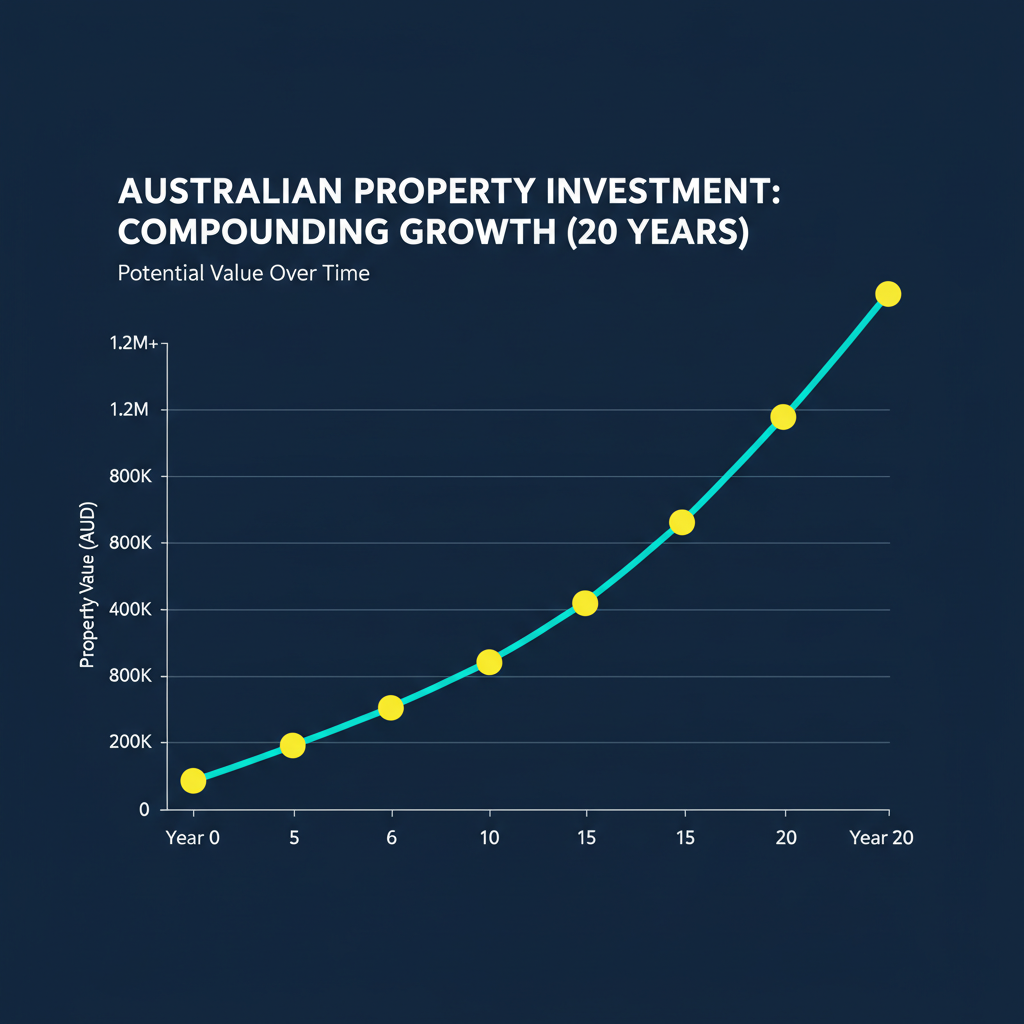
Over the last 40 years, well-located properties in Australian capital cities have delivered more than 7% annual capital growth. At this rate, property values double approximately every 10 years.
Here’s where compounding becomes truly powerful. If you own a $1 million property that grows at 7% annually, it will be worth $2 million after 10 years, generating $1 million in equity growth. But in the second decade, that same 7% growth produces $1.9 million in additional equity, nearly double the first decade’s gains.
The equity created in the later years dwarfs the early years because you’re earning growth on a much larger base.
How Property Compounding Differs From Other Investments
Property investment offers unique advantages that amplify compounding effects.
First, property allows you to use leverage. You can control a $600,000 asset with just $120,000 down (20% deposit). If that property grows 6% annually, you’re earning returns on the full $600,000, not just your $120,000 contribution.
Second, rental income typically grows 3-4% annually, which improves your cash flow over time and supports additional borrowing capacity.
Third, property markets are less volatile than share markets. Over rolling 20-year periods, Australian property has almost always outperformed cash and bonds with lower year-to-year volatility.
The Snowball Effect: Real Numbers
Let’s examine a real-world scenario using conservative growth assumptions.
You purchase a $650,000 property with a $130,000 deposit. Assuming 6% annual growth (below the 7% long-term average), your property will be worth approximately $1.16 million after 10 years.
That’s $510,000 in equity growth from a $130,000 initial investment, representing a 392% return on your deposit over the decade.
Now here’s where compounding accelerates wealth. In years 11-20, that same 6% growth generates an additional $868,000 in equity, bringing the total property value to $2.03 million.
Notice the pattern? The second decade generated 70% more equity growth than the first decade, despite identical growth rates. That’s compounding in action.
Understanding Equity Release as Your Growth Engine
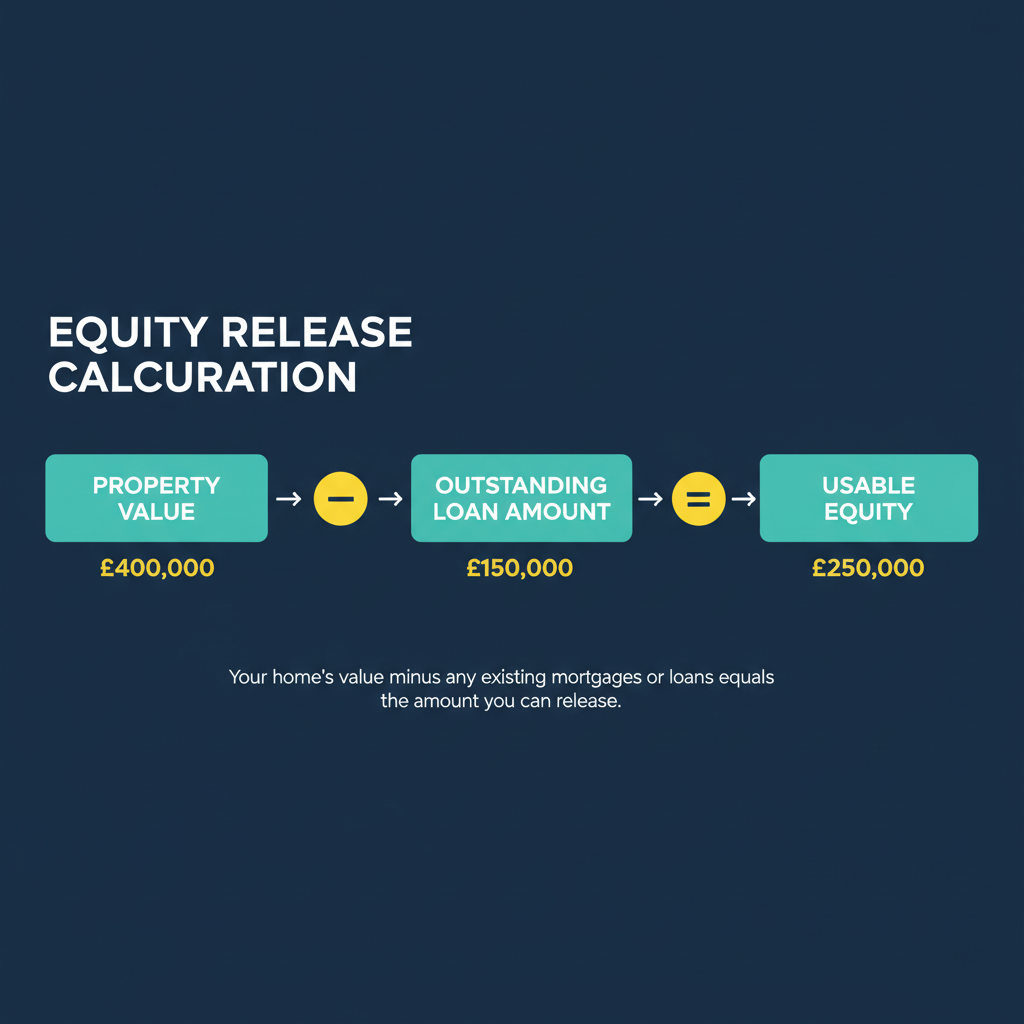
Equity is the difference between your property’s market value and your outstanding mortgage balance.
If your property is worth $800,000 and you owe $500,000, you have $300,000 in equity. But only a portion of that equity can be accessed without selling the property.
Most Australian lenders will allow you to borrow up to 80% of your property’s value. This means if your property is worth $800,000, you can potentially have total lending of $640,000 (80% LVR). If you currently owe $500,000, you could access $140,000 in usable equity.
This usable equity becomes the deposit for your next property purchase, allowing you to scale without needing to save another large deposit from your salary.
The Mechanics of Equity Release
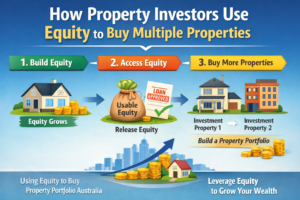
Releasing equity typically involves refinancing your existing property to access the increased value.
Here’s the step-by-step process. First, your lender conducts a property valuation to determine the current market value. Second, they calculate your maximum borrowing capacity at 80% of that value. Third, you refinance to increase your loan to this new level. Fourth, the difference between your old loan and new loan becomes cash you can use as a deposit.
Buyers Agency Australia works with investors to structure equity release strategies that maximize borrowing capacity while maintaining sustainable cash flow across the portfolio.
One critical consideration is serviceability. Banks still assess whether you can service the increased debt based on your income and expenses. This is why choosing properties with strong rental yields and rental growth is essential.
When to Release Equity
Timing matters when accessing equity for your next purchase.
Most successful investors release equity every 3-5 years, giving their properties time to appreciate meaningfully. Releasing equity too frequently can result in high loan-to-value ratios that leave little buffer if markets soften.
The ideal time to release equity is when your property has grown 15-25% in value, your rental income has increased to improve cash flow, and you’ve identified your next strategic purchase.
Patience here separates successful portfolio builders from those who overextend and face financial stress.
The Strategic Framework for Portfolio Building
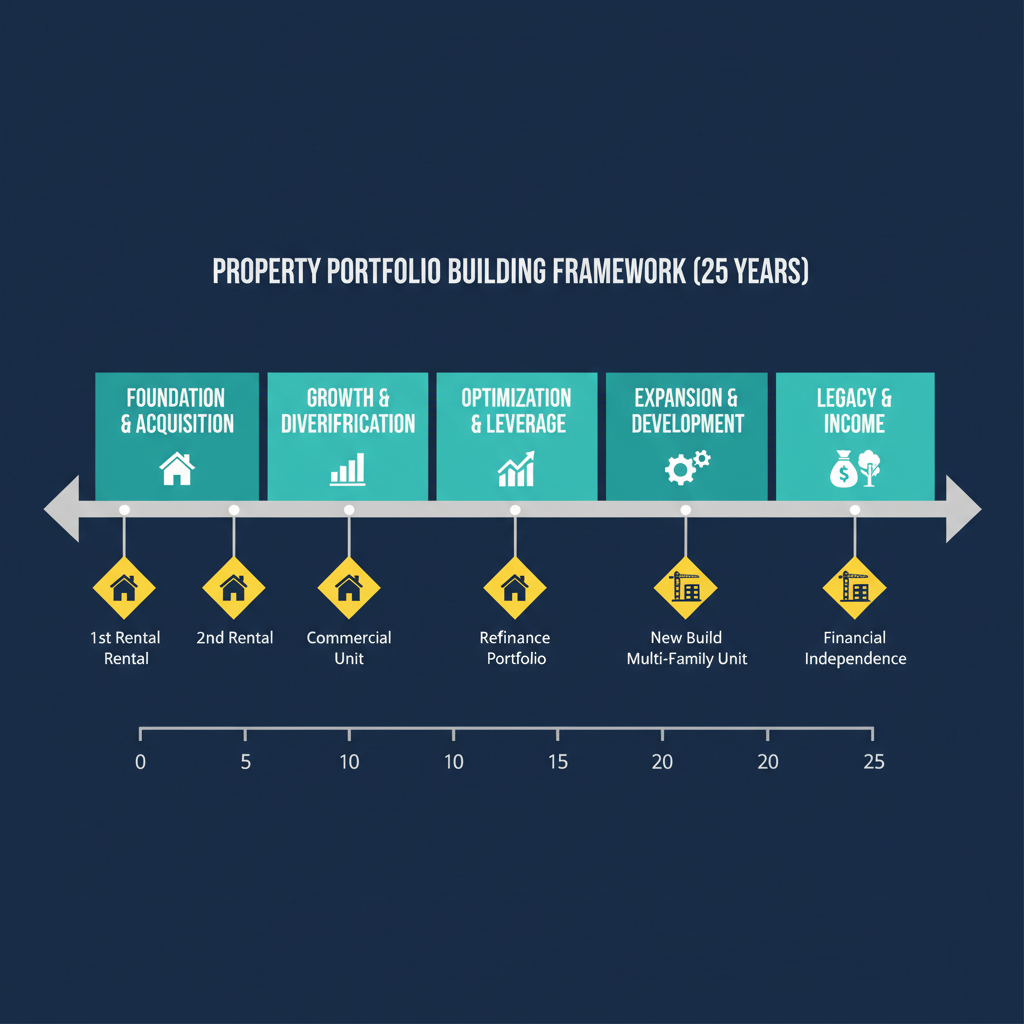
Building a million-dollar portfolio requires a systematic approach, not random property purchases.
The framework used by successful investors follows five clear phases. Phase one focuses on education and goal-setting. Phase two involves acquiring your first strategic property. Phase three centers on equity growth and portfolio expansion. Phase four emphasizes optimization and cash flow management. Phase five is about wealth consolidation and debt reduction.
Each phase has specific timeframes, decision points, and success metrics.
Phase One: Foundation and First Property (Years 1-3)
Your first property sets the trajectory for your entire portfolio.
During this phase, you need to define clear investment goals, understand your borrowing capacity, and identify high-growth locations. Your first purchase should be in an area with strong employment growth, population increase, and infrastructure investment.
Buyers Agency Australia uses proprietary research to identify suburbs showing early signs of gentrification and capital growth acceleration. These areas typically sit 5-10 kilometers from the CBD in major capital cities.
Your first property should target both capital growth and reasonable rental yields of 4-5%. Avoid areas with yields above 7% as these often lack capital growth potential.
The goal in this phase is to establish your foundation property and begin building equity through both capital growth and loan repayment.
Phase Two: Equity Extraction and Second Property (Years 4-6)
By year four or five, your first property should have appreciated 20-30% if you bought strategically.
This equity growth enables your second purchase without requiring another large savings deposit. You refinance your first property to release usable equity, which becomes the deposit for property number two.
Your second property should be in a different location to the first, providing geographic diversification. If your first property was in Brisbane, consider Sydney, Melbourne, or Perth for the second.
Diversification across markets reduces risk and ensures at least one property is likely performing strongly at any given time.
Phase Three: Portfolio Acceleration (Years 7-12)
Years 7-12 represent your portfolio’s growth phase.
During this period, both properties are appreciating, creating compounding equity across two assets. The combined equity from properties one and two can fund the deposit for property three by year 8-10.
By year 12, investors following this framework typically own 3-4 properties with a combined value of $2.5-3.5 million and outstanding debt of $1.8-2.5 million.
Cash flow management becomes critical during this phase. Many investors experience slight negative cash flow across their portfolio during these years. This is acceptable if the shortfall is manageable and you have a clear path to positive cash flow through rental growth.
Phase Four: Optimization and Cash Flow Focus (Years 13-18)
By the mid-point of your portfolio journey, you shift focus from acquisition to optimization.
Rental income has increased significantly across all properties through annual rent increases of 3-4%. Meanwhile, your loan payments remain relatively static if you have fixed-rate or interest-only loans.
This is when many portfolios transition from slight negative cash flow to neutral or positive cash flow. Once you achieve positive cash flow, your portfolio becomes self-sustaining and no longer requires you to contribute from your salary.
Some investors choose to acquire a fourth or fifth property during this phase if borrowing capacity allows. Others pause acquisitions and focus on paying down debt to improve equity positions.
Phase Five: Consolidation and Wealth Realization (Years 18-25)
The final phase involves debt reduction and wealth realization.
By year 20, properties purchased in year one have likely doubled in value at least once, possibly twice. Your total portfolio value may exceed $5 million with debt of $2-2.5 million, leaving $2.5-3 million in equity.
At this stage, many investors begin transitioning from accumulation to income generation. You might sell one property to pay down debt on the others, or convert all properties to principal-and-interest loans to steadily pay off debt.
The goal is to enter retirement with 2-3 fully owned properties providing $100,000+ in annual rental income, plus the option to sell one property to fund a comfortable lifestyle.
Building the Right Team: Your Professional Advisory Board
No investor builds a million-dollar portfolio alone. Success requires a carefully selected team of professionals.
Your core team should include five key professionals. First, an experienced buyers agency who understands investment fundamentals and can identify high-growth properties. Second, a mortgage broker specializing in investment lending who can maximize your borrowing capacity. Third, an accountant experienced in property investment tax strategies. Fourth, a property manager who maintains your properties and secures quality tenants. Fifth, a financial planner who integrates property into your broader wealth strategy.
Each team member plays a specific role in your success.
The Role of a Strategic Buyers Agency
A buyers agency is your most important team member because property selection determines 80% of your investment outcomes.
Dragan Dimovski and the team at Buyers Agency Australia bring over 20 years of investment experience and a $10 million+ personal portfolio to every client engagement. This isn’t theoretical knowledge. It’s boots-on-the-ground experience building wealth through property.
A strategic buyers agency provides market research identifying suburbs entering growth phases, off-market property access before listings hit the internet, negotiation expertise that saves $20,000-50,000 per purchase, due diligence that eliminates problematic properties, and 10-year portfolio modeling that maps your path from one property to 3-5 properties.
Book a free strategy session to discuss your specific situation and receive a custom portfolio roadmap.
Mortgage Broker Selection Criteria
Your mortgage broker needs specific expertise in investment lending, not just residential home loans.
Look for brokers who understand debt structuring strategies, have relationships with lenders who offer higher loan-to-value ratios for investors, can model multiple borrowing scenarios, and explain how to maximize tax deductions through loan structuring.
The right broker can increase your borrowing capacity by $100,000-200,000 through strategic structuring, which could mean the difference between owning two properties or four properties over your investment timeline.
Accountant and Tax Strategy
Property investment offers significant tax advantages, but only if you structure correctly from the beginning.
Your accountant should advise on negative gearing benefits, depreciation schedules that create additional tax deductions, capital gains tax minimization strategies, and optimal ownership structures like discretionary trusts or self-managed super funds.
These tax strategies can save $5,000-15,000 annually once you own 2-3 properties, accelerating your wealth accumulation.
Common Portfolio Building Mistakes and How to Avoid Them
Even experienced investors make critical mistakes that stall portfolio growth.
Understanding these pitfalls helps you avoid years of lost progress.
Mistake One: Buying for Yield Instead of Growth
High rental yields often signal areas with limited capital growth potential.
Properties advertised with 7-9% rental yields are typically in regional or remote areas where employment is limited and population is declining or stagnant. While the immediate cash flow looks attractive, these properties often appreciate slowly or decline in value.
Successful portfolio builders target properties with 4-5% yields in high-growth areas. The capital appreciation over 10-20 years far outweighs the extra $50-100 per week in rent from high-yield properties.
Mistake Two: Emotional Property Selection
Your investment property isn’t your home, and it shouldn’t be selected using the same criteria.
Many investors buy properties they personally would want to live in, focusing on features like views, finishes, or proximity to beaches. But these features often don’t drive investment returns.
Investment properties should be selected based on employment growth, infrastructure investment, population trends, scarcity of land, and rental demand. These fundamental drivers determine capital growth, not whether the kitchen has stone benchtops.
Mistake Three: Overextending on Cash Flow
Aggressive investors sometimes accumulate multiple properties while maintaining significant negative cash flow.
If you’re contributing $2,000 per month from your salary to cover shortfalls across multiple properties, you’re one job loss or interest rate increase away from financial disaster.
Conservative cash flow management is essential. Your total portfolio should require no more than $500-800 per month in contributions during the accumulation phase, and you should maintain 6-12 months of emergency reserves.
Mistake Four: Failing to Diversify Geographically
Some investors buy all their properties in a single market because they’re familiar with the area.
This concentration creates unnecessary risk. If that market experiences an economic downturn, your entire portfolio suffers simultaneously.
Diversification across 2-3 capital cities ensures at least one market is performing well at any given time, smoothing your portfolio’s overall performance.
Advanced Strategies for Accelerated Growth
Once you master the fundamentals, advanced strategies can accelerate portfolio growth.
These techniques require careful execution and professional guidance.
Manufacturing Equity Through Renovations
Some investors accelerate equity growth by purchasing undervalued properties and completing strategic renovations.
This “manufacture equity” strategy involves buying a property $50,000-100,000 below market value, investing $30,000-60,000 in cosmetic renovations, and immediately creating $80,000-140,000 in equity through forced appreciation.
This manufactured equity can be accessed within 6-12 months through refinancing, providing the deposit for your next purchase years earlier than waiting for natural capital growth.
However, this strategy requires construction knowledge, strong cash flow to fund renovations, and the ability to accurately estimate renovation costs and post-renovation values.
Granny Flats and Dual Income Properties
Properties with development potential offer multiple income streams from a single asset.
Adding a granny flat to a property with sufficient land increases the rental income by $250-400 per week while adding $120,000-180,000 to the property’s value. The construction cost of $140,000-180,000 is often exceeded by the value increase, creating instant equity.
Buyers Agency Australia identifies properties with subdivision or granny flat potential in areas where council regulations support these developments.
These dual-income properties significantly improve cash flow, making it easier to service debt and acquire additional properties.
House Hacking to Reduce Living Costs
House hacking involves living in one unit of a multi-unit property while renting out the others.
This strategy is particularly effective for first-time investors. You might purchase a duplex, live in one side, and rent the other side. The rental income covers a significant portion of your mortgage, dramatically reducing your living expenses.
The money saved on housing costs can be redirected toward saving deposits for additional investment properties, accelerating your portfolio timeline.
How Dragan Dimovski and Buyers Agency Australia Accelerate Portfolio Building

Building a million-dollar portfolio is possible through self-education and DIY investing, but partnering with experienced professionals compresses your timeline.
Buyers Agency Australia specializes in helping investors move from one property to 3-5 properties within 10-15 years through proven frameworks and data-driven property selection.
Dragan Dimovski brings over 20 years of personal investment experience, having built a $10M+ portfolio while helping hundreds of clients achieve similar outcomes. This isn’t theoretical advice. It’s battle-tested strategy refined over two decades.
The agency’s approach starts with comprehensive portfolio modeling. You receive a custom 10-year roadmap showing exactly when to buy each property, how much equity you’ll need, and projected portfolio values at each milestone.
Next comes property selection using proprietary research that identifies suburbs entering growth phases 12-18 months before the broader market catches on. This early identification ensures you buy before prices accelerate.
Buyers Agency Australia also provides off-market property access through extensive agent networks in Sydney, Melbourne, Brisbane, Perth, and Adelaide. Off-market purchases eliminate competition and often result in below-market pricing.
Negotiation expertise typically saves clients $20,000-50,000 per purchase. These savings compound across multiple properties over your investment journey.
The agency maintains relationships with property managers, mortgage brokers, and accountants specializing in investment property, ensuring you have access to the full team needed for success.
Connect with Dragan and his team to learn more about their portfolio building strategies, or attend their upcoming FastTrack event where they share the complete framework in detail.
Taking Your First Step Toward Your Million Dollar Portfolio
Every million-dollar portfolio starts with a single property and a clear framework.
The difference between investors who build substantial wealth and those who own a single property for decades isn’t luck, capital, or market timing. It’s having a proven system and the discipline to execute it patiently over 15-20 years.
The framework shared in this guide has helped hundreds of Australian investors build life-changing wealth through property. It combines compounding growth, strategic equity release, geographic diversification, and the right professional team to systematically scale from one property to 3-5 properties.
Your first step is defining your specific goals. Do you want $100,000 in annual passive income by age 60? Are you targeting a $3 million portfolio? How many properties do you need to achieve your lifestyle goals?
Once your goals are clear, your next step is understanding your current borrowing capacity and identifying your first strategic property. This is where most investors benefit from professional guidance to ensure they start on the right foundation.
Buyers Agency Australia offers free strategy sessions where Dragan and his team assess your current situation, discuss your goals, and provide a preliminary portfolio roadmap showing your path forward.
Book your free strategy session today to start building your million-dollar property portfolio with a proven framework and expert guidance.
The best time to start building your portfolio was ten years ago. The second-best time is today.
Frequently Asked Questions
How long does it take to build a million-dollar property portfolio in Australia?
Most investors build a million-dollar portfolio in 10-15 years by purchasing one property every 3-4 years and allowing compounding growth to accelerate equity across multiple properties.
What is the minimum deposit needed to start building a property portfolio?
You typically need $80,000-120,000 for your first property (20% deposit plus costs), but subsequent properties are purchased using equity from previous properties rather than cash savings.
Should I focus on capital growth or rental yield?
Successful portfolio builders prioritize capital growth in high-demand areas with 4-5% yields. Capital appreciation over 10-20 years creates far more wealth than high rental yields in low-growth areas.
How do I access equity without selling my property?
You access equity by refinancing your existing property to borrow up to 80% of its current value, with the difference between your old and new loan becoming usable cash for your next deposit.
Do I need a buyers agency to build a property portfolio?
While not mandatory, experienced buyers agencies significantly reduce research time, provide access to off-market properties, negotiate better prices, and help avoid costly mistakes that can delay your portfolio growth by years.