
How Professional Buyers Agents Analyse Growth Suburbs Using Data and Market Intelligence
Professional buyers agents identify high-growth suburbs by analysing supply-demand ratios, infrastructure pipelines, demographic shifts, economic fundamentals, and market cycle positioning. This data-driven methodology removes emotion from suburb selection and targets areas positioned for sustained capital appreciation over 7-10 year cycles.
If you're searching for your next property investment, you've probably noticed every suburb claims to be the "next boom area." The truth is that fewer than 4% of properties available today qualify as investment-grade, according to Buyers Agency Australia.
The professionals who consistently identify these opportunities don't rely on hunches or marketing hype. They follow a structured, repeatable process grounded in market data and field intelligence.
This guide walks through the exact steps professional buyers agents use to separate genuine growth suburbs from those destined to underperform.
What Defines a Growth Suburb in 2026
The Core Characteristics That Signal Future Appreciation
A growth suburb isn't simply one experiencing price increases today. It's a location where multiple market drivers align to support sustained value appreciation over the next decade.
According to CoreLogic's 2025 data, national dwelling values rose 8.6% annually, adding approximately $71,360 to the median Australian dwelling. However, performance varied wildly by location. Darwin led capital cities with 18.9% growth, while Melbourne managed just 4.8%.
The professionals focus on three non-negotiables when evaluating growth potential:
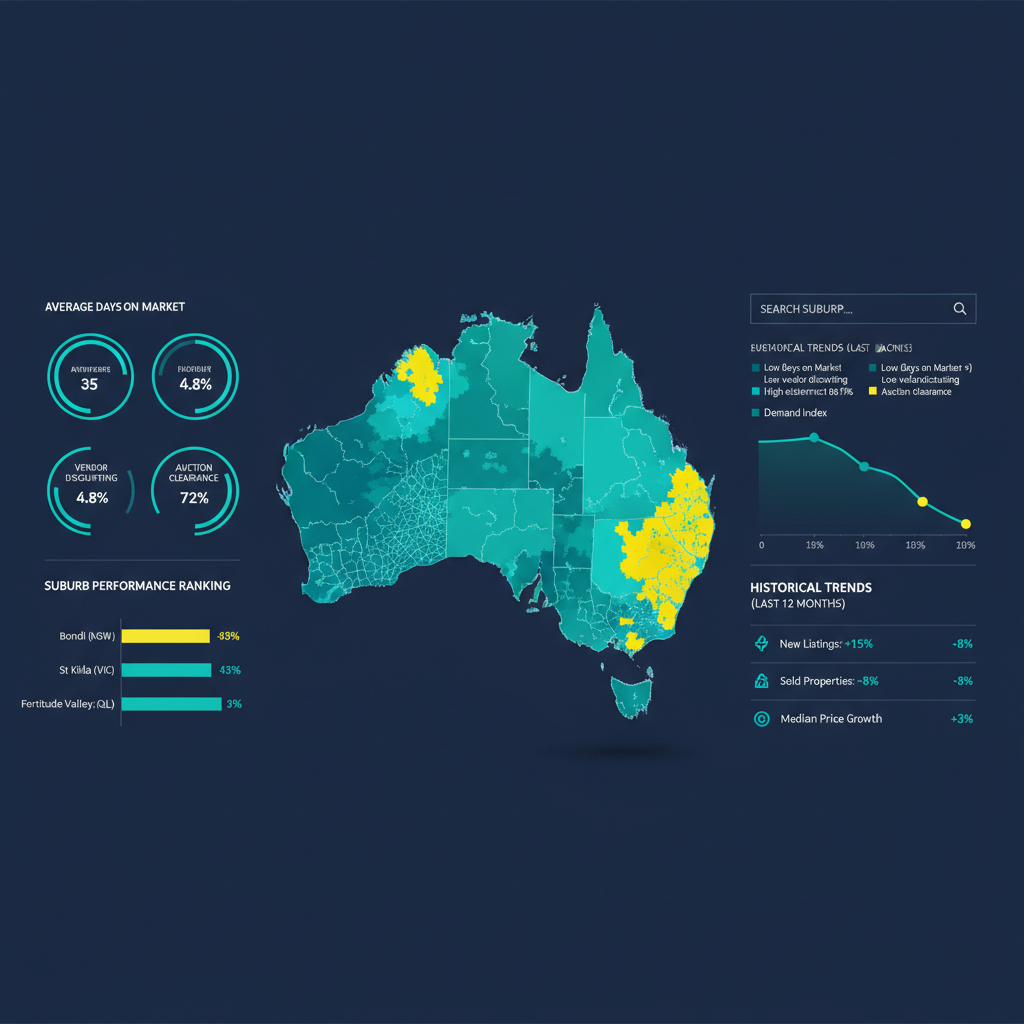
Supply-demand imbalance. More buyers than available stock creates price tension. This shows up in metrics like days on market (under 20 days signals strong demand), vendor discounting rates (under 3% indicates competitive bidding), and auction clearance rates above 75%.
Infrastructure investment. Major transport projects historically deliver 4-7% property value uplift in affected suburbs. The Victorian Planning Authority's analysis of Melbourne's Level Crossing Removals confirmed gains occurred after project completion when noise reduction and aesthetic improvements were fully realised.
Economic fundamentals. Employment diversity, median household income growth, and business investment signal long-term sustainability. Suburbs reliant on single industries carry higher risk.
Why Traditional Suburb Research Falls Short
Most investors rely on backward-looking data: median price growth over the past 12 months, rental yields based on last quarter's figures, or suburb reports that aggregate all property types.
The problem is that property cycles run 7-10 years. By the time growth appears in historical data, early-stage opportunities have passed. Professionals analyse leading indicators that predict where demand will flow 18-36 months ahead.
Another common mistake is treating all sales data equally. The sale of a high-quality investment property on a quiet street carries the same statistical weight as a subpar property on a main road. This is why suburb-level median data can mislead investors about true investment potential.
The Data Sources Professional Buyers Agents Trust
CoreLogic RP Data provides the gold standard for property transaction data, hedonic indices, and suburb-level analytics. Banks, valuers, and government agencies rely on CoreLogic's rigorous data sourcing and quality controls.
SQM Research tracks vacancy rates, rental listings, and supply pipelines. Vacancy rates under 2% indicate rental pressure and strong tenant demand.
Australian Bureau of Statistics (ABS) delivers census data on demographics, household composition, income distribution, and employment patterns. This baseline information identifies suburbs attracting young families, professionals, or retirees.
Real Estate Institute bodies (REIV, REIA) publish auction results, market insights, and agent-reported data. Their median price data for capital cities provides statistically reliable market health indicators with hundreds of data points.
Professional buyers agents layer multiple data sources to cross-verify trends and eliminate single-source bias.
Step 1: Analysing Supply and Demand Fundamentals
Identifying Suburbs With Tight Supply
The most reliable leading indicator of price growth is supply scarcity. When listing volumes drop while buyer enquiry remains steady or increases, prices rise.
Professionals track total listings over rolling 12-month periods. A suburb showing 20-30% fewer listings year-on-year while maintaining stable or rising sales volumes indicates genuine scarcity.
Days on market (DOM) provides another critical signal. Properties selling within 14-20 days suggest buyers are competing for limited stock. Eight markets in Queensland and Western Australia recorded median selling times under 20 days in late 2025, including Busselton, Mackay and Rockhampton at 14 days each, according to CoreLogic's Regional Market Update.
Vendor discounting rates reveal market strength. When properties sell for 2-3% below initial asking prices or less, it indicates buyers are willing to meet or exceed seller expectations. Albany in Western Australia achieved a 2.0% median vendor discount rate with 23.3% annual growth.
Measuring Buyer Demand Intensity
Auction clearance rates above 75% signal strong buyer competition. Sydney and Melbourne use auctions as the primary sale method for 40-60% of transactions, making clearance data particularly valuable in these markets.
Online search volume and enquiry rates provide early-stage demand signals. Professional buyers agents with access to portal analytics can identify suburbs experiencing 15-20% increases in buyer search activity before these translate into sales data.
Property absorption rates measure how quickly new listings are sold relative to the rate new properties enter the market. When absorption outpaces new supply, price pressure builds.
The Supply-Demand Ratio That Predicts Growth
Boomscore, a property research tool established in 2010, uses AI to analyse nine capital growth indicators and rank suburbs based on demand-to-supply ratios. The platform tracks 15,000+ suburbs across Australia, effectively creating 30,000+ micro-markets when split by houses and units.
A high Boomscore indicates demand significantly exceeds supply. However, professionals caution that these ratios are time-sensitive. As prices rise in high-demand suburbs, buyer demand eventually moderates. Developers responding to high demand add new supply, creating competition that can drive prices down.
The sweet spot is identifying suburbs in the early stages of demand acceleration before widespread investor awareness pushes prices beyond intrinsic value.
Stock-to-Sales Ratios and Market Velocity
Stock-to-sales ratios compare available inventory to monthly sales volume. A ratio under 3-4 months indicates a seller's market. Ratios above 6 months suggest oversupply or weakening demand.
Market velocity measures transaction frequency. Suburbs with accelerating sales volumes (15-20% increase year-on-year) combined with low stock indicate markets gaining momentum.
Buyers Agency Australia applies these supply-demand metrics across multiple markets simultaneously, identifying patterns invisible to individual investors analyzing one suburb at a time.
Step 2: Infrastructure Pipeline Mapping
Transport Projects That Drive Genuine Value Uplift
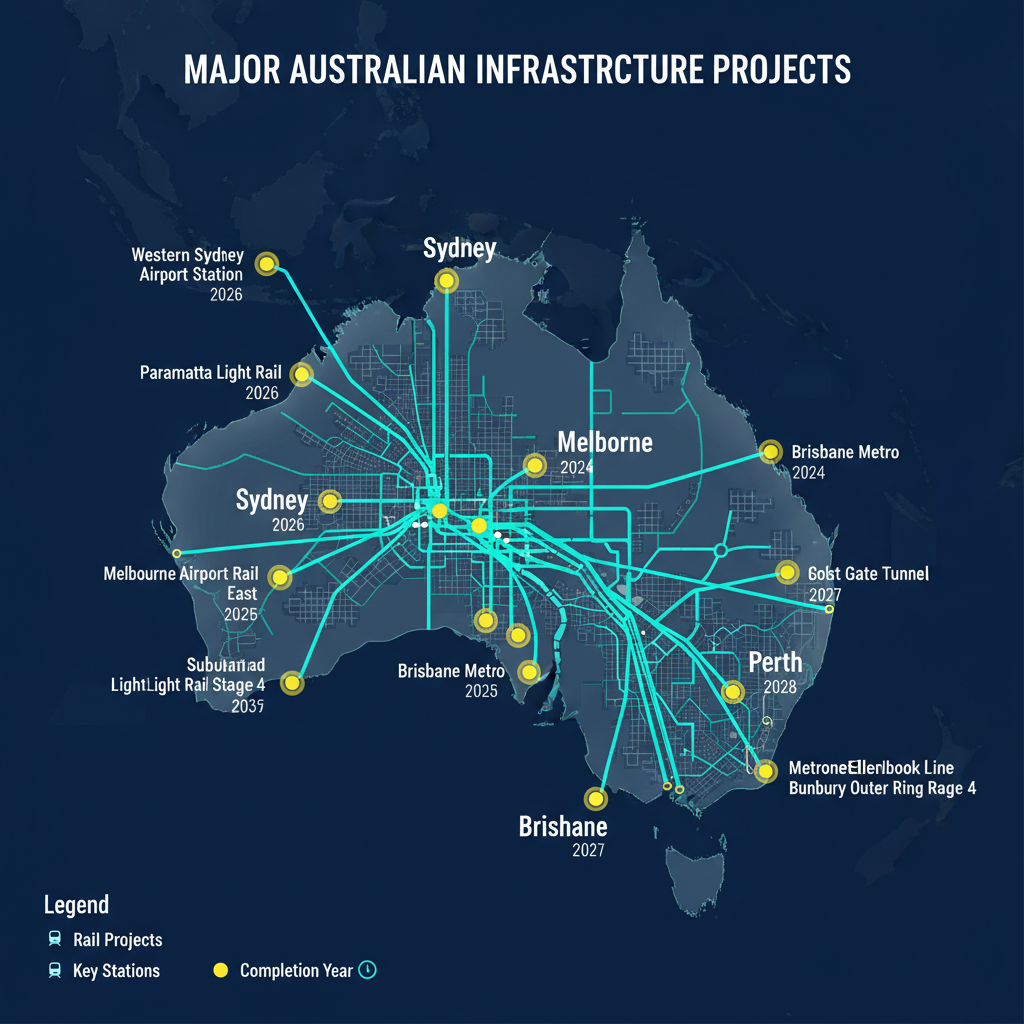
Infrastructure announcements generate headlines, but professional buyers agents focus on projects with confirmed funding, detailed timelines, and proximity to practical completion.
Rail infrastructure consistently delivers stronger value uplift than road projects. The permanent nature of rail provides certainty to developers and homebuyers, encouraging long-term investment in transit-oriented development.
A 2024 study analyzing Sydney transport projects found light rail extensions delivered approximately 6% value uplift after implementation, primarily due to accessibility improvements. Properties closer to stations experienced higher anticipated value increases.
Melbourne's Level Crossing Removal Program lifted property values 4-7% in affected suburbs, with the strongest gains occurring post-completion when noise reduction benefits were realized.
The Three-Phase Infrastructure Value Cycle
Value impact follows a predictable pattern:
Announcement phase. Initial announcements create awareness but typically produce minimal immediate price impact. Uncertainty about timing, funding, and final routes limits buyer confidence.
Construction phase. As projects break ground with confirmed timelines, early-stage value uplift begins. Buyers willing to tolerate short-term disruption can capture pre-completion value growth. This phase offers the best risk-adjusted entry point for investors.
Completion phase. Once infrastructure is operational and benefits are tangible, value uplift accelerates. However, much of the anticipated growth is already priced into properties near completed projects.
Professionals target suburbs 12-24 months before major infrastructure completion, balancing entry price with growth potential.
Major Projects Reshaping Australian Property Markets in 2026
Sydney Metro West will reduce commute times between Parramatta and the CBD from 60 minutes to 20 minutes. Suburbs including Five Dock, Burwood, and North Strathfield within 800m walking distance of planned stations are attracting renewed interest.
Brisbane Cross River Rail delivered four new underground stations in 2025. Woolloongabba, Dutton Park, and Albert Street stations are seeing rising prices as the project transitions from construction to operational benefits.
Melbourne Suburban Rail Loop represents a $125 billion investment connecting major employment, education, and health precincts. Box Hill, Burwood, Glen Waverley, and Clayton are benefiting from confirmed station locations.
Perth Metronet continues expanding public transport across Perth's growth corridors. Alkimos, part of the Metronet coastal corridor, shows median house prices around $742,500 with 4.93% gross yields, attracting investors to high-growth suburbs in Western Australia.
Infrastructure Beyond Transport
Hospitals, universities, and sports facilities create employment hubs and population density.
Brisbane's 2032 Olympic Games preparations are fast-tracking infrastructure across Albion, Hamilton, and Northshore. Venue developments, transport improvements, and urban renewal projects are positioning these suburbs as key investment hotspots.
New shopping centers, schools, and community facilities improve liveability, attracting families and supporting rental demand.
Professionals map confirmed infrastructure projects against current property prices to identify suburbs offering the best value-to-growth ratio before infrastructure benefits are fully priced in.
Step 3: Demographic and Economic Analysis
Population Growth Drivers and Migration Patterns
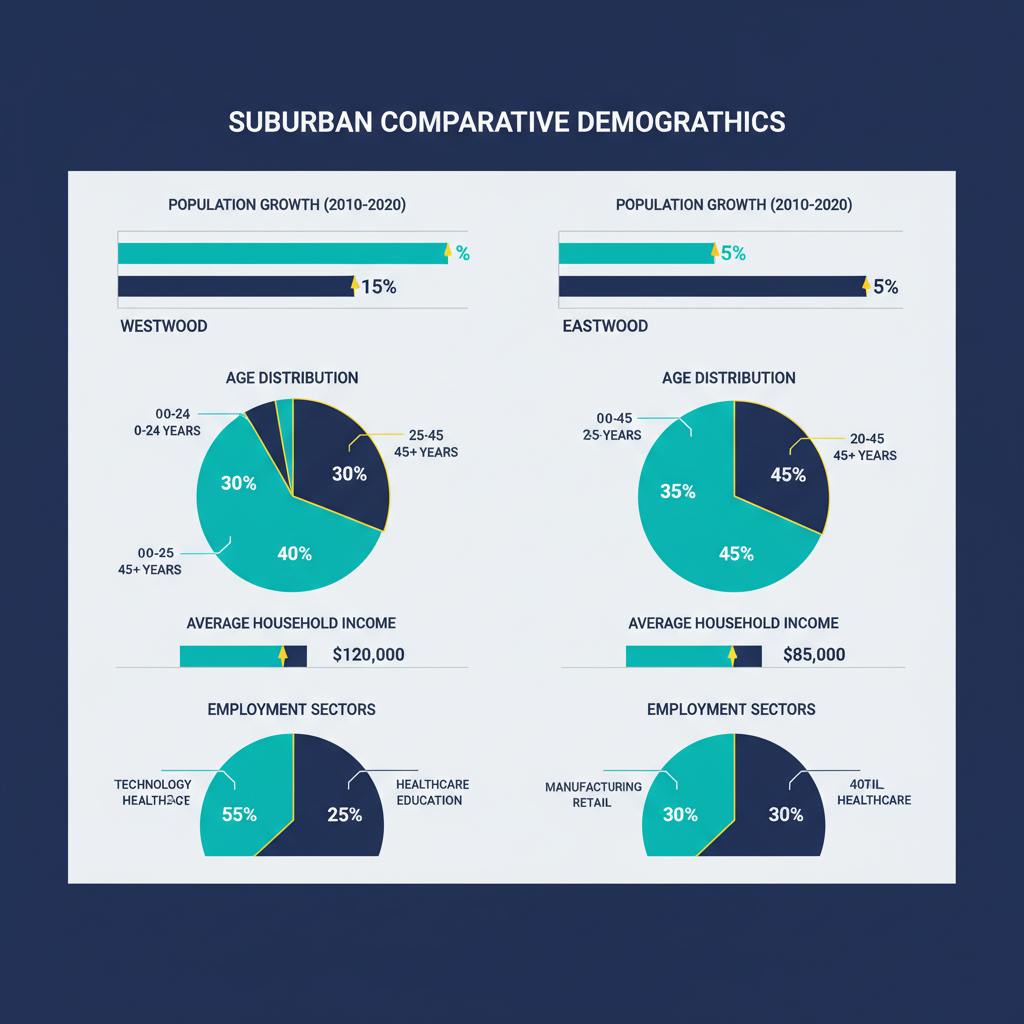
Strong population growth driven by immigration, young professionals, or families signals rising demand for both rental and owner-occupied properties.
Suburbs attracting high proportions of young families (ages 30-45) typically experience sustained demand. These buyers prioritize proximity to quality schools, parks, and family-friendly amenities, creating stable long-term markets.
Interstate migration patterns reveal affordability pressures. Sydney and Melbourne residents priced out of their home markets are driving demand in Brisbane, Perth, and Adelaide. Brisbane saw consistent price growth through 2024-2025 as interstate buyers sought more affordable entry points while maintaining proximity to employment and lifestyle amenities.
Employment Hubs and Economic Diversity
Suburbs within 10-15km of major employment centers consistently outperform distant locations. Gross Regional Product (GRP) indicates economic scale and sustainability.
Parramatta, Sydney's second CBD, has a GRP around $31 billion. A dense pipeline of transport, civic, and precinct developments is boosting jobs and long-term housing demand, according to property research firm Hotspotting.
The Hunter Valley combines a GRP of $95 billion with population growth projected to hit one million by 2031. This economic scale with strong population growth creates property market resilience.
Economic diversity matters. Suburbs heavily reliant on single industries (mining, tourism, manufacturing) carry higher risk when those sectors contract. Professionals favor locations with diverse employment across multiple sectors.
Income Growth and Affordability Positioning
Median household income growth indicates a suburb's capacity to support price appreciation. Areas experiencing 3-5% annual income growth can sustain similar or higher property price growth without affordability constraints.
Affordability positioning relative to comparable suburbs reveals value opportunities. If two suburbs offer similar amenities, school access, and transport connectivity, but one trades at a 15-20% discount, it signals potential for price convergence.
West Launceston, just 2km from Launceston CBD, has similar character to East Launceston but trades at a $630,000 median house price—$270,000 cheaper than its high-profile neighbor, creating a value gap professionals exploit.
Owner-Occupier vs. Investor Ratios
Suburbs with high owner-occupier percentages (65-75%) demonstrate stability. Owner-occupiers maintain properties, engage in communities, and provide price support during market downturns.
Excessively high investor ratios (above 40-50%) can signal oversupply risk, particularly in apartment-heavy suburbs. When multiple investors exit simultaneously during market corrections, prices can fall sharply.
Balanced suburbs with 60-70% owner-occupiers and 30-40% investors offer the best risk-return profile.
Step 4: Property Market Cycle Positioning
Understanding the Four-Phase Property Cycle
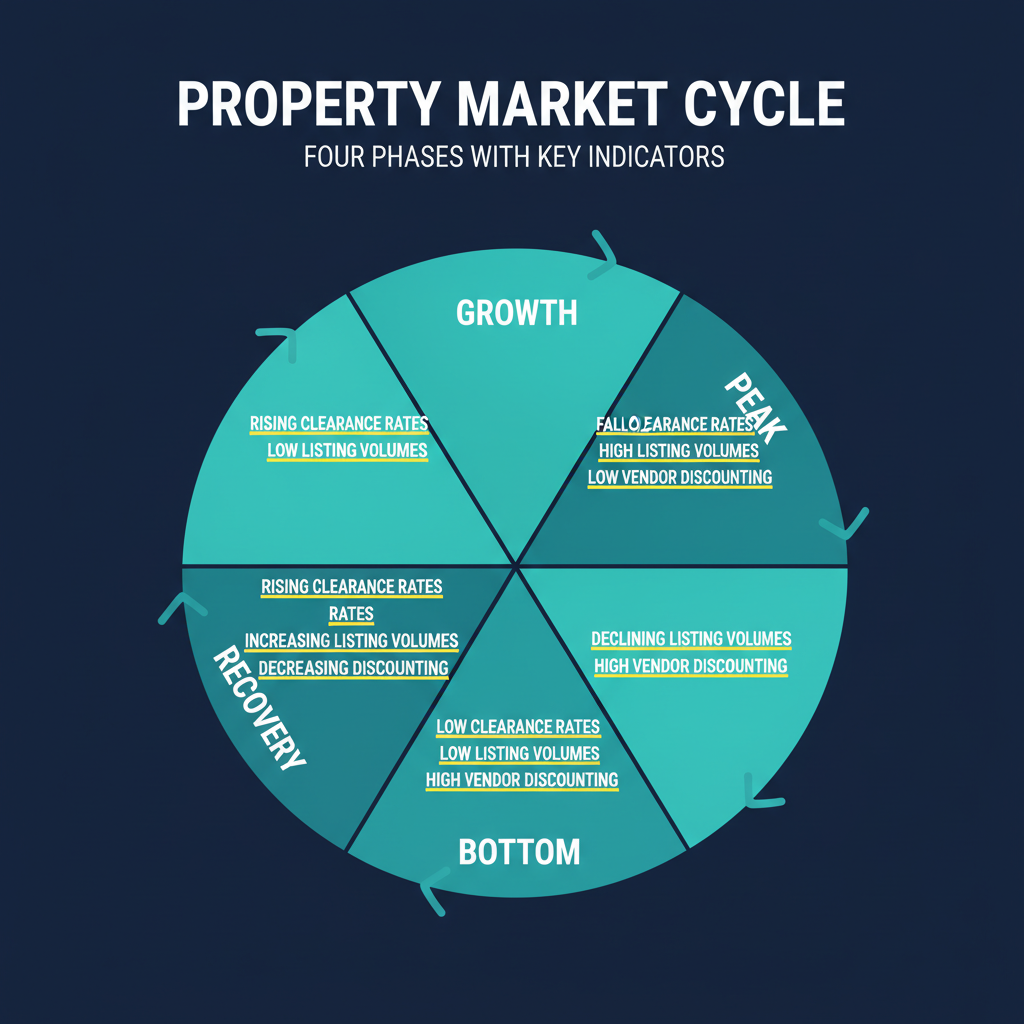
Australian property markets move through four distinct phases over 7-10 year cycles:
Bottom phase. Prices are flat or declining. Listings are high, clearance rates are low (below 60%), and vendor discounting exceeds 5-7%. Negative sentiment dominates. This phase offers the best long-term entry points, but requires conviction to buy when headlines are pessimistic.
Recovery phase. Prices begin rising from low bases. Listings start declining, clearance rates improve (65-75%), and vendor discounting falls to 3-5%. Early buyers capture strong returns as momentum builds.
Growth phase. Prices rise steadily. Stock scarcity becomes evident (listings 20-30% below historical averages), clearance rates exceed 75%, and vendor discounting falls below 3%. Media attention increases. This phase delivers consistent capital growth but with reduced margin of safety.
Peak phase. Prices plateau or peak. Affordability constraints limit buyer numbers. Listings may increase as sellers capitalize on high prices. Clearance rates soften to 70-75% or below. Professionals begin reducing exposure and looking to exit or hold through the next cycle.
Identifying Where Each Market Sits in Its Cycle
Different cities and regions move through cycles at different times. While Sydney and Melbourne may be mid-growth phase, Perth or Adelaide might be entering recovery phase.
Perth property prices saw gradual decline between 2014 and the 2021 pandemic boom, before upticking strongly through 2024-2025. This delayed cycle created opportunities for buyers who recognized Perth's late-cycle positioning relative to eastern capitals.
Darwin led capital cities with 18.9% growth in 2025, underpinned by investor interest driven by lower price points, high yields, and exceptionally low listing volumes, according to CoreLogic.
Professionals map each target market's cycle phase using leading indicators (listings, clearance rates, DOM) rather than lagging indicators (median price growth).
Regional Markets vs. Capital Cities
Regional markets recorded 2.4% quarterly growth in late 2025, marking the strongest growth since the rate tightening cycle began. Western Australia's Kalgoorlie-Boulder (8.1%), Geraldton (7.4%), and Albany (6.2%) topped quarterly performers.
Regional markets offer affordability advantages, but liquidity is lower. Properties may take longer to sell during market downturns. Regional areas also face higher vacancy risk if local employment contracts.
Capital cities provide better liquidity, deeper rental markets, and more diversified economies. However, entry prices are substantially higher.
Buyers Agency Australia analyzes both capital city and regional opportunities, matching market type to investor timeframes, risk tolerance, and portfolio objectives.
Timing Entry Points Within Growth Phases
The ideal entry point is late recovery or early growth phase when momentum is building but prices haven't fully appreciated.
Practical indicators include:
- Listings falling 15-20% year-on-year
- Clearance rates improving from 65% to 75%+
- Vendor discounting falling from 5% to 3%
- Days on market decreasing from 30-40 days to 20-25 days
- Media attention beginning to highlight the market
Waiting for perfect data means missing early-stage opportunities. Professionals accept imperfect information and position portfolios across multiple markets at different cycle stages to balance risk.
Step 5: Suburb-Level Due Diligence
Micro-Market Analysis Within Suburbs
Suburbs aren't homogeneous. Specific streets, precincts, or zones within suburbs can significantly outperform or underperform suburb-wide averages.
Investment-grade properties are typically found in quiet, tree-lined streets within 1-2km of town centers, transport, and schools. Properties on main roads, near industrial zones, or in flood-prone areas underperform regardless of suburb-level growth.
Professionals use street-level heatmaps to identify micro-markets. Tools like HtAG's StreetLens™ Heatmaps provide street-level property insights, revealing which specific streets outperform their suburbs, where rental yields concentrate, and how market dynamics vary block-by-block.
Zoning, Planning, and Development Pipeline Risk
Planning overlays, zoning changes, and development applications materially impact property values.
Areas rezoned for higher density can see existing houses appreciate as developers acquire sites for apartment projects. However, if high-density zoning leads to oversupply of units, rental returns and capital growth for apartments can suffer.
Professionals review local council planning documents, development application registers, and state government infrastructure maps. The NSW Department of Planning and Environment offers online mapping where buyers can search properties and view planning applications in surrounding areas.
Environmental and Physical Constraints
Flood zones, bushfire risks, and contaminated land reduce property values and increase insurance costs. PropTrack data from Victoria shows properties in high-noise zones (aircraft, traffic) experience 6-18% lower values than comparable properties outside these zones.
Aircraft noise has the most substantial impact, with property values falling 6-9% for every 10-decibel increase.
Professionals overlay flood, bushfire, and safety zones on property listings to avoid high-risk locations before proceeding with detailed due diligence.
Rental Market Dynamics and Yield Profiles
Strong rental markets with vacancy rates under 2% support both cash flow and capital growth. Tight rental supply indicates population growth is outpacing housing construction.
Gross rental yields above 5% in capital cities or 6%+ in regional markets provide cash flow buffers and attract investor demand.
Maddington (WA) offers median houses at $592,000 with 4.41% gross yield. Spalding (WA) provides $395,000 median prices with 5.7% yields on houses and 6.1% on units, combining affordability with strong income returns.
Professionals calculate net yields after accounting for rates, strata fees, insurance, and maintenance to determine true cash-on-cash returns.
Step 6: Comparative Suburb Analysis
Building a Shortlist of Candidate Suburbs
After applying supply-demand, infrastructure, demographic, cycle, and due diligence filters, professionals typically narrow 15,000+ Australian suburbs to a shortlist of 10-20 candidates.
This shortlist is compared across key metrics:
- Median price and recent growth trajectory
- Supply-demand indicators (listings, DOM, clearance rates)
- Infrastructure timeline and proximity
- Demographics and economic fundamentals
- Cycle phase positioning
- Rental yield and vacancy rates
- Risk factors (supply pipeline, zoning, environmental)
Creating Weighted Scoring Models
No suburb scores perfectly across all metrics. Professionals develop weighted scoring models assigning importance to different factors based on investor objectives.
An investor prioritizing cash flow might weight rental yield and vacancy rates at 40% of total score, with capital growth indicators at 35% and risk factors at 25%.
A growth-focused investor might reverse this, weighting capital growth indicators at 50%, infrastructure pipeline at 25%, and yield metrics at 25%.
Weighted models provide objective, repeatable frameworks for suburb comparison and reduce emotional decision-making.
Head-to-Head Suburb Comparisons
Direct comparisons reveal relative value. If two suburbs have similar demographics, infrastructure, and economic fundamentals, but one trades at a 20-30% price discount, the cheaper suburb offers better risk-adjusted returns.
Werribee (VIC) at $628,000 median with 3.49% yields competes with Melton at similar price points. Werribee benefits from two new train stations opening by 2027, giving it a slight infrastructure edge.
Alkimos (WA) at $742,500 with 4.93% yields compares favorably to Armadale (WA) at $592,000 with 4.41% yields. Alkimos benefits from Metronet coastal corridor infrastructure, while Armadale offers lower entry prices.
Professionals construct comparison tables assessing 8-10 suburbs side-by-side across 15-20 metrics to identify the top 2-3 candidates for on-ground inspection.
Stress Testing Against Downside Scenarios
Every suburb carries risks. Professionals stress test shortlisted suburbs against potential negative scenarios:
- What if infrastructure is delayed 2-3 years?
- What if interest rates rise another 1-2%?
- What if local employment contracts?
- What if new housing supply doubles?
- What if rental demand softens?
Suburbs with strong fundamentals across multiple dimensions (supply scarcity, diverse economy, established amenity) weather downside scenarios better than suburbs reliant on single growth drivers.
How Dragan Dimovski Identifies High-Growth Suburbs for Long-Term Wealth
Buyers Agency Australia, led by Dragan Dimovski, specializes in data-driven investment strategies designed to build 10-year portfolio models focused on long-term wealth creation.
With over 20 years of experience and a personal $10M+ property portfolio, Dragan has refined a suburb selection methodology that eliminates speculation and centers on repeatable, evidence-based analysis.
The firm operates across all major Australian capital cities, providing clients with access to opportunities beyond their local markets. This national reach allows portfolio diversification across markets at different cycle stages.
Buyers Agency Australia uses a transparent, fixed-fee model rather than commission-based structures. This alignment ensures recommendations prioritize client outcomes over transaction volume.
The team conducts boots-on-the-ground suburb inspections, reviewing infrastructure progress, development activity, and local market sentiment that data alone can't capture. This field intelligence validates desktop research and identifies subtle market shifts before they appear in official data.
Clients receive detailed suburb analysis reports incorporating supply-demand metrics, infrastructure timelines, demographic profiles, comparable sales, and 10-year growth modeling. This transparency allows investors to understand exactly why specific suburbs were recommended.
For investors overwhelmed by 15,000+ suburb options or time-poor professionals unable to conduct comprehensive research, Buyers Agency Australia provides end-to-end property search and negotiation services, from initial strategy to final settlement.
The 'Passive with Property' podcast shares practical insights on suburb analysis, market cycles, and investment strategy, providing investors with ongoing education beyond individual transactions.
Common Suburb Analysis Mistakes to Avoid
Chasing Last Year's Growth Hotspots
By the time a suburb appears on "top growth suburbs" lists, much of the capital appreciation has already occurred. Professionals focus on leading indicators predicting where growth will occur next, not where it happened last year.
Ignoring Infrastructure Timelines
Infrastructure announcements without confirmed funding, detailed plans, or realistic timelines carry high uncertainty. Buying solely on speculation that announced infrastructure will proceed as planned exposes investors to disappointment.
Focus on projects with construction underway or completion dates within 12-24 months.
Overlooking Supply Pipelines
High-demand suburbs can quickly become oversupplied if developers flood the market with new housing. Melonba (NSW) saw 192.9% five-year growth, but new land releases could soften prices if demand slows. Supply risk is particularly acute in greenfield estates and apartment markets.
Professionals monitor development approvals, land release schedules, and construction commencements to assess supply risk.
Relying on Single Data Sources
Median price data alone misses critical context. A suburb's median price might rise simply because high-end properties sold that quarter, not because all properties appreciated.
Layer multiple data sources—sales volumes, listings, clearance rates, DOM, rental yields, vacancy rates—to build comprehensive market pictures.
Confusing Lifestyle Appeal With Investment Quality
Beachside suburbs, tree-change locations, and lifestyle destinations appeal emotionally but don't always deliver strong investment returns. Professionals separate personal preferences from investment criteria.
Investment-grade properties prioritize:
- Proximity to employment centers
- Strong rental demand
- Established amenity (schools, transport, retail)
- Diverse buyer appeal
- Scarcity (limited future supply)
Lifestyle suburbs can work if they also meet these investment criteria, but lifestyle appeal alone doesn't guarantee capital growth.
FAQ
What's the single most important factor for suburb growth?
Supply-demand imbalance drives short-term price movements, but infrastructure investment and employment diversity support long-term sustainable growth.
How many suburbs should I analyse before choosing one?
Professionals typically analyse 50-100 suburbs using data filters, shortlist 10-20 for detailed review, and physically inspect the top 3-5 before making purchase decisions.
Are regional suburbs better investments than capital cities?
Regional markets offer affordability and higher yields but carry liquidity risk. Capital cities provide better liquidity and economic diversity. Match market type to your investment timeframe and risk tolerance.
When's the best time to buy in a growth suburb?
Late recovery or early growth phase, before price momentum is widely recognized. Waiting for perfect data means missing early-stage opportunities.
Can I identify growth suburbs without paying for data subscriptions?
Free resources (ABS, realestate.com.au, domain.com.au, council planning sites) provide baseline data. Professional platforms (CoreLogic, Boomscore, HtAG, SuburbsFinder) offer advanced analytics that save time and improve accuracy.