Capital Growth vs Cash Flow What Actually Builds Wealth in Property Investing Australia
Capital growth builds property portfolios, while cash flow sustains them. For most Australian investors, prioritising capital growth early allows them to scale, build equity, and open up future options, whereas focusing on cash flow too soon often limits long-term wealth creation.
If you're searching for the right investment strategy, you've probably heard these terms thrown around. Some experts swear by high rental yields. Others talk about capital gains like it's the only thing that matters.
Here's the reality: both strategies play critical roles in building wealth through property. The difference lies in understanding when to use each one and how they work together. Most investors don't fail because they picked the wrong strategy. They fail because they didn't have a strategy at all.
This article breaks down the core difference between capital growth and cash flow, how each one affects your portfolio, and how Buyers Agency Australia helps investors build balanced, scalable portfolios that generate both.
What Capital Growth and Cash Flow Actually Mean
Before jumping into which strategy is better, you need to understand what each one actually does for your investment.
Capital Growth Definition
Capital growth is the increase in a property's market value over time. It's measured by comparing what you paid for the property against what it's worth today.
For example, if you bought an investment property for $600,000 in 2020 and it's now valued at $750,000, you've achieved $150,000 in capital growth. That's a 25% increase over five years.
Capital growth is not taxed unless you sell the property. This gives you flexibility in how and when you realise gains. More importantly, capital growth creates equity, which you can use to purchase additional properties without selling your existing assets.
CoreLogic data shows national dwelling values rose 8.6% in 2025, adding approximately $71,360 to the median Australian dwelling value.
Cash Flow Definition
Cash flow refers to the difference between rental income and all property-related expenses. This includes mortgage repayments, council rates, strata fees, property management fees, insurance, maintenance, and land tax.
Positive cash flow means your rental income exceeds your expenses. Negative cash flow (negative gearing) means you're topping up the property from your own pocket each week or month.
A property generating $650 per week in rent with total expenses of $600 per week delivers $50 per week positive cash flow, or roughly $2,600 annually.
Cash flow impacts your borrowing capacity and serviceability. Banks assess your ability to service additional debt based on rental income (minus a buffer) and your current expenses.
According to SQM Research, national rental yields in 2025 range from 2.9% in Brisbane houses to 7.5% in Darwin units, showing significant variation across markets.
The Core Difference Between the Two
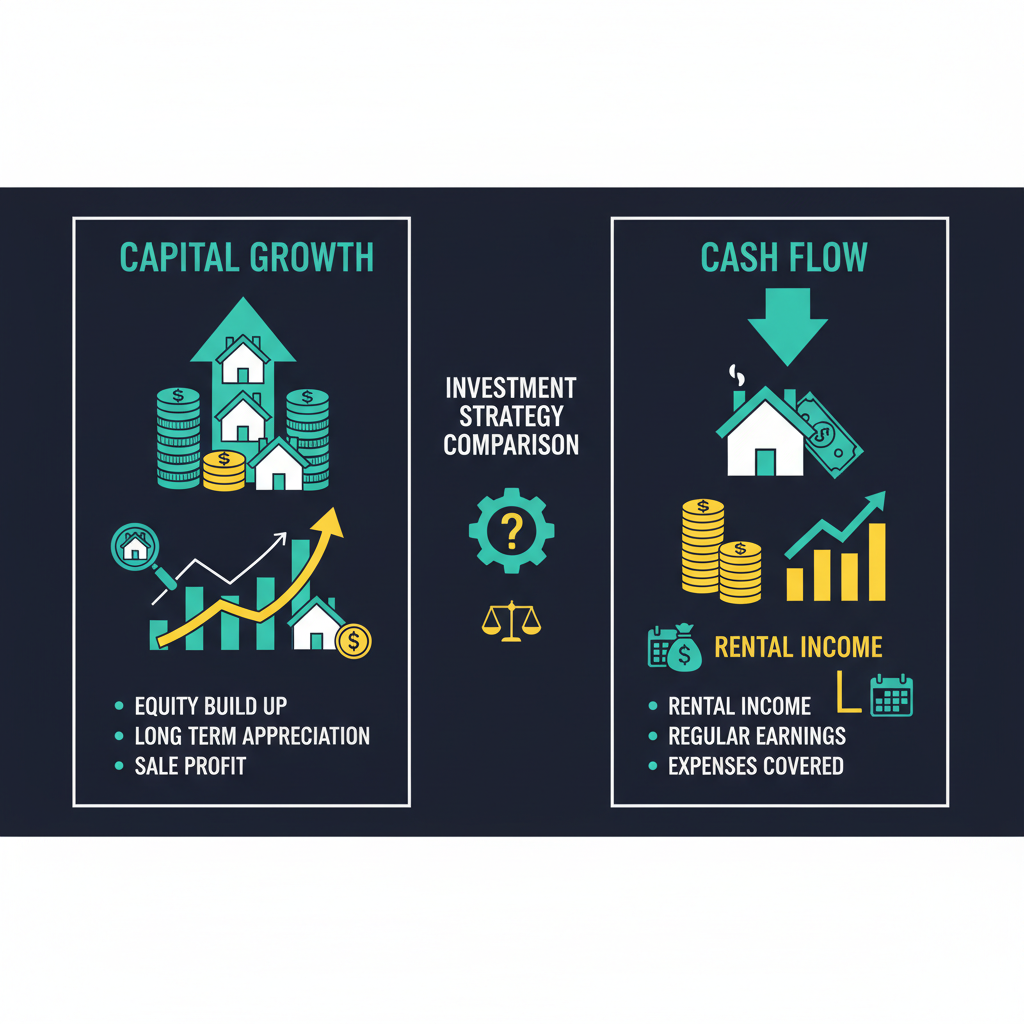
Capital growth compounds over time and builds wealth you can access through equity. Cash flow provides income and helps you hold properties without financial stress.
One builds your net worth. The other sustains your ability to keep investing.
Most property investors assume they must choose one or the other. The reality is that successful portfolios combine both strategies at different stages.
Why Capital Growth Matters More in the Early Stages
If you're building a property portfolio from scratch, capital growth gives you the fastest path to scale.
Equity Is What Funds Your Next Purchase
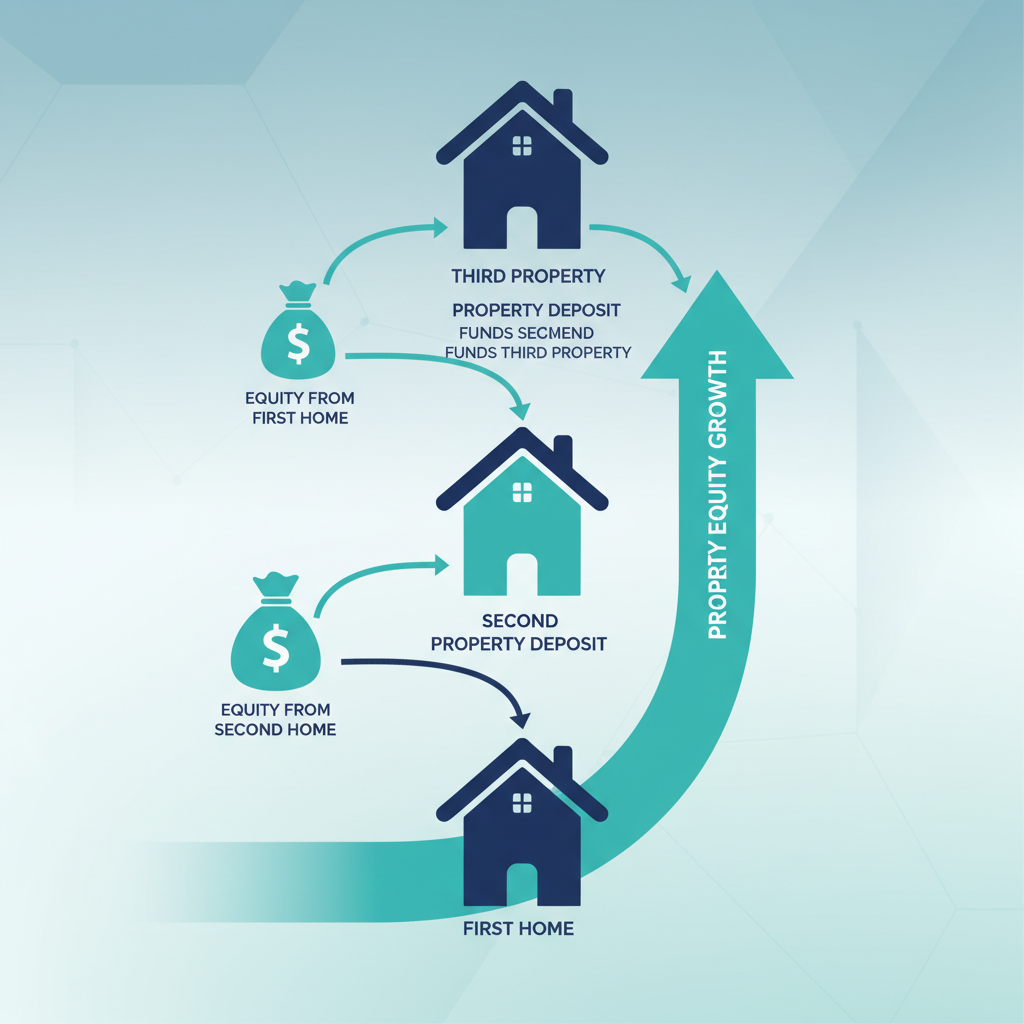
When your property increases in value, you build usable equity. Lenders allow you to borrow against that equity (typically up to 80% of the property's value) to fund your next deposit.
Without capital growth, you're stuck waiting until you save another deposit manually. That can take years.
For example, if your $600,000 property grows to $750,000, you've created $150,000 in equity. At 80% LVR, you can access up to $120,000 in usable equity (after accounting for the original loan balance).
That equity becomes the deposit for your second property. Then your third. This is how investors scale from one property to five or more.
Capital Gains Are Tax-Efficient
Rental income is taxed as ordinary income every year at your marginal tax rate. If you're earning $120,000 per year, rental income is taxed at 37% (plus Medicare levy).
Capital growth, on the other hand, is only taxed when you sell. Even then, if you've held the property for more than 12 months, you receive a 50% CGT discount.
This means capital growth is far more tax-efficient than cash flow for wealth accumulation.
According to the Australian Taxation Office, investors who hold properties long-term and focus on capital growth defer tax and benefit from concessional treatment.
Long-Term Wealth Comes From Appreciation
Over the past 30 years, Australian property values have grown at an average of 6.4% per annum. That means a property purchased for $400,000 in 1995 is now worth approximately $2.5 million.
Cash flow, while helpful, doesn't compound in the same way. A property generating $5,000 per year in positive cash flow will deliver $50,000 over 10 years. A property growing at 6% per year will add $300,000+ in value over the same period.
Historical CoreLogic data confirms that capital city properties have consistently outperformed regional markets in long-term capital growth, despite lower rental yields.
When Cash Flow Becomes Important
Cash flow isn't about getting rich. It's about staying in the game long enough for capital growth to do its job.
Serviceability Limits How Many Properties You Can Buy
Banks assess your borrowing capacity based on your income, existing debts, and the rental income from investment properties.
If every property you own is negatively geared by $200 per week, your serviceability shrinks quickly. After two or three properties, you may not qualify for another loan, even if you have plenty of equity.
Properties with strong rental yields improve your serviceability, allowing you to borrow more and buy more.
Holding Costs Can Force You to Sell
If you can't afford to hold your properties during periods of high interest rates or vacancy, you'll be forced to sell before realising capital gains.
Negative gearing is manageable when you have one property. It becomes a problem when you own multiple properties all losing money every month.
Investors who prioritise cash flow build buffers that protect them during downturns.
Cash Flow Supports Long-Term Portfolio Growth
Once you've built equity through capital growth, switching to cash flow-positive properties allows you to scale further without overextending yourself.
This is the strategy used by portfolio builders who own 5, 10, or 15+ properties. Early properties focus on growth. Later properties focus on income.
According to industry research, investors who balance both strategies are more likely to hold properties long-term and achieve financial independence.
How to Identify High Capital Growth Properties
Not every property grows at the same rate. Certain factors consistently drive above-average capital growth.
Location and Infrastructure Investment
Properties located near major infrastructure projects (new train lines, highways, hospitals, universities) tend to outperform.
Government spending on infrastructure signals long-term confidence in an area and attracts new residents, which drives demand.
For example, suburbs along Brisbane's Cross River Rail corridor have seen significant capital growth since construction began.
Supply and Demand Imbalance
Markets with limited new housing supply and strong population growth deliver the best capital growth.
Perth, Brisbane, and Adelaide all recorded double-digit capital growth in 2025 due to tight supply and strong interstate migration.
Propertyology data shows Perth house values grew 13%, Brisbane 12%, and Adelaide 9% in 2025.
Suburb Gentrification and Uplift
Suburbs experiencing gentrification, new cafes, retail precincts, and demographic shifts often deliver above-average growth.
Investors who buy early in these cycles capture significant capital gains as the suburb matures.
Owner-Occupier Demand
Properties that appeal to owner-occupiers (not just investors) tend to grow faster. Owner-occupiers pay more because they're buying lifestyle, not just yield.
Look for suburbs with good schools, parks, low crime, and proximity to employment hubs.
How to Identify High Cash Flow Properties
If your strategy requires positive cash flow, you need to know where to find it.
Regional and Mining Towns
Regional Western Australia and Queensland deliver some of the highest rental yields in Australia.
Tom Price in WA recorded a 13.2% rental yield for houses in 2025, while Newman delivered 12.4% for units, according to CoreLogic data.
These markets are driven by mining and resource sector employment, which creates strong rental demand.
Unit Markets in Capital Cities
Units typically deliver higher rental yields than houses due to lower purchase prices and strong tenant demand.
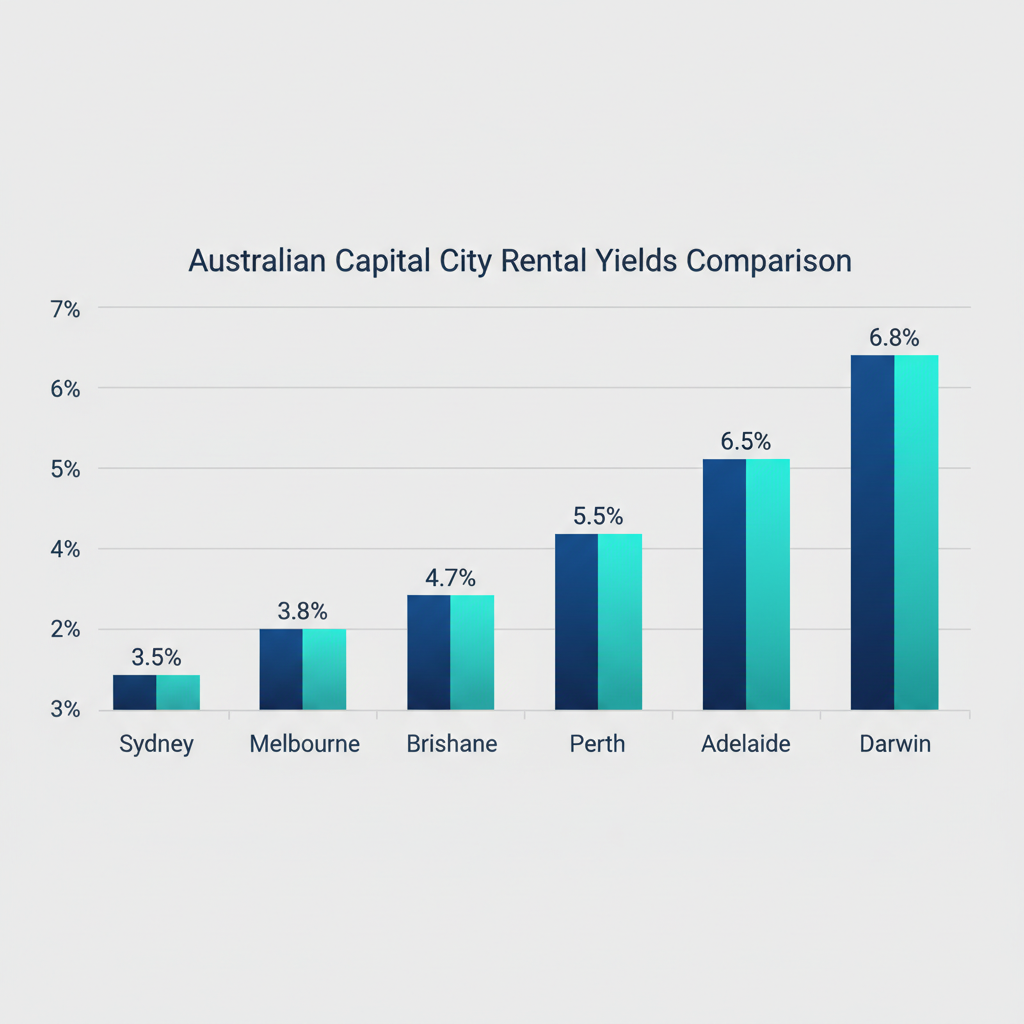
Darwin units average 7.5% rental yield, Perth units 5.7%, and Canberra units 5.2%, according to GlobalPropertyGuide.
Affordable Suburbs With Strong Rental Demand
Suburbs with median house prices under $600,000, low vacancy rates, and proximity to universities, hospitals, or industrial estates often deliver strong cash flow.
These areas attract renters who can't afford to buy but have stable employment.
Dual-Income and Granny Flat Properties
Properties with secondary dwellings, granny flats, or dual-occupancy setups generate two rental incomes from one asset.
This significantly improves cash flow and serviceability.
The Balanced Strategy Most Successful Investors Use
You don't have to pick one strategy and stick with it forever. The smartest investors use both at different stages.
Start With Capital Growth
Your first 1-3 properties should prioritise capital growth. This builds equity quickly and gives you the financial leverage to keep buying.
Focus on capital city suburbs or high-growth regional areas with strong fundamentals.
Add Cash Flow to Sustain Your Portfolio
Once you've built equity, add cash flow-positive properties to improve serviceability and reduce financial stress.
This allows you to hold more properties without overextending your income.
Refinance and Repeat
As your properties grow in value, refinance to access equity and reinvest. This is how investors build portfolios of 5, 10, or 15+ properties over 10-20 years.
The key is patience. Property is not a get-rich-quick strategy. It's a long-term wealth-building vehicle.
Example Portfolio Structure
- Property 1: Sydney or Melbourne suburb, strong capital growth, negatively geared
- Property 2: Brisbane or Adelaide suburb, balanced growth and yield
- Property 3: Regional Queensland or WA, high cash flow, positively geared
This structure balances growth, income, and serviceability.
Common Mistakes Investors Make
Understanding the strategy is one thing. Avoiding mistakes is another.
Chasing Yield Without Growth
Buying a property purely because it has a 7% rental yield is dangerous if the area has no growth prospects.
You'll earn income but never build equity. In 10 years, your property might still be worth what you paid for it.
Without capital growth, you can't scale.
Buying Growth Properties You Can't Afford to Hold
On the flip side, buying a high-growth property with terrible cash flow can force you to sell before you realise the gains.
If you can't afford to hold the property through rate rises or vacancies, you'll lose.
Ignoring Market Cycles
Every market moves in cycles. Perth was flat for a decade before booming in 2022-2025. Melbourne delivered strong growth from 2012-2017, then slowed.
Investors who buy at the peak of a cycle often wait years for returns. Those who buy early in the cycle capture the best gains.
Not Having a Long-Term Plan
Most investors buy one property and stop. They don't have a roadmap for property two, three, or four.
Without a plan, you're reacting to market conditions instead of building strategically.
How Buyers Agency Australia Balances Growth and Cash Flow for Clients

At Buyers Agency Australia, we don't believe in one-size-fits-all strategies.
Our process starts with understanding where you are in your investment journey, your borrowing capacity, and your long-term goals.
For early-stage investors, we focus on capital city suburbs with strong growth fundamentals. We identify areas with infrastructure investment, limited supply, and owner-occupier demand.
For portfolio builders, we source properties that balance growth and yield, ensuring your serviceability remains strong while your equity continues to compound.
We also help clients structure their purchases correctly from day one. That means using the right entities, lenders, and tax strategies to maximise long-term returns.
With over 20 years of experience and a $10M+ personal portfolio, Dragan Dimovski understands how to build scalable, sustainable portfolios that deliver both income and growth.
If you're ready to build a portfolio that actually works, book a free strategy session today.
Frequently Asked Questions
Should I prioritise capital growth or cash flow as a first-time investor?
Capital growth. It builds equity faster, allowing you to buy property two and three sooner. Cash flow becomes more important once you own multiple properties.
What is a good rental yield in Australia?
National averages range from 3-6%. Sydney averages 3.1%, while Darwin delivers 6.6%+. Regional areas often exceed 8%, but check growth prospects.
Can a property deliver both capital growth and cash flow?
Yes, but it's rare. Properties in Brisbane, Adelaide, and Perth often deliver balanced growth and yield. Regional QLD and WA offer high cash flow.
How do I calculate net rental yield?
Divide annual rental income by property value, then subtract all expenses (rates, insurance, strata, management, maintenance). Multiply by 100 for percentage.
Is negative gearing still worth it in 2026?
Yes, if the property delivers strong capital growth. Negative gearing reduces your taxable income while equity compounds. It's a long-term wealth strategy.