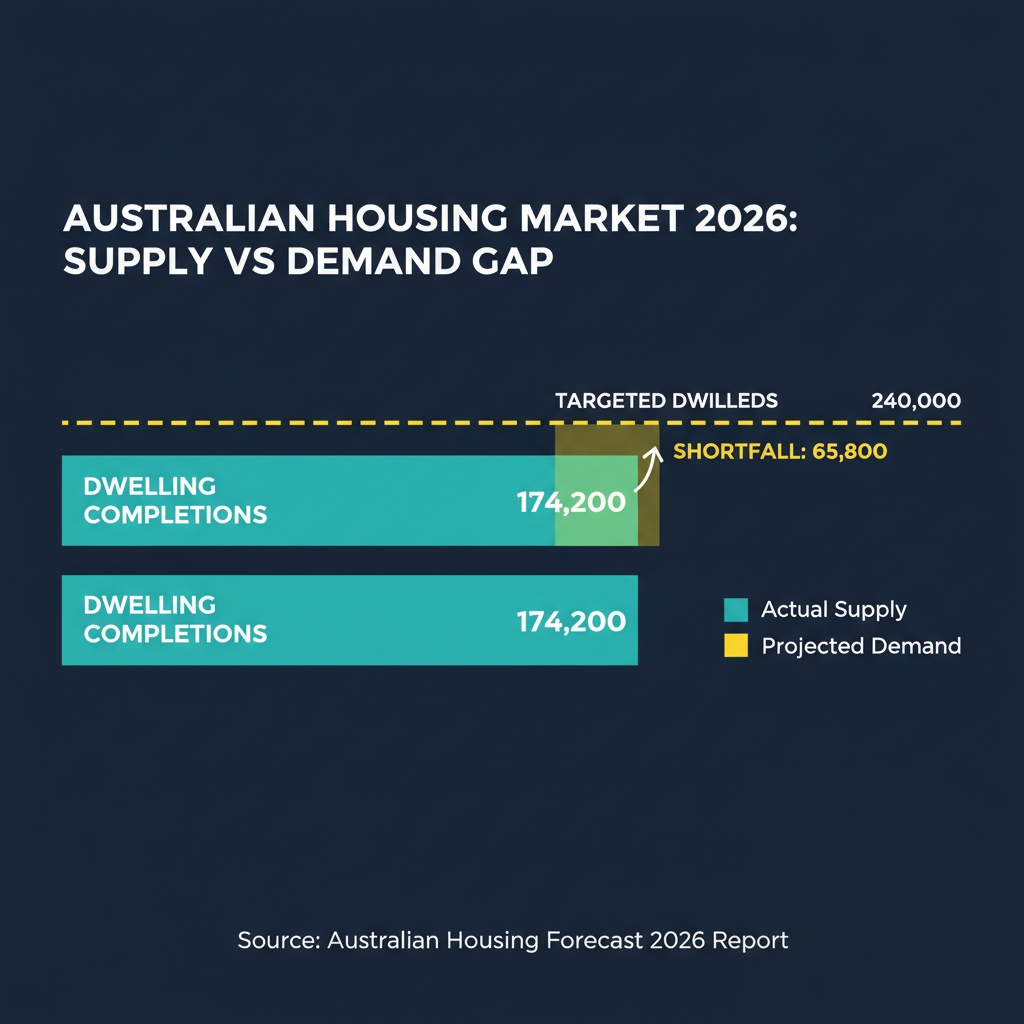
Australia's housing shortage has reached a critical point, with estimates placing the deficit between 200,000 and 300,000 homes for the existing population alone. In the year to September 2025, only 174,200 dwellings were completed, falling 65,800 short of the 240,000 homes needed annually to meet the government's Housing Accord target.
If you're watching property prices climb while trying to break into the market, you're not imagining things. The gap between housing supply and demand has never been wider in modern Australian history.
This isn't just affecting renters and first-home buyers. Investors, downsizers, and even established homeowners are navigating a market shaped by structural undersupply, record-low vacancy rates, and policy settings that can't keep pace with population growth.
The Numbers Behind Australia's Housing Shortage
Current Supply vs Demand Gap
The housing crisis isn't new, but the scale has intensified. According to AMP's Chief Economist Shane Oliver, Australia's cumulative housing shortage sits between 200,000 and 300,000 dwellings, depending on assumptions around household size.
Meanwhile, dwelling approvals tell a worrying story. In 2025, 195,700 dwellings were approved, roughly 44,000 fewer than the 240,000 run rate required to meet government targets.
But approvals don't guarantee completions. Over the last decade, approvals have outpaced completions by 5%, meaning even fewer homes actually get built.
Dwelling Completions Falling Short
Completion data from the Australian Bureau of Statistics shows that in the year to September 2025, just 174,200 dwellings were finished. That's 27% below what's needed.
To meet the National Housing Accord's goal of 1.2 million homes by mid-2029, Australia would need to deliver 240,000 completions annually. Current forecasts from the National Housing Supply and Affordability Council project only 938,000 new dwellings over the Accord period—a shortfall of 262,000 homes.
After accounting for demolitions, net new supply is projected at 825,000 homes, which is 79,000 fewer than expected underlying demand.
Why Supply Can't Keep Up
Several structural issues are choking off new housing:
Construction costs have soared by more than 40% since the start of the COVID-19 pandemic. Residential lot values have jumped 33% over the same period.
Labour shortages remain severe. BuildSkills Australia estimates the industry needs an additional 90,000 residential construction workers just to attempt current targets.
Interest rate impacts have made financing more expensive for developers. Many apartment projects now run on profit margins below 5%, leaving little buffer for cost overruns or delays.
Approval delays compound the problem. In Victoria, planning approvals average 140 days, or over 300 if objections are lodged. The time from approval to completion has increased by more than 50% over the past decade.
What the Housing Shortage Means for Property Prices
Price Growth Forecast for 2026
The supply crunch is directly feeding into price growth. National property values rose 8.2% in 2025, lifting the national median dwelling value to around $900,000.
For 2026, forecasts vary by institution but all point upward:
- KPMG predicts national growth of 7.7%, with houses up 8.2% and units rising 7.1%
- AMP expects 5–7% growth nationally
- ANZ has downgraded its forecast to 4.8% growth following the February rate hike
Perth, Brisbane, and Adelaide are forecast to outperform. KPMG expects Perth house prices to rise almost 13% in 2026, while Brisbane could see 11% growth. Canstar analysis suggests both cities could see median house price increases exceeding $100,000 in 2026 alone.
Sydney and Melbourne face affordability constraints but are still tipped to record 2–7% gains.
Regional Divergence and Hotspots
Australia's housing market is increasingly two-speed. Mid-sized capitals with severe supply shortages are seeing the strongest momentum.
Perth leads national growth, supported by the fastest population growth in the country, limited supply, and relative affordability compared to Sydney and Melbourne.
Brisbane benefits from ongoing interstate migration and strong infrastructure investment ahead of the 2032 Olympics.
Adelaide has seen affordability issues emerge, which may moderate future gains, but supply remains tight.
Sydney and Melbourne, while still expensive, are facing slower growth due to poor affordability, higher inventory, and weaker consumer sentiment in Victoria.
Rental Market Under Extreme Pressure
Rental vacancy rates remain near record lows at around 1.6% nationally. In the year to January 2026, advertised rents rose 5.4%, outpacing wage growth once again.
Since the end of 2019, national advertised rents have climbed 47%, according to Cotality, adding $11,400 to the annual cost of renting. In Sydney alone, renters are paying around $3,770 more per year than 12 months ago.
Demand for rental accommodation continues to far exceed available supply, which is driving both rental growth and investor interest.
Implications for Property Investors
Why This Creates Opportunity
For investors who understand the fundamentals, supply shortages create long-term tailwinds.
When underlying population-driven demand exceeds supply, prices rise. This dynamic has been in play for 20 years, and it's intensifying.
The key for investors is to focus on markets where:
- Population growth is strong
- Vacancy rates are below 2%
- New supply is limited
- Infrastructure investment is confirmed
- Rental yields remain attractive
These conditions exist right now in Perth, Brisbane, and select regional centres.
Strategic Advice for Investors
Don't chase headlines. FOMO buying leads to overpaying in overheated markets. Strategic investors buy assets with strong fundamentals, not postcodes.
Focus on rental yield. With interest rates remaining elevated, cash flow is critical. Look for properties offering yields above 4.5% in high-growth corridors.
Buy in supply-constrained locations. Markets with low listing volumes and high buyer competition will outperform over the next 3–5 years.
Consider interstate investment. Sydney and Melbourne investors are increasingly looking to Brisbane, Perth, and Adelaide for better yield and growth prospects.
How Buyers Agency Australia Helps Investors Navigate Supply Shortages

At Buyers Agency Australia, we specialise in identifying under-market opportunities in supply-constrained markets. With over 20 years of experience and a $10M+ personal portfolio, our founder Dragan Dimovski has built a reputation for data-driven investment strategies that prioritise long-term wealth creation.
We use 10-year portfolio modelling to ensure every acquisition supports your financial goals, not just short-term market sentiment. Our transparent, fixed-fee model means we're aligned with your success, not commission-based incentives.
Whether you're building a portfolio from scratch or scaling from one property to five, we provide end-to-end support—from suburb research to settlement—so you can invest with confidence in markets shaped by structural undersupply. Book a free strategy session to discuss your investment goals.
What It Means for First-Home Buyers
The Affordability Challenge
First-home buyers face the toughest conditions in a generation. The time required to save for a deposit has blown out to 10.6 years, and households with a new mortgage now spend 50% of their income on housing.
The house price-to-income ratio sits at 8.0, meaning the median home costs eight times the median annual household income. In Sydney and Melbourne, that ratio is even higher.
With property prices rising faster than wages, the gap between aspiration and reality is widening.
Government Support Schemes
The Federal Government has expanded the First Home Guarantee Scheme, allowing eligible buyers to purchase with as little as 5% deposit. This has brought forward demand, with Domain estimating the scheme could pull 20,000 first-home buyers into the market in year one.
The Help to Buy scheme allows the government to take a 30–40% equity stake in a property, reducing upfront costs.
But these demand-side policies add fuel to an already undersupplied market, potentially driving prices higher in the short term.
First-Home Buyer Strategy
If you're a first-home buyer, here's what to focus on:
Get pre-approved early. Knowing your borrowing capacity helps you act quickly in competitive markets.
Consider rentvesting. Buying an investment property in an affordable, high-growth market while continuing to rent where you want to live can be a smarter wealth-building strategy.
Work with a buyer's advocate. Professional representation gives you access to off-market deals, skilled negotiation, and peace of mind that you're not overpaying. Contact Buyers Agency Australia to discuss your first-home purchase.
Look beyond the CBD. Outer suburbs and regional centres with strong infrastructure investment often offer better value and growth potential.
Policy and Structural Issues Driving the Shortage
The 1.2 Million Homes Target Won't Be Met
The Albanese government's Housing Accord aims to deliver 1.2 million new homes by mid-2029. But current trends show this target is unachievable.
Over the first 18 months of the Accord, 287,200 dwellings were approved—20% fewer than the 360,000 target. No state or territory is on track to meet its implied housing target.
Victoria is forecast to achieve 98% of its target, while Western Australia, Queensland, and the ACT will hit around 80%. Other states lag further behind.
Migration and Population Growth
Australia recorded 266,000 net migrants annually between Q4 2019 and Q2 2025, including the COVID-19 border closure. This is the strongest net overseas migration in the nation's history.
The government has pledged not to lower immigration, meaning the housing shortage will worsen unless construction output accelerates dramatically.
If immigration remains strong, KPMG forecasts Australia's housing shortage could double to 400,000 by 2028–29.
Why Construction Can't Scale Fast Enough
Even if government policies improve, the construction industry lacks the capacity to deliver 240,000 homes per year.
Productivity in residential construction has been falling for a decade. Overregulation, slow land release, labour shortages, and material cost increases all constrain supply.
The solution requires long-term reform—planning system overhauls, workforce development, and tax incentives that prioritise housing supply over speculation.
FAQ
How many homes is Australia short?
Between 200,000 and 300,000 dwellings for the existing population, with the gap widening if migration stays high.
Will house prices drop in 2026?
No. All major forecasters predict continued price growth, though at a slower pace than 2025 due to affordability constraints.
Which cities have the worst housing shortage?
Perth, Brisbane, and Adelaide have the lowest vacancy rates and strongest buyer demand relative to supply.
How long will the housing shortage last?
At least another decade. Construction output won't meet demand until 2030 or beyond, assuming major policy reforms.
Should I invest in property during a housing shortage?
Yes, if you buy strategically. Supply shortages support long-term price growth and rental yield, making it a strong investment environment for informed buyers.