Property investors are moving away from Sydney in 2026 because median house prices have reached $1.6 million while rental yields have dropped below 3%, making cash flow impossible and locking out most buyers. Combined with rising interest rates reducing borrowing capacity by up to $50,000, investors are shifting capital to Brisbane, Adelaide, and Perth where entry prices are 30-50% lower and rental yields exceed 4.5%.
If you're searching for investment property in 2026, you've probably noticed something. Sydney keeps getting more expensive while delivering less income. You're not imagining it.
The city that once dominated Australia's property investor mindset is losing its appeal. Not because Sydney lacks long-term fundamentals, but because the math simply doesn't work anymore for anyone building wealth through property. Median house prices sitting at $1.6 million with gross rental yields below 3% mean you're paying premium prices for underwhelming returns.
Meanwhile, markets like Brisbane, Adelaide, and Perth are delivering what Sydney can't: affordable entry points, strong rental yields above 4.5%, and genuine capital growth momentum backed by infrastructure spending and migration. When Buyers Agency Australia works with interstate investors, the question isn't whether to leave Sydney—it's where to move capital next.
Sydney's Affordability Crisis Has Hit Breaking Point in 2026
Median Prices Make Entry Impossible for Most Buyers
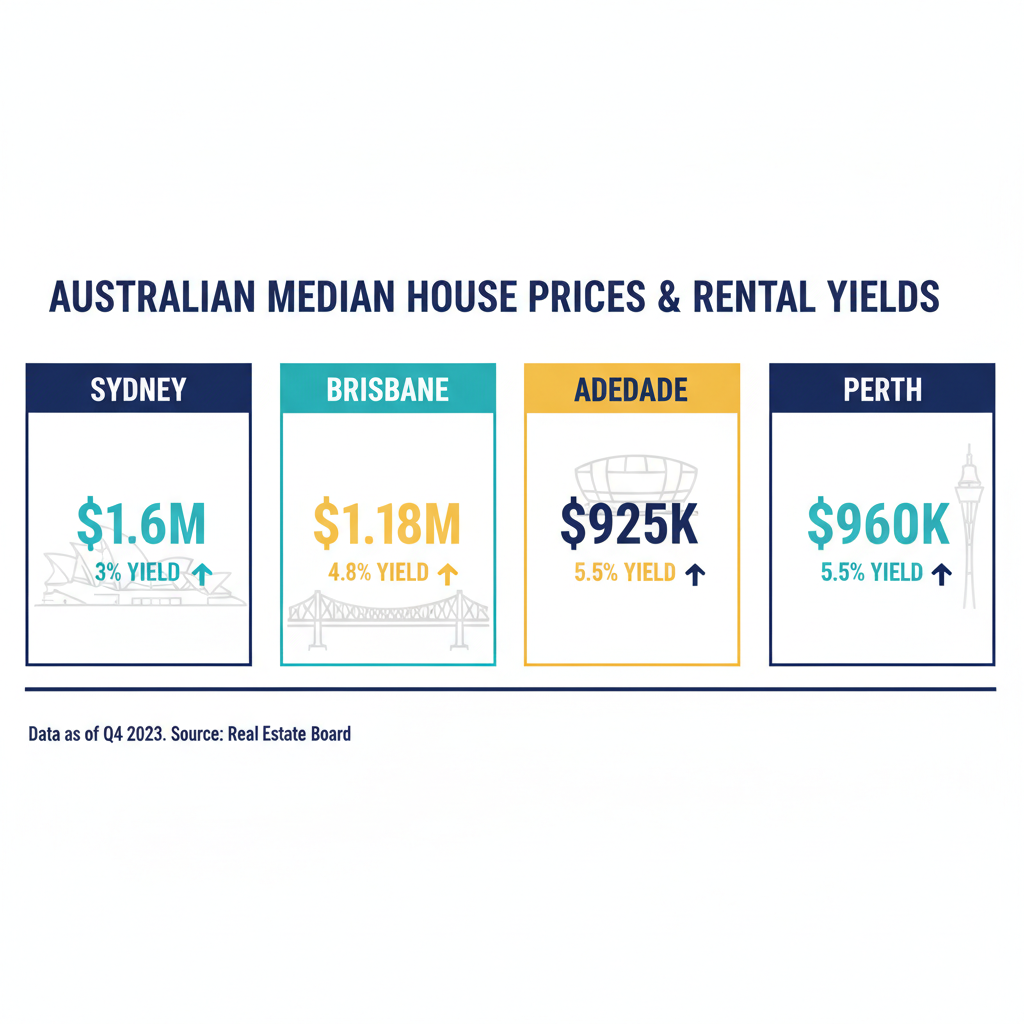
Sydney's median house price reached $1.6 million in early 2026, according to Cotality data. That's not a premium suburb figure. That's the city-wide median.
For context, a buyer needs a $320,000 deposit (assuming 20% down) plus stamp duty of around $78,000 just to get through the door. You're looking at close to $400,000 in upfront capital before you own anything. Even with the expanded First Home Guarantee allowing 5% deposits up to $1.5 million, monthly repayments at current interest rates exceed $8,500 on a standard variable loan.
That's simply out of reach for the majority of Australian households, including experienced investors who would rather deploy that capital across multiple properties in higher-performing markets.
Rental Yields Below 3% Destroy Cash Flow
Sydney's gross rental yields have collapsed to around 2.8-3.0% for houses, the lowest of any Australian capital city. Units fare slightly better at 3.5-4.0%, but still lag behind interstate alternatives by 1-2 percentage points.
Let's be clear about what that means. On a $1.6 million house returning 3% gross yield, you're collecting $48,000 per year before costs. After property management fees, council rates, insurance, maintenance, and vacancy, your net yield drops closer to 2%. If you're borrowing at 6.5%, you're losing money every single month.
Investors can no longer rely on capital growth alone to justify holding negatively geared Sydney property, especially when interest rates have risen and borrowing capacity has tightened significantly in 2026.
Rising Interest Rates Have Cut Borrowing Power by $50,000
The RBA raised the cash rate to 4.10% in March 2026 following a February hike, reversing the rate cuts delivered in 2025. According to Canstar modelling, these two rate hikes alone have reduced borrowing capacity by approximately $25,000 for single-income earners and $49,000 for dual-income couples.
That's a direct hit to how much property you can afford. A buyer who could borrow $900,000 in late 2025 might only qualify for $850,000 today. In Sydney's market, that's the difference between securing a livable property and being priced out entirely.
For investors holding variable-rate loans, repayments have increased by hundreds of dollars per month since January 2026. On a $1 million loan, each 0.25% rate rise adds roughly $150 per month to repayments. Two hikes mean an extra $300 monthly, or $3,600 annually, straight off your cash flow.
Where Investors Are Moving Capital in 2026
Brisbane: 4-8% Growth with 4.5-5.5% Rental Yields
Brisbane has become the default interstate destination for Sydney investors, and the numbers explain why. Median house prices sit around $1.18 million as of February 2026, according to NAB market data, roughly $420,000 cheaper than Sydney.
More importantly, rental yields in Brisbane range from 4.5% to 5.5% in middle-ring suburbs, double what you'd achieve in Sydney. That's the difference between a negatively geared liability and a property that contributes positively to your portfolio cash flow.
Brisbane's annual growth rate hit 17.3% in 2025, driven by interstate migration, infrastructure spending linked to the 2032 Olympics, and vacancy rates below 1%. Major bank forecasts for 2026 range from 4% to 9.5% growth, with ANZ predicting the strongest performance at 9.5% and CBA on the conservative end at 5%.
The city benefits from $7.1 billion in Olympic infrastructure funding, including Cross River Rail, Brisbane Metro, and stadium upgrades. These aren't speculative projects. They're under construction, creating tangible employment and population growth that directly supports property demand.
When Buyers Agency Australia sources properties in Brisbane, the focus is on established suburbs within 10-20km of the CBD—places like Kenmore, Albany Creek, and Ormiston—where scarcity, transport links, and owner-occupier appeal combine to deliver long-term outperformance.
Adelaide: Median Prices Under $1 Million with 4.5-6.5% Yields
Adelaide remains Australia's most affordable capital city for property investment, with median house prices around $925,000 and units at $660,000, according to Cotality data for January 2026. That's nearly $700,000 cheaper than Sydney houses.
Rental yields in Adelaide range from 4.5% to 6.5% depending on suburb and property type, with northern suburbs near defence precincts and southern growth corridors offering some of the strongest cash-flow opportunities in the country. Vacancy rates remain exceptionally tight at 0.8%, among the lowest nationally, ensuring consistent rental demand.
Adelaide's property market delivered 8.8% annual growth in 2025, with forecasts for 2026 ranging from 4% to 6%. The city benefits from the $90 billion AUKUS submarine program, which is creating thousands of high-paying defence jobs at Osborne, driving sustained housing demand across northern and western corridors.
Infrastructure investment includes the North-South Corridor motorway, Gawler Line electrification, and ongoing hospital expansions. These projects improve connectivity and amenity across Greater Adelaide, making established suburbs like Elizabeth, Salisbury, and Morphett Vale increasingly attractive to both tenants and owner-occupiers.
For investors, Adelaide offers the rare combination of affordable entry, strong yield, and genuine capital growth potential—without the negative gearing trap that defines Sydney's market.
Perth: 8% Growth Forecast with Sub-1% Vacancy Rates
Perth is delivering some of the strongest investor outcomes in Australia, with median house prices around $960,000 and rental yields pushing 5-6% in high-demand suburbs. Vacancy rates sit at just 0.6% as of January 2026, according to SQM Research data, the tightest rental market in the country.
Western Australia's population surpassed 3 million in 2025, making it the fastest-growing state, yet new housing construction remains well below demand. Only 22,602 new homes were completed in the 2024-25 financial year, nowhere near sufficient to accommodate population growth.
Property values in Perth recorded 18.4% growth in 2024, with Westpac forecasting 8% growth for 2026. That's significantly above the national average and more than double Sydney's expected performance.
Perth benefits from a low mortgage-to-income ratio and relative affordability compared to eastern capitals, meaning buyers can secure quality property without stretching serviceability. For investors, that translates to better holding power and lower financial stress even as interest rates rise.
Median time on market in Perth is just 9 days, one of the fastest in Australia, signalling intense buyer competition and strong underlying demand. Properties lease in a median of 16 days, with suburbs like Subiaco and Joondalup moving even faster.
Buyers Agency Australia targets Perth's established suburbs near employment hubs and transport links, where infrastructure investment and scarcity combine to deliver both yield and growth.
The Financial Reality: Sydney vs Interstate Comparison
Entry Price and Deposit Requirements
Let's compare what $400,000 in upfront capital buys you across different markets.
In Sydney, that $400,000 covers your 20% deposit and stamp duty on a $1.6 million median house. You're borrowing $1.28 million at current variable rates around 6.5%, resulting in monthly repayments of approximately $8,500. Your gross rental income at 3% yield is $4,000 per month. You're losing $4,500 monthly before accounting for any other holding costs.
In Brisbane, the same $400,000 secures a $1.2 million property with a 20% deposit plus stamp duty. You're borrowing $960,000 with monthly repayments around $6,400. At a 4.8% gross yield, rental income is $4,800 per month. You're negatively geared by $1,600 monthly, but your equity position is stronger and capital growth forecasts are superior.
In Adelaide, $400,000 can secure you two investment properties. You could buy two houses at $500,000 each in high-yield northern suburbs, each with a 20% deposit ($100,000) and minimal stamp duty due to lower price points. Each property delivers 5.5% gross yield ($27,500 annually or $2,290 monthly). Your combined rental income is $4,580 per month against combined repayments of approximately $5,000. You're close to neutral cash flow while holding two appreciating assets.
In Perth, $400,000 secures a $900,000 property with strong yield and capital growth momentum. At 5.5% gross yield, you're collecting $4,125 monthly against repayments of $6,000. You're negatively geared by $1,875 monthly, but vacancy rates below 1% ensure consistent tenancy and minimal income gaps.
The takeaway: Every dollar of capital deployed interstate delivers better yield, lower holding costs, and stronger growth prospects than the same capital locked in Sydney.
Cash Flow Comparison: Sydney vs Brisbane
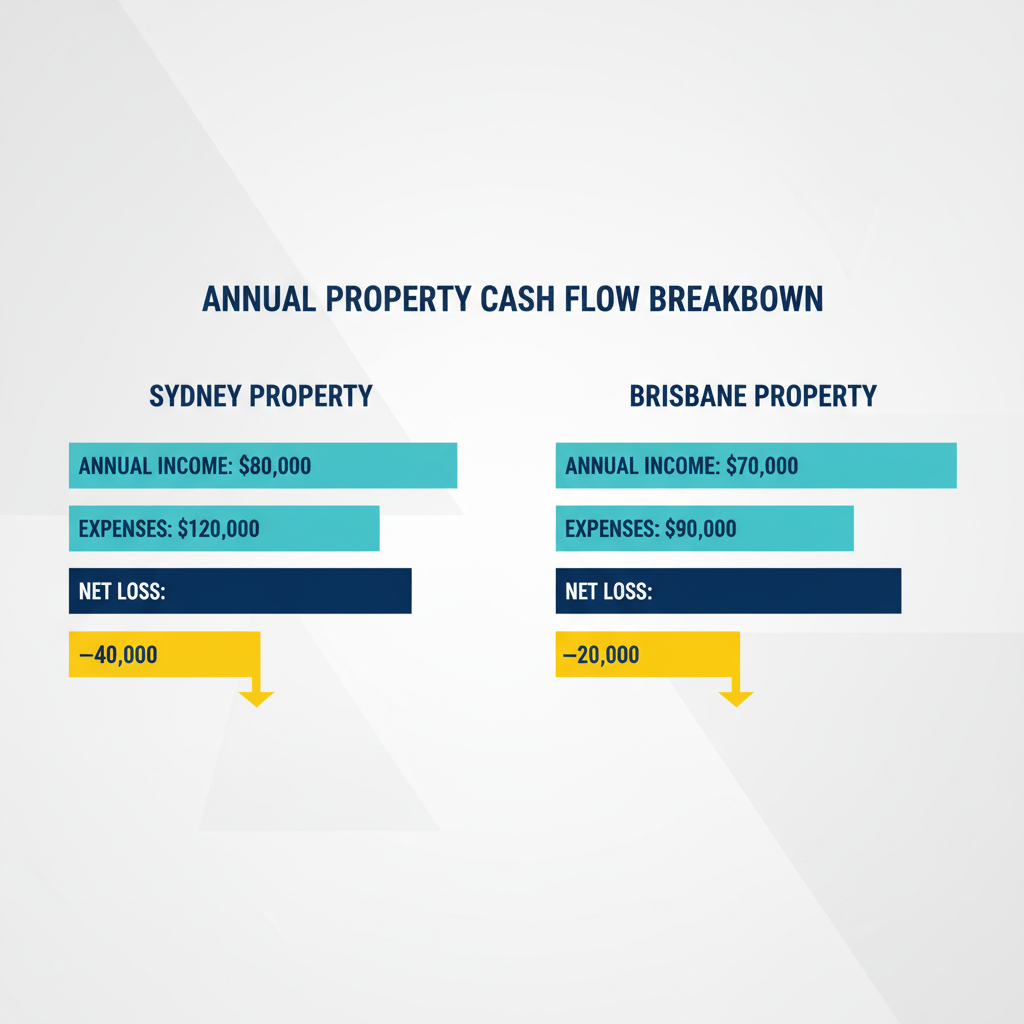
Let's run a side-by-side annual cash flow comparison for a $1.2 million investment property in Sydney versus Brisbane.
Sydney:
- Purchase price: $1.2M
- Gross rental yield: 3.0%
- Annual rental income: $36,000
- Annual loan repayments (80% LVR at 6.5%): $62,000
- Property management (7%): $2,520
- Council rates: $2,000
- Insurance: $1,200
- Maintenance (1% of property value): $12,000
- Total annual costs: $79,720
- Net annual loss: $43,720
Brisbane:
- Purchase price: $1.2M
- Gross rental yield: 4.8%
- Annual rental income: $57,600
- Annual loan repayments (80% LVR at 6.5%): $62,000
- Property management (7%): $4,032
- Council rates: $1,800
- Insurance: $1,400
- Maintenance (1% of property value): $12,000
- Total annual costs: $81,232
- Net annual loss: $23,632
Brisbane delivers $20,000 better cash flow annually on the same purchase price. Over a 10-year hold, that's $200,000 less capital required to fund the investment, significantly improving your overall return on equity.
When you factor in Brisbane's superior capital growth forecasts (4-8% vs Sydney's 5-7%), the gap widens further. Brisbane isn't just cheaper to hold—it's likely to outperform Sydney on appreciation as well.
Tax Implications and Negative Gearing
Negative gearing remains a key strategy for Australian property investors, allowing you to offset rental losses against your taxable income. But here's the issue: the larger your annual loss, the more capital you need to fund the investment.
In the Sydney example above, you're losing $43,720 annually. At a marginal tax rate of 37%, you're getting back roughly $16,200 via negative gearing, leaving you $27,520 out of pocket each year. Over 10 years, that's $275,000 in after-tax cash you've pumped into holding the property.
In Brisbane, your annual loss is $23,632. At the same tax rate, you recoup $8,740, leaving you $14,892 out of pocket annually. Over 10 years, that's $148,900—still significant, but $126,000 less than Sydney.
The difference is stark. Negative gearing is supposed to accelerate wealth creation by allowing you to hold growth assets you couldn't otherwise afford. But when the losses become too large, you're simply burning capital.
Smart investors in 2026 are prioritizing markets where negative gearing supports growth, not where it's required just to stay afloat.
Why Borrowing Capacity Matters More Than Ever in 2026
Serviceability Buffers Are Tightening
Lenders assess your ability to service a loan by stress-testing repayments at rates 3% above the actual loan rate. With variable rates now sitting around 6.5%, lenders are testing your serviceability at 9.5%.
That buffer has always existed, but as actual rates climb, the gap between what you can theoretically afford and what lenders will approve shrinks rapidly. A borrower who qualified for $800,000 at 5.5% variable might only qualify for $720,000 at 6.5%, even if their income hasn't changed.
New debt-to-income (DTI) restrictions introduced in February 2026 further limit high-leverage lending. Banks are now required to restrict the share of new loans with DTI ratios above six times gross income, making it harder for investors to borrow large sums relative to their earnings.
For Sydney investors, this creates a double bind. Prices remain elevated, but your ability to borrow has deteriorated. You're forced to bring more equity to the table or accept a lower-quality property in a less desirable location.
Interstate markets offer a path forward. Lower entry prices mean you can secure quality property within tightened serviceability limits, preserving your borrowing capacity for future purchases.
Rising Interest Rates Have Reset the Market
The RBA's decision to hike rates twice in early 2026 marked a clear shift in monetary policy. After three rate cuts in 2025, inflation rebounded in the second half of the year, forcing the central bank to reverse course.
The March 2026 rate hike was decided by a 5-4 vote, with all board members acknowledging inflation remains above target and risks tilting upward due to geopolitical factors, according to the RBA's official statement. That split decision signals further hikes remain possible if inflation doesn't moderate.
Markets are currently pricing a roughly even chance of another 0.25% hike in May 2026. If that occurs, variable mortgage rates will climb above 7%, pushing monthly repayments on a $1 million loan past $7,500.
For investors, this environment demands careful market selection. Sydney's combination of high entry prices, low yields, and rising rates creates a perfect storm of negative cash flow and constrained borrowing capacity. Interstate markets with stronger yields and lower entry prices offer better risk-adjusted returns.
Interstate Investment Preserves Future Borrowing Power
One of the most overlooked benefits of interstate investment is borrowing capacity preservation. When you buy a $600,000 property in Adelaide instead of a $1.6 million property in Sydney, you're using $1 million less debt.
That unused borrowing capacity remains available for your next purchase. It allows you to scale your portfolio faster, acquiring multiple properties across different markets instead of tying all your equity and serviceability into a single Sydney asset.
Buyers Agency Australia works with investors to model 10-year portfolio strategies that prioritize diversification and borrowing power preservation. The goal isn't just to buy one property—it's to build a portfolio of 3-5 properties over a decade that collectively deliver strong cash flow and capital growth.
Sydney's pricing makes that impossible for most investors. Interstate markets make it achievable.
How Buyers Agency Australia Helps Investors Identify the Right Interstate Markets

Data-Driven Market Selection Based on Yield and Growth
Buyers Agency Australia doesn't chase headlines or speculative hotspots. The firm's approach is built on data-driven analysis of rental yield, capital growth history, vacancy rates, infrastructure investment, and employment diversity.
Founder Dragan Dimovski has over 20 years of property investment experience and a personal portfolio exceeding $10 million. That experience informs every market recommendation and property selection.
When assessing interstate markets, the firm prioritizes:
- Rental yield above 4.5%: Ensures positive or near-neutral cash flow, reducing the capital drain of negative gearing.
- Vacancy rates below 2%: Indicates strong tenant demand and minimal income disruption.
- Infrastructure catalysts: Transport upgrades, employment hubs, and government investment drive long-term demand.
- Population growth: Interstate and overseas migration create sustained housing demand.
- Median price relative to Sydney: Lower entry prices improve affordability and borrowing capacity utilization.
This framework consistently identifies Brisbane, Adelaide, and Perth as superior alternatives to Sydney for investors focused on wealth creation rather than postcode prestige.
End-to-End Service for Interstate Buyers
Buying interstate presents unique challenges. You're evaluating suburbs you may never have visited, dealing with unfamiliar property managers, and navigating interstate settlement processes.
Buyers Agency Australia removes that complexity. The firm handles:
- Market research and suburb selection based on your investment criteria
- Property inspections and due diligence (building and pest, title searches, council checks)
- Negotiation and contract management
- Coordination with conveyancers, lenders, and property managers
- Post-settlement support including tenant placement and ongoing portfolio reviews
You're not simply handed a list of properties and left to figure out the rest. You're guided through every step by a team with boots-on-ground expertise in each target market.
That level of support is particularly valuable for time-poor professionals who recognize the opportunity in interstate investment but lack the bandwidth to execute independently.
Transparent Fixed-Fee Model Aligns Incentives
Buyers Agency Australia operates on a transparent fixed-fee model, not a percentage of purchase price. That structure eliminates the incentive to push clients toward more expensive properties and ensures advice is genuinely aligned with your financial goals.
Whether you're buying a $500,000 property in Adelaide or a $1.2 million property in Brisbane, the service level and strategic advice remain identical. The focus is on finding the right property for your portfolio, not maximizing the agency's commission.
Clients also benefit from access to off-market opportunities—properties that never hit public listings. In competitive interstate markets like Brisbane and Perth, off-market access can be the difference between securing a high-quality asset and missing out entirely.
To explore how Buyers Agency Australia can help you identify the highest-performing interstate markets for your portfolio, book a free strategy session.
Key Risks and Considerations for Interstate Investment
Market Volatility and Economic Cycles
No property market moves in a straight line. Brisbane, Adelaide, and Perth have all experienced cycles of boom and correction over the past two decades.
Perth, in particular, has a history of volatility tied to Western Australia's resources sector. The city's property market surged during the mining boom of 2012-2014, then corrected sharply when commodity prices fell. Prices didn't recover to 2014 peaks until 2024.
That history doesn't invalidate Perth as an investment destination in 2026, but it does require careful property selection. Focus on established suburbs with diversified employment bases, not mining towns or outer-fringe developments entirely dependent on resources sector employment.
Brisbane and Adelaide have demonstrated more stable long-term growth trajectories, but both markets are currently experiencing above-average appreciation. Forecasts suggest moderation in 2027 as affordability constraints and higher interest rates temper demand.
Smart investors buy for the long term, not short-term speculation. If you're planning a 10+ year hold, current market cycles matter less than underlying fundamentals like population growth, infrastructure investment, and rental demand.
Property Management and Distance
Managing an interstate investment property requires a reliable property manager. You won't be driving past to check on maintenance issues or meeting tenants in person.
Choose a property manager with a strong local reputation, transparent fee structures, and proactive communication. Poor property management can erode returns through extended vacancies, deferred maintenance, and tenant disputes.
Buyers Agency Australia connects clients with vetted property managers in each interstate market, ensuring your asset is professionally managed from day one.
Distance also affects your ability to assess property condition before purchase. Rely on professional building and pest inspections, and don't skip due diligence just because a property looks good in photos.
Strata and Body Corporate Issues
If you're considering units or townhouses in Brisbane or Perth, pay close attention to strata fees and body corporate governance. High strata fees can erode cash flow, while poorly managed complexes can result in unexpected special levies for building repairs.
Request strata reports during due diligence and review the sinking fund balance, recent AGM minutes, and any planned major works. A complex with deferred maintenance or governance disputes is a red flag.
Houses on freehold land avoid these issues entirely but typically command higher purchase prices and lower rental yields than units. Weigh the trade-offs based on your cash flow priorities and risk tolerance.
Frequently Asked Questions
Is Sydney still a good long-term investment despite current challenges?
Sydney remains fundamentally strong due to population growth, employment diversity, and infrastructure investment. However, current pricing and yields make it unsuitable for most investors seeking cash flow or portfolio growth. Long-term holders with significant equity may benefit from appreciation, but new investors should prioritize interstate markets with better risk-adjusted returns.
How do I finance an interstate investment property?
Lenders treat interstate investment properties identically to local investments for serviceability and LVR purposes. You'll need a 20% deposit to avoid lenders mortgage insurance on investment loans. Work with a mortgage broker experienced in investment lending to compare rates and structures across lenders. Your borrowing capacity depends on income, existing debts, and the rental income the new property will generate.
What are the tax implications of owning interstate investment property?
Tax treatment is identical regardless of property location. You can negatively gear rental losses against your taxable income, claim depreciation on building and fixtures, and deduct expenses like property management, insurance, and loan interest. CGT applies when you sell, with a 50% discount available if you've held the property for more than 12 months. Consult a tax advisor to optimize your structure.
Should I visit the interstate market before buying?
Visiting helps you understand the area's amenity, transport links, and tenant appeal, but it's not essential if you're working with a buyer's agent who provides detailed market research and property inspections. Many successful interstate investors rely entirely on professional due diligence and never visit the property before settlement. Prioritize data over emotional attachment to location.
How quickly can interstate markets correct if interest rates keep rising?
Higher interest rates reduce borrowing capacity and dampen buyer demand, which can slow or reverse capital growth. However, markets with tight vacancy rates and strong rental yields tend to be more resilient because investors can still achieve positive cash flow. Brisbane, Adelaide, and Perth all benefit from structural supply shortages that support prices even as rates rise. Corrections are possible but less likely in markets with genuine demand fundamentals.