Rising interest rates haven't crashed Australia's property market because the nation faces a structural housing deficit of 200,000 to 300,000 dwellings. Strong population growth, record-low rental vacancy rates near 1.6%, and chronic construction underperformance create demand floors that outweigh borrowing cost pressures. While Sydney and Melbourne are slowing, Brisbane, Perth, and Adelaide continue posting double-digit gains.
The RBA raised the cash rate to 4.1% in March 2026, marking the second consecutive hike. Variable mortgage rates now sit between 6.5% and 7%, up from pandemic lows of 2.5%.
Yet national property prices rose 8.6% through 2025, adding $71,400 to the median dwelling value. Every major forecast predicts further gains in 2026, defying traditional interest rate logic.
This isn't a temporary anomaly. It's a fundamental shift driven by supply constraints that interest rates alone can't fix. Buyers Agency Australia helps investors cut through media fear to identify where these structural forces create genuine opportunity.
Why Interest Rates Haven't Crashed Property Prices in 2026
The RBA's Rate Pivot Created Confusion Not Collapse
The Reserve Bank delivered three rate cuts through 2025, lowering the cash rate from 4.35% to 3.6%. Markets priced in more easing.
Then inflation spiked to 3.8% by December 2025. The Middle East conflict drove oil prices above US$100 per barrel. Petrol jumped 15% in weeks.
The RBA hiked 25 basis points in February 2026, then again in March. Markets now expect the cash rate to reach 4.85% by year-end, according to Canstar data.
But here's what the headlines miss: property prices didn't crash during the 2022-2023 hiking cycle either. Sydney and Melbourne dipped temporarily, then recovered. Brisbane, Perth, and Adelaide powered through with double-digit growth.
The reason is simple. Australia isn't building enough homes to meet demand.
Australia's 200,000 Dwelling Shortage Is the Real Story
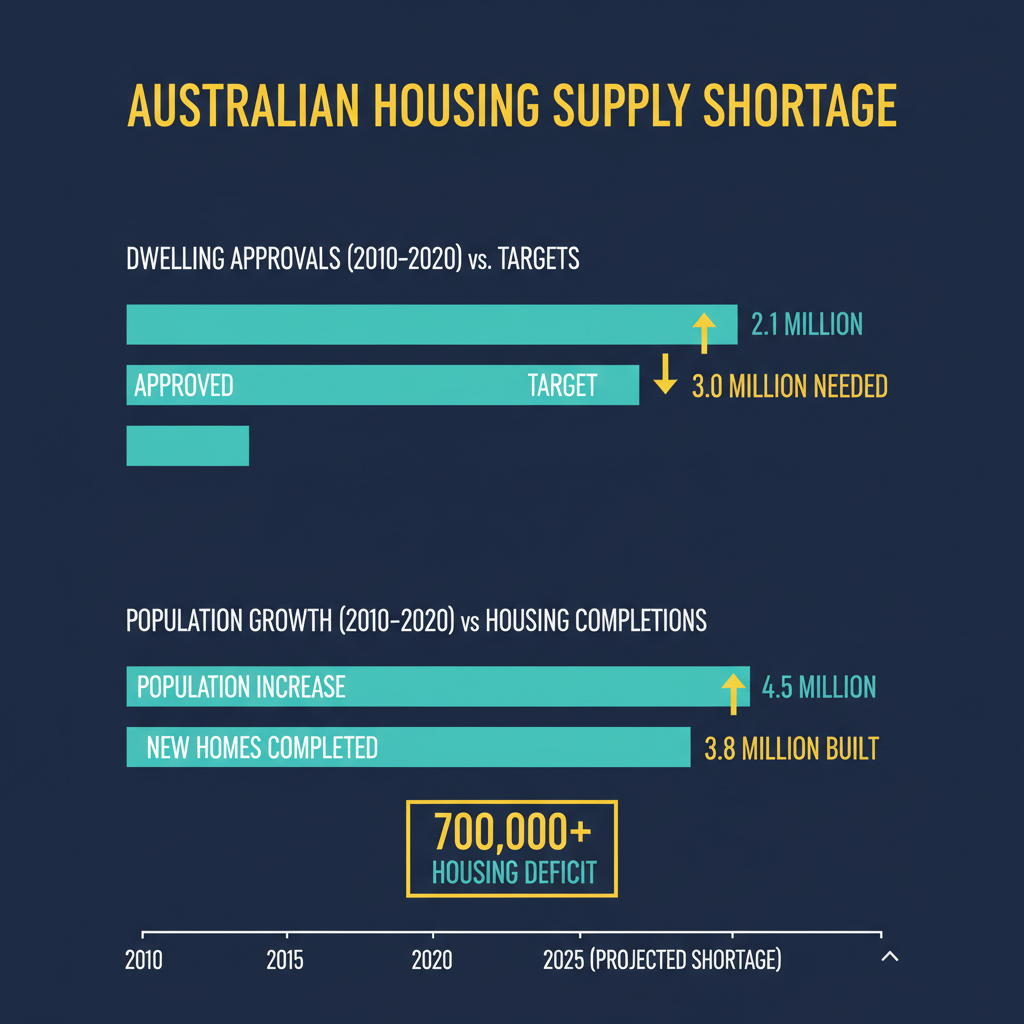
Shane Oliver, AMP's chief economist, estimates Australia's cumulative housing deficit sits between 200,000 and 300,000 dwellings. The National Housing Supply and Affordability Council projects the shortage could hit 400,000 by 2028-29 if migration remains strong.
The government's Housing Accord targets 1.2 million new homes over five years. That's 240,000 annually.
Dwelling approvals in the year to February 2026 totaled 196,500. That's 77,660 homes (19%) below target. Completions lag approvals by roughly 5%, according to MacroBusiness analysis.
Construction costs rose 40% since 2020. Labour shortages persist. Interest rate hikes make development finance more expensive. The result: supply is getting worse, not better.
Property prices can't crash when there aren't enough homes to meet demand.
Population Growth Outpaces Construction by 73,000 Homes Annually
Australia's net overseas migration hit record levels post-pandemic. While slowing from peak 2023 levels, migration still added 423,000 people in the year to March 2025.
The government forecasts 365,000 net arrivals for 2025-26. Even at lower levels, migration creates housing demand of roughly 180,000 dwellings per year when accounting for average household size.
Australia is completing around 165,000 to 190,000 dwellings annually. The gap between demand and supply is approximately 40,000 to 75,000 homes per year.
This isn't a short-term mismatch. It's a structural problem compounding annually. Every year the shortage grows, it puts upward pressure on prices and rents.
Interest rates influence how quickly prices rise. They don't determine whether prices rise.
Rental Vacancy Rates Near Record Lows Create Price Floors
National rental vacancy rates sit at 1.6%, near record lows. Any rate below 3% signals a tight rental market. Below 2% indicates crisis conditions.
NAB's Housing Monitor shows advertised rents rose 5.9% on a six-month annualized basis in December 2025. Brisbane's forecast vacancy rate could drop to 0.7% by 2030.
Low vacancy rates have two effects. First, they support investor demand. Strong rental returns offset higher mortgage costs. Second, they force renters into buying, maintaining purchase demand despite affordability constraints.
When vacancy rates are this low, landlords can't exit the market without creating rental chaos. This creates a floor under property values.
Queensland Markets Show How Supply Beats Rate Movements
Brisbane Property Prices Up 11% Despite Higher Rates
Brisbane house prices are forecast to grow 10-11% in 2026, according to KPMG's Residential Property Outlook. Units are forecast up 8%.
This isn't speculative froth. It's genuine supply-demand imbalance.
Brisbane's population is growing faster than construction. Infrastructure projects like Cross River Rail and the 2032 Olympics are concentrating demand in supply-constrained suburbs.
Advertised stock is 29% below the five-year average. Properties sell in a median of 22 days. Investors are achieving strong rental yields while prices appreciate.
Buyers Agency Australia works with clients buying Brisbane properties that deliver 5-6% rental yields with capital growth potential. The combination is rare in Sydney or Melbourne.
Regional Queensland Recording 12.6% Annual Growth
Regional Queensland delivered 12.6% growth in the 12 months to January 2025, according to Cougar Homes data.
Townsville house prices jumped 24.75% to $695,000. Mackay rose 24% to $598,800. Cairns increased 10.82% to $764,020.
These aren't fringe markets. They're regional cities with defense, mining, tourism, and healthcare employment bases.
Affordability relative to capital cities is driving migration. Sydney and Melbourne buyers are cashing out equity and purchasing multiple properties in Queensland.
This trend accelerates when rates rise. Higher rates don't stop buyers—they redirect them to markets where yields and growth align.
Perth Leading the Nation with 13% Growth in 2025
Perth house prices rose approximately 13% in 2025. The median exceeded $1 million for the first time in early 2026.
Western Australia's population is growing through interstate and overseas migration. Mining and resources continue driving high wages. More than 20,000 new homes were completed in 2024, but demand still exceeds supply.
Advertised stock is 40% below the five-year average. Properties sell in 7-8 days. Rental yields remain strong.
Perth demonstrates a critical principle: supply-constrained markets with employment strength outperform regardless of interest rates.
Why Media Headlines Get Property Crashes Wrong
Confusing Borrowing Capacity with Market Demand

Every 0.25% rate hike reduces borrowing capacity by approximately $12,000 for average earners, according to Canstar research.
Media reports focus on this reduction. They assume lower borrowing capacity equals lower prices.
But borrowing capacity is only one demand input. Cash buyers, investors with equity, downsizers, and international buyers aren't rate-sensitive.
In supply-constrained markets, rate-insensitive buyers set the price floor. Marginal buyers get priced out, but transactions continue at higher prices.
Ignoring That Crashes Require Supply Surplus
Property markets crash when supply exceeds demand. Classic examples include Irish and Spanish property crashes following construction booms.
Australia has the opposite problem. We're building 40,000 to 75,000 fewer homes per year than population growth requires.
You can't crash a market that doesn't have enough product. Prices might stop rising. They might plateau. But they won't crash while the shortage persists.
The last significant Australian property price correction occurred in 1990-1991, when unemployment hit 10.8% and construction had overshot demand. Neither condition exists today.
Overlooking Employment as the True Crash Trigger
Australia's unemployment rate sits at 4.0%, near multi-decade lows. Labour force participation is strong. Wage growth is positive.
Forced sales drive property crashes. Forced sales occur when unemployment spikes and mortgage holders can't service debt.
As long as employment remains strong, most borrowers can absorb higher rates. They reduce discretionary spending, not housing payments.
The RBA knows this. Their stress testing assumes borrowers can service rates above 9%. Most loans were written with 3% serviceability buffers.
Missing That Investors Are Still Buying
Investor lending increased through 2025 despite rate rises. Experienced investors understand that long-term property performance depends on location fundamentals, not rate cycles.
Domain forecasts show rental yields rising across most capitals. Negative gearing remains intact. Depreciation benefits continue.
Smart investors are buying now because supply constraints create multi-year tailwinds. Rate movements are short-term noise against structural shortage.
How Dragan Dimovski Identifies Rate-Resistant Properties
Focus on Supply-Constrained Suburbs Not Rate Forecasts
Dragan Dimovski has over 20 years of property investment experience and a successful personal portfolio. His methodology centers on supply-demand fundamentals that persist across rate cycles.
Buyers Agency Australia analyzes:
- Dwelling approval rates versus population growth
- Zoning constraints limiting future supply
- Infrastructure projects concentrating demand
- Historical capital growth through previous rate cycles
- Rental vacancy trends over 5-10 year periods
Properties meeting these criteria perform whether rates are 3% or 6%.
Target Owner-Occupier Desirable Investment Grade Assets
Buyers Agency Australia defines investment-grade properties as owner-occupier desirable, in supply-constrained suburbs, within 10-15km of employment hubs, and demonstrating historical capital growth.
These properties maintain demand across economic conditions. When rates rise and marginal buyers exit, owner-occupiers with genuine housing needs continue purchasing.
This creates downside protection. It's not about chasing the highest short-term growth. It's about buying properties that won't fall when conditions tighten.
Avoid Emotional Properties and Oversupplied Precincts
The biggest investor mistake in rising rate environments is buying trendy, overpriced, or fringe locations with no long-term demand drivers.
Off-the-plan apartments in oversupplied precincts are particularly risky. Unit completions are forecast to exceed demand in several inner-city areas.
Buyers Agency Australia steers clients away from government stimulus-dependent markets, areas with excessive supply pipelines, and properties without genuine scarcity.
Maintain Cash Reserves for Rate Volatility
Buyers Agency Australia recommends clients maintain a minimum 20% deposit to avoid lenders mortgage insurance, plus an additional six-month cash reserve for vacancy, repairs, and interest rate increases.
This buffer allows investors to hold through rate cycles without forced sales. It's the difference between building wealth and becoming a distressed seller.
The Data That Proves Supply Beats Rates Every Time
Property Prices Rose 20% During Pandemic Border Closures
The clearest evidence that rates don't determine prices comes from 2020-2021.
Net overseas migration fell dramatically. Over 100,000 more people left Australia than entered. Population growth slowed to unprecedented lows.
If population growth drove prices, this should have crashed the market. Instead, property prices rose an astonishing 20% in 18 months, according to The Australia Institute research.
Why? Record-low interest rates, fiscal stimulus, and construction that still didn't match underlying demand. The supply problem predates the pandemic.
Dwelling Stock Grew 19% While Population Grew 16% Yet Prices Jumped 70%
Over the past decade, Australia's dwelling stock increased 19% while population grew 16%. Supply outpaced population.
Yet house prices increased 70%, far exceeding household income growth.
This proves supply isn't just about raw dwelling numbers. It's about household formation, location preferences, dwelling type mismatches, and investor activity.
Australia could build more dwellings than population growth and still have shortages if those dwellings are in the wrong locations or don't match demand.
CoreLogic Data Shows Capital Cities Up 8.2% in 2025
CoreLogic's Home Value Index shows dwelling prices across Australia's capital cities rose 8.2% during 2025, according to NAB's Housing Monitor.
This occurred during a year of rate cuts, then hikes, then uncertainty. The median national home value hit approximately $900,000.
Regional areas modestly outperformed at 9.7%. Properties are selling in a median 28 days. Rental growth continues at 5.9% annualized.
The data doesn't show a market on the verge of collapse. It shows a market adjusting to structural shortage.
Strategy Beats Timing in Every Property Cycle
Buying Well Matters More Than Buying at Perfect Rates
Timing interest rate bottoms is impossible. Even economists who forecast rates professionally get it wrong.
Bank of Queensland analysis of four decades of data shows property prices typically rise 10-15% following rate cut cycles, regardless of how many cuts occur.
The critical factor isn't when you buy. It's what you buy and whether you can hold it through cycles.
Buyers Agency Australia clients bought Brisbane properties in 2022 when media predicted crashes. Those properties are now up 20-30% while delivering strong rental yields.
Waiting for Perfect Conditions Means Missing Compounding Growth
Every year you wait is a year of potential capital growth and equity build lost. Property doubling times in supply-constrained markets are typically 7-10 years.
Delaying one year can cost $50,000-$100,000 in foregone growth plus lost rental income and tax benefits.
The best time to buy is when you find the right property at a price you can afford, with a buffer for rate volatility.
Smart Investors Are Buying Contrarian While Others Wait
Melbourne's comparatively lower price base and forecast 6.8% growth in 2026 make it an attractive re-entry point for long-term investors, according to KPMG forecasts.
Sydney's status as a major jobs hub supports underlying demand, even as affordability constraints slow short-term momentum.
Contrarian buyers are accumulating while media fear keeps competitors sidelined. This is how generational wealth is built.
Frequently Asked Questions
Will Australian property prices crash in 2026?
Unlikely. Supply shortages, migration, and rental market tightness support price floors. Expect divergence, not crash.
How do rising interest rates affect property prices?
Rising rates reduce borrowing capacity and demand, but supply constraints and migration can offset impacts in tight markets.
Should I wait to buy property until rates fall?
Strategic selection matters more than timing. Australia's 200,000-300,000 dwelling shortage supports ongoing price appreciation.
What are the best cities to invest in 2026?
Perth, Brisbane, and Adelaide forecast the strongest growth. Melbourne offers contrarian value for long-term investors.
How much deposit do I need to invest in property in 2026?
Aim for 20% deposit plus six-month cash reserves to avoid mortgage insurance and buffer rate rises.
Why Investors Choose Buyers Agency Australia in Volatile Markets

Dragan Dimovski founded Buyers Agency Australia on a simple principle: data-driven property selection beats market timing every time.
With over 20 years of experience and a $10M+ personal portfolio, Dragan understands that rising rates create opportunity for buyers who know where to look. His team analyzes supply pipelines, infrastructure impacts, and demographic trends to identify properties that perform across cycles.
Buyers Agency Australia operates nationally across all major capitals. The firm's transparent fixed-fee model aligns incentives with clients. No commissions mean no pressure to buy the wrong property.
Clients receive 10-year portfolio modeling showing how properties perform under various rate scenarios. This removes emotion and grounds decisions in evidence.
The 'Passive with Property' podcast shares weekly insights on market conditions, investment strategies, and case studies from real transactions.
Ready to stop worrying about rates and start building wealth through strategic property investment? Book a free strategy session with Buyers Agency Australia to discuss your goals and discover which markets offer the best risk-adjusted returns in 2026. Or contact the team directly to learn how a national buyers agency can help you buy with confidence, regardless of what interest rates do next.