
Using your super to buy property in Australia requires setting up a Self-Managed Super Fund and following strict compliance rules. You can purchase residential or commercial investment property through a Limited Recourse Borrowing Arrangement, provided it meets the sole purpose test.
More Australian investors are exploring SMSF property investment in 2026 as traditional lending tightens and super balances grow. With approximately $83 billion invested in residential property across SMSFs and LRBA borrowing now reaching 90% LVR, the strategy is gaining momentum.
The attraction is clear. You gain direct control over a tangible asset inside a tax-advantaged structure. But SMSF property isn't a shortcut—it's a structured retirement strategy demanding time, expertise and capital. Done right, it can deliver long-term wealth. Done wrong, it triggers penalties that can cost you nearly half your retirement savings.
This guide walks you through the complete SMSF property process in 2026, from setup to compliance, so you can decide if it's the right path for your financial future.
Why SMSF Property Investment Is Growing in 2026
SMSF property investment has surged because it combines control, tax efficiency and long-term capital growth.
According to the ATO's 2022–23 statistical overview, total SMSF investment in property reached $200.5 billion, up from $196.1 billion the prior year. Residential property alone accounts for $83.1 billion.
The numbers reflect investor confidence. Property is tangible, understood, and historically reliable. Over the decade to September 2025, Australia's median property price rose 71.1%.
But 2026 brings new dynamics. Interest rates remain elevated, with the big four banks ruling out rate cuts. Lenders are offering more competitive SMSF loan products, with some packages starting from 6.19% p.a.
For investors who've hit personal borrowing limits, an SMSF offers a separate capacity pathway. You're not just buying property—you're redirecting retirement capital into an asset you control.
That control comes with responsibility. The ATO has ramped up compliance scrutiny, particularly around Limited Recourse Borrowing Arrangements and related-party transactions.
Buyers Agency Australia works with clients nationally to identify investment-grade properties that fit SMSF compliance requirements and long-term wealth strategies.
What Is a Self-Managed Super Fund
A Self-Managed Super Fund is a private superannuation structure where you act as both trustee and member.
Unlike retail or industry funds, you make all investment decisions. You control where the money goes—whether that's shares, term deposits, or property.
That control is the main appeal. But it also means you're responsible for compliance, administration, audits and tax reporting.
SMSFs can have up to six members. Most are set up with a corporate trustee structure, where a company acts as trustee and all members are directors. This reduces costs if membership changes and simplifies compliance.
Key SMSF Obligations
You must maintain the fund for the sole purpose of providing retirement benefits. Every decision, transaction and investment must align with that goal.
You're required to:
- Prepare and implement a documented investment strategy
- Keep detailed records of all transactions
- Lodge an annual tax return and supervisory levy
- Appoint a registered SMSF auditor annually
- Ensure all dealings are conducted at arm's length
The ATO outlines your obligations clearly. Breaches can result in penalties, disqualification, or the fund being deemed non-compliant and taxed at 45%.
SMSFs are not suitable for everyone. You need time, financial literacy, and a balance typically above $200,000 to justify the setup and ongoing costs.
For property investors, SMSFs offer a vehicle to acquire real estate using superannuation capital—but only if you follow the rules strictly.
Step by Step SMSF Property Investment Process
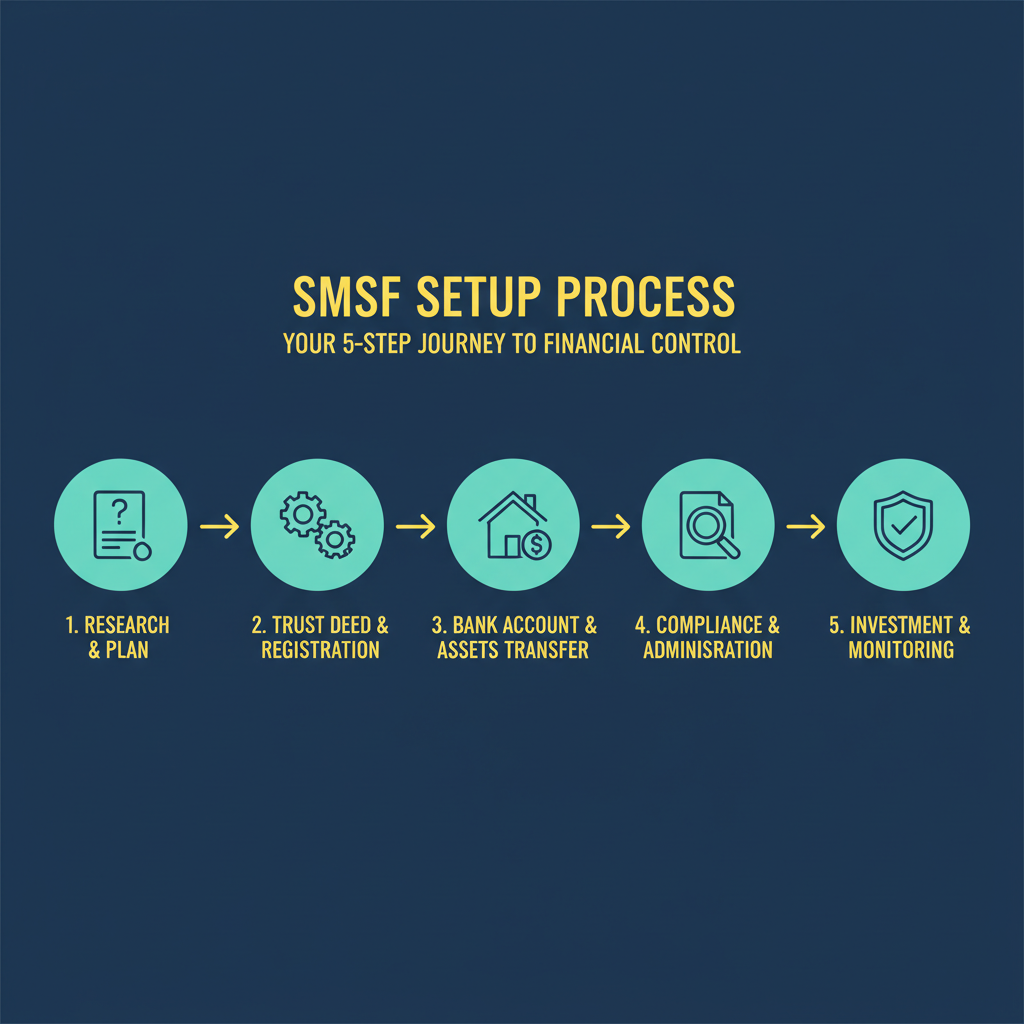
Buying property through your super requires a specific sequence. Miss a step or breach a rule, and you risk compliance penalties.
Here's the process broken down into clear, actionable stages.
Step 1: Set Up Your SMSF
You start by establishing the legal structure.
This involves registering a corporate trustee company with ASIC, creating a trust deed, obtaining an ABN and TFN, and opening a dedicated bank account.
Setup costs range from $1,000 to $3,000 depending on your chosen provider and structure. A corporate trustee adds around $600 to $800 but simplifies future changes.
You'll also need to prepare an investment strategy that documents your objectives, risk tolerance, diversification approach, and how property fits your retirement goals.
Many advisors recommend engaging an SMSF specialist accountant from day one. They'll ensure your deed allows borrowing and property investment, which not all template deeds do.
Your investment strategy must be reviewed annually and updated when circumstances change.
Step 2: Understand Limited Recourse Borrowing Arrangements
SMSFs can't borrow freely. You must use a Limited Recourse Borrowing Arrangement.
Under an LRBA, the property is held in a separate trust (called a bare trust or holding trust) until the loan is repaid. The SMSF holds a beneficial interest in the property and makes loan repayments.
If the SMSF defaults, the lender's recourse is limited to the property. They can't pursue other SMSF assets.
Key LRBA rules include:
- You can only borrow to purchase a single acquirable asset
- The asset cannot be altered in a way that changes its character while the loan is in place
- All costs must be paid from the SMSF bank account
- The loan must be on commercial terms if from a related party
LRBA interest rates are typically 2–3% higher than standard investment loans due to the limited recourse nature.
For 2025–26, the ATO safe harbour rates for related-party LRBAs are 8.95% for real property and 10.95% for listed securities.
Most lenders cap LVRs at 70–80% for SMSF residential property. If the loan exceeds 80%, trustees often provide a personal guarantee—but that guarantee must not give the lender recourse to SMSF assets.
Step 3: Calculate SMSF Setup and Ongoing Costs
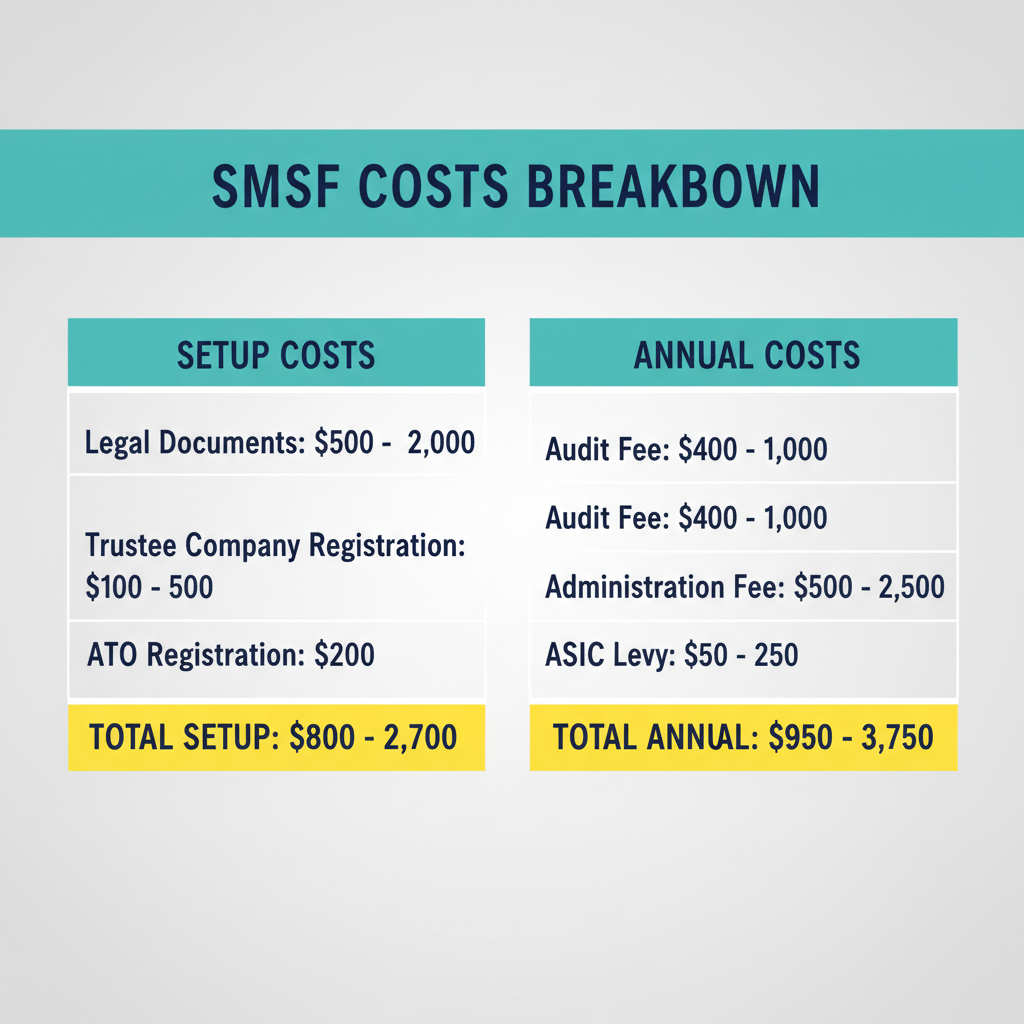
SMSF property investment isn't cheap. You need to budget for both upfront and recurring expenses.
Setup Costs:
- Trust deed and corporate trustee registration: $500–$1,000
- LRBA bare trust structure: $800–$1,500
- Investment strategy and initial advice: $500–$1,200
- Bank account and Electronic Service Address: $280
Annual Costs:
- Accounting and administration: $2,000–$4,500
- Independent audit: $550–$800
- ATO supervisory levy: $259
- ASIC annual review fee: $65
- Actuarial certificate (if in pension phase): $300–$500
Property-Specific Costs:
- Stamp duty, conveyancing, building and pest inspections
- Property management fees: 5–8% of rental income
- Insurance: building, landlord liability, public liability
- Council rates, strata fees, maintenance
According to Superguide, median annual costs for funds between $200,000 and $500,000 sit around $5,674, or 1.14% on a $500,000 balance.
The consensus is that you need at least $200,000 in super to make an SMSF cost-effective, or $250,000 if purchasing property.
Step 4: Choose the Right Property for Your SMSF
Not every property suits an SMSF.
You're investing for retirement, not lifestyle. That means prioritising long-term capital growth, rental reliability, and low maintenance.
Key selection criteria:
- Strong rental demand and low vacancy rates
- Markets with population growth and infrastructure investment
- Properties that don't require constant repairs or tenant turnover
- Purchase price that allows your SMSF to meet loan repayments, expenses and compliance costs
Brisbane, Perth and Adelaide are expected to outperform Sydney and Melbourne in 2026, driven by stronger local economies and tighter supply.
You must also ensure the property meets compliance requirements:
- It cannot be purchased from a related party (unless it's business real property)
- It cannot be lived in by you, members, or related parties
- It cannot be rented to you, members, or related parties
- All transactions must be at market value and arm's length
Buyers Agency Australia helps investors identify properties that meet SMSF compliance standards while delivering strong investment fundamentals.
Work with a buyer's agent who understands SMSF rules. A misstep can be costly—and irreversible.
Step 5: Maintain Strict Compliance and Record Keeping
Once you've purchased the property, compliance doesn't stop.
You must maintain meticulous records of every transaction, lease agreement, repair invoice, and loan repayment.
Key compliance obligations:
- All expenses must be paid from the SMSF bank account
- Rental income must be deposited directly into the SMSF account
- Lease agreements must be documented and at market rates
- Repairs are allowed, but improvements funded by the loan are restricted
- You must not provide any present-day benefit to members or related parties
The sole purpose test is the overarching principle. Your SMSF must be maintained solely to provide retirement benefits.
Common breaches include:
- Renting to a family member at below market rate
- Using the property for personal holidays
- Paying expenses from your personal account
- Making improvements without proper documentation
Your annual audit will review compliance. The auditor reports contraventions to the ATO, which can impose penalties ranging from administrative sanctions to disqualification.
For non-compliant funds, the tax rate jumps to 45% on the entire balance—a catastrophic outcome.
Key SMSF Property Rules You Must Follow
SMSF property investment is governed by strict rules. Understanding them isn't optional—it's the foundation of compliant investing.
The Sole Purpose Test
Every SMSF must be maintained for the sole purpose of providing retirement benefits to members.
This is not a principal purpose or dominant purpose—it's exclusive.
According to SMSFR 2008/2, the test requires a strict standard of compliance. Any benefit that is not incidental, remote or insignificant can trigger a breach.
When you buy property in your SMSF, its primary objective must be investment returns—rental income, capital growth, or both. You cannot live in it, use it as a holiday home, or let friends stay rent-free.
Arm's Length Transactions
All dealings must be conducted on a commercial basis.
If you rent business real property to your own company, the lease must be at market rent. If you borrow from a related party, the interest rate must align with the ATO's safe harbour benchmarks.
You cannot:
- Purchase residential property from yourself or related parties
- Rent residential property to yourself, family members or related parties
- Provide services to the SMSF at below-market rates
Commercial property offers more flexibility. You can lease business real property to a related party, but only if it's used wholly and exclusively for business and leased at market rates.
No Personal Use Ever
This rule is absolute.
You cannot stay in the property, even if you pay market rent. You cannot let your children live there while they study. You cannot use it for weekends or holidays.
The ATO reviews SMSF property transactions closely. In the case of Aussiegolfa Pty Ltd v Commissioner of Taxation (2018), the court examined whether accommodation provided to a member's daughter breached the sole purpose test. While the court found no breach in that specific case, the scrutiny was intense.
The takeaway is clear: avoid any arrangement that could be perceived as providing a present-day benefit.
Property Cannot Be Altered Under an LRBA
While the loan is in place, you cannot make changes that alter the character of the property.
Repairs and maintenance are allowed. Painting, fixing a leaking roof, or replacing a hot water system are fine—provided funds come from the SMSF, not the loan.
But you cannot:
- Build on vacant land
- Subdivide the property
- Add a granny flat or second dwelling
- Convert residential to commercial use
Once the loan is repaid and legal ownership transfers to the SMSF trustee, you regain flexibility—but major changes still require careful compliance review.
Costs and Fees for SMSF Property Investment
SMSF property investment involves multiple cost layers. Understanding them upfront helps you budget accurately and avoid cash flow stress.
Establishment Costs
Setting up an SMSF with property capability typically costs between $1,500 and $4,850.
This includes the trust deed, corporate trustee registration, LRBA bare trust structure, investment strategy, and initial accounting setup.
Providers like Superannuation Warehouse offer packages from $1,400, while full-service advisors may charge $3,000+.
You also need to account for stamp duty, legal fees, and property acquisition costs—these are paid by the SMSF, not you personally.
Annual Compliance and Administration
Ongoing SMSF costs are unavoidable.
Typical annual fees include:
- SMSF accounting and administration: $1,800–$4,500
- Independent audit: $550–$800
- ATO supervisory levy: $259
- ASIC annual review fee: $65
If your SMSF holds both accumulation and pension accounts, you may need an actuarial certificate to determine exempt income, adding $300–$500.
Property-specific expenses include:
- Property management: 5–8% of rental income
- Building and landlord insurance: $800–$1,500 annually
- Council rates, strata fees, repairs and maintenance
All expenses must be paid from the SMSF bank account. Commingling personal and SMSF funds is a red flag for auditors.
Loan Costs
SMSF loans carry higher interest rates due to their limited recourse nature.
Expect to pay 2–3% above standard investment loan rates. In 2026, SMSF refinance rates start from around 6.19% p.a., depending on LVR and lender.
Lenders typically cap LVRs at 70–80%. Some now offer up to 90% LVR, but higher ratios attract stricter serviceability tests and often require personal guarantees.
Most SMSF loans are interest-only to preserve cash flow, but principal and interest options are available.
Is It Cost-Effective?
The consensus is clear: SMSFs become cost-effective once balances exceed $200,000 to $250,000.
Below that threshold, retail super fees (typically 0.5–1% of balance) are often cheaper than the flat costs of running an SMSF.
For a $500,000 SMSF holding property, annual costs might sit around $5,000–$7,000. That's roughly 1–1.4% of the balance—comparable to retail super.
But the real comparison is control and asset class. If you want direct property exposure with tax efficiency, an SMSF may be the only viable path.
Pros and Cons of SMSF Property Investment
SMSF property investment offers significant benefits, but it's not a shortcut to wealth. Understanding both sides helps you decide if it suits your circumstances.
Advantages
Tax Efficiency
Rental income is taxed at 15% in accumulation phase. Capital gains on assets held more than 12 months are taxed at 10%.
If the property is held in pension phase and within your transfer balance cap, rental income is tax-free and capital gains are exempt.
Control and Flexibility
You choose the property, manage the investment strategy, and make all decisions.
You're not reliant on fund managers or limited to listed securities.
Long-Term Wealth Building
Property historically delivers reliable capital growth and income. Over the decade to September 2025, Australian property rose 71.1%.
For investors with long time horizons, property can significantly enhance retirement outcomes.
Separate Borrowing Capacity
If you've reached personal lending limits, an SMSF provides a separate capacity pathway.
You can continue building your property portfolio using super capital.
Disadvantages
Complexity and Compliance Risk
SMSFs demand time, expertise, and meticulous record-keeping.
Breaches can result in penalties or the fund being deemed non-compliant and taxed at 45%.
Liquidity Risk
Property is illiquid. You can't quickly sell a portion if you need cash.
Pension accounts require minimum annual drawdowns, which can strain cash flow if the property isn't tenanted.
Concentration Risk
Many SMSFs hold just one property, creating overexposure to a single asset class.
If the property underperforms or requires significant repairs, your retirement savings suffer.
Higher Costs
SMSF costs are fixed and ongoing, regardless of performance.
For balances under $200,000, retail super is often cheaper.
No Personal Use
You can never live in the property or let family use it.
This restriction is permanent and non-negotiable.
Common SMSF Property Mistakes to Avoid
SMSF property investment is unforgiving of errors. These are the most common mistakes trustees make—and how to avoid them.
Buying the Wrong Property
Many investors chase capital growth without considering rental reliability or cash flow.
Your SMSF must meet loan repayments, expenses, and compliance costs from rental income and contributions. A property with weak rental demand or high vacancy creates cash flow stress.
Prioritise investment-grade properties in high-demand markets with strong infrastructure and population growth.
Breaching the Sole Purpose Test
Even minor breaches can have severe consequences.
Common mistakes include staying in the property during inspections, renting to family at mates' rates, or paying expenses from personal accounts.
The sole purpose test applies throughout the fund's entire life. Even after you retire, the property must remain an investment.
Poor Cash Flow Planning
Property generates income, but it also demands cash.
You need buffers to cover vacancies, repairs, insurance, and unexpected costs. Many trustees underestimate how quickly cash reserves deplete.
Ensure your SMSF has sufficient liquidity to meet obligations without forced asset sales.
Ignoring Diversification
Holding 80% or more of your SMSF in a single property is high-risk.
If the property underperforms or the market softens, your retirement savings suffer.
Consider diversifying across asset classes or geographic locations.
Not Engaging Professional Advisors
SMSF property investment requires specialist knowledge.
Engaging an SMSF accountant, financial advisor, and buyer's agent reduces compliance risk and improves investment outcomes.
Buyers Agency Australia specialises in identifying investment-grade properties that align with SMSF compliance requirements and long-term wealth strategies.
How Dragan Dimovski and Buyers Agency Australia Support SMSF Investors

SMSF property investment demands expertise across compliance, finance, and market selection.
Buyers Agency Australia, led by Dragan Dimovski, provides end-to-end support for SMSF investors nationally.
With over 20 years of experience and a personal portfolio exceeding $10 million, Dragan understands the intersection of property investment and superannuation strategy.
Buyers Agency Australia offers:
- Property sourcing that meets SMSF compliance requirements
- Market research identifying high-growth, high-yield opportunities
- Negotiation services to secure properties at fair value
- Portfolio modelling to ensure long-term wealth creation
The firm operates across Sydney, Melbourne, Brisbane, Perth, and Adelaide, with a fixed-fee, transparent pricing model.
Dragan hosts the 'Passive with Property' podcast, sharing insights on investment strategy, market trends, and wealth creation.
For SMSF investors, Buyers Agency Australia provides boots-on-the-ground expertise, removing emotion from the buying process and ensuring properties align with retirement objectives.
Book a free strategy session to explore if SMSF property investment fits your goals.
Real Example: SMSF Property Purchase Scenario
Let's walk through a realistic scenario to illustrate how SMSF property investment works in practice.
Meet Sarah and Tom
Sarah (52) and Tom (54) are high-income professionals with combined super balances of $450,000.
They've reached their personal borrowing capacity but want to continue building wealth through property.
After consulting with their SMSF accountant and financial advisor, they decide to set up an SMSF and purchase an investment property in Brisbane.
The Setup
- SMSF establishment cost: $2,200 (corporate trustee, LRBA structure, investment strategy)
- Property purchase price: $650,000
- SMSF deposit (20%): $130,000
- LRBA loan amount: $520,000 at 6.5% p.a. interest-only
- Stamp duty and acquisition costs: $25,000
Year One Financials
- Rental income: $32,500 ($625/week)
- Loan interest: $33,800
- Property management (7%): $2,275
- Insurance, rates, maintenance: $4,200
- SMSF compliance costs: $3,500
- Net cash flow: -$11,275
Sarah and Tom contribute $15,000 annually to cover the shortfall and build liquidity.
Tax Position
The SMSF reports a net rental loss of $11,275. No tax is payable.
Depreciation and capital allowances further reduce taxable income in future years.
Five-Year Outlook
Assuming 6% annual capital growth, the property is worth $870,000 after five years.
Equity gain: $220,000
Loan balance (interest-only): $520,000
Net equity: $350,000
Sarah and Tom's SMSF has grown from $450,000 to approximately $650,000 (including contributions and compounding), with a tangible asset they control.
They're positioned to transition to pension phase in 7–10 years, where rental income becomes tax-free.
When SMSF Property Investment Makes Sense and When It Doesn't
SMSF property investment is powerful—but it's not for everyone.
When It Makes Sense
You have a combined super balance of $200,000 or more
Below this threshold, setup and ongoing costs make SMSFs less cost-effective than retail funds.
You have at least 7–10 years until retirement
Property is a long-term asset. Short time horizons increase liquidity risk.
You're confident managing compliance obligations
You need financial literacy, time, and attention to detail. If you're not prepared to engage professional advisors, SMSFs aren't suitable.
You've hit personal borrowing limits
An SMSF provides separate borrowing capacity, allowing you to continue building your property portfolio.
You want direct property exposure
If property aligns with your investment strategy and risk tolerance, an SMSF offers the most tax-efficient vehicle.
When It Doesn't Make Sense
Your super balance is under $200,000
Costs outweigh benefits. Stick with retail super.
You're within 5 years of retirement
Liquidity risk is too high. You may need to access capital quickly to fund pension drawdowns.
You lack time or expertise
SMSFs demand ongoing attention. If you can't commit, the compliance risk is too great.
You want lifestyle property
If you're tempted to use the property personally, an SMSF is the wrong structure.
You prefer simplicity
SMSFs are complex. If you value convenience over control, retail super is a better fit.
Frequently Asked Questions About SMSF Property Investment
Can I live in a property owned by my SMSF?
No. Residential property owned by an SMSF cannot be lived in by members or related parties at any time.
What is the minimum super balance for SMSF property investment?
Most experts recommend at least $200,000 to $250,000 to justify setup and ongoing costs.
Can I borrow to buy property in my SMSF?
Yes, through a Limited Recourse Borrowing Arrangement. The property is held in a bare trust until the loan is repaid.
What happens if I breach SMSF property rules?
Breaches can result in penalties, disqualification, or the fund being deemed non-compliant and taxed at 45%.
Can I buy property from a family member?
No. Residential property cannot be purchased from related parties. Commercial property may be allowed if it qualifies as business real property.