
A mortgage broker for investment property Australia isn't just about finding the lowest interest rate. The right broker structures loans to maximize borrowing capacity, protect future portfolio growth, and align finance with your 10-year wealth strategy. For investors scaling from one property to five or more, loan structure is 8.5 times more valuable than a 0.5% rate discount.
If you're searching for a mortgage broker to fund your next investment property, you're probably comparing rates and asking about fixed versus variable. Here's the truth: most investors focus on the wrong metrics.
Interest rates matter, but they're not the deciding factor between building a thriving portfolio and hitting a lending wall at property two. The real differentiator is whether your broker understands loan structuring, lender serviceability policies, and how to position your finances for multiple acquisitions. Buyers Agency Australia works with investors daily who've been knocked back by brokers who treated investment loans like home loans, and the cost of that mistake is measured in missed opportunities and locked equity.
Why Investment Property Brokers Are Different from Home Loan Specialists
The Investment Loan Landscape in 2026
Investment loans in Australia carry different serviceability calculations than owner-occupied mortgages. Lenders typically assess only 75-80% of expected rental income when calculating borrowing power, and interest rates sit 0.3-0.5% higher than owner-occupier products. According to recent industry analysis, "investment mortgage brokers understand rental yields, negative gearing, and tax benefits."
But the real complexity emerges when you're building a portfolio. Each new loan impacts your debt serviceability for the next acquisition. A broker who doesn't structure loans with future purchases in mind will inadvertently cap your growth at two or three properties.
What Separates Generalist Brokers from Investment Specialists
A home loan broker helps first-time buyers secure finance for a single property. An investment specialist architects a lending structure that supports acquisitions three, five, and ten years into the future.
The distinction isn't just experience. It's about understanding which lenders offer the most investor-friendly serviceability policies, how to split loans across entities, when to use interest-only periods strategically, and how to access off-market lending products designed for portfolio growth.
Most brokers who helped you buy your family home won't have relationships with the 8-12 lenders in Australia that actively support multi-property investors. They won't know which banks shade rental income at 80% versus 75%, or which lenders allow you to refinance Property A to release equity for Property B without re-assessing your entire portfolio.
The Cost of Using the Wrong Broker
Let's be specific about the financial impact. Say you borrow $800,000 through a broker who structures your loan poorly. You pay 0.5% extra in interest annually because you're locked into a single lender.
That's an additional $53,000 in after-tax interest over 20 years. But here's the bigger problem: if that structure limits your borrowing capacity, you might miss out on acquiring a second property that would have generated $450,000 in equity growth over the same period. That's an 8.5x return difference, according to loan structuring analysis.
The wrong broker doesn't just cost you money. They cost you opportunity.
Key Selection Criteria for Investment Property Mortgage Brokers
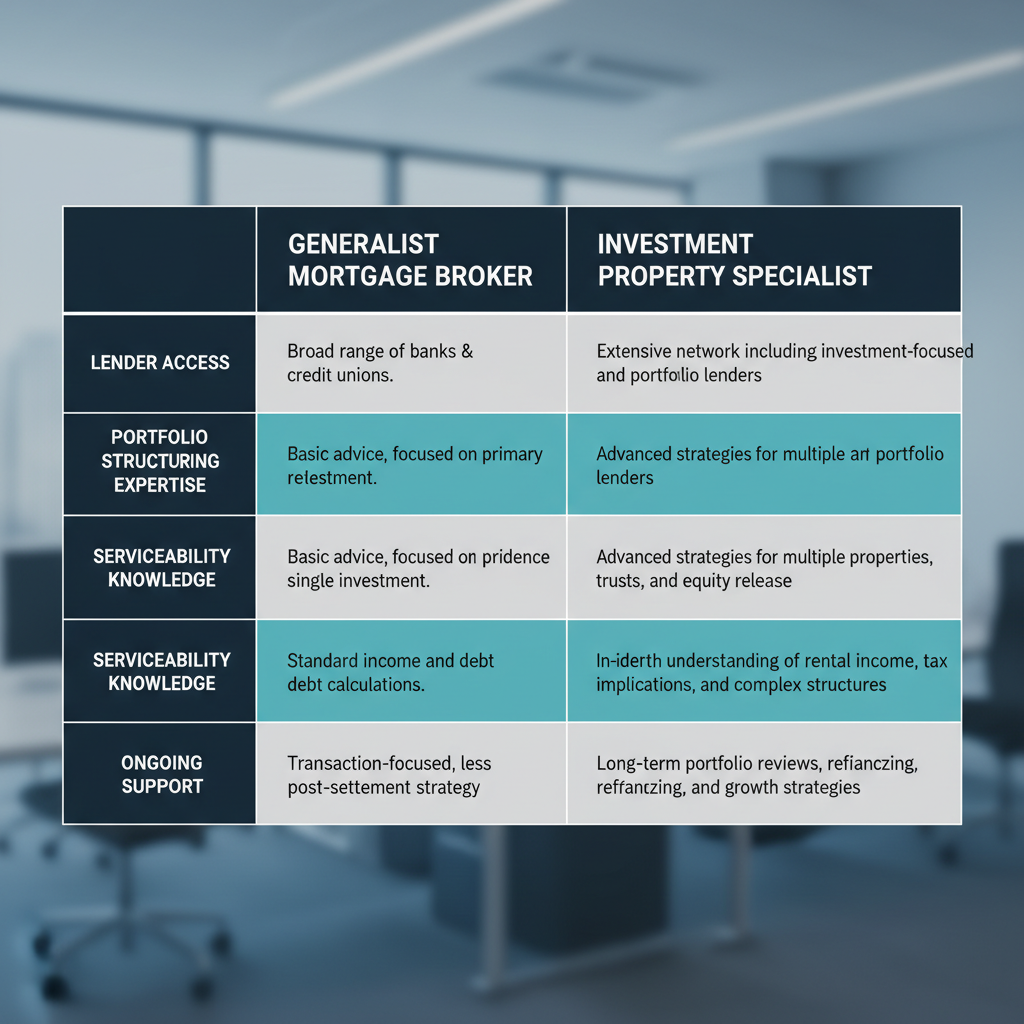
Specialization in Investment Lending
Does the broker dedicate 60% or more of their practice to investment property finance? Ask directly. A broker who primarily serves first-home buyers won't have the depth of knowledge required for portfolio structuring.
You want someone who works daily with clients scaling from one property to five, who understands construction loans for renovations, and who can navigate SMSF property loans if that's part of your strategy. Specialization matters because lender policies for investors change frequently, and a generalist won't track those shifts.
Lender Panel Depth and Relationships
How many lenders does the broker have access to? The answer should be 30-40 minimum, with at least 8-10 of those being specialist lenders who actively court investor business.
More importantly, does the broker maintain direct relationships with credit assessors at those lenders? When your application sits in a gray area (perhaps you're self-employed, or you want to buy interstate), those relationships determine whether you get approved or declined. According to mortgage advisory research, "specialist brokers maintain relationships with lenders who actively seek investment property business."
Proven Track Record with Portfolio Investors
Ask for case studies. How many clients has the broker helped scale from one investment property to three or more? Can they provide examples of complex structuring scenarios they've navigated, such as cross-collateralization releases, equity extraction, or refinancing to improve serviceability?
If the broker can't articulate specific strategies they've employed to maximize borrowing capacity for previous clients, keep searching.
Understanding of Tax and Entity Structures
While a mortgage broker isn't a tax advisor, they should understand how different ownership structures (individual, joint, trust, company, SMSF) impact lending. They should ask whether you've spoken to an accountant about the optimal structure before recommending loan products.
A broker who never mentions entity structure or who dismisses it as irrelevant isn't thinking long-term about your wealth strategy. Buyers Agency Australia integrates finance, tax, and property strategy discussions from day one, ensuring every decision supports your 10-year plan.
Loan Structuring Strategies That Maximize Borrowing Capacity
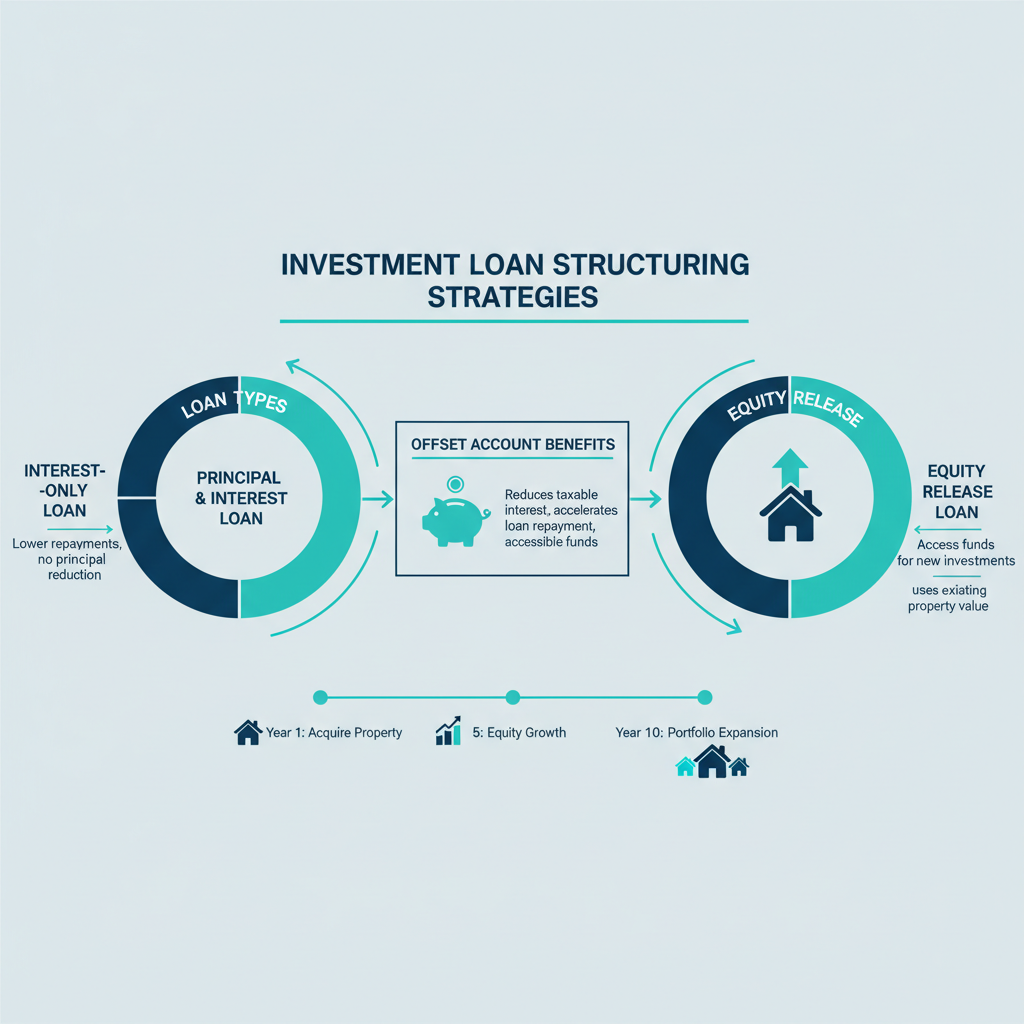
Why Structure Matters More Than Rate
You can't build a multi-property portfolio by accident. Every loan you take out either enables or restricts your next acquisition. The way you structure debt today determines how much equity you can access tomorrow.
Here's a concrete example. Say you buy an investment property for $600,000 with a 20% deposit ($120,000). You borrow $480,000. If you structure that as a single principal-and-interest loan, your repayments will be higher, which reduces your debt serviceability for future loans.
Instead, an experienced broker might split the loan: $400,000 interest-only for the first five years (maximizing cash flow) and $80,000 principal-and-interest (building a repayment buffer). This structure keeps your monthly outgoings lower, preserving borrowing capacity for the next property.
That's basic. Now scale it across three properties, add equity release loans, and factor in rental income shading across different lenders. This is where investment specialists earn their value.
Interest-Only vs Principal-and-Interest Repayments
Interest-only loans reduce monthly repayments by 30-40%, which directly increases your borrowing capacity for subsequent purchases. According to portfolio lending analysis, "by only paying the interest component, your monthly repayments are lower. This maximises your cash flow."
But interest-only periods are temporary, typically 1-5 years. When that period ends, repayments jump significantly as you start paying down principal. A strategic broker plans for this, either by refinancing before the interest-only period expires or by ensuring your portfolio's rental income can absorb higher repayments.
Offset Accounts and Redraw Facilities
An offset account linked to your investment loan reduces the interest charged without technically paying down the principal. This preserves tax deductibility (since the loan balance remains unchanged) while lowering your effective interest rate.
A redraw facility lets you access extra repayments you've made on a loan. However, using redraw for personal expenses can muddy the tax treatment of your loan, which is why most investment-focused brokers recommend offset accounts instead.
These aren't minor details. They're the difference between a loan that supports your strategy and one that creates tax headaches down the line.
Splitting Loans Across Lenders
Here's a strategy most brokers won't mention: deliberately spreading your loans across multiple lenders. Why? Because lenders assess serviceability differently. Some cap investment loan portfolios at three properties. Others have no hard limit but tighten serviceability at higher debt levels.
By splitting loans across lenders, you avoid hitting any single lender's internal risk threshold. You also create flexibility to refinance individual properties without triggering a full portfolio review. According to investment loan structuring research, "structuring loans strategically (e.g. spreading across different lenders) can also help manage risk and borrowing capacity."
This requires a broker who thinks three moves ahead and who maintains active relationships with 8-10 lenders simultaneously.
How Borrowing Capacity Calculations Work for Investors
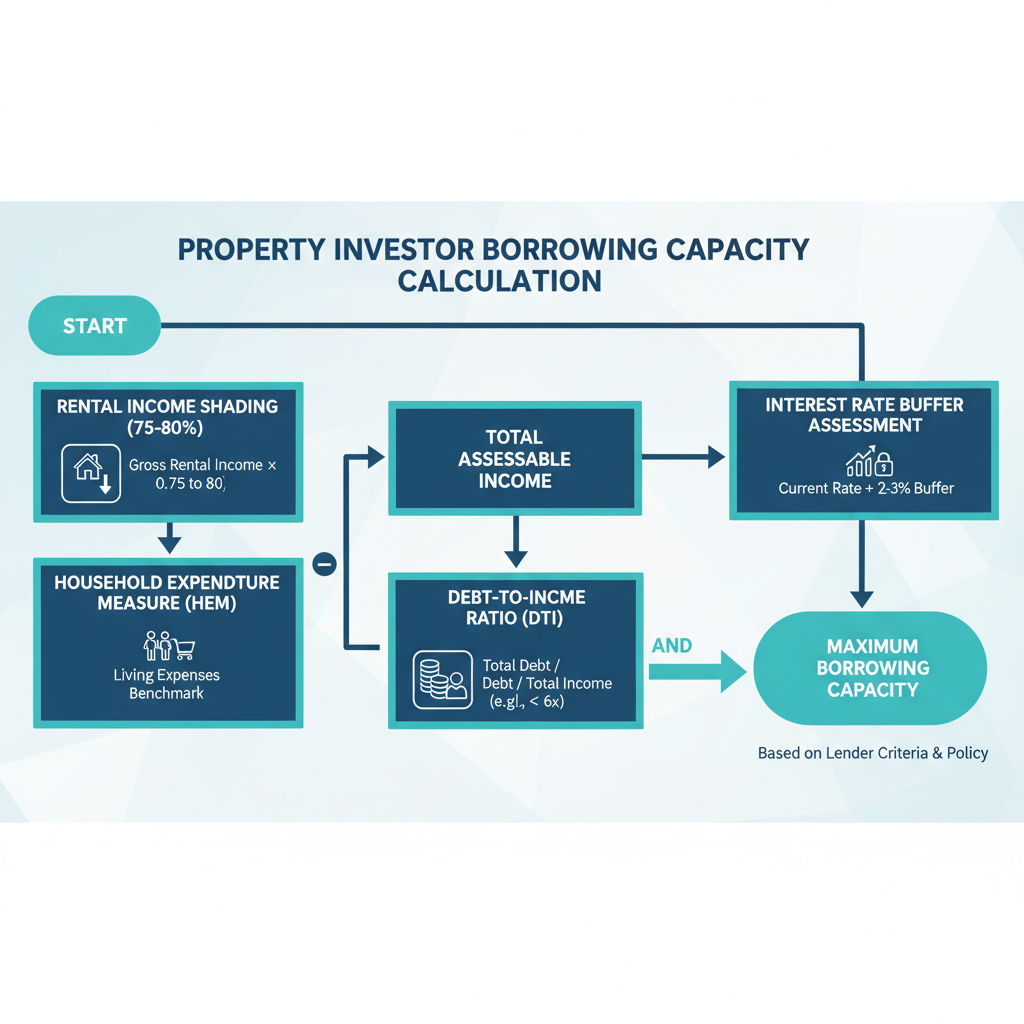
Rental Income Shading
Lenders don't count 100% of your expected rental income when calculating serviceability. Most apply a "shading" factor of 75-80%, meaning if your property generates $30,000 annual rent, the lender only credits you with $22,500-$24,000.
Some specialist lenders shade at 85%, which can increase your borrowing power by $50,000-$100,000. An investment-focused broker knows which lenders offer the best shading and structures your applications accordingly. Mortgage advisory services note that "some specialist lenders use higher percentages, which can increase your borrowing power significantly."
The Household Expenditure Measure (HEM)
Australian lenders use the HEM to estimate your living expenses based on household size and location. If your actual expenses are lower than the HEM, lenders still use the HEM figure, which can reduce borrowing capacity.
However, if your expenses exceed the HEM, lenders use your actual spending, which reduces capacity even further. This is why brokers advise cleaning up discretionary spending (subscriptions, dining out, personal loans) 3-6 months before applying for investment finance.
Interest Rate Buffers
Lenders don't assess your ability to repay at today's interest rate. They add a buffer of 2-3% to ensure you could still service the loan if rates rose. This "stress test" is a major factor in determining how much you can borrow.
Some lenders use a 2% buffer, others use 3%. A broker who knows which lenders apply the lowest buffer can increase your borrowing capacity by tens of thousands of dollars without changing any other variable.
Debt-to-Income Ratios
Australian lenders are increasingly adopting debt-to-income (DTI) ratios, capping total borrowing at 6-8 times your gross annual income. For high-income professionals (doctors, IT executives, business owners), this can be a hard ceiling that limits portfolio growth.
An experienced broker structures your applications to stay within DTI limits while maximizing property value, often by focusing on higher-yield, lower-price properties in the early stages of portfolio building.
Common Mistakes Investors Make When Choosing a Broker
Prioritizing Rate Over Structure
The biggest mistake is choosing a broker who leads with interest rate comparisons. Rate matters, but it's a secondary consideration for investors.
A broker who saves you 0.2% on your interest rate but structures your loan in a way that limits future borrowing has cost you far more than they saved. Ask prospective brokers how they approach loan structuring before you ask about rates.
Using the Same Broker Who Did Your Home Loan
Your home loan broker might be excellent at what they do. But if they don't specialize in investment lending, they're the wrong choice for your portfolio.
Investment loans require different expertise, different lender relationships, and different strategic thinking. Don't conflate competence in one domain with competence in another.
Not Asking About Portfolio Strategy
If a broker doesn't ask about your 5-year and 10-year property goals in the first meeting, they're not thinking strategically. Investment lending isn't transactional. It's a multi-year relationship where each loan builds on the previous one.
A portfolio-focused broker will ask how many properties you want to own, what your target yield and capital growth metrics are, and whether you're planning to hold or sell properties in the medium term. They'll structure loans that support that vision, not just the immediate purchase.
Failing to Review Loan Structure Annually
Your first investment loan structure might be optimal in Year 1. By Year 3, when property values have risen and rental income has increased, a refinance to release equity could be the difference between buying your next property or waiting another two years.
The best brokers schedule annual reviews, not to churn loans unnecessarily, but to ensure your structure remains aligned with your portfolio goals. Buyers Agency Australia recommends quarterly check-ins with your mortgage broker during active acquisition phases.
How Buyers Agency Australia Supports Investment Loan Success

Integrating Property Strategy and Finance
Buyers Agency Australia operates on a simple principle: property acquisition and finance strategy are inseparable. You can't select the right property without understanding your borrowing capacity, and you can't structure loans effectively without knowing your investment timeline.
That's why Buyers Agency Australia works with a network of investment-focused mortgage brokers who understand portfolio structuring. When you engage Buyers Agency Australia, your property search is informed by what you can borrow today and what you'll be able to borrow in 18-24 months after the first property appreciates.
This integrated approach prevents the most common investor mistake: buying a property you can afford now but that limits your ability to scale later.
Fixed-Fee Transparency in a Commission-Driven Industry
Most mortgage brokers earn commissions from lenders, which creates an inherent conflict of interest. While reputable brokers disclose this and act in your best interest, the commission structure can influence which lenders they recommend.
Buyers Agency Australia uses a transparent fixed-fee model for property acquisition services. When they refer you to a mortgage broker, they're recommending someone based on expertise and client outcomes, not referral fees. This matters because you want advice that's genuinely in your best interest, not advice that maximizes someone else's commission.
Case Example: Scaling from One Property to Three
Let's look at a recent client scenario. A Sydney-based IT professional earning $180,000 annually bought his first investment property in Brisbane for $550,000. His home loan broker set up a standard principal-and-interest loan at 6.2% variable.
Two years later, he wanted to buy a second property. His borrowing capacity had increased slightly due to rental income, but not enough to purchase another $550,000 property. He was stuck.
Buyers Agency Australia reviewed his structure and immediately saw the problem. The loan was structured for repayment, not portfolio growth. They connected him with an investment specialist broker who refinanced the existing loan into an interest-only structure, released $80,000 in equity, and spread the debt across two lenders to preserve future borrowing capacity.
Within 12 months, he'd acquired two additional properties, both in high-yield markets identified by Buyers Agency Australia's research team. His portfolio now generates $72,000 in annual rental income, and his path to five properties is clear.
That's the difference between a transactional broker and a strategic one.
Access to Off-Market Deals That Require Fast Finance
Many of the best investment properties never hit the open market. Buyers Agency Australia sources off-market deals through direct relationships with selling agents, but these opportunities often require fast finance approval.
If your mortgage broker takes three weeks to get pre-approval, you'll miss out. The brokers Buyers Agency Australia works with can turn around pre-approvals in 48-72 hours when needed, giving you a competitive advantage in off-market negotiations.
Speed matters, but speed without accuracy is worthless. These brokers combine fast turnaround with meticulous structuring, ensuring you're both competitive and strategically positioned. If you're serious about off-market acquisitions, book a free strategy session to discuss how Buyers Agency Australia coordinates finance and property search.
Questions to Ask Before Hiring a Mortgage Broker
What Percentage of Your Clients Are Property Investors?
If the answer is less than 50%, you're talking to a generalist. That's not necessarily bad for a first investment property, but it's insufficient if you're planning to scale.
You want a broker who lives and breathes investment lending, who tracks lender policy changes weekly, and who has structured loans for clients with 5+ property portfolios.
How Many Lenders Do You Work With, and Which Ones Favor Investors?
A broker with access to 40+ lenders but who only actively uses 5-6 isn't much better than a bank employee. You want to know which lenders the broker places most investor loans with and why.
Ask for specifics: Which lenders offer the best rental income shading? Which ones have the lowest interest rate buffers? Which ones will still lend to you at property five or six?
Can You Provide Examples of Complex Structuring You've Done?
This is where you separate experienced brokers from novices. Ask them to walk you through a recent case where they had to get creative to maximize borrowing capacity.
Maybe they refinanced multiple properties to consolidate debt and release equity. Maybe they split a loan across three lenders to avoid hitting a single lender's portfolio cap. Maybe they structured a loan in a family trust to protect assets while maintaining borrowing power.
If they can't articulate specific examples, they don't have the experience you need.
What's Your Process for Annual Reviews?
A broker who only talks to you when you're buying a new property isn't managing your portfolio proactively. The best brokers schedule annual reviews to assess whether your current structure is still optimal.
Property values change. Rental income changes. Lender policies change. Your structure needs to adapt. Ask how the broker approaches ongoing portfolio management, not just one-off loan approvals.
How Do You Get Paid, and Does That Influence Your Recommendations?
Most brokers earn commissions from lenders, typically 0.6-0.7% of the loan value upfront plus ongoing trail commissions. There's nothing wrong with this model as long as it's disclosed.
But you should ask: Does the commission structure vary across lenders? Do you receive higher commissions from certain lenders? How do you manage that conflict of interest?
A trustworthy broker will answer these questions directly and explain how they prioritize your interests even when commission structures vary.
The Role of the Broker in Your Investor Team
Coordinating with Accountants and Tax Advisors
Your mortgage broker should work collaboratively with your accountant, especially when entity structures are involved. If you're buying in a trust or through a company, the broker needs to understand the tax implications and ensure the loan structure supports your accountant's strategy.
This coordination isn't optional. It's essential. A broker who dismisses your accountant's input or who doesn't understand basic trust and company structures will create problems down the line.
Working with Buyers Agents
When you're working with both a buyers agent and a mortgage broker, they need to communicate. The buyers agent should understand your borrowing capacity before recommending properties. The broker should understand the buyers agent's strategy before structuring loans.
Buyers Agency Australia has cultivated relationships with investment-focused brokers precisely because this coordination dramatically improves client outcomes. When your buyers agent and broker are aligned, you move faster, avoid mis-matched purchases, and structure loans that support long-term growth. Explore how this integrated approach works by attending a FastTrack Event.
Ongoing Portfolio Monitoring
Your broker isn't just a service provider during acquisition. They're a long-term partner who monitors your portfolio, tracks lender policy changes, and proactively recommends refinancing when it makes strategic sense.
This ongoing relationship is how sophisticated investors stay ahead of the market. When a lender changes serviceability criteria, your broker knows immediately and assesses whether it impacts your portfolio. When interest rates shift, your broker models whether refinancing saves money or frees up borrowing capacity.
Frequently Asked Questions
What's the typical cost of using a mortgage broker for investment property?
Most mortgage brokers don't charge clients directly. They're paid commissions by lenders, typically 0.6-0.7% upfront. Some brokers charge fees for complex structuring, usually $2,000-$5,000 for multi-property portfolios.
How long does investment loan approval take?
Pre-approval typically takes 3-7 days with a specialist broker. Full approval after you've found a property takes 2-4 weeks, depending on lender workload and application complexity.
Can I use different brokers for different properties?
Yes, but it's not recommended. A single broker who manages your entire portfolio has a complete view of your finances and can structure loans cohesively. Multiple brokers create fragmentation and increase the risk of poor structuring.
How often should I review my investment loan structure?
Annually at minimum. More frequently if you're actively acquiring properties, if interest rates change significantly, or if lender policies shift. Your broker should initiate these reviews proactively.
What's the difference between pre-approval and formal approval?
Pre-approval is a conditional indication that you can borrow a certain amount, based on preliminary assessment. Formal approval comes after you've found a property and the lender has verified all details and valued the property. Pre-approval is essential before you start searching.