
Dual income properties are investment properties that generate two separate rental income streams from a single asset—typically through a duplex, granny flat, dual key layout, or co-living configuration. In 2026, they're delivering rental yields of 6% to 13% in high-demand Australian markets, offering investors stronger cash flow, lower vacancy risk, and faster mortgage paydown in a high interest rate environment.
If you're searching for a property strategy that actually pays for itself, dual income properties deserve your attention.
While most investors chase capital growth and accept years of negative cash flow, dual income setups flip the script. You're collecting two rents instead of one, which means better serviceability, faster equity buildup, and breathing room when interest rates stay elevated.
In 2026, Buyers Agency Australia is seeing more investors pivot toward dual income strategies as rental shortages intensify and vacancy rates sit below 1.5% nationally. The numbers are clear: properties with two income streams outperform single-dwelling investments on yield, and they attract a broader tenant pool, reducing the risk of extended vacancies.
What Is a Dual Income Property in Australia
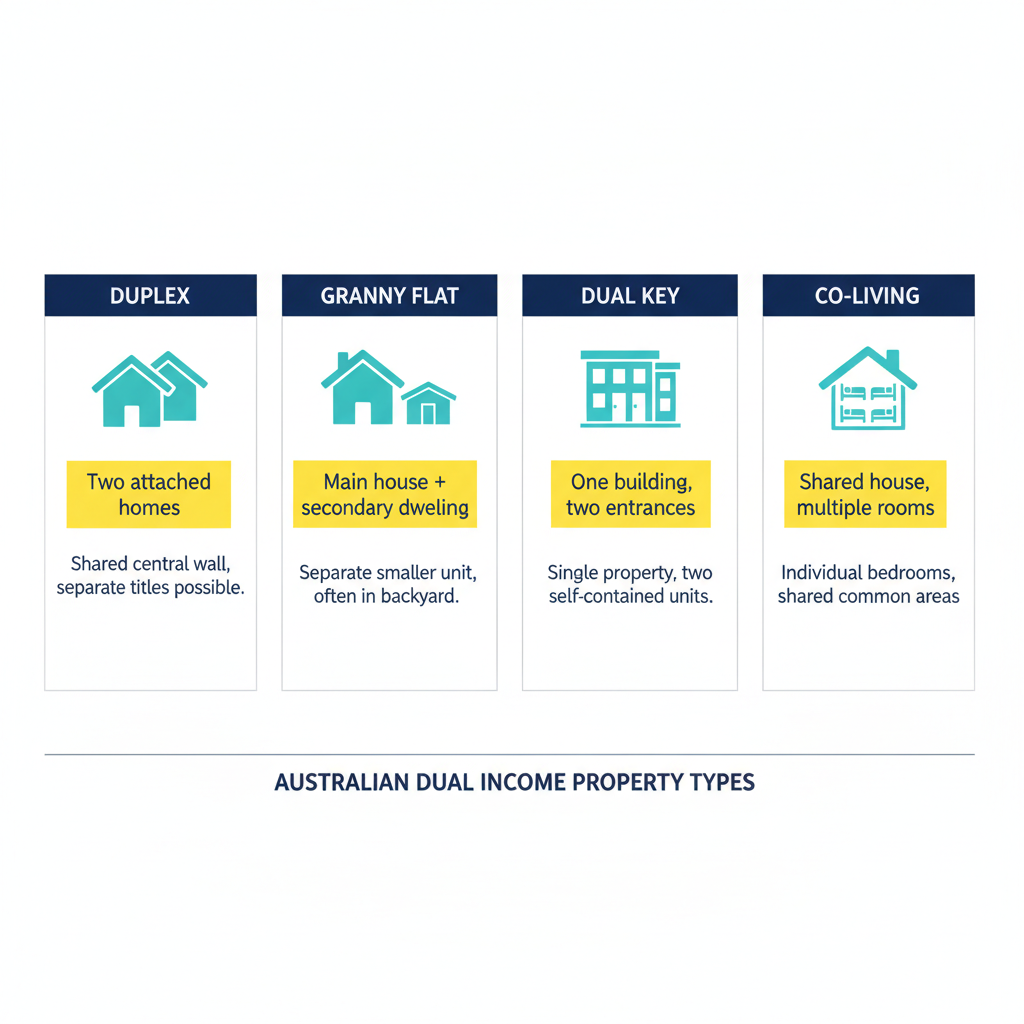
A dual income property contains two separate, rentable living spaces on one title or parcel of land.
Each space can be leased independently, generating two rental income streams for the owner. The property types that qualify include duplexes (two attached or detached dwellings), granny flats (secondary dwelling on the same lot as the main house), dual key apartments or houses (two self-contained units within one structure, each with separate entry), and co-living or boarding house setups (multiple private rooms with shared common areas).
The defining feature is always the ability to collect rent from two or more separate tenants or households simultaneously.
Duplex Properties
A duplex consists of two dwellings on one lot of land, either attached (sharing a common wall) or detached (side-by-side or front-to-back). Each dwelling functions as a standalone home with its own kitchen, bathroom, living area, and entrance.
In NSW, dual occupancy regulations were updated in 2025, standardising lot size requirements at 450 square metres with a 12-metre minimum frontage across most of Greater Sydney. This reform unlocked thousands of previously ineligible lots for duplex development.
Duplex properties can be subdivided into separate titles, allowing investors to sell one dwelling while retaining the other, or hold both for dual rental income. Typical rental returns for a duplex in Brisbane or Perth range from $400 to $600 per dwelling per week in 2026, depending on location and finish quality.
Granny Flats and Secondary Dwellings
A granny flat is a self-contained secondary dwelling built on the same lot as the main house. It includes a kitchen, bathroom, and sleeping area, making it fully independent.
Granny flats deliver some of the highest rental yields in the dual income category. Research shows granny flats generate gross rental yields of 8% to 14% on construction cost alone, compared to 3% to 5% for traditional standalone houses.
Typical construction costs range from $120,000 to $200,000, depending on size, finishes, and site preparation requirements. Weekly rents for granny flats in Sydney and Melbourne sit between $350 and $600 in 2026, with strong tenant demand and low vacancy periods.
State governments have introduced streamlined planning pathways to fast-track granny flat approvals. In NSW, secondary dwellings of up to 60 square metres can be built on most residential lots without council consent, subject to conditions. This makes granny flats one of the most accessible entry points for investors seeking dual income strategies.
Dual Key Properties
A dual key property is one dwelling designed to accommodate two separate households on a single legal title. Each area has its own entrance, allowing occupants to live or rent independently, though they may share facilities like laundry areas.
Dual key properties are often designed to look like standard houses from the street but feature a separate side door or internal partition. They differ from duplexes because they remain on one title and typically share more infrastructure.
Investors benefit from two rental incomes without the need to subdivide land or manage two separate properties. However, financing dual key properties can be more restrictive, with lenders requiring higher deposits and stricter serviceability assessments due to the reliance on sustained rental income.
Dual key properties appeal mainly to investors rather than owner-occupiers, which can limit resale demand. Rental yields remain strong in high-demand markets, but investors should model vacancy risk for both units when stress-testing cash flow projections.
Co-Living and Boarding House Models
Co-living properties feature multiple private bedrooms with shared common spaces like kitchens, living rooms, and bathrooms. Each bedroom is rented separately, generating multiple income streams from one property.
This model suits properties near universities, hospitals, and CBDs where single professionals, students, and shift workers seek affordable accommodation. Weekly rents per room range from $200 to $350 in metro markets, depending on location and amenities.
Co-living setups require more active tenant management due to higher turnover and shared-space dynamics. However, they offer income diversification—if one room sits vacant, the other rooms continue generating rent. Investors should check local council regulations, as some areas restrict boarding houses or require development approval for co-living configurations.
Why Dual Income Properties Are Growing in Popularity in 2026
Australian investors are shifting toward dual income properties as affordability pressures, rental shortages, and higher interest rates reshape the investment landscape.
Rental Shortage and Low Vacancy Rates
Australia's national vacancy rate sits around 1.2% in early 2026, signalling critically tight rental conditions. Rental demand continues to absorb available housing faster than new supply can be delivered, keeping vacancy rates below historical averages.
This supply-demand imbalance creates strong tenant competition, particularly for affordable housing options. Dual income properties appeal to a broader tenant pool—families, single professionals, students, shift workers—reducing the likelihood of extended vacancies.
Properties with granny flats or dual key layouts attract tenants seeking privacy and independence at a lower cost than renting a standalone home. Migration-driven demand is outpacing housing supply, with new arrivals typically entering the rental pool before considering long-term purchases. This sustained demand benefits investors holding multi-income properties in employment corridors and growth regions.
Higher Interest Rates and Cash Flow Pressure
Interest rates remain elevated in 2026, increasing mortgage repayments and putting pressure on negatively geared investment strategies. Investors relying on a single rental income stream often face shortfalls between rental income and total holding costs.
Dual income properties address this by generating two separate rent payments, improving cash flow and reducing reliance on personal income to cover mortgage repayments. A duplex generating $800 per week across two tenancies delivers $41,600 annually, compared to $20,800 from a single $400-per-week rental.
This additional income improves serviceability when refinancing or acquiring additional properties. Lenders assess rental income against loan repayments, and dual income properties demonstrate stronger cash flow resilience, which can unlock higher borrowing capacity for portfolio growth.
For investors holding properties through rate hikes, dual income configurations provide a buffer, reducing the risk of forced sales or financial stress.
Multigenerational Living Trends
The number of multigenerational households increased by 22% between 2016 and 2021, with around 335,000 Australian homes comprising three or more generations. Rising housing costs and rents are driving more families to consolidate under one roof.
Properties with granny flats, dual key layouts, or separate living areas cater to this demand. Adult children, elderly parents, and extended family members can live close while maintaining privacy and independence.
For investors, this trend broadens the tenant pool beyond traditional families. Properties offering two self-contained living areas appeal to multi-generational tenants willing to pay premium rents for flexible, private accommodation.
Buyers Agency Australia sees growing interest from clients seeking properties that support long-term tenancy stability. Multigenerational tenants tend to stay longer, reducing turnover costs and vacancy periods for landlords.
Government Planning Reforms
State governments have introduced planning reforms to fast-track dual income property development and address housing shortages. In NSW, the Low-Rise Housing Diversity Code allows dual occupancies, granny flats, and secondary dwellings to be approved as complying development, reducing approval timeframes from 60 to 90 days to around 20 business days.
Victoria introduced reforms in late 2023 allowing small secondary dwellings of up to 60 square metres to be built without a planning permit in most residential zones. These reforms have shifted granny flats from restricted, family-only accommodation into a category of income-producing assets.
Queensland, South Australia, and Western Australia have implemented similar reforms, removing barriers that previously limited dual income property development. These changes unlock thousands of backyards for secondary dwellings, creating fresh opportunities for investors to add rental income to existing holdings.
Buyers Agency Australia works with investors to identify properties in council areas with favourable dual income regulations, ensuring projects align with local planning requirements and maximise approval speed.
Benefits of Dual Income Properties for Investors
Dual income properties deliver measurable advantages over single-dwelling investments, particularly in 2026's high-cost, low-vacancy market.
Higher Rental Yield
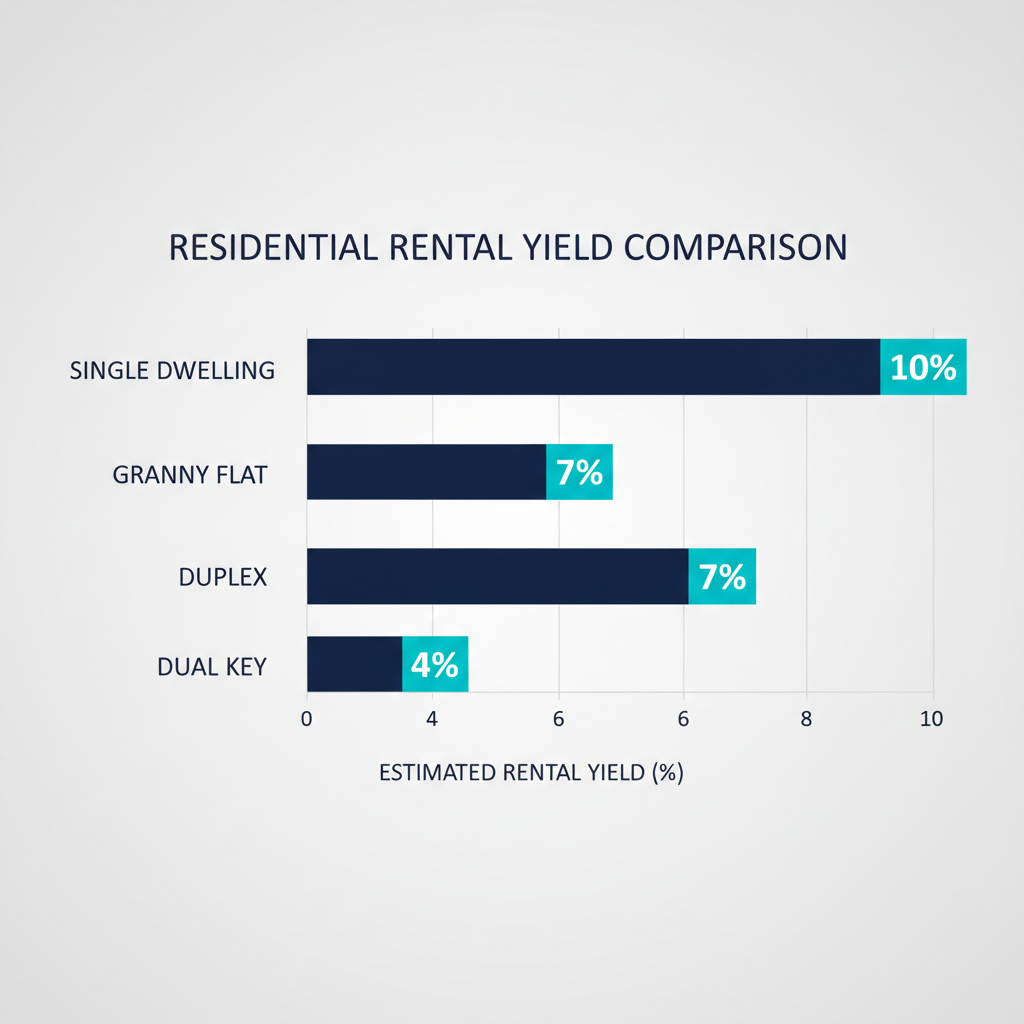
Dual income properties consistently outperform single-dwelling investments on rental yield. Adding a granny flat can increase a property's overall rental yield by 1.4 to 1.65 percentage points compared to similar homes without one.
Granny flats deliver gross rental yields of 8% to 13% on construction cost alone. A $180,000 granny flat generating $450 per week produces a 13% gross yield, compared to 4% to 5% for most standalone houses.
This yield advantage improves cash flow, accelerates equity buildup, and supports faster mortgage paydown. Investors can reinvest surplus income into additional properties or offset holding costs during rate hikes.
In regional markets and outer suburbs where land is more affordable, dual income properties can achieve positive cash flow from settlement, eliminating the need for ongoing top-ups.
Reduced Vacancy Risk
Holding two rental income streams reduces the financial impact of vacancies. If one dwelling sits vacant, the other continues generating rent, maintaining partial cash flow.
This income diversification is particularly valuable in markets with seasonal vacancy fluctuations or during tenant turnover periods. Investors holding single-dwelling properties face 100% income loss during vacancies, increasing financial stress and mortgage repayment shortfalls.
Dual income properties also attract a broader tenant demographic. Granny flats appeal to singles, couples, and downsizers. Main houses suit families. This tenant diversity reduces the risk of both dwellings sitting vacant simultaneously.
Improved Serviceability and Borrowing Capacity
Lenders assess investment property loans based on rental income relative to repayments. Dual income properties demonstrate higher rental income, improving serviceability ratios and unlocking greater borrowing capacity.
An investor generating $800 per week across two dwellings ($41,600 annually) has stronger serviceability than an investor earning $400 per week from a single property ($20,800 annually). This difference can be the margin between loan approval and rejection when acquiring additional properties.
Banks typically assess 80% of rental income when calculating serviceability, so every additional dollar of rent improves borrowing power. Investors building portfolios benefit from this compounding effect, as each dual income property strengthens the case for future acquisitions.
Buyers Agency Australia structures dual income property strategies to maximise serviceability, helping clients scale portfolios faster without hitting lending limits.
Faster Equity Growth
Dual income properties generate higher cash flow, which can be redirected toward mortgage principal repayments. This accelerates equity buildup and reduces loan-to-value ratios faster than single-income properties.
Investors can also add value through strategic development. Building a granny flat on an existing property increases the asset's rental income and overall market value. A well-designed granny flat can add $100,000 to $150,000 in property value, often exceeding construction costs.
This manufactured equity allows investors to refinance and access funds for additional purchases without selling assets. It's a core wealth-building strategy for portfolio investors targeting long-term financial independence.
Realistic Rental Income Examples Across Australia
Rental income for dual income properties varies by location, property type, and market conditions. Here are realistic 2026 examples across major Australian markets.
Sydney Dual Income Property Rents
In Sydney's outer suburbs like Campbelltown, Penrith, and Liverpool, a duplex generates $450 to $550 per dwelling per week. Total weekly income: $900 to $1,100.
Granny flats in Western Sydney rent for $350 to $500 per week, depending on size and finishes. A main house renting for $600 per week plus a granny flat at $400 per week delivers $1,000 weekly income.
Inner suburbs like Marrickville and Earlwood see granny flat rents of $500 to $650 per week, with main houses generating $700 to $900. Total weekly income: $1,200 to $1,550.
Melbourne Dual Income Property Rents
Melbourne's growth corridors—Wyndham, Casey, Melton—deliver duplex rents of $400 to $500 per dwelling per week. Total weekly income: $800 to $1,000.
Granny flats in Melbourne's middle-ring suburbs rent for $350 to $500 per week. Main houses in suburbs like Reservoir and Coburg rent for $500 to $650 per week. Combined income: $850 to $1,150 weekly.
Dual key apartments in Melbourne's CBD and inner suburbs generate $300 to $400 per unit per week. Total weekly income: $600 to $800.
Brisbane Dual Income Property Rents
Brisbane's northern and southern corridors—Logan, Ipswich, Moreton Bay—deliver strong dual income yields. Duplexes rent for $450 to $600 per dwelling per week. Total weekly income: $900 to $1,200.
Granny flats in Brisbane's established suburbs like Chermside, Carindale, and Sunnybank rent for $350 to $500 per week. Main houses generate $550 to $700 per week. Combined income: $900 to $1,200.
Brisbane's tight rental market and strong population growth support consistent tenant demand for dual income properties.
Perth and Adelaide Dual Income Property Rents
Perth's northern suburbs—Baldivis, Ellenbrook, Butler—deliver duplex rents of $400 to $550 per dwelling per week. Total weekly income: $800 to $1,100.
Granny flats in Perth rent for $300 to $450 per week. Main houses generate $450 to $600 per week. Combined income: $750 to $1,050 weekly.
Adelaide's growth suburbs—Munno Para, Seaford, Mount Barker—deliver similar yields. Duplexes rent for $350 to $500 per dwelling per week. Granny flats generate $300 to $400 per week.
Both markets offer relative affordability, making them attractive for investors seeking positive cash flow and strong rental yields.
Key Risks and Considerations for Dual Income Properties
Dual income properties deliver strong yields, but investors must understand the risks and operational complexities before committing capital.
Council and Zoning Regulations
Council regulations determine whether dual income properties are permissible on a given lot. Zoning, lot size, setbacks, and building height restrictions vary across local government areas.
In NSW, dual occupancies require a minimum 450 square metre lot with a 12-metre frontage in most of Greater Sydney. Four councils—Hawkesbury, Blue Mountains, Wollondilly, and Bathurst—remain exempt from 2025 reforms due to bushfire and flood risks.
Granny flats have separate regulations. Most states allow granny flats on residential lots meeting minimum size requirements, but some councils restrict use to family members only, prohibiting open-market rental.
Investors should confirm zoning and council requirements before purchasing. Buyers Agency Australia conducts due diligence on every property, verifying dual income feasibility and council approval pathways to avoid costly surprises post-purchase.
Lending and Finance Challenges
Not all lenders finance dual income properties on standard terms. Dual key properties and boarding houses face stricter lending criteria, with higher deposit requirements and lower loan-to-value ratios.
Banks assess dual income properties based on rental income sustainability. Properties reliant on high rental yields for serviceability may face tougher scrutiny during loan approval or refinancing.
Investors should stress-test cash flow under conservative rental income assumptions. If one dwelling sits vacant for three months, can you still cover repayments?
Construction loans for granny flats require staged drawdowns, meaning investors need sufficient equity or savings to cover initial construction costs before rental income commences.
Working with a mortgage broker experienced in dual income property finance ensures you secure competitive rates and structure loans for long-term flexibility.
Tenant Management Complexity
Managing two tenancies on one property increases administrative workload. Separate lease agreements, bond lodgements, and rent collection processes apply to each dwelling.
Tenant disputes between occupants of the main house and granny flat can arise, particularly around noise, parking, and shared outdoor spaces. Clear lease terms and property rules help mitigate these issues.
Vacancy coordination is another consideration. If both dwellings fall vacant simultaneously, advertising, inspections, and tenant selection double. Property managers experienced in dual income properties streamline this process, but management fees typically range from 7% to 10% of rental income per dwelling.
Investors should budget for higher maintenance costs. Two kitchens, two bathrooms, and two sets of appliances mean more frequent repairs and replacements.
Construction and Development Costs
Building a granny flat or duplex requires upfront capital. Granny flat construction costs range from $120,000 to $200,000. Duplex builds range from $400,000 to $700,000, depending on size, finishes, and site complexity.
Site preparation, council approvals, utility connections, and landscaping add to total costs. Investors should obtain fixed-price contracts to avoid cost blowouts during construction.
Typical payback periods for granny flats range from 6 to 10 years, depending on rental income and construction costs. This timeline assumes consistent tenancy and no major maintenance events.
Investors should model return on investment before committing to construction. If a granny flat costs $180,000 and generates $400 per week ($20,800 annually), the gross payback period is 8.6 years. After accounting for maintenance, insurance, and management fees, net payback extends to 10 to 12 years.
How Buyers Agency Australia Identifies High-Yield Dual Income Opportunities

Buyers Agency Australia specialises in sourcing dual income properties that deliver real cash flow from day one. Dragan Dimovski and his team use a data-driven, boots-on-the-ground approach to identify opportunities that most investors miss.
Property Selection Criteria
Buyers Agency Australia filters properties based on location fundamentals, yield potential, and development feasibility. Every property must pass strict criteria: proximity to employment hubs, rental demand drivers (universities, hospitals, transport), zoning and council approval pathways, land size and configuration for granny flats or duplexes, and rental comparables confirming achievable income.
Properties in growth corridors with strong population inflows take priority. Brisbane's northern suburbs, Perth's Baldivis and Ellenbrook, and Adelaide's northern growth zones consistently deliver dual income opportunities with yields above 6%.
Buyers Agency Australia avoids over-supplied markets and areas with weak rental demand. The goal is long-term tenancy stability, not speculative capital growth.
Due Diligence and Feasibility Analysis
Every property undergoes comprehensive due diligence before purchase. This includes zoning verification (confirming dual occupancy or granny flat permissibility), council pre-lodgement meetings (clarifying approval pathways and development constraints), building and pest inspections, title searches and easement checks, rental appraisals from local property managers, and construction cost estimates for granny flats or subdivisions.
Buyers Agency Australia partners with town planners, builders, and quantity surveyors to deliver accurate feasibility reports. Clients receive clear projections of total investment costs, expected rental income, and cash flow outcomes before making offers.
This eliminates guesswork and ensures investors enter dual income projects with full transparency.
Negotiation and Off-Market Access
Buyers Agency Australia negotiates on behalf of clients, securing properties below market value where possible. Dragan's 20-plus years of experience and established agent relationships provide access to off-market listings before they hit public portals.
Off-market properties often deliver better value because competition is lower. Vendors selling privately avoid auction pressure, creating opportunities for buyers to negotiate favourable terms.
Buyers Agency Australia structures offers based on rental yield targets, ensuring clients pay the right price for the income the property will generate.
Ongoing Portfolio Strategy
Buyers Agency Australia doesn't stop at settlement. The team provides ongoing portfolio support, helping clients refinance, develop granny flats, or acquire additional properties to scale wealth.
Dragan's approach is about building long-term financial independence, not one-off transactions. Clients receive 10-year portfolio projections, showing how dual income properties compound equity and cash flow over time.
If you're serious about building a portfolio that pays for itself, book a free strategy session with Buyers Agency Australia and see how dual income properties fit your investment goals.
Frequently Asked Questions About Dual Income Properties
What rental yield can I expect from a dual income property?
Dual income properties typically deliver gross rental yields of 6% to 13%, depending on property type and location. Granny flats often achieve the highest yields on construction cost.
Do I need council approval to build a granny flat?
Yes. Council approval is required for granny flats intended for rental. Regulations vary by state and council, so confirm requirements before construction commences.
Can I finance a dual key property with a standard home loan?
Some lenders require higher deposits and stricter serviceability for dual key properties. Work with a mortgage broker experienced in dual income property finance.
How long does it take to recover granny flat construction costs?
Typical payback periods range from 6 to 10 years, depending on rental income and construction costs. Net payback extends to 10 to 12 years after expenses.
Are dual income properties suitable for first-time investors?
Yes, if cash flow is the priority. Dual income properties reduce negative gearing and improve serviceability, making them ideal for investors seeking passive income and portfolio growth.
Conclusion: Dual Income Properties Deliver Real Cash Flow in 2026
Dual income properties are one of the smartest strategies for Australian investors in 2026.
While capital growth remains uncertain and interest rates stay elevated, dual income properties deliver immediate cash flow improvements. Two rental income streams reduce vacancy risk, accelerate equity buildup, and improve borrowing capacity for portfolio scaling.
Buyers Agency Australia specialises in identifying dual income opportunities that deliver positive cash flow from settlement. Dragan Dimovski and his team combine data-driven research with boots-on-the-ground market knowledge to source properties most investors never see.
If you're ready to build a portfolio that pays for itself, book a free strategy session with Buyers Agency Australia and discover how dual income properties can accelerate your wealth-building journey.