As geopolitical tensions escalate in 2026, the recent U.S.-Israeli strikes on Iran have reignited global uncertainty and market volatility. History shows that during major crises, wars, financial shocks, and pandemics, investors consistently move capital into tangible assets like Australian property, viewing it as a safer, more stable store of wealth compared to volatile equities or currency markets.
We've all seen the headlines. On 28 February 2026, U.S. and Israeli forces launched coordinated strikes across Iran, triggering a new military conflict that sent oil prices soaring more than 40 percent in 10 days and disrupted global markets. The immediate response from capital markets was predictable: investors fled to defensive positions, gold surged, and government bonds rallied.
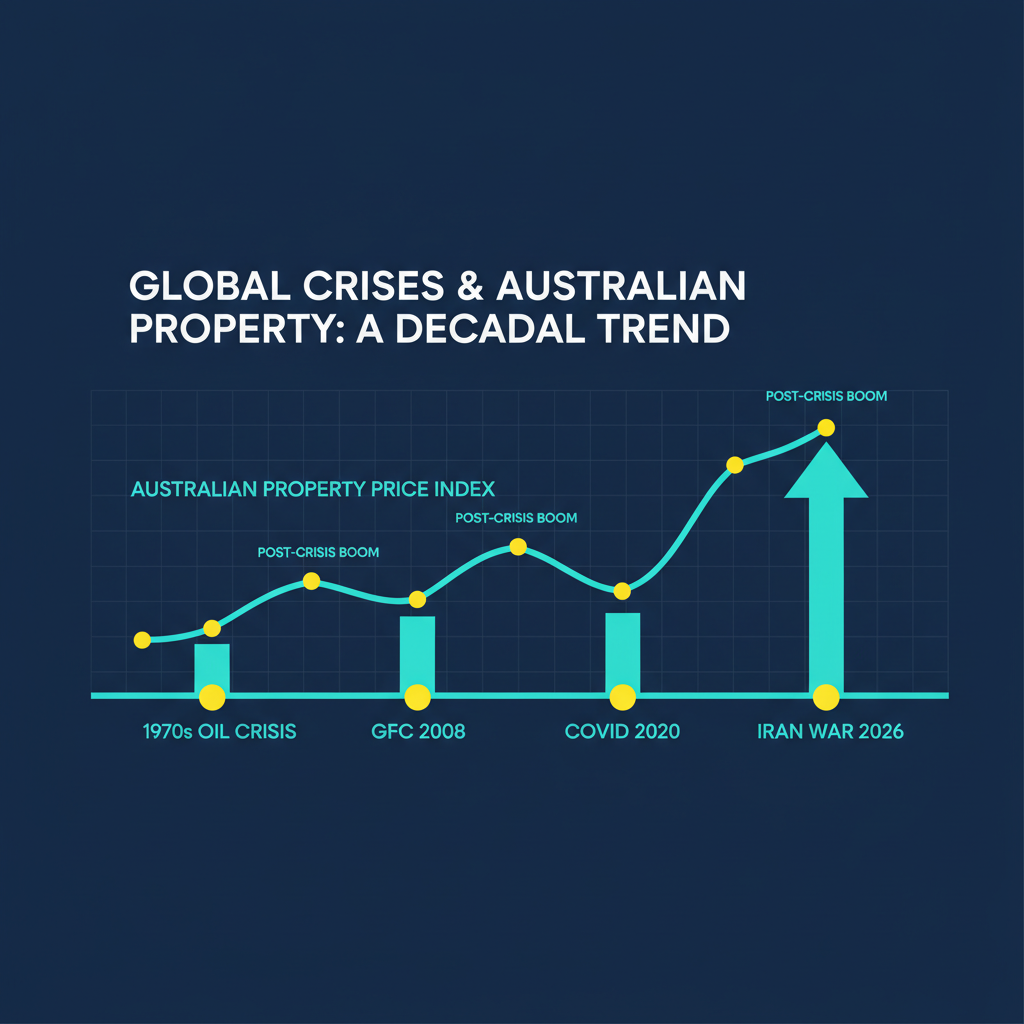
But here's the thing. Australian property has historically been one of the most resilient safe-haven assets during global disruptions. From the oil shocks of the 1970s to the post-GFC recovery and the COVID property boom, Australian real estate has repeatedly demonstrated an ability to absorb global uncertainty and emerge stronger on the other side.
For property investors, understanding this pattern is critical. While share markets panic and currencies swing wildly, Buyers Agency Australia focuses on long-term fundamentals that have consistently underpinned Australian property values through every major global event of the past 50 years.
Why Global Crises Drive Capital Into Property
The Safe Haven Phenomenon Explained
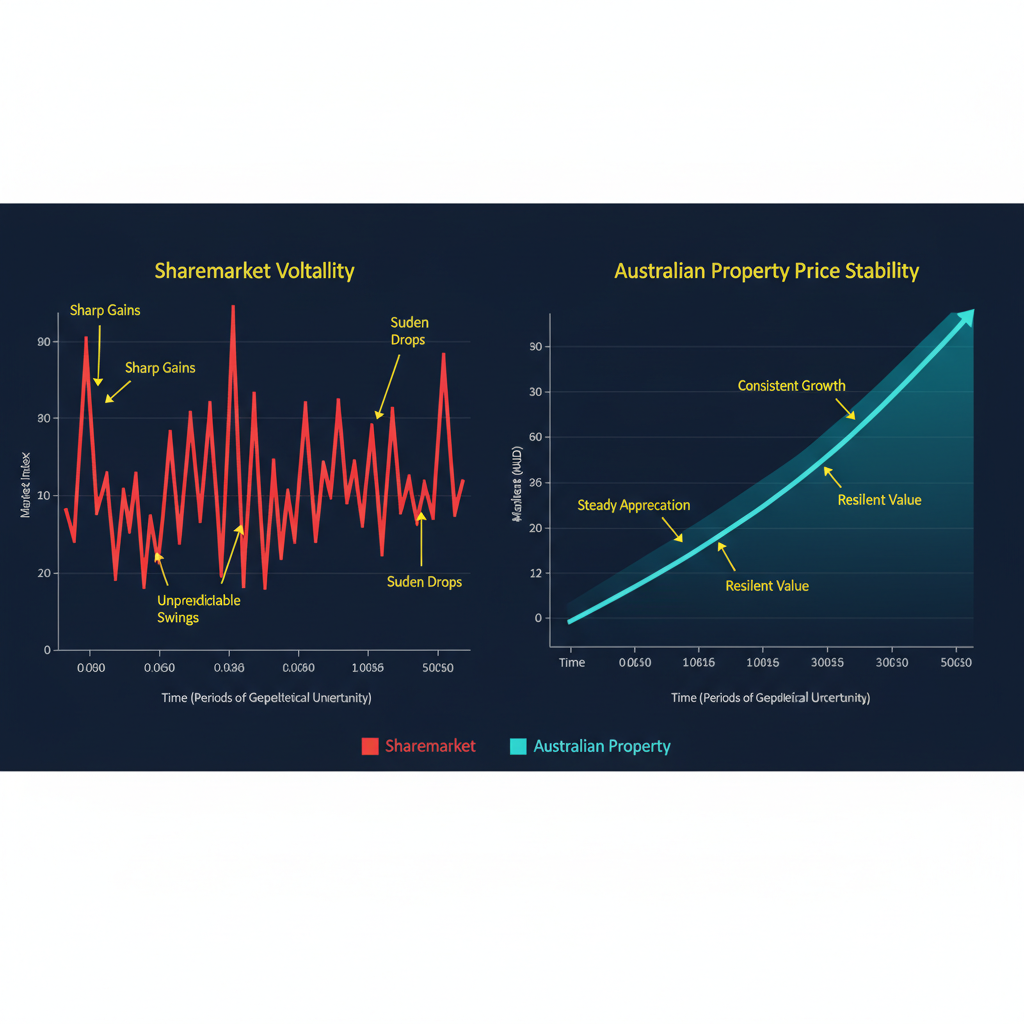
When global tensions rise, investors don't just sit still. They actively redeploy capital away from high-risk, liquid assets into tangible stores of value.
Property fits this profile perfectly. Unlike shares or bonds, property is a physical asset with intrinsic utility. People need housing regardless of whether oil prices are at $73 or $107 per barrel.
According to recent analysis from George James Consulting, Australia and New Zealand are increasingly viewed as safe-haven destinations during geopolitical instability due to strong democratic institutions, transparent legal systems, and well-regulated financial sectors.
Three Drivers of Capital Flight to Real Estate
First, inflation fears push investors toward hard assets. Wars disrupt energy supplies, as we're seeing with oil prices rising from $73 to over $107 per barrel during the Iran conflict. This inflationary pressure erodes cash holdings and makes property more attractive as a hedge.
Second, currency volatility makes investors nervous. When geopolitical tensions escalate, currencies can swing wildly based on policy decisions, sanctions, or capital controls. Property denominated in Australian dollars offers stability in a country with consistent monetary policy and strong rule of law.
Third, housing shortages create persistent upward price pressure regardless of external shocks. Australia's chronic undersupply means that even during uncertain times, fundamental demand-supply imbalances support prices.
Historical Precedent: Oil Crises and Property Booms
The 1970s provide a clear template. Driven by global oil crises and surging inflation, Australians turned to property as a safe investment when cash was losing value rapidly.
As Credit Mediation notes, property prices soared during this time, especially in Sydney and Melbourne. The idea that property could make you rich in just a few years took hold, and speculation became rampant.
Fast forward to 2026, and we're seeing similar dynamics. Oil markets disrupted. Inflation concerns rising. Geopolitical uncertainty at multi-decade highs. History suggests capital will again flow toward the stability of bricks and mortar.
The Global Financial Crisis How Australia Defied Expectations
The 2008 GFC and Australian Property Resilience
Many expected Australian property to crash during the Global Financial Crisis. The U.S., UK, and Ireland all saw devastating housing market collapses that triggered broader financial crises.
But Australia was different. While house prices fell briefly in 2009, the market quickly recovered as interest rates dropped and government stimulus kicked in.
The Reserve Bank of Australia confirms that Australia did not experience a large economic downturn or financial crisis during the GFC, though economic growth slowed and unemployment rose temporarily.
Why Australia Avoided the Housing Crash
Tighter lending standards mattered. Australia didn't experience the same subprime lending excesses that devastated the U.S. market.
Government intervention was swift and effective. Stimulus packages supported household income and confidence, preventing panic selling.
Most importantly, fundamental demand remained strong. Population growth, limited supply, and relatively affordable mortgage rates kept the market supported even as global markets collapsed.
By 2010, national dwelling price growth had returned strongly, with house prices reaching new records by 2011 according to Australian Property Update.
Lessons for the 2026 Iran Conflict
The GFC teaches us that external global shocks don't automatically translate to Australian property crashes. In fact, they often do the opposite: they drive capital toward Australia as a safe, stable, transparent market with strong rule of law.
Investors fleeing volatility in Europe, the Middle East, or Asia have historically looked to Australian property as a destination for capital preservation.
This pattern is unlikely to change in 2026. If anything, escalating tensions in the Middle East could accelerate capital flows into Australian real estate from investors seeking stability.
The Post COVID Property Boom Proof That Crises Drive Prices Higher
Unprecedented Growth During a Global Pandemic
COVID-19 was supposed to crash property markets. Economists predicted 30 percent price declines. Borders were closed. Unemployment spiked. Yet Australian property values surged.
According to PropTrack data, national home values surged 39.9 percent from March 2020 to March 2024. Regional areas soared nearly 54 percent, outpacing capital cities across most states.
This wasn't a small blip. It was one of the most powerful property booms in Australian history, occurring during one of the worst global health crises in a century.
Why COVID Drove Property Prices Higher Not Lower
Record-low interest rates made borrowing cheap. Mortgage rates dropped below 2 percent in mid-2022, allowing buyers to take out larger loans.
Government stimulus flooded the market. Programs like HomeBuilder injected billions into the property sector, driving demand for new construction and renovations.
Remote work shifted preferences. Lockdowns and work-from-home arrangements increased demand for larger homes with dedicated office space, pushing up prices in regional areas and suburban markets.
Supply constraints worsened. Building delays, supply chain disruptions, and labour shortages meant new housing completions fell even as demand surged.
CoreLogic's Tim Lawless notes that the big 38.4 percent lift in dwelling values since March 2020 has been a mixed blessing: welcomed by homeowners but worsening affordability metrics as wages rose by less than half the increase in housing prices.
The Iran War and Capital Flight Dynamics
The 2026 Iran conflict shares key characteristics with COVID. It's a global shock creating uncertainty, disrupting supply chains, and pushing up inflation expectations.
Oil prices rising 40 percent in 10 days will feed into broader inflation across food, transport, and energy costs. This makes cash holdings less attractive and real assets like property more appealing.
Capital is already moving. According to HedgeCo analysis, investors have poured tens of billions into money-market funds and defensive assets as geopolitical tensions intensify. Property in stable jurisdictions like Australia is a natural next destination for this capital.
Iran War 2026 Oil Prices Inflation and Property Demand
The Oil Shock Connection
Brent crude oil rose from $73 per barrel on 27 February to $107 on 8 March 2026, a more than 40 percent increase in 10 days according to Al Jazeera.
This isn't just a short-term spike. Iran controls the Strait of Hormuz, which handles approximately 20 percent of global oil exports. Continued disruption could keep prices elevated for months or years.
Higher oil prices feed directly into inflation. Transport costs rise. Manufacturing becomes more expensive. Consumer prices increase across the board.
How Inflation Drives Property Investment
Inflation erodes the value of cash and fixed-income investments. A 5 percent inflation rate means $100,000 in the bank loses $5,000 in real purchasing power annually.
Property, by contrast, tends to appreciate during inflationary periods. Construction costs rise, making new builds more expensive and supporting existing property values.
Rental income also rises with inflation. Landlords can adjust rents upward to match cost-of-living increases, providing an inflation-protected income stream.
This pattern played out in the 1970s when oil crises drove inflation and property investors sought protection in real assets. It's playing out again in 2026.
Population Growth and Housing Shortages Amplify the Effect
Australia faces a chronic housing shortage. Building approvals remain well below levels needed to match population growth according to Cotality data.
Net overseas migration hit record levels post-COVID, adding approximately 518,000 people in the year ending 30 June 2023 according to ABS data.
When you combine persistent housing shortages with capital flight from volatile regions, you create strong upward pressure on prices regardless of short-term interest rate movements.
How Dragan Dimovski Identifies War Proof Property Investments

The 10 Year Portfolio Modeling Approach
Dragan Dimovski, founder of Buyers Agency Australia, has over 20 years of experience navigating property markets through multiple global crises including the GFC, European debt crisis, and COVID pandemic.
His approach focuses on 10-year portfolio modeling that identifies properties likely to perform strongly regardless of external shocks. This means targeting assets in high-demand areas with structural supply constraints, strong employment growth, and improving infrastructure.
Rather than chasing short-term gains, Dragan prioritises fundamentals: population growth, rental yields, capital growth potential, and downside protection.
Focused on Data Driven Investment Strategies
Buyers Agency Australia uses detailed market analysis to identify suburbs and property types that have historically outperformed during periods of global uncertainty.
This includes targeting markets with:
- Strong local employment bases that aren't dependent on volatile global commodity prices
- Infrastructure investment that will continue regardless of geopolitical events
- Demographic tailwinds from internal migration patterns
- Rental markets with low vacancy rates and rising yields
The transparent, fixed-fee model means clients know exactly what they're paying upfront, with no commission-based incentives that might encourage unsuitable purchases.
Why Investors Choose Buyers Agency Australia During Uncertainty
Time-poor professionals don't have the bandwidth to monitor global oil markets, geopolitical tensions, and their impact on local property fundamentals. That's where expert guidance becomes invaluable.
Buyers Agency Australia provides end-to-end purchasing solutions: identifying opportunities, conducting due diligence, negotiating deals, and securing properties that align with long-term wealth creation goals.
Dragan's personal portfolio of over $10 million demonstrates his commitment to the strategies he recommends to clients. He doesn't just talk about buying during uncertainty; he actively does it.
For investors seeking clarity during chaotic global markets, this boots-on-the-ground expertise provides a competitive edge that DIY approaches simply cannot match.
Historical Patterns Every Major Crisis Followed by Property Growth
The 40 Year Resilience Record
Australian housing has shown remarkable long-term resilience. According to Cotality analysis, there have been only six periods of price decline in the past 40 years.
More striking still, strong property growth often occurred when least expected. In 1988, with interest rates near 15 percent and rising, Australian home values skyrocketed 31 percent. In 2021, amid a global pandemic and closed borders, national values jumped almost 25 percent.
These standout years remind us that housing markets are influenced by more than just interest rates. Supply constraints, population growth, and capital flight dynamics play equally important roles.
Comparing Property to Global Share Indices
Over the past 25 years, Australian capital city house prices have outperformed major local and global share indices according to analysis by The Australian.
Adelaide delivered 559 percent returns since early 2000, climbing from $130,500 to about $860,000. Brisbane followed with 533 percent growth, while Hobart recorded 519 percent gains.
By comparison, the strongest sharemarket performers were U.S. equities. Despite the dotcom crash and GFC, the Nasdaq climbed 415 percent, still trailing Adelaide property by more than 140 percentage points.
This consistent outperformance makes Australian property uniquely attractive to investors seeking stable, long-term wealth creation.
Seven Key Events That Prove the Pattern
Post-WWII price cap removal (1949): Prices surged 77 percent in 12 months as pent-up demand was released.
1970s oil crises: Inflation drove investors into property as a tangible store of value, creating sustained price growth.
1980s financial deregulation: Easy credit access fueled a property boom that survived the early 1990s recession.
Global Financial Crisis (2008-2009): Prices dipped briefly but recovered quickly, reaching new records by 2011.
Mining boom (2003-2008): Regional WA and Perth doubled in price as capital flowed to high-growth areas.
COVID pandemic (2020-2022): National values surged 30.8 percent during the sharpest upswing on record.
Post-COVID recovery (2023-2025): Despite interest rate hikes, values bounced back 14.5 percent driven by housing shortages.
Each of these events followed a similar pattern: initial uncertainty, capital flight to safety, and strong property price growth as investors sought protection from volatility.
What the 2026 Iran War Means for Property Investors Right Now
Short Term Uncertainty Long Term Opportunity
The Iran conflict will create short-term market volatility. Share prices will swing. Currency markets will react to every news headline. Oil prices will remain elevated as long as the Strait of Hormuz faces disruption.
But property investors operate on different timeframes. A well-chosen investment property in a high-demand suburb isn't affected by daily oil price movements.
What matters is the 5-year, 10-year, and 20-year outlook. And on those timeframes, the fundamentals supporting Australian property remain intact: population growth, housing shortages, strong employment, and improving infrastructure.
Capital Flight from Volatile Regions
The Middle East has historically been a significant source of property investment capital. Wealthy individuals and families seek stable jurisdictions to preserve wealth during regional instability.
Australia ticks every box: strong rule of law, transparent legal system, stable political environment, and well-regulated financial markets. These characteristics make Australian property attractive to investors fleeing conflict zones.
According to Wikipedia's analysis of the economic impact, several economists suggested the conflict could drive capital outflows from the region into overseas property markets, notably prime real estate in global cities.
Australia's major capitals, Sydney, Melbourne, Brisbane, are prime beneficiaries of this dynamic.
Interest Rates and Timing Considerations
The Reserve Bank of Australia has maintained a cautious stance on interest rates. While the Iran conflict could push up inflation via higher oil prices, Australia's well-capitalized banking system and prudent lending standards provide downside protection.
Savvy investors recognise that trying to time the market perfectly is a fool's errand. The best time to buy is when you find a fundamentally sound property in a high-demand area at a fair price.
Working with Buyers Agency Australia helps investors cut through the noise and focus on properties that will deliver strong returns regardless of short-term global events.
Frequently Asked Questions
Will the Iran war cause Australian property prices to fall?
Historically, global crises drive capital into Australian property as a safe-haven asset. While short-term volatility is possible, long-term fundamentals remain strong.
How did property prices perform during past wars and crises?
Australian property has consistently rebounded and grown following major global events including the GFC, oil crises, and COVID pandemic.
Should I wait to buy property until the Iran conflict resolves?
Timing the market is difficult. Quality properties in high-demand areas tend to appreciate over 10-year timeframes regardless of short-term geopolitical events.
What types of property are safest during geopolitical uncertainty?
Properties in capital cities and established suburbs with strong employment, infrastructure, and rental demand offer the most resilience during global volatility.
How can I protect my property investment from global shocks?
Focus on fundamentals: buy in high-demand areas, ensure strong rental yields, and work with experts who understand long-term market cycles and risk management.
Book Your Free Strategy Session Today
Global uncertainty creates opportunity for informed investors. While share markets panic and currencies swing wildly, Australian property continues to offer stability, tangible value, and long-term wealth creation.
Dragan Dimovski and the team at Buyers Agency Australia have guided hundreds of investors through volatile markets, helping them build portfolios designed to withstand global shocks and deliver consistent returns.
Whether you're a first-time buyer overwhelmed by market complexity or an experienced investor seeking to expand your portfolio, expert guidance makes the difference between panic and profit.
Book your free strategy session today to discover how the right property investment can protect and grow your wealth regardless of what's happening in the Middle East, global oil markets, or currency exchanges.