
Using equity to buy investment property is how most Australian investors build wealth without saving another massive deposit. Equity is the difference between your property's value and what you owe, and lenders typically let you access up to 80% of your home's value to use as a deposit for your next purchase.
If you're sitting on a property that's grown in value, you're sitting on opportunity.
The problem is most investors don't know how to tap into it. They wait years, saving for another deposit, when the equity in their current property could fund the next purchase right now.
This guide walks you through exactly how to turn one property into a small portfolio using equity. We'll cover how equity works, how to calculate what you can access, the step-by-step process to purchase your next property, and the risks you need to manage along the way. By the end, you'll have a clear roadmap to build long-term wealth through property without waiting another decade.
What Is Property Equity and How Does It Work
Understanding Home Equity in Simple Terms
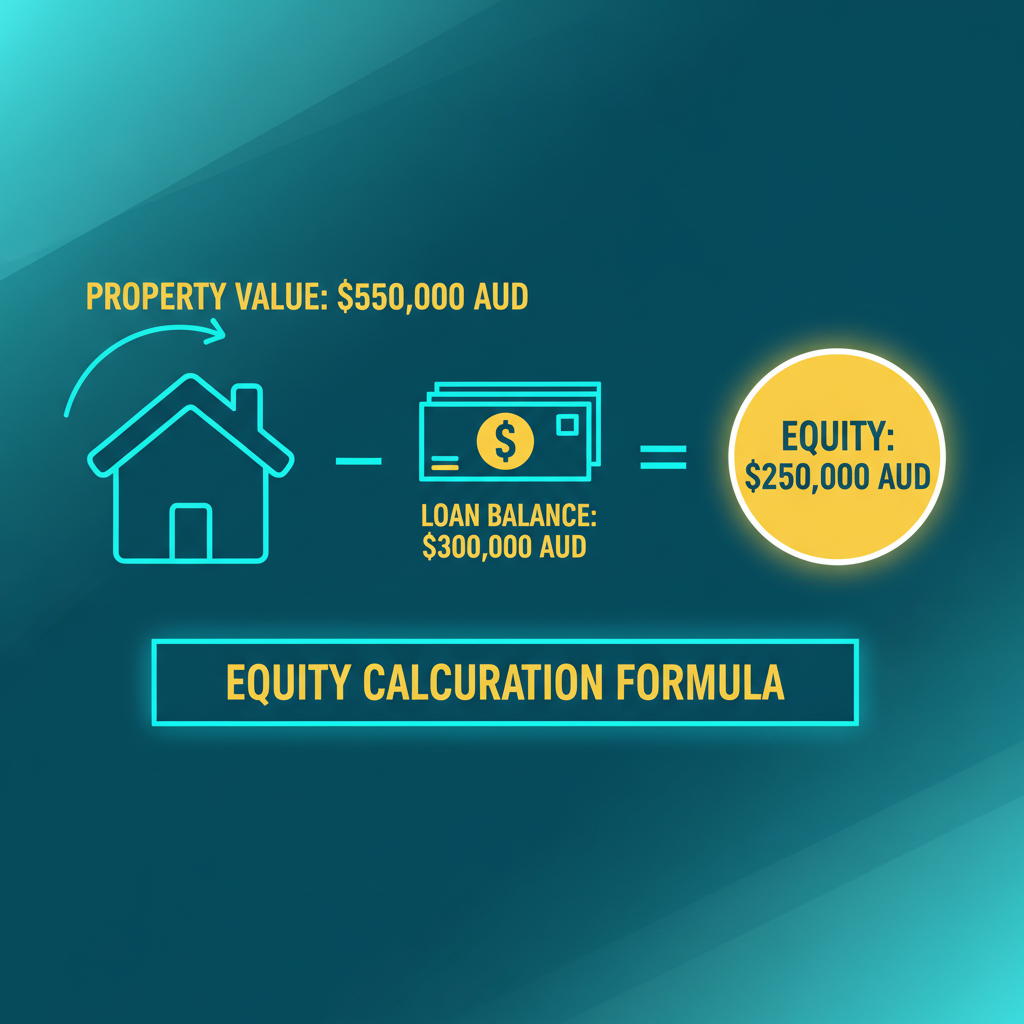
Equity is the portion of your property that you actually own outright.
If your home is worth $800,000 and you owe $500,000 on your mortgage, your equity is $300,000. That $300,000 is yours, built up through loan repayments and capital growth.
As you pay down your mortgage and as property values rise, your equity grows. According to Propertyology's 2026 outlook, a house purchased in 2026 for $750,000 could be worth $2.4 million in 20 years.
Total Equity vs Usable Equity
Not all equity is available to borrow against.
Most Australian lenders cap usable equity at 80% of your property's value to avoid Lenders Mortgage Insurance and reduce default risk. This is called your usable equity.
Here's the formula: Usable equity = (Property value × 80%) – Outstanding loan balance.
Using the example above, if your home is worth $800,000 and you owe $500,000, your usable equity is $140,000. That's ($800,000 × 0.80) – $500,000.
How Property Growth Builds Equity Faster
Capital growth is the silent wealth builder.
Perth home values increased 13% in 2025, Brisbane 12%, and Adelaide 9%, according to Propertyology data. If you bought a $600,000 property in Brisbane in early 2025, it could be worth $672,000 by the end of the year.
That's $72,000 in equity you didn't save. You just owned the right property in the right market.
Buyers Agency Australia helps investors identify high-growth markets before the boom hits, positioning clients to capture maximum equity gains in the shortest time.
How to Calculate Your Usable Equity
Step One Get a Current Property Valuation
You can't calculate equity without knowing what your property is worth today.
Lenders use bank valuations, not real estate agent appraisals. A bank valuation is conservative and reflects what the lender could recover if you defaulted.
You can request a desktop valuation from your lender or use online tools from CoreLogic or RP Data. If you're refinancing or applying for a new loan, the lender will organise this automatically.
Step Two Calculate Your Usable Equity
Once you have your valuation, the math is straightforward.
Let's say your property is valued at $1,000,000 and your outstanding loan is $650,000.
- 80% of property value = $800,000
- Minus outstanding loan = $800,000 – $650,000
- Usable equity = $150,000
That $150,000 can be used as a deposit for your next property, covering stamp duty, conveyancing, and building inspections.
Step Three Apply the Rule of Four
A quick way to estimate your buying power is to multiply your usable equity by four.
If you have $150,000 in usable equity, you could potentially purchase a property worth $600,000. That's because lenders typically lend up to 80% of a property's value, meaning your equity covers the 20% deposit.
This is a rough guide. Your actual borrowing capacity depends on income, expenses, credit history, and serviceability.
The Step by Step Process to Buy Your Second Property
Review Your Current Loan and Serviceability
Before you borrow against equity, check your existing loan structure.
Are you on a competitive interest rate? If not, refinancing to a lower rate can free up cash flow and improve your borrowing capacity. According to Finder, investment loan rates in March 2026 start from 5.20% p.a.
Lenders will assess your ability to service both loans. They apply a buffer, typically 3% above your actual interest rate, to ensure you can afford repayments if rates rise.
Choose Between Refinancing or a Second Loan
You have two main options to access equity.
Refinancing your existing loan means increasing the loan amount and withdrawing the difference as cash. Most investors choose this because it's simpler to manage one loan.
A home equity loan or line of credit is a separate loan secured against your property. It gives you flexibility to draw funds as needed, but interest rates are often higher.
Identify Your Next Investment Property
This is where strategy matters more than speed.
Don't buy the first property you see. Focus on markets with strong fundamentals like population growth, infrastructure investment, and employment diversity.
Perth, Brisbane, and Adelaide are forecast to outperform Sydney and Melbourne in 2026, according to LJ Hooker's market outlook. Regional hubs are also delivering consistent growth.
Buyers Agency Australia specialises in identifying investment-grade properties in high-growth corridors before the market catches on. Their team conducts suburb-level due diligence, analysing rental yields, vacancy rates, and 10-year growth forecasts.
Submit Your Loan Application
Once you've found a property, submit your loan application.
You'll need to provide income documentation, tax returns, bank statements, and details of your existing loans. Lenders will assess your debt-to-income ratio and ensure your total borrowings don't exceed safe levels.
Pre-approval gives you buying power at auction or during negotiation. It also speeds up settlement.
Settle and Manage Your Portfolio
After settlement, you'll be servicing two loans.
Set up your repayments on autopay and monitor your cash flow closely. If you've purchased an investment property, rental income should cover most or all of your repayment costs.
Keep detailed records of all expenses for tax time. Interest on investment loans is tax-deductible, as are property management fees, council rates, and maintenance costs.
Real World Example Turning One Property Into Two
Starting Position One Property Owned
Let's say you bought a property in Brisbane in 2020 for $500,000 with a 20% deposit.
You borrowed $400,000. Fast forward to 2026, Brisbane property values have grown significantly. Your property is now worth $650,000, and you've paid your loan down to $370,000.
Your total equity is $280,000. Your usable equity is ($650,000 × 0.80) – $370,000 = $150,000.
Using Equity to Purchase Property Two
You want to buy a $600,000 investment property in a high-yield suburb.
You need a 20% deposit ($120,000), plus $30,000 for stamp duty and costs. Total upfront cost: $150,000.
You refinance your existing loan, increasing it to $520,000 to release the $150,000 equity. You use that to cover the deposit and costs for property two.
You then take out a new loan of $480,000 for the remaining 80% of the purchase price. The new property is rented for $550 per week, generating $28,600 per year before expenses.
Portfolio Position After Two Properties
You now own two properties worth a combined $1,250,000.
Your total debt is $1,000,000 ($520,000 + $480,000). Your equity across the portfolio is $250,000.
If both properties grow at 6% per year, your combined equity will increase by $75,000 annually through capital growth alone, not including loan repayments.
Repeating the Process to Build a Five Property Portfolio
Property Three The Equity Snowball Effect
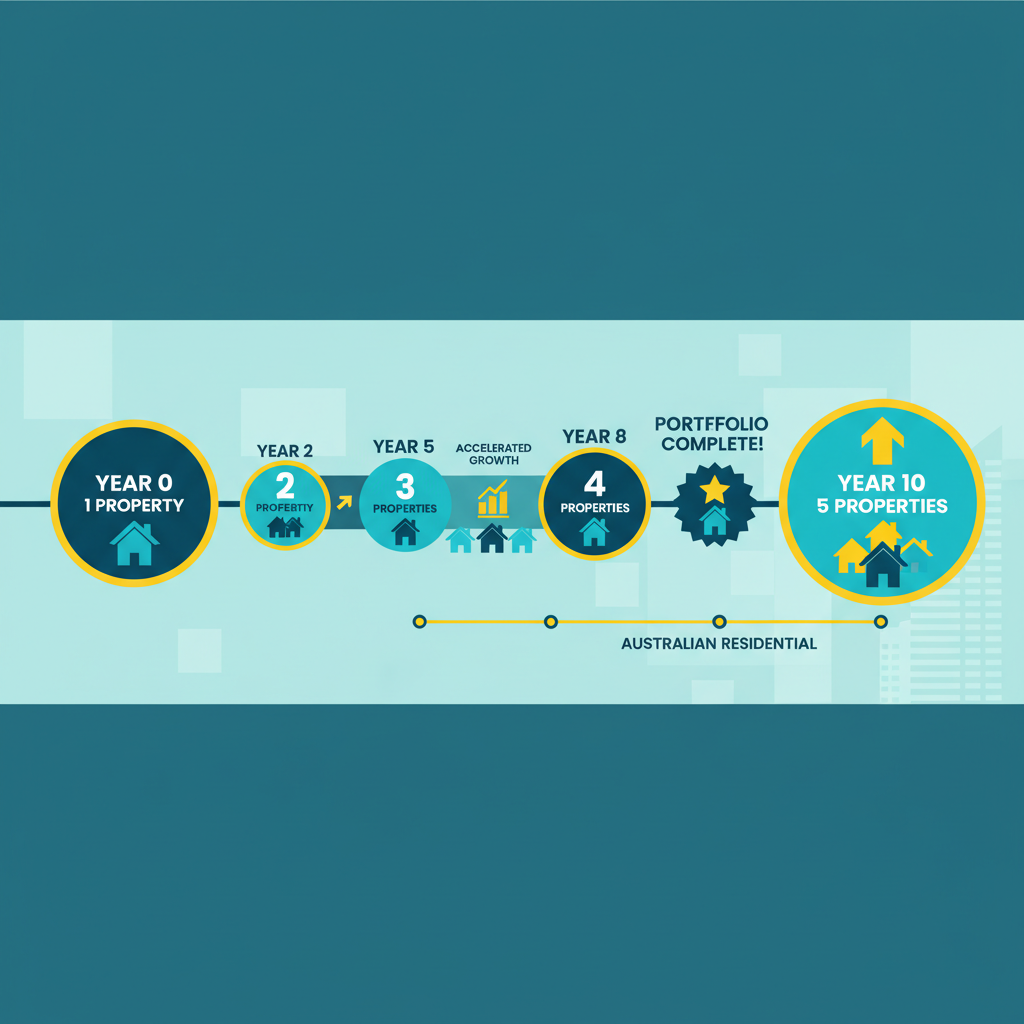
After owning property two for three years, it's now worth $715,000 and your loan is down to $460,000.
Usable equity on property two = ($715,000 × 0.80) – $460,000 = $112,000.
Meanwhile, property one has grown to $750,000 with a loan balance of $500,000. Usable equity = $100,000.
Combined usable equity across both properties = $212,000. That's enough to fund the deposit and costs for a $700,000 property.
Property Four and Five Timing and Market Selection
You don't need to buy every year.
Smart investors wait for the right market conditions and focus on serviceability. Each new loan increases your debt, so cash flow management is critical.
By year seven, if you've purchased strategically in high-growth markets, you could own five properties with a combined value of $3.5 million and total debt of $2.8 million.
Your equity position is $700,000. Rental income covers most or all of your loan repayments, and you're building wealth passively through capital growth.
How Dragan Dimovski Structures Multi Property Portfolios
Dragan Dimovski, founder of Buyers Agency Australia, has over 20 years of property investment experience and a personal portfolio exceeding $10 million.
His approach prioritises cash flow positive properties, long-term capital growth, and conservative debt levels. He models every acquisition over a 10-year horizon, factoring in interest rate rises, vacancy periods, and maintenance costs.
Clients who work with Buyers Agency Australia receive a personalised equity roadmap, showing exactly when to purchase, which markets to target, and how to structure loans for maximum tax efficiency.
Risks to Manage When Using Equity

Over Leveraging and Cash Flow Pressure
The biggest mistake investors make is borrowing too much too fast.
If you max out your usable equity on every property, you leave no buffer for interest rate rises, vacancy periods, or unexpected repairs.
A good rule of thumb is to keep your loan-to-value ratio below 70% across your portfolio. This gives you breathing room and protects you from forced sales if the market softens.
Interest Rate Rises and Repayment Shock
In February 2026, the RBA increased the cash rate, and many economists expect further rises.
Variable investment loan rates currently sit between 5.20% and 6.00% p.a. A 1% rate rise on a $500,000 loan increases repayments by roughly $400 per month.
Stress-test your portfolio. Can you afford repayments if rates rise 2%? If not, reduce debt or increase your income buffer.
Negative Equity and Market Downturns
If property values fall and your loan balance exceeds your property value, you're in negative equity.
This limits your ability to refinance or sell without bringing cash to settlement. To avoid this, buy quality properties in supply-constrained markets with strong long-term fundamentals.
Buyers Agency Australia focuses on assets with proven resilience, avoiding oversupplied apartment markets and speculative fringe suburbs.
Cross Securitisation and Exit Flexibility
Cross-securitisation means using multiple properties as security for one loan.
While it can simplify lending, it locks your properties together. If you want to sell one property, the lender may refuse unless you reduce the loan or offer alternative security.
Where possible, structure loans so each property secures its own loan. This gives you maximum flexibility.
Tax Implications and Deductions
Interest Deductibility on Investment Loans
Interest paid on loans used to purchase investment properties is tax-deductible.
If you borrow $150,000 in equity to buy an investment property, the interest on that $150,000 is deductible. However, if you use equity for personal expenses, it's not.
Keep clear records and separate loan splits for investment and personal use. The ATO is strict on this.
Negative Gearing and Cash Flow Benefits
Negative gearing occurs when your property expenses exceed rental income.
The loss can be offset against your taxable income, reducing your overall tax bill. For high-income earners, this can provide significant cash flow relief.
However, negative gearing only makes sense if you're confident in long-term capital growth. Don't buy a poor asset just for the tax benefits.
Capital Gains Tax When You Sell
When you sell an investment property, you'll pay capital gains tax on the profit.
If you've held the property for more than 12 months, you receive a 50% CGT discount. For example, if you make a $200,000 profit, only $100,000 is added to your taxable income.
Timing your sale strategically, such as in a lower-income year, can reduce your tax liability.
Why Investors Choose Buyers Agency Australia for Equity Strategies
Building a multi-property portfolio isn't about luck. It's about strategy, timing, and execution.
Buyers Agency Australia takes the guesswork out of equity planning. They work with clients to map out a personalised acquisition timeline, showing exactly when to purchase, which markets to target, and how to structure loans for maximum growth and tax efficiency.
With Dragan Dimovski's 20+ years of experience and a $10M+ personal portfolio, the team knows what works and what doesn't. They've helped hundreds of investors build wealth through property, avoiding common mistakes and positioning clients in high-growth markets before the boom.
Whether you're buying your second property or your fifth, Buyers Agency Australia provides end-to-end support, from market research and property selection to negotiation and settlement.
Ready to turn your equity into a portfolio? Book a free strategy session and get your personalised equity roadmap.
Frequently Asked Questions
How much equity do I need to buy a second property in Australia?
You typically need at least $100,000 in usable equity to cover a 20% deposit and costs on a $400,000 property, though this varies based on the purchase price and your borrowing capacity.
Can I use equity from my home to buy an investment property?
Yes, you can refinance your owner-occupied home to release equity and use it as a deposit for an investment property, provided you meet the lender's serviceability requirements.
What is the 80% loan-to-value rule in Australia?
Lenders typically lend up to 80% of a property's value without requiring Lenders Mortgage Insurance, meaning you need at least 20% equity or deposit to avoid LMI.
How do I calculate my usable equity?
Multiply your property value by 80%, then subtract your outstanding loan balance. For example, a $1M property with a $600,000 loan has $200,000 usable equity.
What are the risks of using equity to buy investment property?
The main risks include over-leveraging, interest rate rises, cash flow pressure, and negative equity if property values fall. Always stress-test your portfolio before borrowing.